Why Max Scherzer Will Become Even More Dominant in Return to NL
Max Scherzer is now a Washington National, having agreed to terms on a reported seven-year contract worth at least $180 million, according to Ken Rosenthal of Fox Sports.
This means two things: One, by signing the 30-year-old right-hander, who was the top name on the free-agent board this offseason, the Nationals suddenly have gone from runaway favorites to win the National League East to a team that may be impossible to catch up with.
Two, Scherzer may be even more dominant in his return to the Senior Circuit.
TOP NEWS

Realistic Offseason Trade Ideas 💡

Players Who Were Worse Than You Think in 2026 ⚾
Latest Free Agent Rumors 👂
Scherzer spent the past five seasons with the Detroit Tigers, during which he transformed from an enigmatic, inconsistent arm with loads of potential into a Cy Young winner and one of the sport's true aces.
To wit, over the past three campaigns, Scherzer has posted a 3.24 ERA, 1.13 WHIP and a ridiculous 10.5 strikeout-per-nine rate, which ranks second in baseball, with only Yu Darvish (11.2) netting a higher mark. Scherzer's 16.5 wins above replacement (WAR) over that time checks in as the third best, behind only Clayton Kershaw and Felix Hernandez, according to FanGraphs.
But prior to all that, Scherzer pitched the first two years of his career with the Arizona Diamondbacks, who drafted him 11th overall in 2006. Back then (2008-09), he was simply trying to find his footing in the majors and prove that his funky delivery could hold up as a starting pitcher.
Now that Scherzer is back in the NL—where teams score fewer runs, sport shallower lineups and have to bat a pitcher instead of a designated hitter—well, look out.
As Phil Rogers of MLB.com writes:
"[Scherzer is] going to be a killer in the National League—not that this is anything new. He won the American League Cy Young Award in 2013 and finished fifth this season.
Given his low-mileage arm, he might just be starting. It's a good bet for any team that can afford him, even one that already has a stacked rotation.
"

There are several factors that could make Scherzer even better than he has been over the past few seasons.
| .253 | BA | .249 |
| .316 | OBP | .312 |
| .390 | SLG | .383 |
| 7.51 | K/G | 7.90 |
| 4.18 | R/G | 3.95 |
The NL was worse in each of those offensive categories, which proves that it's easier to pitch in the Senior Circuit, especially for an elite arm like Scherzer.
Heck, simply look at Doug Fister, Scherzer's former (and now current again) rotation mate, who jumped from the Tigers to the Nationals in a trade last offseason.
Fister, who is a very solid mid-rotation pitcher but far from the same caliber starter as Scherzer, went from a 3.67 ERA, 1.31 WHIP and 9.9 hits per nine in his final season with the Tigers in the AL to a 2.41 ERA, 1.08 WHIP and 8.4 hits per nine in 2014, his initial year with the Nats in the NL.
For those scoring at home, that's an ERA plummet of well more than a full run—1.26, to be exact, or roughly 34 percent.
Now, Fister got somewhat lucky—his fielding independent pitching (3.93) actually was his worst since his rookie season of 2009, per Baseball-Reference, in large part because of a .262 batting average on balls in play that was fifth-lowest in MLB—so Scherzer isn't likely to see that dramatic of a drop. But pitching in the NL undoubtedly is easier.
To that end, Scherzer owns a 2.04 ERA and 99 strikeouts in 66.0 innings of interleague play the past three seasons. Yikes.
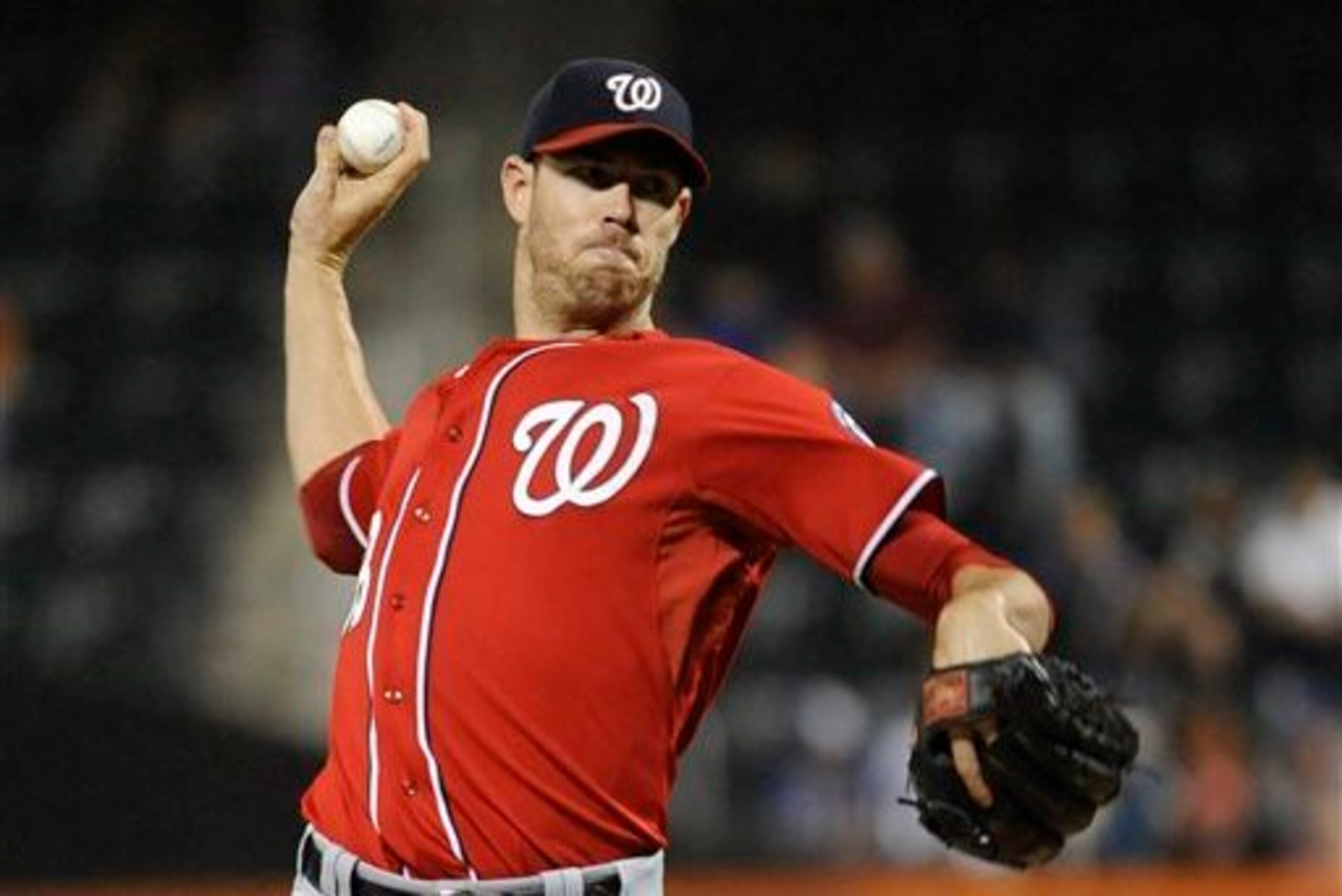
On top of that, Scherzer will be moving to the NL East, which the Nats won by a whopping 17 games in 2014, by far the largest margin in the sport. The division is filled with four lineups that were among the worst at scoring runs and making contact. That should suit Scherzer just fine.
Each of the New York Mets, Atlanta Braves, Miami Marlins and Philadelphia Phillies finished in the bottom half of runs scored last year, with the Fish's 645 runs (3.98 per game) checking in as the highest total at No. 16 overall.
As for strikeouts, the same goes: All four of those clubs were in the top half of the majors in most whiffs, with the Mets' 1,264 (7.8 per game) the lowest mark at No. 14.
| Marlins | 645 | 16th | 1,419 | 3rd |
| Mets | 629 | T-21st | 1,369 | 4th |
| Phillies | 619 | T-23rd | 1,306 | 8th |
| Braves | 573 | 29th | 1,264 | 14th |
After all, Scherzer could get at least 14 starts against those four inept NL East offenses, which is the average number of times his new rotation mates—Stephen Strasburg (17 starts), Jordan Zimmermann (16), Tanner Roark (15), Gio Gonzalez (13) and Fister (10)—faced the Mets, Braves, Marlins or Phillies a year ago.
Put all of the above together, and Scherzer could be in line to have his best season yet in 2015, better than even his Cy Young Award-winning 2013. Look out, National League.
Statistics are accurate through the 2014 season and courtesy of MLB.com, Baseball-Reference and FanGraphs unless otherwise noted.
To talk baseball or fantasy baseball, check in with me on Twitter: @JayCat11.



.jpg?w=2560 "Injury-stricken Seahawks signing veteran RB")
.jpg?w=2560 "2 NFL Officials Suspended")


.jpg?w=2560 "Mahomes' Wife Trolls Kubiak 💀")

.jpg?w=2560 "Viral Rams Coach Vid 🖕")