

Does Josh Hamilton Have Enough Trade Value to Be More Than Pure Salary Dump?
If the Los Angeles Angels have it in mind to try and trade Josh Hamilton for something of value, there's only one thing to say:
Good luck with that.
It's only been two years since the Angels signed Hamilton to a five-year, $125 million contract, but the word is indeed that they want out. Though Hamilton does have a full no-trade clause, Ken Rosenthal of FoxSports.com reported last month that the Angels had discussed trading the 33-year-old outfielder.
TOP NEWS
Yankees Sloppy in Game 2 Loss 😬

Realistic Offseason Trade Ideas 💡

Players Who Were Worse Than You Think in 2026 ⚾
This doesn't mean Hamilton is going to be traded, mind you, but it's not hard to get at why these talks took place. Hamilton has authored a modest .741 OPS and posted, according to FanGraphs, only 3.1 WAR in two years for the Angels. It's just not working out between him and them, which makes the $90.2 million remaining on his deal look...well, "problematic" is a good word.
Publicly, of course, the Angels are singing a different tune.
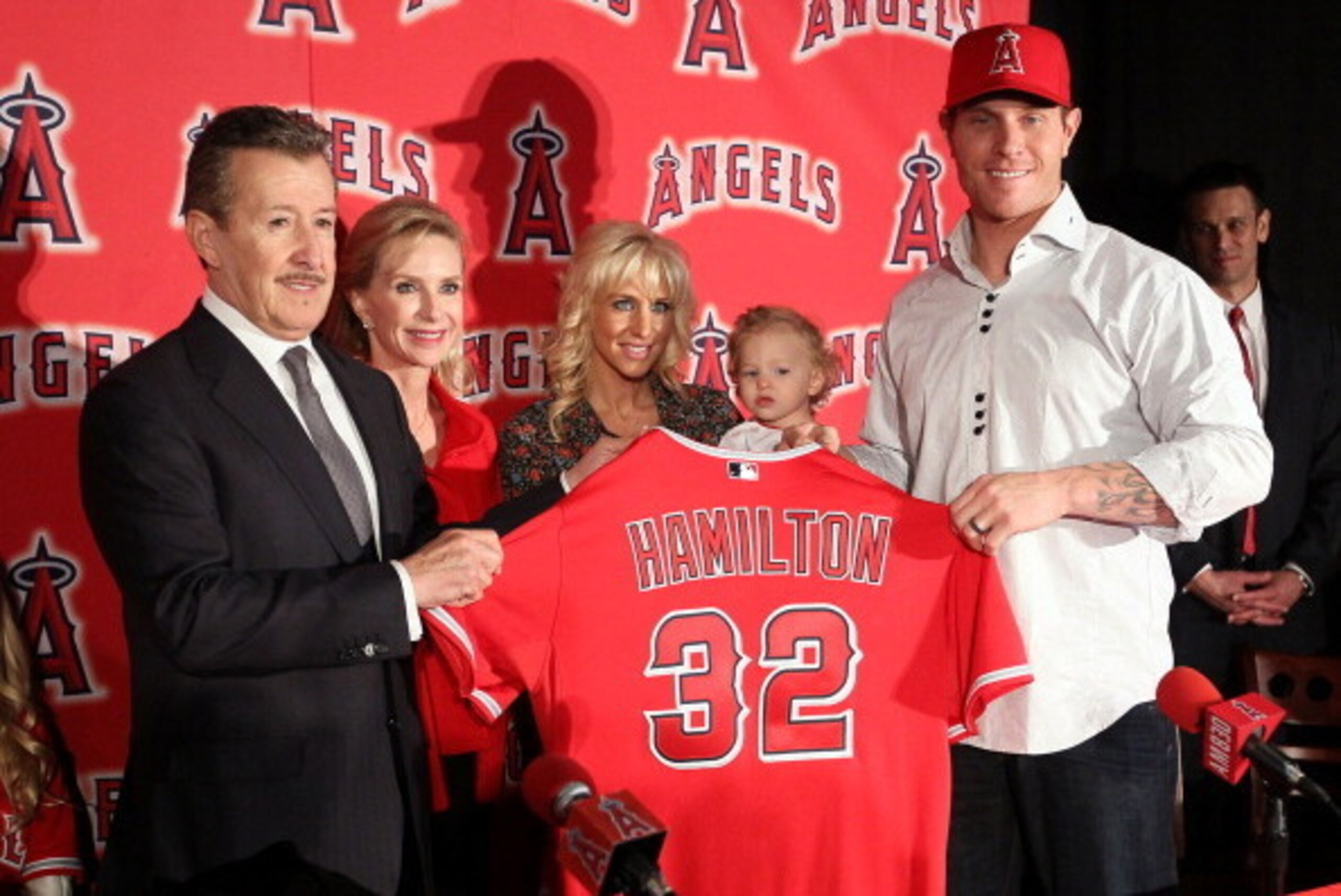
“We do believe in Josh,” general manager Jerry Dipoto told Rosenthal. “We’ve seen it every day when he takes batting practice. We’ve seen him hit balls that humans shouldn’t hit. What he does, 99 percent of the players can’t do."
Dipoto added the organization is "absolutely of the belief" that Hamilton can regain the form that made him a five-time All-Star between 2008 and 2012 with the Texas Rangers.
But while this may be Dipoto's public stance, here's guessing he wouldn't hesitate to use Hamilton to make a Prince Fielder- or Matt Kemp-style trade if given the chance.
Fielder netted the Detroit Tigers Ian Kinsler last winter, and Kemp netted the Los Angeles Dodgers Yasmani Grandal earlier this winter. To complete the deals, the Tigers and Dodgers only had to eat about $30 million. If the Angels could eat $30 million of the $90.2 million Hamilton is still owed while getting a similarly solid piece in return, they'd presumably be quite pleased.
But is Hamilton the Angels' very own Fielder or Kemp, or is he their Ryan Howard? Is he a piece that other teams could actually be attracted to, or is he a virtually unmovable albatross?
As much as the Angels probably want him to be the former, Hamilton unfortunately looks more like the latter.
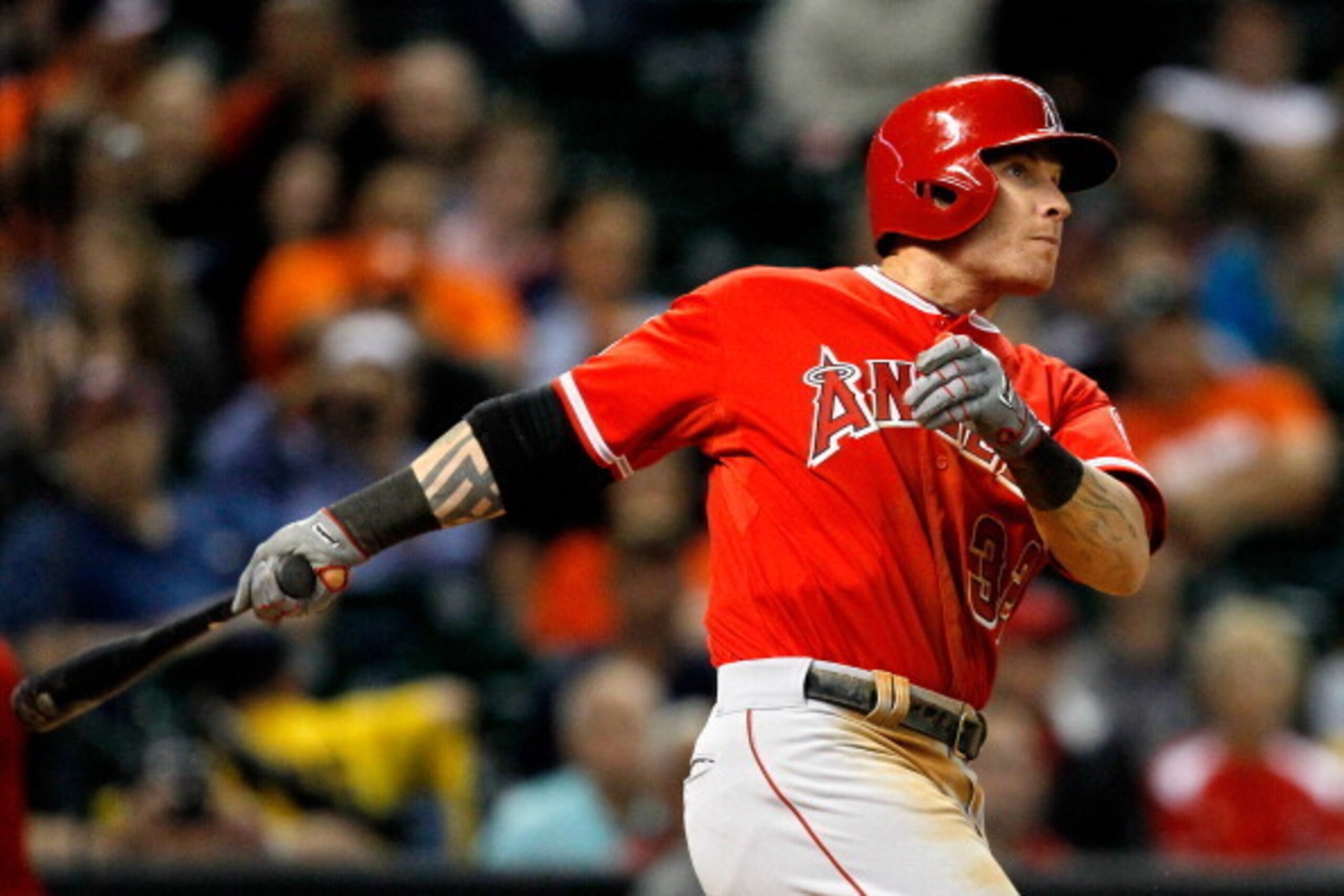
If Hamilton was coming off just one bad year, things wouldn't look so bad. One bad year at age 33 is more concerning than one bad year at, say, age 27, but it's not necessarily the end of the world either.
But the projections aren't optimistic about Hamilton's immediate future. According to FanGraphs, both the Steamer and ZiPS systems see Hamilton posting a sub-.750 OPS and around 1.5 WAR in 2015.
One reason it's easy to believe them is that Hamilton isn't coming off merely one bad year. In reality, he's been down on his luck for over two-and-a-half years.
If you go back to May 13, 2012, you'll find Hamilton fresh off a six-game stretch that featured eight home runs and a 2.036 OPS. His full-season OPS at the time was a staggering 1.321.
But in his final 116 games of 2012, Hamilton hit only .251 with a modest 0.816 OPS. He has yet to rebound, and there's now an ocean-sized gap between the player he is and the player he used to be:
| 2007-5/13/2012 | 2658 | 8.5 | 18.4 | 136 | .313 | .371 | .560 | .931 |
| 5/14/2012-2014 | 1510 | 8.3 | 26.4 | 56 | .254 | .319 | .447 | .766 |
If there's an optimistic perspective of Hamilton's decline, it's that a change of scenery could get him turned around.
Hamilton wasn't particularly bad even after he cooled down in 2012, after all, and similar production hasn't been entirely absent during his time with the Angels. As Rosenthal noted, Hamilton has OPS'd 0.661 at the notoriously pitcher-friendly Angel Stadium of Anaheim, and 0.814 everywhere else.
As such, maybe a move to a more neutral ballpark could help him. A move to a more hitter-friendly park, particularly one that favors left-handed batters, could surely help.
Or not.
Of all the figures in the table above, one thing that stands out is Hamilton's loss of power. And it looks even worse if you isolate what he's done in Anaheim, as he's gone from slugging .549 to slugging .426.
It's easy to chalk that up to the Big A's huge dimensions. But BaseballHeatMaps.com keeps track of the average distance of players' fly balls and home runs, and Hamilton's figures aren't flattering:
- 2007-2012: 295.9 FT
- 2013: 273.5 FT
- 2014: 275.6 FT
Compared to the first six years of his career, Hamilton's homers and fly balls are suddenly traveling about 20 feet shorter. That's a big enough drop to downplay the notion that the Big A is what's killing his power. Rather, his power seems to legitimately be dying.
One of the other things that stands out in the above table is something that a simple ballpark change certainly wouldn't be able to fix: Hamilton's strikeout problem.
That strikeouts are a problem for Hamilton these days shouldn't be news to anyone. It's an issue that's gotten a lot of play, in large part because Hamilton has looked the part of a strikeout-happy hitter.

Hamilton's plate discipline metrics at FanGraphs can provide some insight. Ever since 2012, he's been chasing more pitches outside the zone (O-Swing%), failing to make contact with them (O-Contact%) and, in general, whiffing a ton (SwStr%):
| 2007-2011 | 35.9 | 59.1 | 13.7 |
| 2012-2014 | 42.8 | 52.4 | 18.3 |
The decline of Hamilton's approach looks bad on its own, but it looks even worse in the context of how easily pitchers have taken advantage of it.
Pitchers have moved to exploit Hamilton's poor discipline, dropping their percentage of pitches in the strike zone from 43.5 between 2007 and 2011 to 37.2 in the three years since. They've also stopped throwing him fastballs, going from 52.1 percent heat to 43.7 percent heat. In 2014, he saw only 40.1 percent fastballs, easily a new low for recorded history.
On this front, Hamilton has yet to give pitchers an excuse to stop. Brooks Baseball can show how he can't stop swinging or whiffing at the slow stuff. And according to BaseballSavant.com, he's hit .213 and .241 against breaking balls in particular the last two years.
In other words, Hamilton has yet to come up with an answer for the extra junk pitchers have thrown his way. Here's FanGraphs' Jeff Sullivan with some dire thoughts on that:
"Over the history that we have, Hamilton is seeing fewer fastballs than anyone ever. In turn, he’s whiffing more than ever, and striking out more than ever...Perhaps, at some point, Hamilton will adjust. But if he doesn’t, this could be a hell of a thing to monitor."
So though there's merit to the idea that a change of scenery could fix everything for Hamilton, there's more merit to the idea that it wouldn't fix anything. Hamilton's power decline appears too real, and he has yet to adjust to what's been an obvious attack on the weaknesses in his approach.
And we haven't even gotten into the other concerns Hamilton comes with.
Injuries limited Hamilton to only 89 games in 2014 and have obviously been one of the stories of his career. That's likely not changing, as he's a soon-to-be 34-year-old who probably has the durability of an even older man thanks to his regrettable history with substance abuse.
And though Hamilton's hitting problems rightfully take center stage, his defense has also become a problem. The defensive metrics have pegged him as a below-average outfielder in each of the last three years, and the eye test doesn't offer a contrarian opinion.
Given everything involved, a move to designated hitter could be what Hamilton needs. It could help keep him healthy, and the position's singular focus could help his hitting. A strict platoon role would be even more ideal, as Hamilton's career OPS against righties is 129 points better than he's done against lefties.
But as far as Hamilton's trade value is concerned, this prospect isn't very helpful. Only 15 teams can have a DH. Not all of them need a DH. Fewer still need a DH who profiles best as a platoon DH.
All told, Hamilton doesn't look like Fielder or Kemp. Both were younger, recently productive hitters who projected as everyday players at the time they were dealt. Hamilton looks a lot more like Howard: older and more fragile with a cold bat and the appearance of a guy who should be a part-timer.
Maybe there's a team out there intrigued by the idea of taking a chance on Hamilton. But since it would be a chance without much apparent upside, the Angels probably can't capitalize on it.
More than likely, the only way they're moving Hamilton is if they agree to eat the majority of the $90.2 million he's still owed while agreeing to take on very little, if any, talent. For them, the attraction would have to be the opportunity to shed as much salary as possible.
So we say again: Good luck with that. Though the Angels may be hoping Hamilton is a movable asset, he's more like a burden they'd be lucky to pass on to someone else.
Note: Stats courtesy of Baseball-Reference.com unless otherwise noted/linked.
If you want to talk baseball, hit me up on Twitter.

.jpg?w=2560 "Grading WWE Raw 🔠")



.jpg?w=2560 "Viral Rams Coach Vid 🖕")
.jpg?w=2560 "2 NFL Officials Suspended")
