Miami Dolphins Must Keep Bill Lazor and Ryan Tannehill Together
The Miami Dolphins and Ryan Tannehill have had a relatively uneventful relationship to this point.
After being selected in the top 10 of the the 2012 NFL draft, Tannehill was immediately inserted into the starting lineup. He was reunited with his college coach, Mike Sherman, who was the offensive coordinator working under Joe Philbin.
Tannehill was supposed to benefit from his understanding of Sherman's system and his already established relationship with the former Texas A&M head coach. Therefore, expectations were relatively high even though Tannehill was widely considered a raw quarterback prospect after playing wide receiver for a stretch in college.
TOP NEWS

New NFL contenders starting to emerge after Week 4
.jpg?w=2560 "Cardinals Giants Football")
Love's Body Already 'Tired'
Vrabel Trolls CJGJ After WR Shade
Sherman was expected to be positive for Tannehill, but the opposite proved to be the case.
Sherman's offense was rigid and predictable. He didn't play to the strengths of his players, and the players he was working with proved to be limited. Over Tannehill's first two seasons, he was playing in dysfunctional offenses.
As a rookie, he had no viable receiving options. As a second-year starter, his offensive line completely handicapped what the quarterback could do.
Through two seasons of asking Tannehill to do a lot with a little, the then-25-year-old quarterback was still unsure of his future entering the start of this season. At the very least, the Dolphins thought they had given him a respectable supporting cast entering the year.
Crucially, Sherman was replaced by former Philadelphia Eagles quarterbacks coach Bill Lazor. As a Chip Kelly disciple, Lazor was implementing an offense that resembled the one his former boss had run with great success at Oregon and in Philadelphia.
Lazor proved to have some inconsistencies with his play-calling, but it was immediately clear that Tannehill was a perfect fit in his offense.
As hinted by his time as a wide receiver in college, Tannehill is an above-average athlete at the quarterback position. This made him a dangerous running threat in the read-option elements of the Dolphins' newly designed rushing attack.
More importantly, Tannehill's strengths as a passer were being accommodated.
While he still struggles somewhat throwing the deep ball—although not nearly as much as his raw numbers would suggest—his ability to connect with receivers on short and intermediate routes allowed the Dolphins' passing attack to improve under Lazor.
During Sherman's two seasons in charge of the Dolphins offense, the unit ranked 22nd and 18th overall in Defense-adjusted Value Over Average, per Football Outsiders. The passing offense alone ranked 23rd and 20th during those seasons.
So far this season, Lazor's offense has ranked 12th in DVOA overall, while the passing offense has been above average in terms of efficiency.
That rating would be significantly better if Tannehill's receivers weren't so unreliable.
After reviewing all of the quarterback's throws this season, it became clear the receivers have cost Tannehill at least 37 completions, 501 yards and seven touchdowns by failing at the catch point-on accurate throws.
A huge number of those plays have come on deep throws, and an especially large number came during the first four weeks—after which Philbin appeared to consider benching his young quarterback.
Exemplified by Jay Gruden, NFL head coaches don't always care for the nuance of player performance like you would expect. Per ESPN.com, Gruden said the team result always matters more than the quarterback's individual performance—something that is simply illogical.
Because Philbin was potentially going to lose his job if the Dolphins sustained a sluggish start to the season, his desperation fuelled that misstep.
Despite unreliable receivers and an inconsistent offensive line, Lazor has improved Tannehill's raw statistical output.
Through 15 games this season, Tannehill is completing 67 percent of his passes while throwing for 3,768 passing yards, 26 touchdowns and 12 interceptions. He has also added 317 rushing yards, one rushing touchdown and just one lost fumble.
Tannehill is on pace to post a career high in yards and touchdowns thrown, while averaging more yards per attempt than in either of his first two seasons as a starter. Unless he has four turnovers in his final game of the season, he will also post a career low in total turnovers for the year—despite dropping back more than ever before.
In Lazor's offense, Tannehill has had the opportunity to show off his quick decision-making.
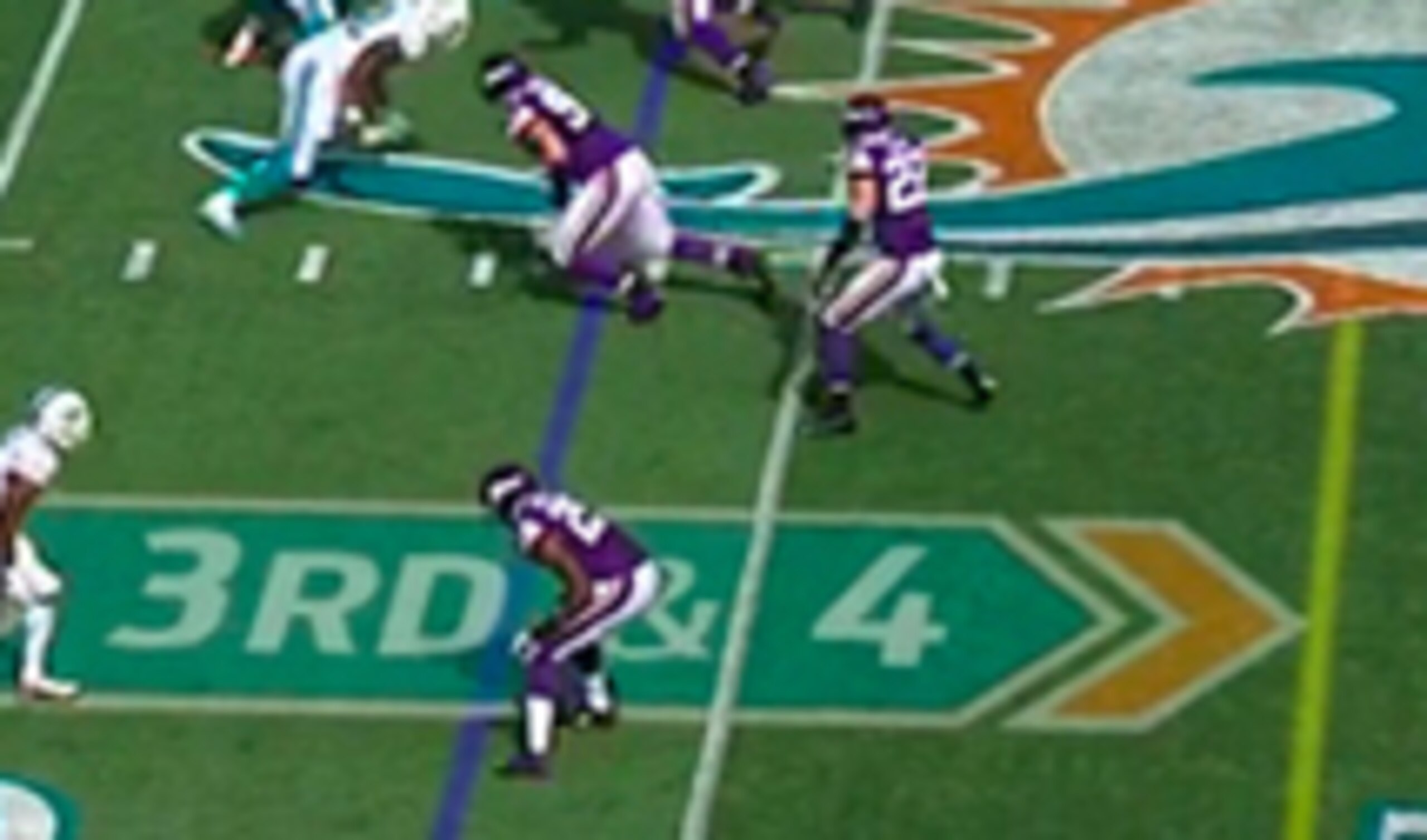
It's something that stands out on read-option runs but also when throwing the ball quickly underneath. On this play, the offense initially lines up with five wide receivers and Tannehill alone in the backfield. However, before the snap, Lamar Miller runs behind Tannehill into the opposite flat.
Miller isn't a running threat, but he offers Tannehill a quick outlet that works to the same effect.

As soon as Tannehill gets the football, he begins to read the coverage on the right side of the offense. He is focused on the outside cornerback and Harrison Smith, who has dropped into space underneath. Tannehill's outside receiver is running an angled curl route infield, with Miller running toward the sideline behind him.
Tannehill has to read the movement of the outside cornerback to determine where he goes with the football.

Because the outside cornerback moved with the outside receiver infield, Tannehill knows immediately he should throw the ball to Miller outside. An unblocked pass rusher is left in the passing lane, though, so he needs to adjust the flight of the football to get it to him quickly.

By throwing the ball over the free defender, Tannehill puts the ball in Miller's hands in space. Miller has an easy first down before he continues down the sideline, eating up the available space that was created by the offense's route combinations and Tannehill's quick decision.
This is a small aspect of the game, but it's the kind of play off of which Lazor has built his passing attack.
Sherman's offense didn't allow Tannehill to consistently make quick decisions and get rid of the football to his receivers. Even as his offensive line continued to struggle last season, Sherman made no adjustments to prevent the young quarterback from being sacked 58 times.

For his first touchdown against the Minnesota Vikings on Sunday, Tannehill made a quick decision to throw the ball down the field from another spread formation. He found Dion Sims in the end zone for the score—but, more significantly, he negated a blown block by right guard Mike Pouncey.
If Tannehill held the ball longer, he would have been forced to move his feet to evade the free defender. That would have disrupted the timing of the whole play.
By spreading the field, Lazor was able to put his athletic tight end in a one-on-one matchup against a Vikings backup safety in space. Sims runs a quick double-move route to come wide open down the seam. Tannehill releases the ball at the same time Sims comes out of his break, as evidenced by the above image where you can see Miller in his route.
Locating and throwing to open receivers isn't an issue for Tannehill.
He consistently makes good decisions and throws catchable passes to all areas of the field. He needs to be more consistent with his accuracy, but his ability is still evident and exemplified on a regular basis.
Tannehill receives more criticism for his inability to fit the ball into tight windows when throwing the ball down the field. However, his ability to make difficult throws isn't the problem.
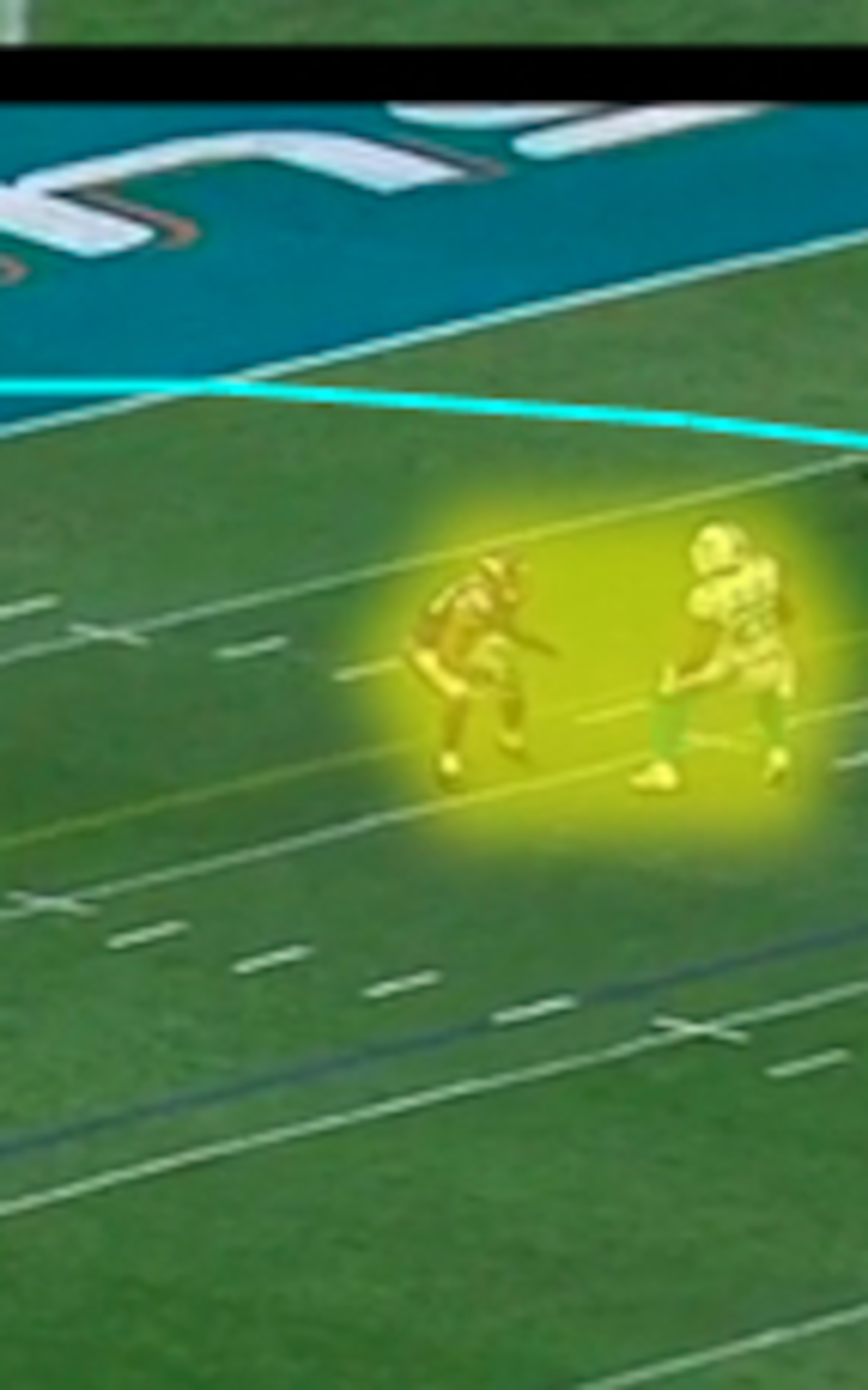
On this play, the Dolphins come out in their typical formation from the shotgun with Miller in a position to receive a handoff from Tannehill. The Dolphins have two tight ends lined up tight on the right side of the formation and two wide receivers spread to the left.
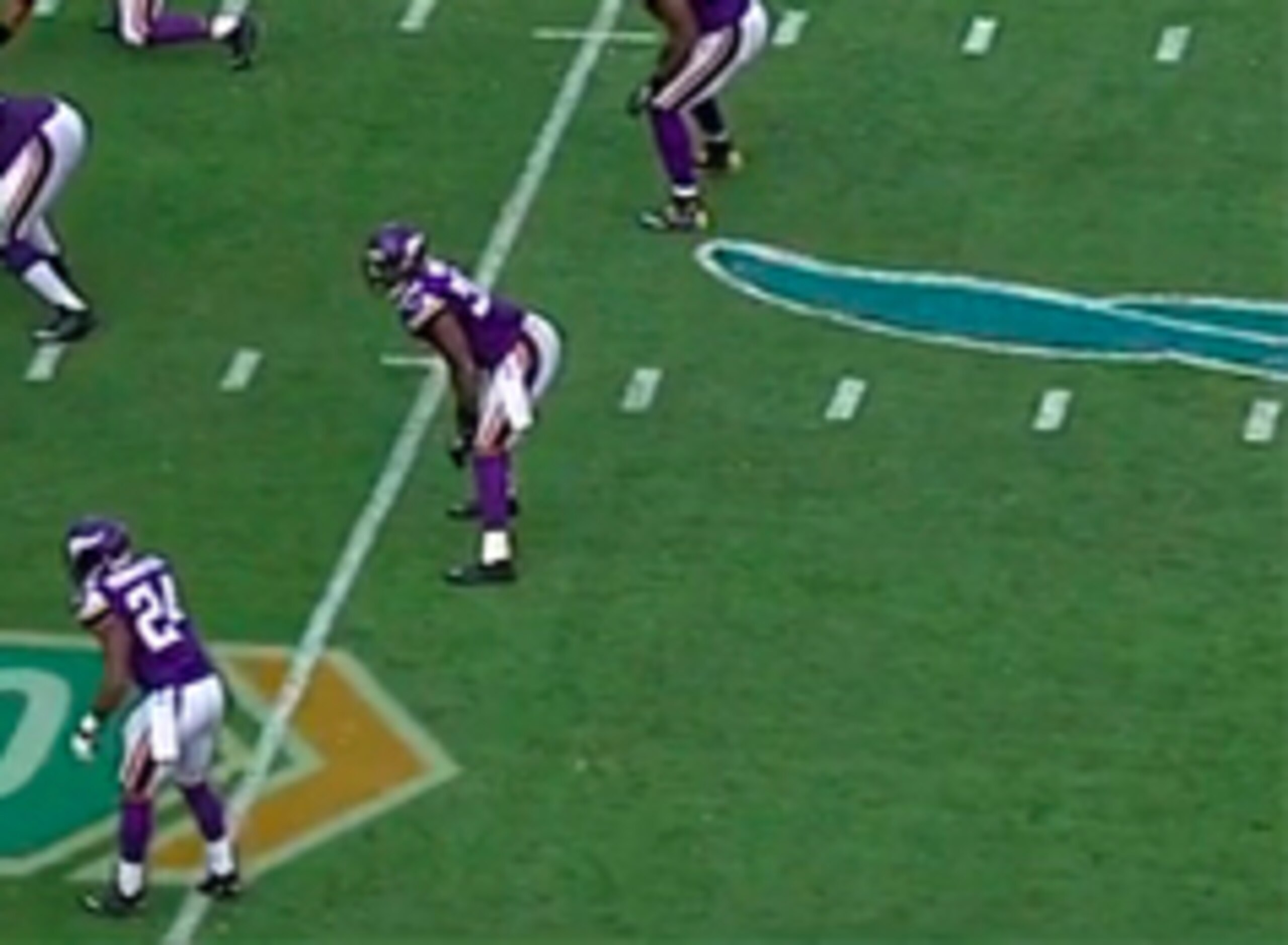
The Dolphins are using play action with each of their receivers and tight ends releasing vertically into their routes. Despite the play action, the Vikings defense maintains its depth on the second level while only rushing three players.
Because of the defense's actions, Tannehill has time to survey the defense—but the coverage downfield is crowded, so he has to hold the ball before fitting it into a tight window.

As two defenders close on him in the pocket, Tannehill delivers the ball down the right sideline to Charles Clay. Clay has gotten inside position on cornerback Captain Munnerlyn, but Munnerlyn has recovered position to be on his back.
Tannehill drops the ball over Munnerlyn and puts it in a perfect spot for Clay to catch it in stride.
Regularly this year, Tannehill has made these kinds of throws downfield, but his receivers either failed to adjust to the football or simply dropped the ball. When his receivers run closer to the sideline, they often misjudge the flight of the ball before catching it, which leaves their feet unnecessarily out of bounds.
While playing in an offense that has held him back more than propped him up, Tannehill has consistently improved his individual play over his first three seasons in the NFL.
If the Dolphins were uncertain about his future with the franchise before this season, they shouldn't have any doubts now. Even if Philbin doesn't stay on as the head coach, every effort should be made to keep Tannehill and Lazor together.
Each part of this duo brings out the best in the other.
Presuming Miami continues to build its supporting cast around the quarterback and focuses on retooling the defense in the offseason, the future in South Beach should be bright.
That's not something often said during the past decade or so.
.jpg?w=2560 "Cardinals Giants Football")
.jpg?w=2560 "Titans Ravens Football")
.jpg?w=2560 "OBJ Calls Out Giants 😳")
.jpg?w=2560 "Tyreek Deal May Come Soon")