Meet Melvin Gordon, the Most Snakebitten Heisman Trophy Candidate Ever
To truly appreciate Melvin Gordon’s season—one of the most historic and unfortunately timed stretches of brilliance the sport has ever seen—you must quantify it with something more.
How about total football fields? Let’s begin our journey there. In 13 games, the 213-pound back who hails from Kenosha, Wisconsin rushed for the equivalent of nearly 24 football fields length- to-length, a feat only three players have ever achieved. To put this in perspective, only 40 teams—yes, full rosters made up of multiple running backs—can say the same this season.
Oh, full-length fields don’t suffice as running back currency? Well, then how about miles? That’s not a method by which we typically calculate a running back’s rushing output, although it’s appropriate on this occasion. Gordon, despite matching up against defenses that clearly knew when and where he would get the football, totaled more than 1.3 miles on the ground this season.
Next time you’re about to hit your cruising speed on the treadmill, think about that.
We could keep going, diving deeper into the endless rabbit hole of statistical absurdity, although it won’t change the outcome come Saturday. Despite delivering a resume seemingly constructed with the Heisman in mind, Wisconsin’s celebrated workhorse will likely finish a distant second to Oregon’s Marcus Mariota when the winner is announced.
Gordon’s spectacular effort couldn’t have come at a worse time, stacked side-by-side with one of the more dominant, stat-crazed seasons a college quarterback has ever had. His finest single-game performance—one of the best days a running back has ever had—was overshadowed, astonishingly, just one week later.
More important to those hoping to become the next Melvin Gordon, this all came during a time when the running back has been deemed replaceable.
Gordon wasn’t just going up against Big Ten defenses; the obstacles were far greater.
“You’re not looking at running backs anymore,” former Wisconsin running back and Heisman winner Ron Dayne told Bleacher Report. “Everyone’s looking at different positions. It didn’t circle back around yet for him to get the attention that he needed.”

Dayne won his Heisman in 1999, which might as well be 1899 when it comes to league appreciation for the position. Operating with a much larger frame and drastically different running style, his 2,034-yard, 20-touchdown year was deemed Heisman worthy at a time when the position was viewed differently. It was appreciated.
Now back at Wisconsin as a student, university employee and a valuable asset to the Badgers’ recruiting efforts, Dayne has passed along pieces of his Heisman experience to Gordon as he braces for New York City, sharing stories of the moment, his first encounter with Jay-Z and more.
“You’re going to see so many people you’ve seen on TV,” Dayne told his latest protégé.
Before sharing red-carpet stories, Dayne provided feedback to Gordon along the way as he raced toward the award. He didn’t stress running styles, blocking schemes or areas in which he could improve. In fact, Dayne’s approach was much simpler in nature while speaking to one of the sport's brightest stars.

“The biggest thing I told him when I got to talk with him is to have fun. Laugh,” Dayne said. Go out there and have fun no matter what. Don’t worry about stats.”
Whether he worried about them or not, the stats came. And like the rest of us football mortals without a Heisman resting comfortably in our trophy case, Dayne marveled over what Gordon accomplished week to week.
It was a different kind of dominance, a style unique from Montee Ball—another Wisconsin back who ended up in NYC not long ago after his dream season. It was different from James White, Brian Calhoun and Anthony Davis, other Badger backs who delivered tremendous results during their Madison tenures.
“He’s a different style running back. I can’t compare him to any running back now or any old-school running back either,” Dayne said. “I tell him he looks like Jamal Charles because he’s got the long hair, he’s fast and he can truck guys. He certainly doesn’t run like I did.”
Dayne’s style was built on power and vision; Gordon’s most diabolical traits are unquestionably his speed parlayed with his own knack for finding small openings and making the most of it.
What Gordon hasn’t received ample credit for is the way he has adapted over the course of his college career, a career that will end following the team’s bowl game against Auburn.
“They said all he could was run outside, then the next year he was running inside on all of his plays,” Dayne said. “Then it was he couldn’t catch, and he got multiple touchdowns this year catching the ball. He’s a monster, and he changed every year.”

Playing in an offense deprived of any reasonable threat to pass, No. 25 has managed to accumulate rushing yards in bulk. Gordon finished with 2,336 rushing yards, 151 receiving yards and 29 total touchdowns, three of which came by way of pass. He averaged nearly 180 yards per game.
“I always have high expectations for myself and always expected to be good,” Gordon said. “But I never thought it would be this crazy.”
Gordon totaled 33 plays of 20 yards or more, which was tops in the nation. He eclipsed 200 total rushing yards in five different games this season and ran for 100 yards or more in all but two outings.
My goodness, we fell down the Gordon stat rabbit hole, didn't we?
He carried the ball 100 more times than he had previously and averaged 7.6 yards per carry, just slightly under his robust career average. In the third quarter of games—a time when most backs wear down—Gordon averaged more than 10.5 yards per rush.
His 408-yard effort against Nebraska broke LaDainian Tomlinson's single-game FBS record for rushing yards in a single game—a record that was set the same year Dayne took home the Heisman.
The very next week, Oklahoma’s Samaje Perine overtook Gordon’s record. A historic milestone that had stood for more than a decade fell in seven days.
This, in many ways, sums up Gordon’s season: remarkable dominance that somehow—through a strange sequence of events—never quite received the appreciation it deserved thanks to dream seasons and dream Saturdays from other magnificent players.
At the same time, Perine’s effort added further ammunition to a battle Gordon fought for this season. Even though it took a little shine off the performance, Gordon reached out to Perine to congratulate him shortly after.
“All of us running backs around the country are trying to make a statement that we are important,” Gordon said. “We’re trying to do the best we can to help out our teams and show that running backs are just as important as any of our positions. We’re trying to show that as much as we can, and that’s not just me.”
It wasn’t just him. The 2014 season was indeed the year of the running back, although it was Gordon’s magical campaign that led the charge.
It didn’t end with a bang against Ohio State in the Big Ten Championship—with Gordon totaling just 76 yards on the ground in the loss—but his overall performance stacks up valiantly compared to some of the greatest running back seasons ever.
| Name | School | Year | Rushing Yards | YPC | TDs |
| Melvin Gordon | Wisconsin | 2014 | 2,336 | 7.6 | 29 |
| Barry Sanders | Oklahoma State | 1988 | 2,628 | 7.6 | 37 |
| Reggie Bush | USC | 2005 | 1,740 | 8.7 | 18 |
| Montee Ball | Wisconsin | 2011 | 1,923 | 6.3 | 39 |
| Mark Ingram | Alabama | 2009 | 1,658 | 6.1 | 20 |
| Ron Dayne | Wisconsin | 1999 | 2,034 | 6.0 | 20 |
| Andre Williams | Boston College | 2013 | 2,177 | 6.1 | 18 |
| Kevin Smith | UCF | 2007 | 2,567 | 5.7 | 30 |
| LaDainian Tomlinson | TCU | 2000 | 2,158 | 5.8 | 22 |
The name on the list you can’t avert your eyes from is none other than the great Barry Sanders, the player Gordon grew up watching along with the late, great Walter Payton.
“Those were the first two guys my dad showed me,” Gordon said.
Arguably the greatest college football player of all time, Sanders’ 1988 season at Oklahoma State is the one all running backs are chasing. As Gordon’s production increased, the comparisons to Sanders’ year started to become more prominent for Gordon as he navigated expectations.
While he embraced the attention and managed the madness, he also didn’t have any interest in stacking resumes or running styles side by side.
“Barry Sanders? No. I don’t think you can emulate or be anything like Barry Sanders,” Gordon said. “He’s just one of a kind. There’s only one Barry Sanders and you can’t be like him. You can try, but you won’t be too successful.”
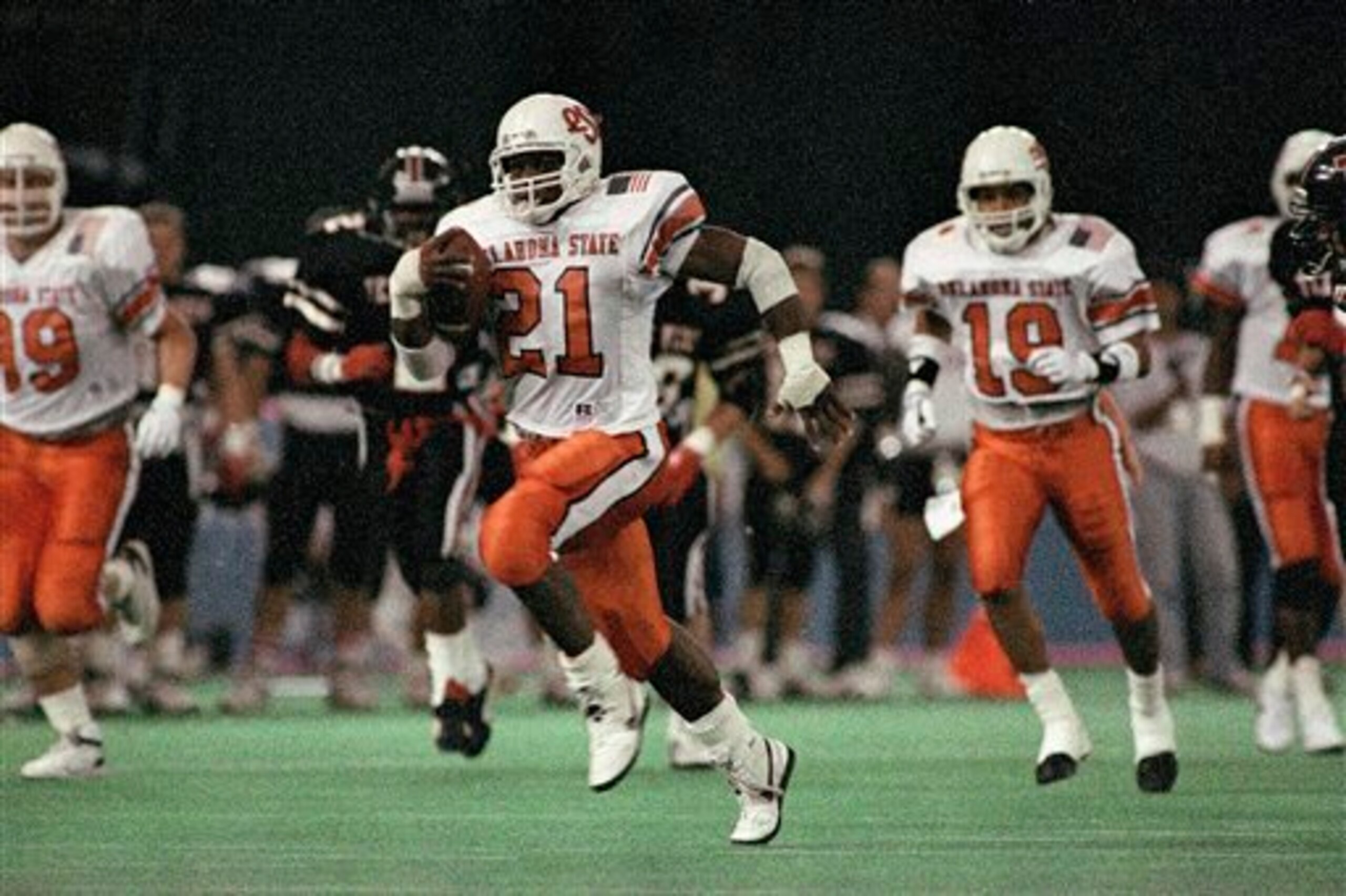
The record is still within reach, although it will take a monumental effort to get there. For the first time all year, however, Gordon isn’t moving toward history. He’s not running from defenses; he’s not running to keep an entire position relevant.
Gordon has finally stopped moving, and he will be able to celebrate his season and his accomplishments in the spotlight, even if he doesn't hear his name called as the Heisman ceremony winds down.
“It’s been a goal of mine and it just shows what type of year I had and how hard I worked,” Gordon said. “I came back to help my team and do some things to become a better player, as well, and I think this is showing that.”
Although Gordon won’t win the sport's most prestigious award, history is not out of the picture just yet. His work is nowhere near complete.
“I’m trying to do my best to be remembered, and hopefully this is a step to that direction, he added.”
Gordon needs 292 rushing yards against Auburn in the Outback Bowl on January 1 to hit Sanders’ historic mark before departing for the NFL. For any other running back managing realistic expectations, such gaps would seem unrealistic and unreasonable. For Gordon, it seems oddly attainable.
After all, it’s not even three full football fields and less than a quarter mile.
Unless noted otherwise, all quotes were obtained firsthand. All stats courtesy of CFBstats.com.

.jpg?w=2560 "Buzz: Donald Eyeing Media Future")
.jpg?w=2560 "🔴 Live: WWE NXT 👊")