

How Colts OC Pep Hamilton Has Created the League's Most Explosive Offense
The Indianapolis Colts do not have the league's best offense.
Despite announcers' weekly notes that the Colts boast the NFL's "No. 1" offense, using total yards to measure an offense is inherently lazy and inaccurate.
Any measure that takes turnovers, context and quality of opponent into play would leave the Colts in the "Good, but not Great" realm. Football Outsiders, for example, has the Colts offense at a middling 13th by DVOA, while Advanced Football Analytics has Indianapolis as 18th in Win Percentage Added (although fourth in Expected Points Added).
.jpg?w=2560 "Rams 49ers Football")
While those measures may downplay the Colts a bit, in the end the team probably belongs right around where its Drive Success Rate (per Football Outsiders) ranks: sixth. Other teams with a more balanced and less turnover-prone offense, like Green Bay, New England and Denver, have been better this year, especially as of late.
But while the Colts can't reasonably be called the league's best offense, what Pep Hamilton has created in Indianapolis is the league's most explosive offense, and it's not particularly close. It is the offense that has the best chance of producing big plays at any given time.
With an offense built around quarterback Andrew Luck and a ridiculous depth of pass-catchers, Hamilton has smartly dropped the ball-control, possessive style that the coaches have expressed a desire for in the past for a versatile style with well-timed vertical elements.
Take a look at some of the Colts' offensive stats from the year.
| Statistic | 37.31 | 2.58 | 2:44 | 6.00 | .147 | 4.79 | 69 | 26 |
| Ranking | 4 | 3 | 14 | 14 | 22 | 16 | 1 | 1 |
The Colts rank extremely high in points and yards per drive but irregularly low (or mediocre, rather) in possessive stats like time of possession or plays per drive. While the team's points in the red zone and touchdown rate in the red zone rank smack dab in the middle of the league, the Colts are fifth in touchdowns per drive.
This, of course, is because of the Colts' league-leading 16 touchdowns that have come outside of the red zone, per Pro-Football-Reference.com. This is led, of course, by Luck's league-best 15 touchdown passes of over 20 yards, and it's not due to having one big play threat. The Colts have four pass-catchers with at least three receiving touchdowns of over 20 yards: T.Y. Hilton, Donte Moncrief, Dwayne Allen and Coby Fleener. Only one other team has more than two such receivers (Denver, three).
Of course, that big-play focus comes at a cost: The Colts are more turnover-prone than they'd like and haven't been great in the red zone, where the space to operate is compacted. Until they get a better running game to balance out the offense, that likely won't change too much. But given the team's personnel, Luck, Hamilton and the rest of the Colts offensive staff and players have done a very good job in 2014.
So how exactly does this play out on tape?
To start we look at some of Pep Hamilton's best play-calling of the season, which came against Washington on Sunday. The plays didn't result in an explosive touchdown, unlike just about every other play (or so it seemed), but it was very close and showed an example of how Hamilton has tried to creatively use the play-action game this season.
The first play came midway through the second quarter. On first down from the Washington 42, the Colts ran a play action to the right out of a two-tight end set with an extra offensive lineman. Having likely seen some of the Colts' success with six offensive linemen on tape (Week 2, for example), the Redskins bunched up toward the line of scrimmage.
Note that it is rookie wide receiver Donte Moncrief in on these single-receiver sets. His blocking ability allows the Colts to either run or pass out of these single-WR sets with great effectiveness.

With a great play design, Coby Fleener ran a drag route across the formation to the backside, where Luck turned and found him open for 16 yards after the play action. With the single-high safety keying in on Moncrief's route down the sideline, Fleener was easily able to outrun a flat-footed WAS linebacker to get open.
It was a well-designed play that fooled the Redskins for a big gain. But the best part was yet to come.
On the next down, the Colts lined up once again in a six-OL, two-TE set. They again ran a play action, this time with Fleener coming across the front side of the formation. The Washington defense was ready, and the safety bit up on Fleener's route.

But this left a void for Moncrief to expose with a post route, and Luck went for the big play. Now, CB David Amerson was able to get a finger on the ball, and Moncrief couldn't pull it in, but the potential for the big play was clearly there.
Overall, Hamilton has done a very good job of timing his play calls this year, using different plays to set up a defense for a big play later in the game.
One big key in doing so is T.Y. Hilton. The third-year receiver has come into his own this season, becoming a bona-fide No. 1 receiver. Hilton ranks in the top 10 in just about every possible receiving stat this season, and is doing so with a variety of routes.
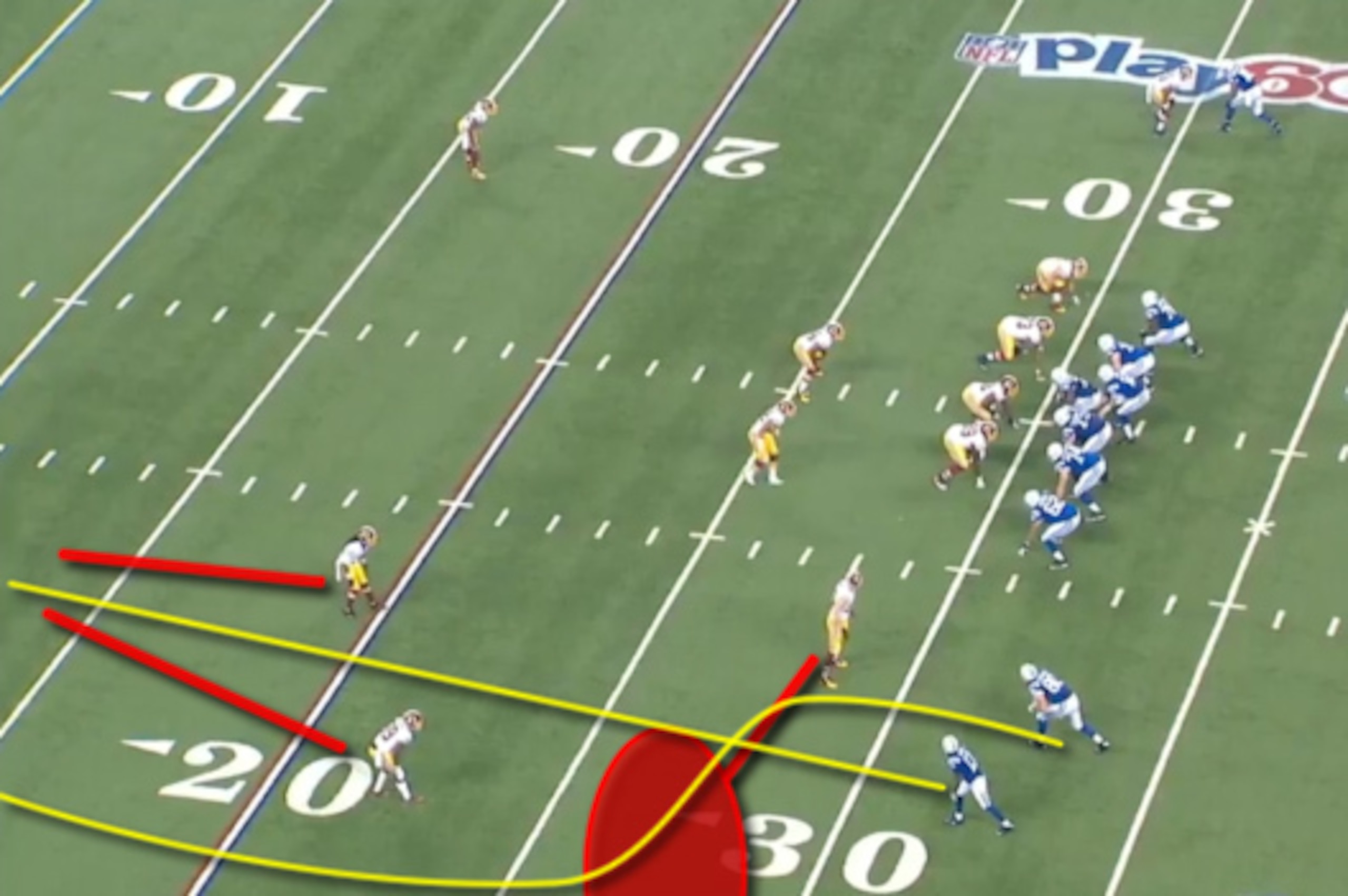
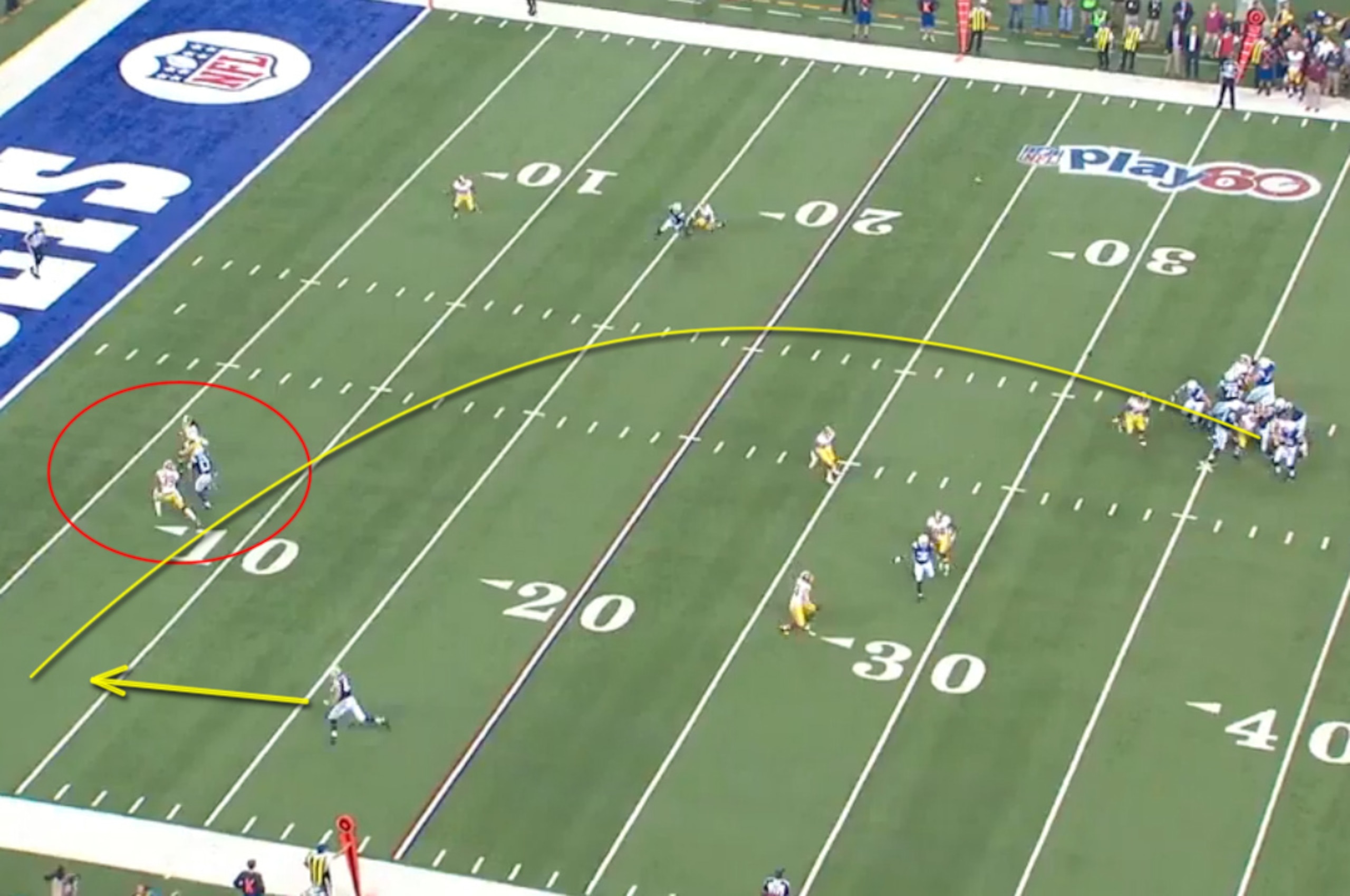
Against Washington, the Colts used Hilton's versatility to set up Washington. The Redskins had a safety rolled over the top of Hilton throughout the game, and the Colts noticed it early. On the Colts' first touchdown drive of the game, they ran vertical switching routes with Hilton and Fleener, and the result was a 30-yard touchdown to Fleener as both the safety and cornerback tracked Hilton into the end zone.
Now worried about the deep ball, Washington next would get set up by Indianapolis' consistent targeting of Hilton underneath.
Luck targeted Hilton five times in the game, all in the first half. His routes: 10-yard out, 15-yard curl, 8-yard out, 20-yard back-shoulder go route and 10-yard out. No deep routes over the top, no screens, all short and intermediate breaking routes.
Determined not to let Hilton beat them, the Redskins went at Hilton, continually biting on the diminutive receiver's breaks. This would leave wide open space for big-play opportunities for Coby Fleener and Donte Moncrief.


For the Colts, it's all about the depth at pass-catcher. Earlier in the season, it was the tight ends drawing the safeties into the middle of the field and leaving room for Luck to find receivers down the sideline (look at Hilton's score last week against the Jaguars, or Moncrief's touchdown against Pittsburgh). In this particular matchup, it was the opposite.
It puts an incredible amount of stress on opposing safeties, which is expanded even more when the team has an explosive running back like Dan Herron running well out of the backfield. Of course, having a quarterback like Luck, who has the ability to move safeties with his eyes, is a large part of the equation as well.
As Fleener continues to develop and Moncrief earns more playing time, the Colts' ability to create big plays shouldn't diminish, and it's a good thing. With the defense's inconsistencies, the Colts will need the ability to strike quickly come playoff time.
All statistics and snap counts come from Pro Football Focus (subscription required) and Pro Football Reference unless otherwise noted. All training camp observations were obtained firsthand by the reporter unless otherwise noted.
Kyle is an NFL and Indianapolis Colts analyst for Bleacher Report and the editor-in-chief of Colts Authority. Follow Kyle on Twitter for more stats, analysis and general NFL analysis.

.jpg?w=2560 "Grading Dynamite From Mexico City 🔠")