San Francisco 49ers: Colin Kaepernick and an NFL Story of Unrecognized Success
The San Francisco 49ers made Colin Kaepernick their starting quarterback midway through the 2012 season.
Kaepernick’s promotion also came a mere two weeks after his 25th birthday.
Consistent success to the tune of 24 regular-season wins, a 4-2 playoff record and 66 total touchdowns in just 41 NFL starts for the former Nevada star has ultimately gone unrecognized.
Most of the incessant criticisms were also undeserved, at the very least until Kaepernick put forth a career-worst performance on Thanksgiving night.
Let’s embark on a timeline of how the No. 36 overall pick in the 2011 NFL draft has found himself at the lowest moment and most pressurized standing of his professional career.
Remove the No. 1, Replace with the 36th

Former No. 1 overall pick Alex Smith suffered through six years and five miserable seasons as the 49ers' starting quarterback.
Then, when Jim Harbaugh became head coach in 2011, the long-time goat turned into savior for the Niners franchise.
Well, at least temporarily.
Smith first led San Francisco to a 13-3 record and epic playoff comeback over the New Orleans Saints. He finished the 2011 season with a career-high 3,144 passing yards with 17 touchdown passes, five interceptions and an NFL-best interception ratio of 1.1 percent.
He then had completed 70.1 percent of his passes with 13 touchdowns en route to a 6-2-1 mark before a concussion against the St. Louis Rams forced him to the sidelines in 2012.
Yet, despite generating a 19-5-1 combined record with 30 touchdowns and seven game-winning drives in 27 starts, Kaepernick became the 49ers starter for good—even after Smith had recovered from his head injury.
Harbaugh elevated his hand-picked draft selection to the starting role in Week 10 of that season.
Following an awe-inspiring performance in a win over the Chicago Bears, Kaepernick has accomplished great things and received little appreciation for his efforts.
Win a Conference Championship, Nearly Win a Super Bowl
Let’s continue with Kaepernick’s first career start in the NFL.
After compiling a 69.6 completion percentage with two scores and zero picks in a 32-7 rout over Chicago, Kaepernick reeled off four more wins en route to a 5-2 finish.
He ended the regular season with 10 touchdown passes, three interceptions and a league-high 8.6 yards per attempt. He added 415 yards and five touchdown runs on the ground.
Then the postseason happened.
Per common sports vernacular, Kaepernick went off.
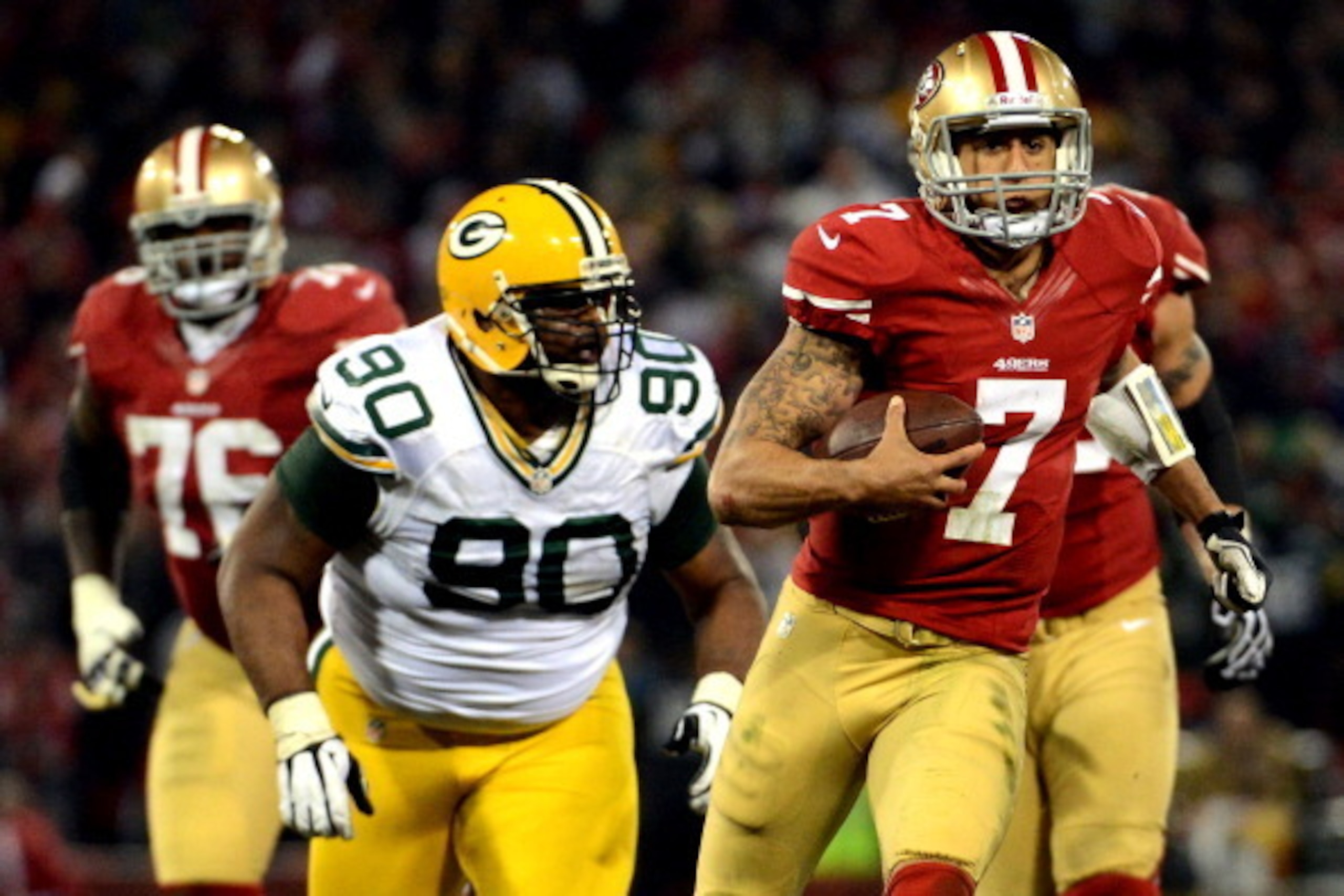
He passed for two scores with an incredible 92.7 QBR in the 49ers’ 45-31 demolition of the Green Bay Packers. He rushed for an even more astonishing—and quarterback playoff record—181 yards and two touchdowns.
Yes, that was his first career playoff start.
Kap then one-upped himself in the passing department. Despite rushing for only 21 yards, he picked apart the Atlanta Falcons with a 76.2 completion percentage, one touchdown and tremendous 94.8 QBR in the NFC Championship Game.
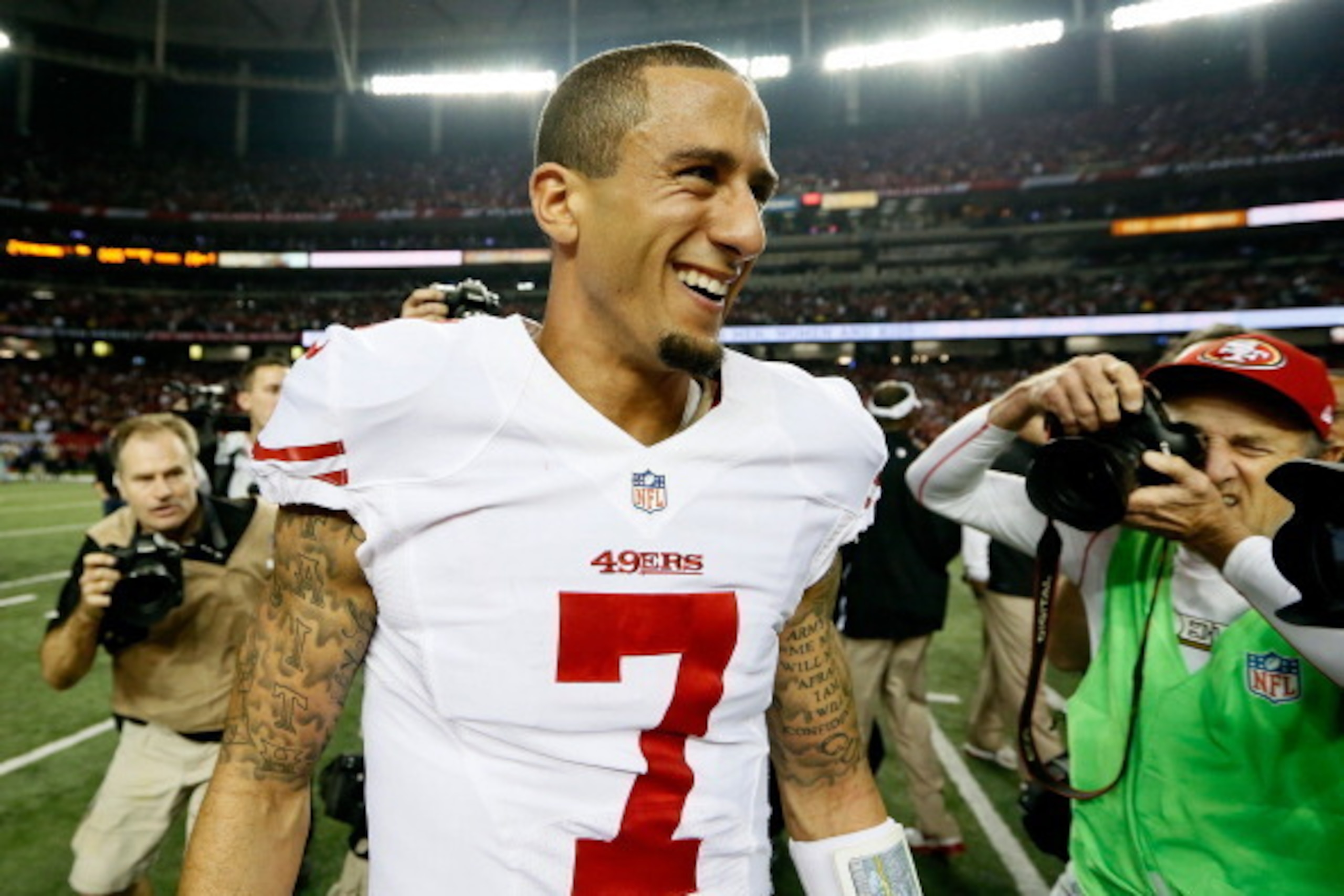
And he did it on the road.
The 49ers emerged victorious and moved onto Super Bowl XLVII.
What Kaepernick accomplished on the football world’s biggest stage continues to defy how rookie starters are supposed to perform.
After San Francisco’s usually stout defense and reliable special teams put the 49ers in a 28-6 hole against the Baltimore Ravens, Kap almost did the unthinkable.
He finished with 302 yards, 10.8 yards per attempt and one touchdown through the air and another 62 yards and a score with his legs.
No Ravens running back matched those latter totals by the Niners dual-threat quarterback.
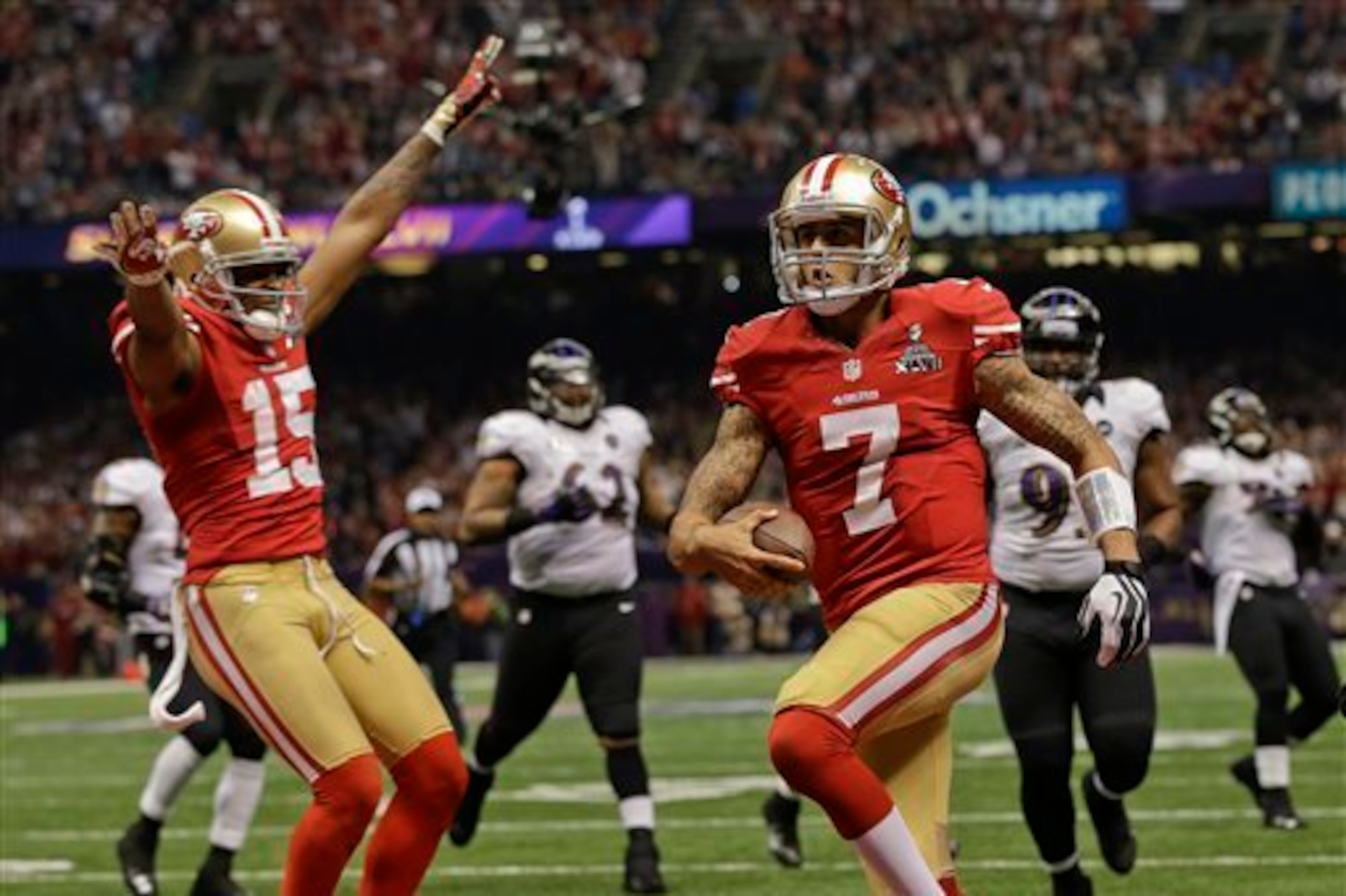
Kap also overcame a second-quarter interception and earned an above average 61.7 QBR, which included his eye-popping touchdown run that reduced the deficit to 31-29.
Regrettably, the world only remembers how the game ended.
Despite driving the 49ers 75 yards to the Ravens’ five-yard line in the waning minutes of the fourth quarter, viewers only recall the three-straight incompletions to Michael Crabtree.
They seem to forget an inexcusable timeout by Harbaugh that negated a potential game-winning play, not to mention a debatable pass interference non-call on Kap’s final throw.
Most importantly, many experts, fans and detractors alike continually fail to appreciate a phenomenal—and near-unprecedented—Super Bowl outing by a first-year starter.
It’s not like playing quarterback in the NFL isn’t already the most challenging of all roles in professional sports or anything.
12 Wins, Playoff Berth in the NFL’s Toughest Division Still Not Enough

After helping deliver the 49ers to a 12-4 record and postseason berth out of the NFC West in 2013, Kaepernick hadn’t done enough.
His 21 touchdown passes and four game-winning drives were too few, his 58.4 completion percentage was too low and his 524 rushing yards and four scores were OK—nothing more.
Oh, and his 68.6 QBR and 91.6 passer rating represented a total regression from his 72.2 and 98.3, respectively, the year before.
Remember that Kaepernick operated without Crabtree—his go-to target in 2012—and had just two reliable, albeit very effective pass-catchers in Anquan Boldin and Vernon Davis for most of the season.
Unfortunately, history forgets such compromising elements when the player being evaluated is a quarterback—in spite of it being a very much dependent position.
At any rate, the 49ers made it to the playoffs for a second time with No. 7 as their field general.
Two More Postseason Wins, Expectations Remain Unfilled
Kaepernick and Co. began their latest January run with a rematch against the Packers.
As he did after an early pick-six in the prior wild-card matchup, Kap overcame an interception and two stalled drives in the red zone.
Except this time, he did so in the unfriendly and rather snowy confines of Lambeau Field.
His 42-yard burst up the middle led to a Frank Gore touchdown and 13-7 Niners scoreline just two plays later in the second quarter.
And that was just a foreshadowing taste of what would go down in money time.
Trailing 17-13 early in the fourth quarter, Kaepernick’s 24-yard run off left end and perfect 28-yard pass to Davis down the seam put the road team back in front. Then, with the game tied at 20-20 with 5:06 remaining, Kap’s third-down and fourth-quarter prowess materialized with both his arm and legs.

A 17-yard conversion to Crabtree and an 11-yard run helped push the 49ers into the red zone. With snow cascading down on the field, Phil Dawson came in and did his thing from 33 yards out for the game-winner as time expired.
Kaepernick started slow but finished strong, compiling 227 yards passing, 98 yards rushing and a winning 88.8 QBR against the Aaron Rodgers-led Packers.
As if to seemingly tempt the naysaying masses, the 49ers’ supreme talent once again saved his clutch work for when San Francisco needed it most: its second playoff matchup on the road.
Kaepernick erased the memory of a few shortcomings on third down and began transforming scoring opportunities into touchdown conversions against the Carolina Panthers.
He capped an 80-yard drive just before halftime with a strike to Davis in the corner of the end zone. That gave the 49ers a 13-10 lead—one that Kap made sure stood up.
On the Niners’ opening series of the third quarter, he converted a 3rd-and-1 with his legs against Carolina’s stout defensive front. And two plays after a 45-yard hookup to Boldin, the league’s most lethal rushing quarterback ran it in from four yards out.
The touchdown run put the Panthers in a 20-10 hole from which they would never recover.
Kaepernick’s two scoring plays did the damage against a similarly skilled, yet unprepared Cam Newton on the playoff stage. Kap went head to head with the former No. 1 overall pick and beat him at his own game—on his own field.
Of course, Gore, Boldin and the 49ers' stellar defense also deserved credit for this postseason triumph.
But it’s not surprising that Kap’s supporting cast, 53.5 completion rate and “lowly” 211 total yards—and not his 71.9 QBR and game-deciding touchdowns—defined his performance.
Six Inches Away from Another Super Bowl, Tarnished Reputation Ever Since
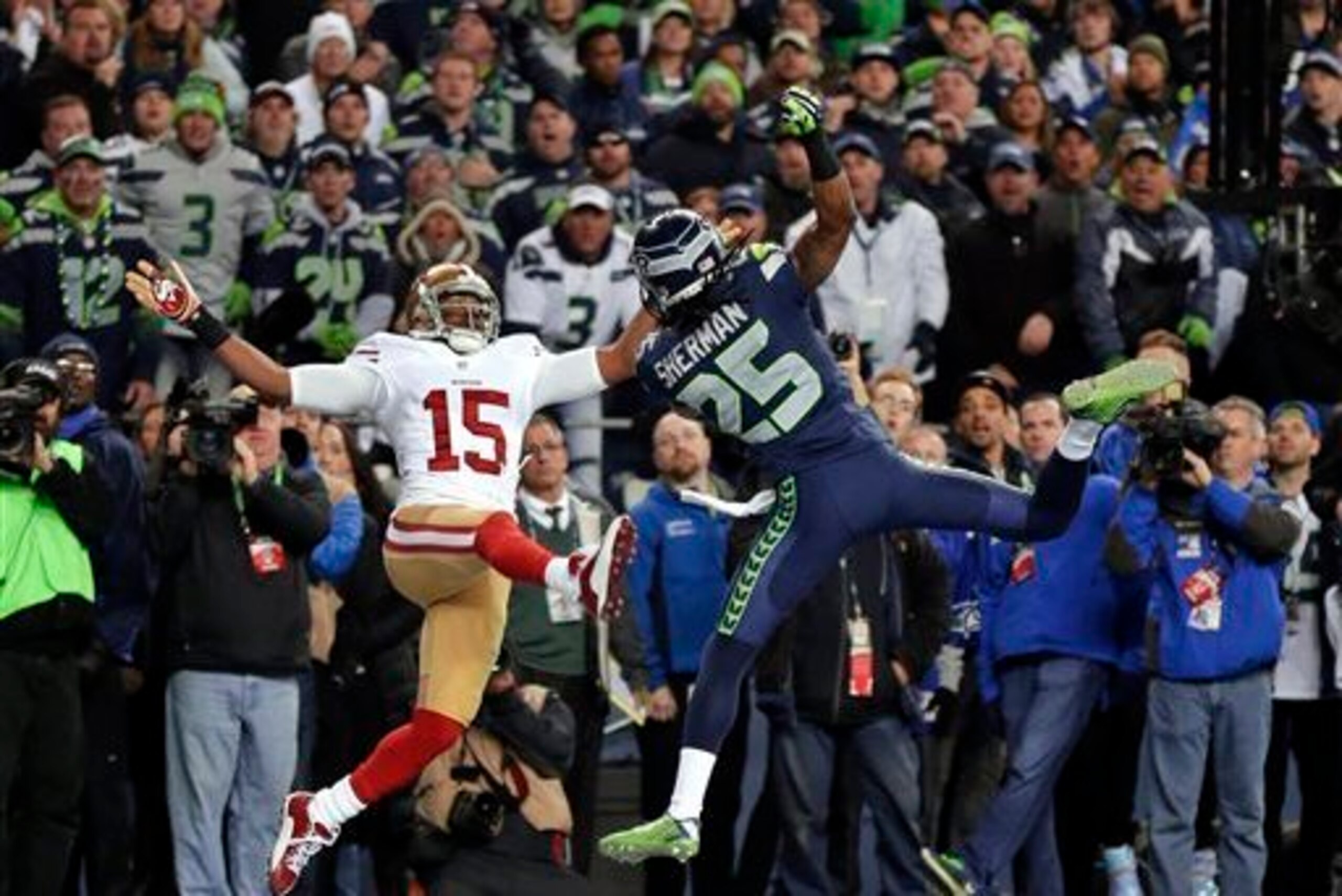
What happened on the final play of the 2013 NFC Championship game might forever prevent Kaepernick from receiving his due tribute.
And it was literally inches away from propelling the 49ers into football’s promised land.
Trailing Seattle 23-17 with 3:37 remaining, Kap converted a do-or-die fourth down and a subsequent 3rd-and-2 with completions to Gore and Crabtree. He helped advance the 49ers all the way to the Seahawks’ 18-yard line.
Yet, with just seconds left on the clock, his deep end-zone throw to Crabtree didn’t have enough hang time. The would-be game-winner came just within the reach of Richard Sherman, who tipped it to Malcolm Smith for the game-saving interception.
The rest, as they say, is, well, a soul-crushing history in the eyes of 49ers fans.
But said history from a more disinterested perspective also dictates that Kaepernick’s ever-so-slightly underthrown pass outweighed all the positives that came before it.
It ignores his incredible 130 rushing yards against a Seattle front that was impervious to just about every running back in the league at home. It says that his go-ahead 26-yard touchdown strike off one foot to Boldin in the third quarter didn’t matter.
A pass that was less than a foot away from securing the 49ers access to the Super Bowl and into a favorable matchup with the Denver Broncos is the only thing that did.
Instead of being known as a success story with six game-winning drives in the regular season and another two in the playoffs, Kaepernick finds himself known as the guy who just can’t get it done in the big games.
For Kap in 2014, Success is a Forgotten Memory
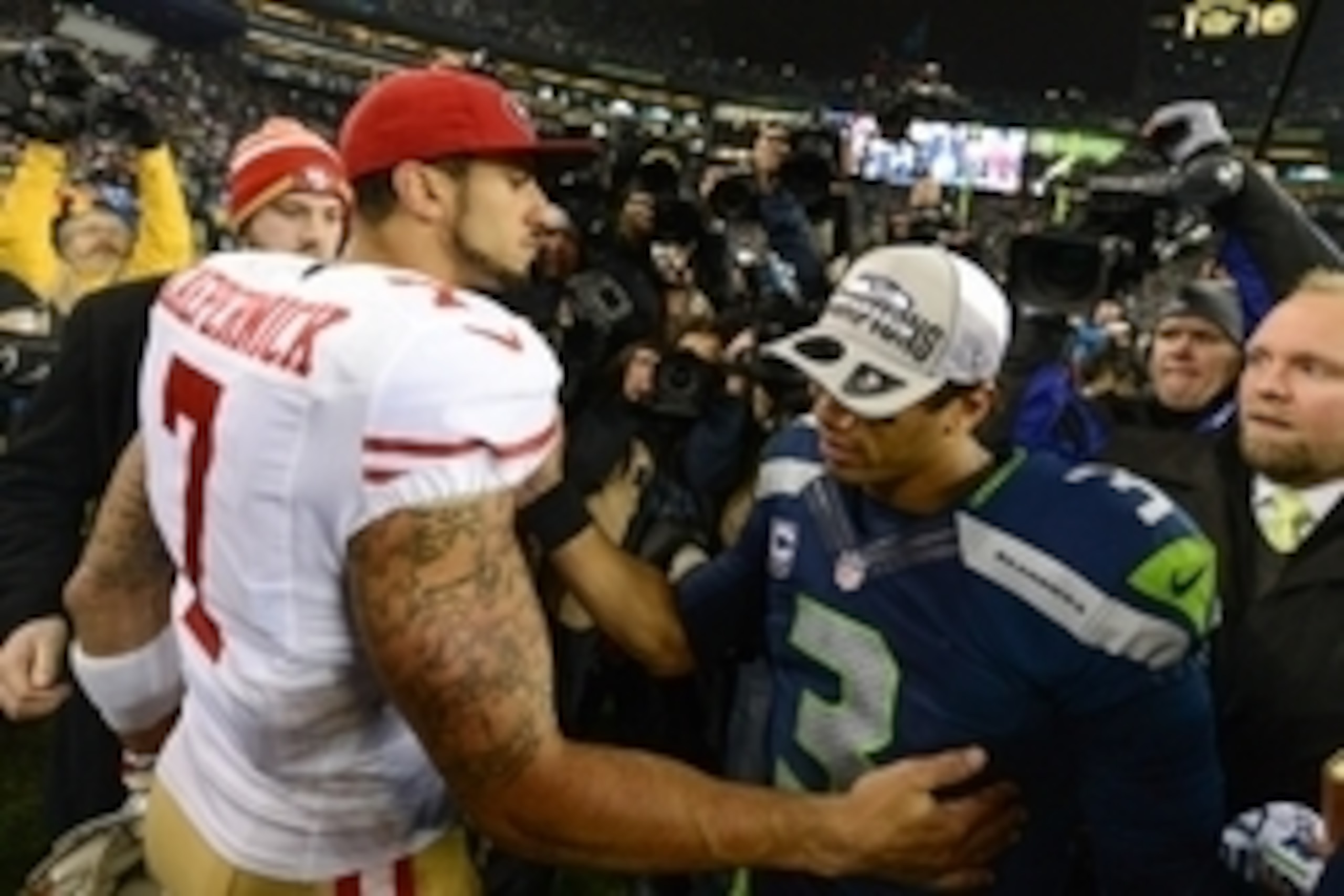
The modern anxious NFL audience demands instant championships from its franchise quarterbacks operating on great teams.
Those who don’t immediately deliver are deemed to be relative busts.
Russell Wilson deserved every possible accolade after helping the Seahawks win the Lombardi Trophy in his second season. Playing behind an all-time defense or not, he put forth a winning performance at the most critical position on the field.
What he also did, however, was inadvertently skew expectations for the quarterback position to absurdly unfair levels.
And no quarterback has endured more pressure than Kaepernick.
Following another loss to Seattle, Kap is now standing on tenuous ground.
He produced an unsightly 4.2 yards per attempt, 10.7 QBR and 36.7 rating against the Seahawks at home on Thanksgiving night. Each one represented a bottom-three career mark.
Kap showcased his worst when the Niners needed him at his best.
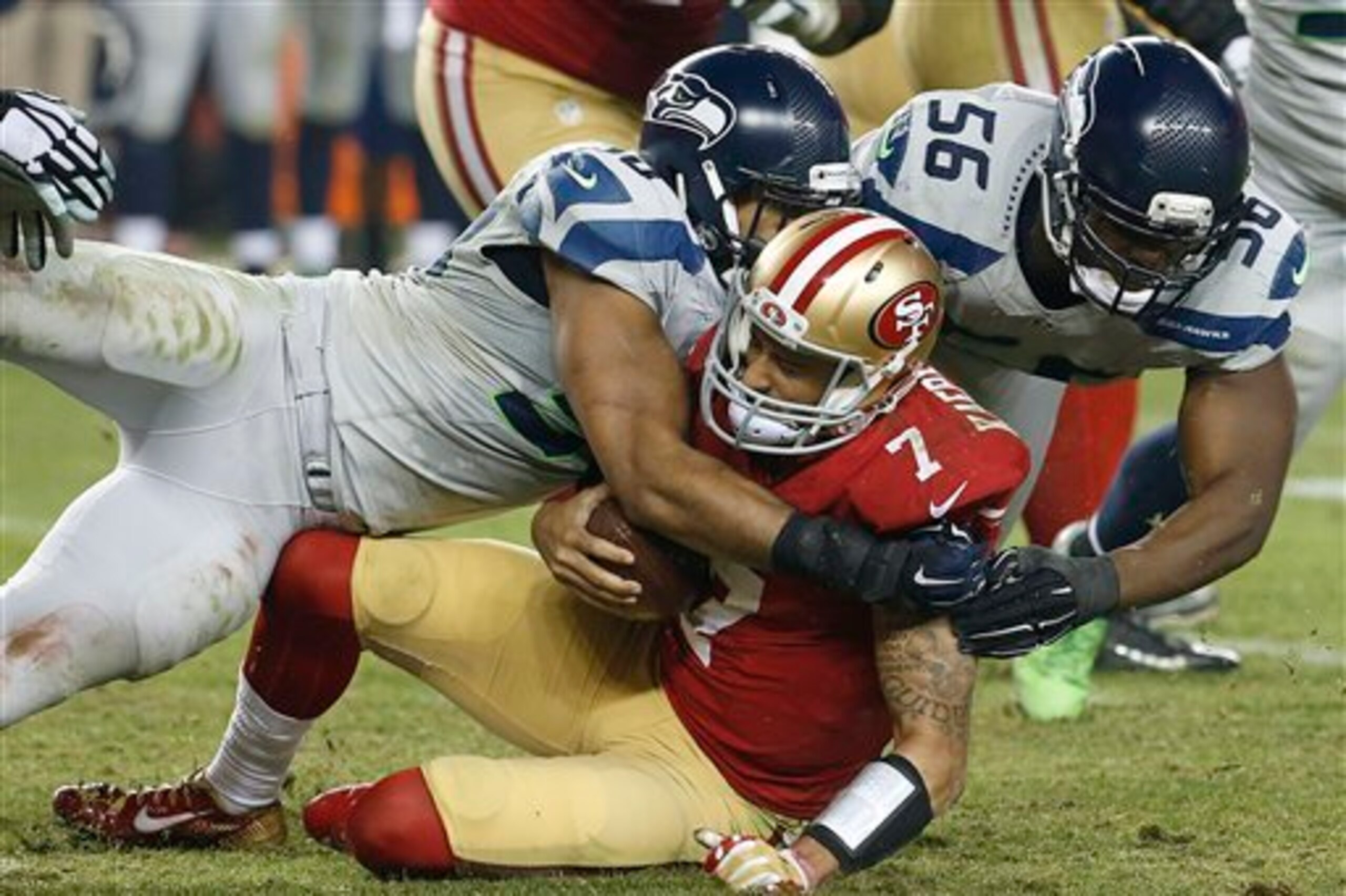
The Red and Gold will likely miss the playoffs due to their quarterback’s untimely collapse against a division rival.
Despite being loaded offensively with Gore, Boldin, Crabtree, Davis, Carlos Hyde and Stevie Johnson—not to mention a new contract—Kaepernick has wilted in the face of inflated demands.
He’s on the verge of setting career-worst marks for interceptions, QBR and passer rating.
Potential career highs in passing and rushing yards won’t suffice. This is especially true in light of what transpired during the 49ers’ most important game of the year.
Kap helped secure victory against the Dallas Cowboys, Philadelphia Eagles and St. Louis Rams with multiple-touchdown efforts, but he also helped ensure defeat with costly turnovers versus the Seahawks, Rams and highly suspect Bears.
So, what’s in store for the Niners’ franchise centerpiece moving forward?
Kaepernick must now accept the label of unrealized potential with a reputation for failure in the big game.
It isn’t a warranted evaluation from a big-picture perspective, and his established success in the postseason will continue to go unrecognized until he wins a Super Bowl.
But unless the 49ers win out and a host of other teams lose multiple times, Kaepernick will exist in gridiron infamy.
All team and player statistics courtesy of Pro-Football-Reference and ESPN unless otherwise noted.
Joe Levitt is a Featured Columnist for Bleacher Report, waxing academic, colloquial and statistical eloquence on the San Francisco 49ers. Follow him on Twitter @jlevitt16
.jpg?w=2560 "Eagles Bears Football")