

Just How Good Is the Jacksonville Jaguars Pass Rush?
While sometimes advanced stats may disagree about something, it's rare that they disagree about something as much as they disagree about the Jacksonville Jaguars pass rush.
For those of you who have consigned the Jaguars to the depths of the NFL and haven't been paying attention, head coach Gus Bradley's pass rush is getting results. The 2013 Jaguars finished 30th in Football Outsiders' Adjusted Sack Rate, a stat that measures sacks based on pass dropbacks faced rather than games played. The 2014 Jaguars? They're second in the league.
| Sen'Derrick Marks | 475 | 5.0 |
| Ryan Davis | 185 | 4.5 |
| Chris Clemons | 483 | 4.0 |
| Andre Branch | 281 | 3.0 |
| Abry Jones | 205 | 2.0 |
| Roy Miller | 348 | 1.0 |
| Red Bryant | 316 | 1.0 |
| Ziggy Hood | 249 | 1.0 |
| Chris Smith | 33 | 0.5 |
TOP NEWS

Peyton Manning's son sidelined with injury
Every Team's Roster Cuts ✂️
.jpg?w=2560 "Falcons Buccaneers Football")
Bijan Accepts Godfather Offer ✅
And the amazing thing about it is that the Jaguars haven't done this by bringing in a premium pass-rusher via the draft or free agency. Not a single player on the team has more than five sacks, though successful reclamation project Sen'Derrick Marks has already broken his career high in a season after notching his fifth.
Instead, the Jaguars have consciously tried to keep their pass-rushers fresh by giving them fewer snaps. Nine different Jacksonville defensive linemen have seen 180 or more snaps this season. It may seem sometimes like the Jaguars are more of a football sciences lab than a football team, but sometimes some good can come out of all these experiments. Maybe this is something we'll see more teams play with in the future.
The biggest success story for the Jaguars has been undrafted free agent Ryan Davis, a third-year player out of Bethune-Cookman. It's hard to find players with the kind of production Davis has provided—4.5 sacks in just 185 snaps—who aren't eventually pushed into bigger roles.
Davis jumps off the tape in his limited exposure. Here's one of his two sacks against Ryan Tannehill in Week 8.

Davis (black triangle) is aligned over Dolphins left tackle Branden Albert but will be rushing the C-Gap, as No. 98 (defensive end Chris Smith) fans out wide to occupy Albert. This isolates Davis against Dolphins left guard Daryn Colledge (circled).

Davis is able to beat Colledge with hand play, getting a step on the outside that Colledge can't really recover from. Colledge winds up holding Davis for the slightest time and is nearly called for it.
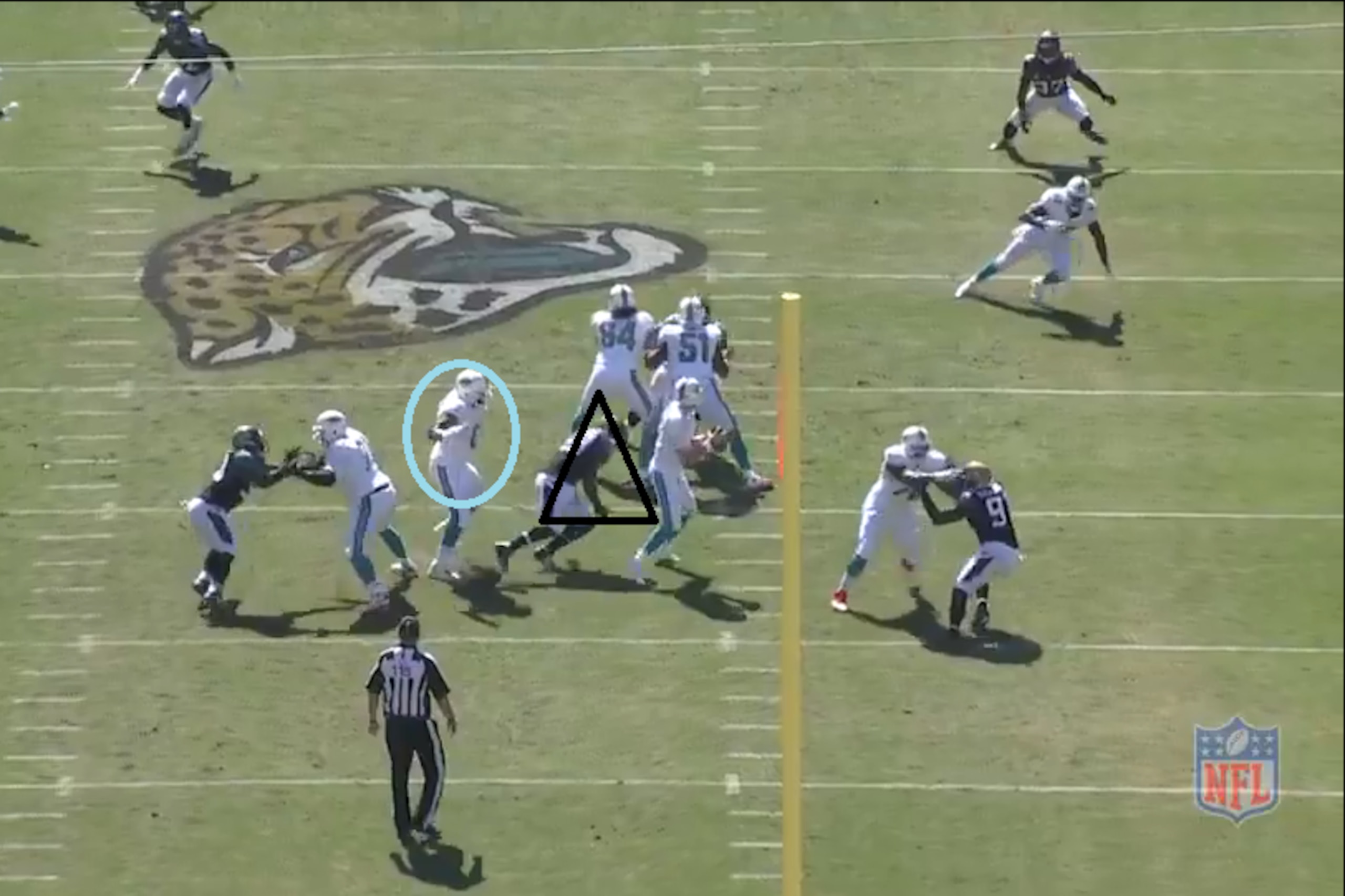
When a pass-rusher can create this much open space in front of him on a routine basis, it's pretty clear that he's got technique and leverage on his side. Tannehill completely ignores Davis and is brought down easily to force a punt.
So we've got evidence that the Jaguars are productive from purely a sack standpoint. Yet here's the interesting thing: If you rely on Pro Football Focus' pass-rush ratings (subscription required), the Jaguars are the sixth-worst unit in the league. In fact, of their linemen, only Marks and Davis have positive pass-rush ratings at all:
| Chris Clemons | 483 | -14.2 | 7 |
| Sen'Derrick Marks | 475 | +8.3 | 15 |
| Roy Miller | 348 | -1.1 | 6 |
| Red Bryant | 316 | -8.6 | 2 |
| Andre Branch | 281 | -0.6 | 8 |
| Tyson Alualu | 275 | -6.3 | 5 |
| Ziggy Hood | 249 | -0.5 | 8 |
| Abry Jones | 205 | -0.2 | 0 |
| Ryan Davis | 185 | +12.6 | 7 |
| Chris Smith | 33 | -1.7 | 0 |
My intuitive guess for this was that perhaps the Jaguars recorded sacks but not hurries. The phrase "disruption equals production" has been tossed around a lot lately, and quarterbacks do tend to perform much worse under pressure. So that makes some sense. PFF doesn't provide an easy list of team hurries (to my knowledge), but the Jaguars have 68 hurries, and PFF"s top-ranked pass rush, Miami, has 136.
This leaves me with a lot of questions going forward about the Jacksonville pass rush. Certainly, it helped key the Jaguars' only win to date, a 24-6 victory over the Cleveland Browns:
But this dichotomy hits on a lot of questions which I don't think have been studied carefully in the NFL stats community: How much is hurry production correlated with actual sack production? How much should we weigh the two together on a descriptive basis? How about on a predictive one?
And as for the Jaguars themselves, should they not bother picking a defensive end if that's the best available player for them in this year's draft? Does this system of keeping defensive linemen fresh mean they are more likely to beat quarterbacks for sacks? How should they self-evaluate the job that their pass rush has done?
I don't have any easy answers here, because I don't think there are any. My gut instinct is that the lack of hurries means something, and that the Jaguars shouldn't pass up a top pass-rusher if one becomes available to them in the draft. Still, it is interesting that they've been able to create this level of sack production with what I think most around the NFL would deem a fairly untalented line.

.jpg?w=2560 "Jets RB Taken To Hospital")
.jpg?w=2560 "Grading Every Team's Season 🔠")