Chris Borland Is Emerging as the Top Defensive Rookie of the Year Candidate
It feels wrong to even give San Francisco 49ers linebacker Chris Borland any Defensive Rookie of the Year consideration. It doesn’t seem fair, and at first it feels like the mere thought should be in violation of an NFL bylaw written on a dusty scroll.
Very little about Borland is fair, though by the end of this season we’ll grow used to living in the world he’s created for us.
Any hesitancy around including Borland in the Defensive Rookie of the Year conversation fades fast when you consider what he's done with his still-few opportunities.
TOP NEWS
The Biggest Disappointments of NFL Season So Far ☹️
B/R's Expert Week 4 2026 NFL Picks 🔮
.jpg?w=2560 "Falcons Steelers Football")
Rodgers' 75 Hand Signals 🤯
Borland has started only four games, and until linebacker Patrick Willis’ injury in Week 6 (which eventually ended his season) he was limited strictly to special teams duty. But even during kick return coverage he was magnetized to the ball. For example, in Week 5 the Kansas City Chiefs returned five of the 49ers’ seven kickoffs. How many times did Borland tackle a kick returner? Four.
That was when we first started to realize this Borland character might not be normal. He’s around the ball-carrier so much it’s as though the football itself is a homing beacon.
The next astonishing digit associated with Borland is 270, his total defensive snaps. As we continue here keep that number firmly in mind. It shows the little time Borland has needed to do remarkable and award-worthy things.
The Defensive Player of the Week for Week 11 (the first 49ers rookie to be given that honor since Andre Carter in 2001) has recorded 48 tackles over his last three games and 63 overall. Even if we focus specifically on his solo tackles, he still has 35 of those in that span.
Baltimore Ravens linebacker C.J. Mosley is also having a fine season. If we were awarding the Defensive Rookie of the Year right now he would likely still win it by default.
The comparison between the two rookie linebackers is the sort of thing that makes you wonder why Borland wasn’t starting all season. He could have been the replacement for the also-injured NaVorro Bowman.
| C.J. Mosley | 10 | 672 | 90 | 2 |
| Chris Borland | 4 | 270 | 63 | 2 |
Again, focus on the playing time there and what little of it Borland has received so far. Then once you’re done with that, move your eyes just a touch to the right. Suddenly the tackle gap between the two looks pretty minuscule considering Borland has been on the field for 402 fewer snaps (patience, we’ll discuss his pass defense in a minute).
He’s had double-digit tackles in three straight games, and in two of them he didn’t need any help. Borland finished with 15 solo tackles in Week 9 and then 11 the following game. Mosley has logged four double-digit tackle games all season and not one as a solo tackle artist.
Of course, any analysis of a linebacker that relies solely on tackles is flawed. The metric isn’t meaningless, but its significance only goes so far because a tackle that happens 20 yards downfield after a long run is given the same weight as when a ball-carrier is dragged down behind the line of scrimmage.
About those tackles for a loss or no gain then: Borland has nine of them. He also has a sack to his name and a game-clinching fumble recovery in overtime during a Week 10 win over the New Orleans Saints. Say, have I mentioned he’s played only 270 snaps yet?
Defensive stops are charted by Pro Football Focus, and it’s a metric designed to gauge how often a defender’s tackle results in an offensive failure. A failure is defined as getting less than 40 percent of the required yardage to move the chains on first down, 60 percent on second down and all of it on third- or fourth-down attempts.
Every time you record a stop as an individual, the progress of an entire unit (the offense) is set back. Borland has 28 stops to his name so far, 21 of which have come in run defense, according to PFF (subscription required). So on nearly 20 percent of his run snaps he’s forcing an offensive misfire, and the 49ers’ own offense is one play closer to getting back onto the field.
But we need some more context for that percentage and the force field Borland has erected against the run. So let’s do another comparison, going beyond just Mosley this time.
From PFF again, here’s Borland alongside his middle linebacker brethren. He’s tied for eighth in run stops.
| Paul Worrilow | 289 | 33 |
| Luke Kuechly | 266 | 32 |
| Lawrence Timmons | 238 | 29 |
| Sio Moore | 229 | 27 |
| Curtis Lofton | 247 | 27 |
| C.J. Mosley | 229 | 26 |
| D'Qwell Jackson | 229 | 23 |
| Chris Borland | 106 | 21 |
| Rolando McClain | 159 | 21 |
| DeMeco Ryans | 206 | 21 |
| Paul Posluszny | 194 | 21 |
| Keenan Robinson | 241 | 21 |
Of the 12 linebackers listed there, nine have played over 100 snaps more than Borland against the run. Yet four have only equaled his run stops, and the gap between Borland and the rest is tiny considering the vast difference in playing time.
Borland is more Wolverine than Superman when a running back attempts to take a forward step with the ball, and he's more superhuman than actual human. He’s reached that status through field vision and instincts.
He’s not fast, and using the word “awful” to describe his 40-yard dash time at the 2014 scouting combine is accurate (4.83). But Borland makes his lack of speed matter so very little with his ability to read and diagnose a developing play.
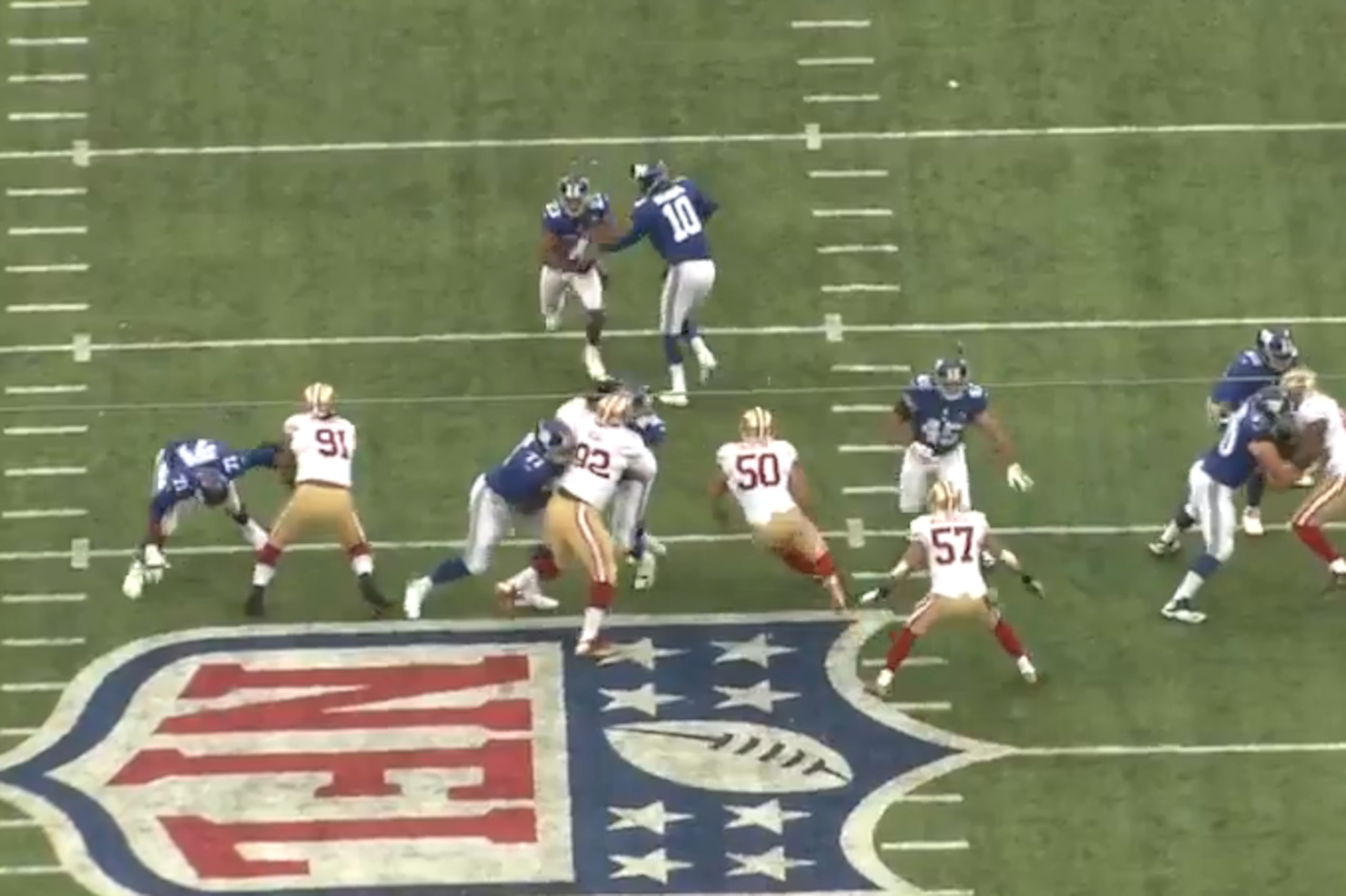
His success lies in the element of surprise and quickness instead of speed. His sudden burst at the snap was on display throughout a Week 11 win over the New York Giants, especially on a 1st-and-10 play midway through the second quarter on San Francisco's own 35-yard line.
The Giants lined up with three wide receivers and quarterback Eli Manning under center with running back Rashad Jennings alone in the backfield behind him. On an early down they were looking to advance closer to the red zone with a run up the middle.
But immediately Borland was a problem—and by that I mean before pretty much anyone else other than the quarterback and center knew the ball had been snapped.
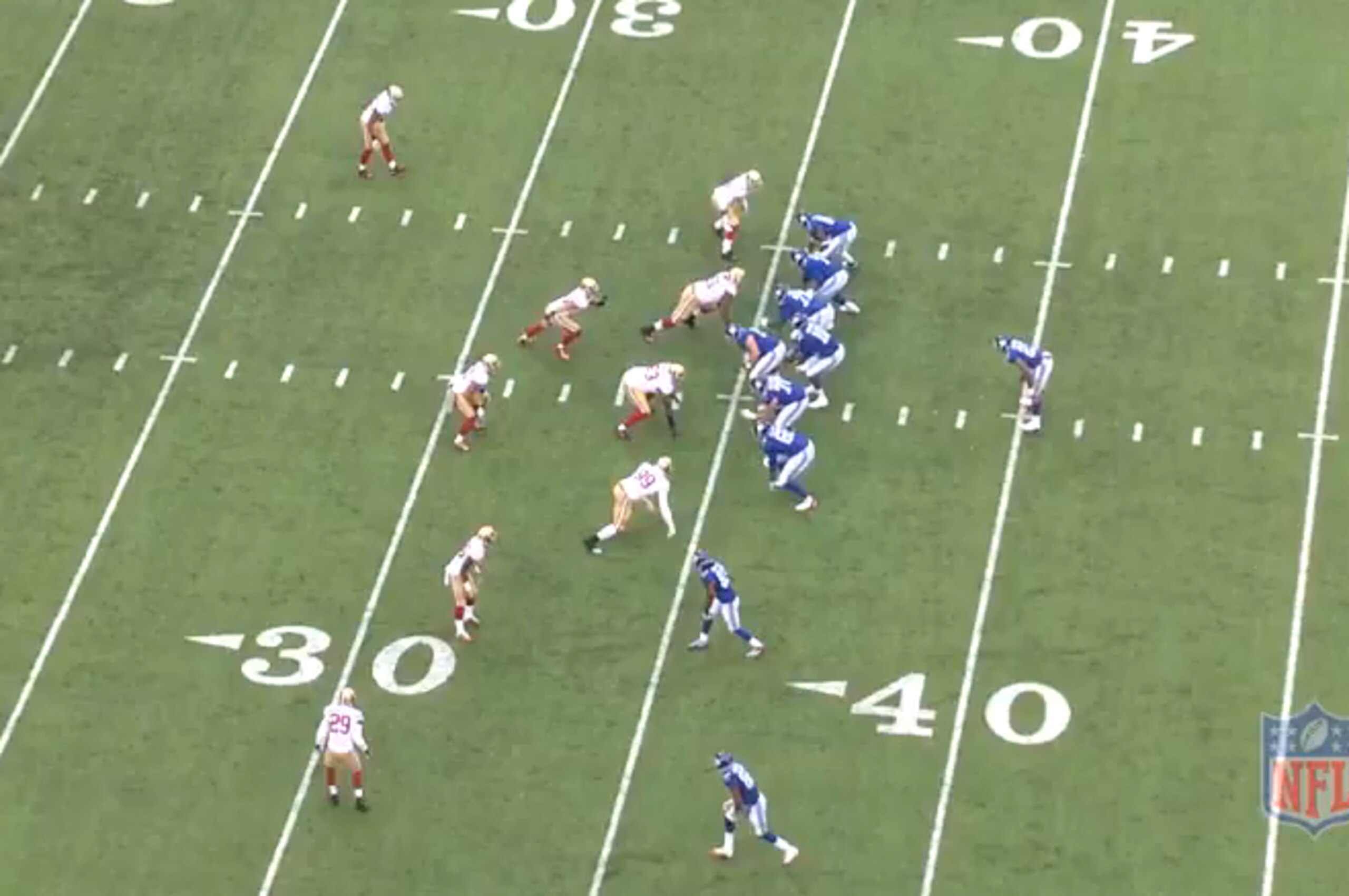
Borland was shooting the gap, and he timed his sprint forward perfectly. Before Giants guard John Jerry and center J.D. Walton could react he was bearing down on Jennings.
The running back hadn’t even received the handoff yet and already his view wasn’t pleasant.

Jerry was able to shift over and get a piece of Borland, but that delayed the inevitable for only a brief second. Borland dove to wrap Jennings up by the legs and limit him to a gain of only two yards.
Even if Borland wasn’t able to make the tackle he would have still had a successful play. With his precision timing he penetrated deep into the backfield early and halted the running back’s forward momentum, forcing Jennings to cut and change direction right away.
Linebackers like Borland are anchors for a swarming defense. He makes plenty of stops on his own while also giving teammates opportunities to close in on a diverted runner.
Later in the same game we saw a similar ending to another doomed play. This time the Giants tried to deceive Borland with some misdirection. But Borland and deception are bitter enemies.
From the I formation Jennings took two strides to his right immediately after the snap before planting and cutting back toward a developing hole on the left. The aim was for one linebacker to bite on those first steps, while the other would be picked off by fullback Henry Hynoski.
But Borland is too quick for such trickery (mentally and physically).

As Jennings took his first wide false stride, Borland sensed a hole in the opposite direction and fired through that gap quickly.
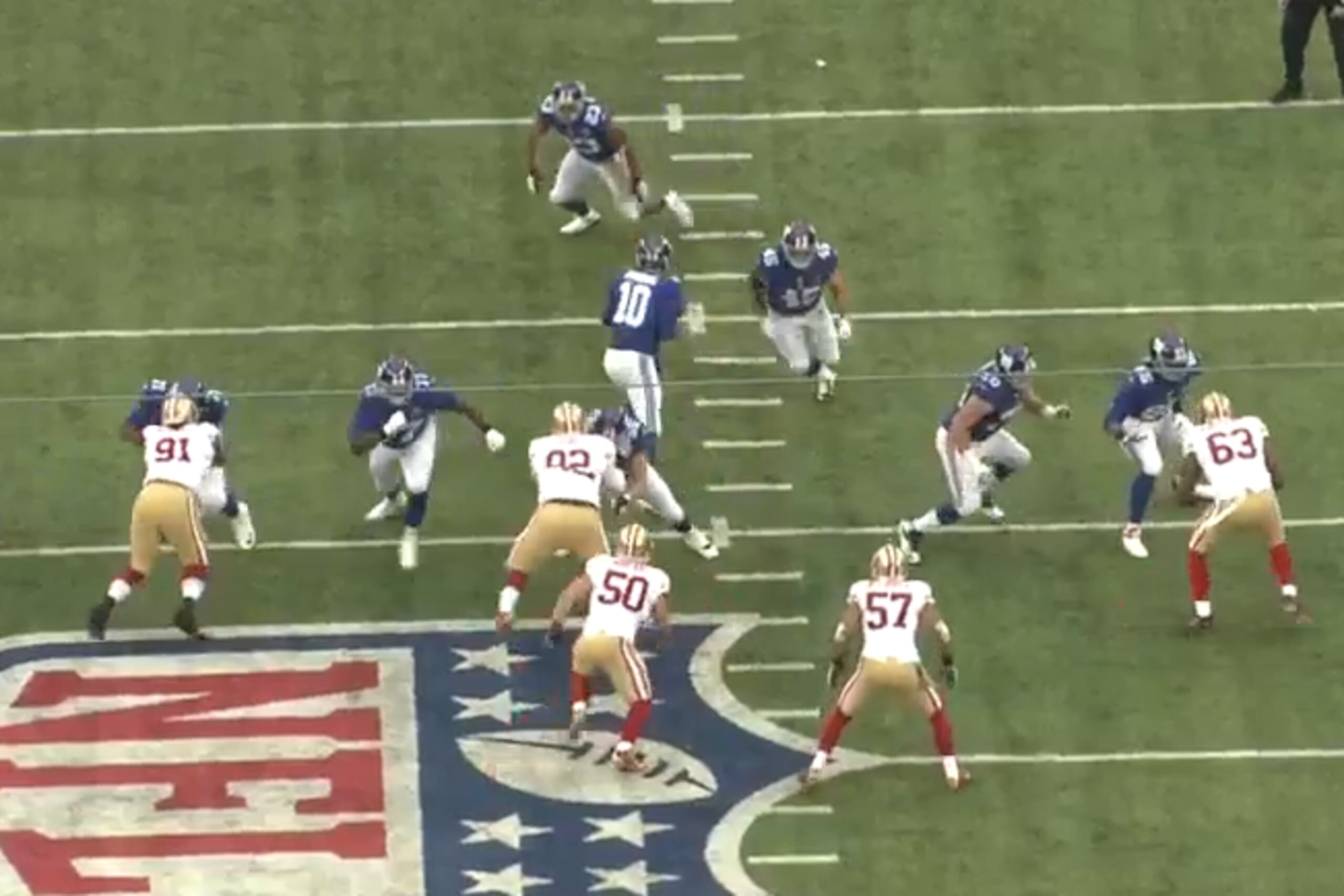
Hynoski is a fine fullback, but he can only block one man. The resulting overload and Borland’s acceleration into the backfield led to a loss of one yard and a wasted second-down play.
When Willis was declared out for the remainder of the season, there was no need for concern over a sudden run-defense spiral. The aforementioned statistical and video evidence from Borland is now more than enough to calm any fears.
Instead, the worry surrounded Borland’s pass defense. He’s fine in coverage, but his name still isn’t Patrick Willis. Few linebackers in the NFL are as reliable as Willis against the pass, especially when he’s assigned to out-muscle opposing tight ends.
Over time Borland may get exposed when has to drop back instead of defending only what’s in front of him, and that may still become a weakness. But with his two interceptions Sunday he made doubters like myself eat some pretty delicious crow (I prefer it with mustard).
If he keeps doing that over the 49ers’ final six games, there won’t much of a conversation. Borland will be the Defensive Rookie of the Year.

.jpg?w=2560 "Buccaneers Jets Football")