Are Toronto Raptors Legit Threats in the East?
Title contention is a fluid concept for the NBA's Eastern Conference teams, most of which fall outside the hypercompetitive championship-chasing circle.
Are the continuously climbing Toronto Raptors one of the few legitimate squads firmly fixed to that exclusive conversation? Following a white-hot, near-perfect start to 2014-15, are they the third exception for a conference thought to have two—the Cleveland Cavaliers and Chicago Bulls—at most? Or was their 100-93 loss to Chicago Thursday night indicative of a team that's only almost there?
Time is typically a friend of clarity. But, while the regular season is still in its infancy, the Raptors have been playing well enough for long enough to warrant investigation into their incandescent beginnings.
TOP NEWS

NBA Power Rankings Entering Preseason 🔢
Giannis' Warning to NBA ⚠️
Wizards Guard Admits Tanking 😨
Early Dominance Through Familiar Play

Incredibly hot is the only context in which to describe this team's start.
The Raptors have won seven of their first nine games, which marks is their best start through nine contests in franchise history by far. Their previous best (6-3) came during the 1999-2000 campaign, 15 long years ago—the significance of which is neither lost on nor relevant to the Raptors themselves.
“I think our guys are intelligent enough to know that it’s way too early to put any kind of stock in anything,” head coach Dwane Casey said before the team's victory over the Orlando Magic, per the National Post's Scott Stinson. “We know who we are, but we’re still trying to establish our identity, which is as a defensive team. It’s very early in anybody’s process to know where we are.”
Indeed, the Raptors know who they are early on: a defensive team, and an offensive team, and a winning team. They have done a little bit of everything, establishing themselves as a balanced two-way force that will scrap and claw or run their way to victory.

Through their first eight games, they were pumping in 112.9 points per 100 possessions, which ranked second in the league and would be a franchise best if it holds. They were also limiting opponents to just 101.7 points per 100 possessions, tying them with the Indiana Pacers for the league's fifth-most effective defense. And they've maintained this double-ended balance while playing at a brisk pace; they ranked seventh in possessions used per 48 minutes through eight contests.
None of that means it's time to declare the Raptors world-beaters. Everything they do comes with a caveat. It's early. Too early. Still, it's difficult not to see their current play as sustainable.
It was only last year that they ranked in the top 10 of offensive and defensive efficiency. Is it far-fetched to believe they can maintain dual top-five statuses one year later?
Nothing they're doing is especially new, after all. It's not unusual to see DeMar DeRozan flirt with 22 points and three or four assists per game. He did that last season. It's not atypical of Kyle Lowry to throw up 18 points and six assists regularly. He did that last season too.
The same can be said of Amir Johnson, Jonas Valanciunas and Terrence Ross. No one on this team is playing beyond their means or last year's performance. Lou Williams is the lone exception, and that's only because he wasn't on the team in 2013-14. His 10.9 points are right around his career average of 11.4.
That is admittedly the strongest argument in favor of these Raptors: consistency.
Roles haven't changed much, if at all. Their hot start is the product of methodical basketball—a deliberate offense with a distinct pecking order and a defensive system comprising hybrid zones that force opponents into mostly mid-range jumpers and three-pointers, as shown below:
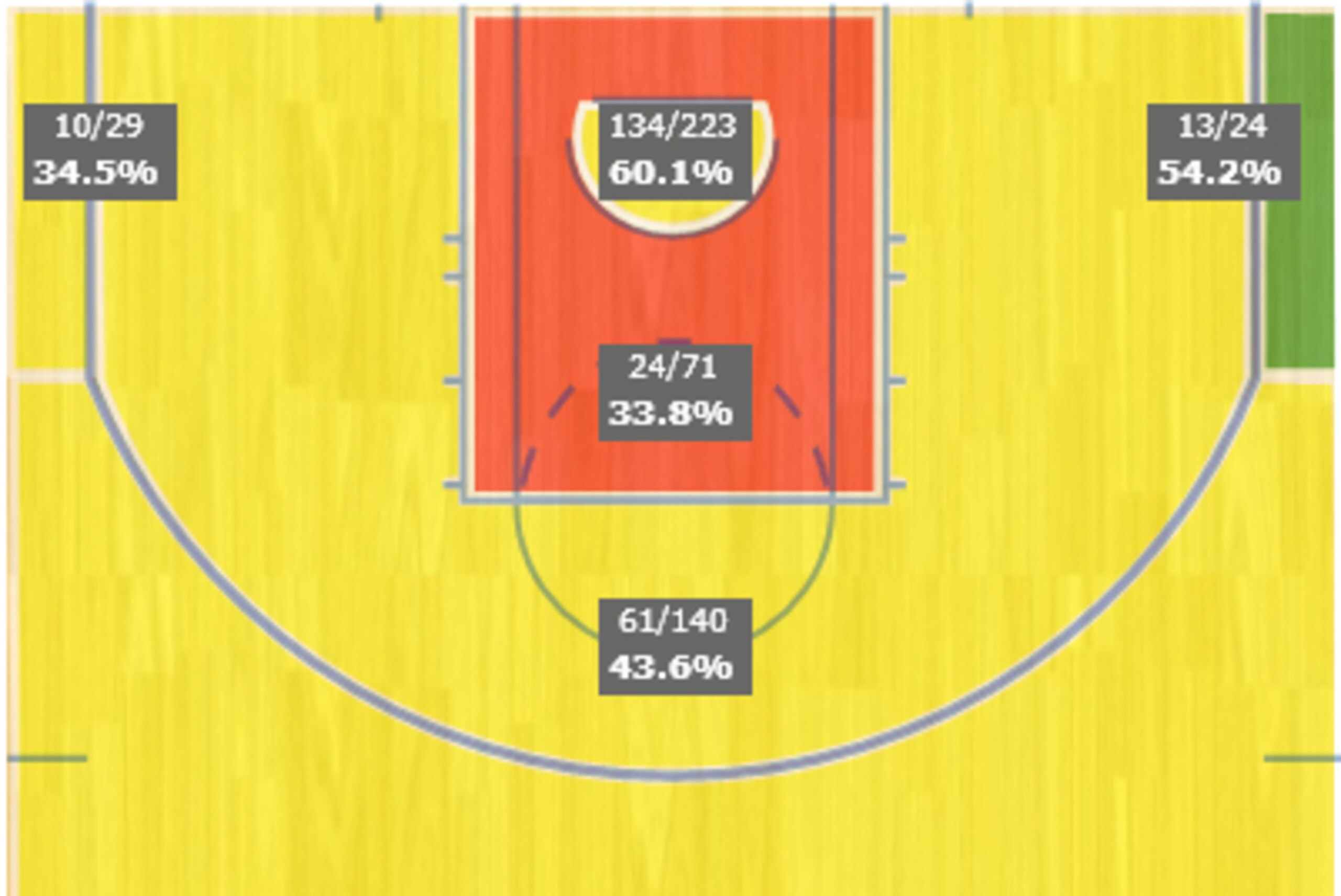
When a team wins in excess by playing its usual brand of basketball, it's difficult not to believe, because that familiarity is reason enough to buy what we're seeing, even this early.
The Caveats
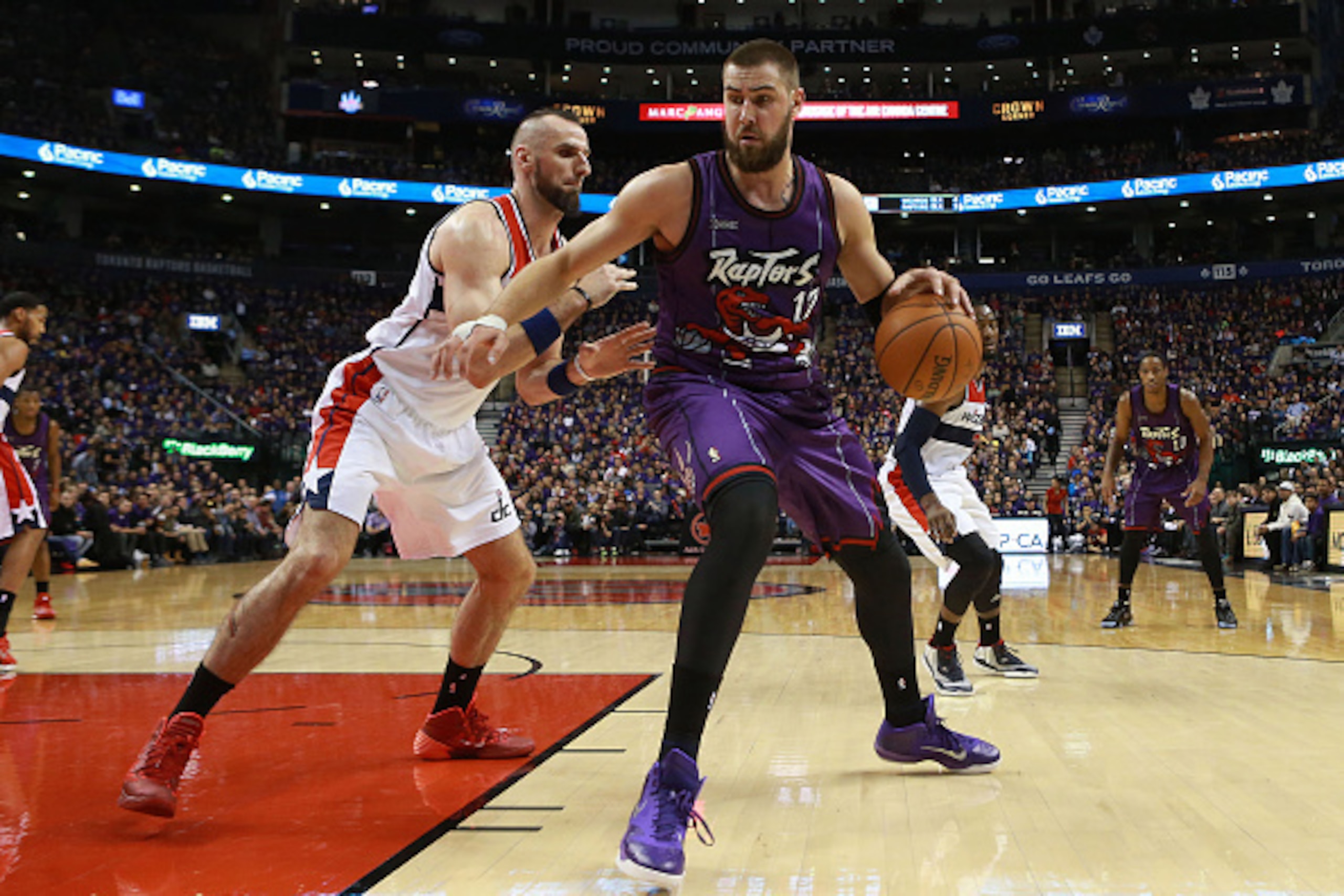
Parade, meet Rain.
For all the Raptors have done well, they are far from infallible. Winning 75 percent of games is impressive, but it's marred by relatively unimpressive competition.
Only four of their opponents finished with records above .500 last year—the Oklahoma City Thunder, Miami Heat, Washington Wizards and Bulls. Though the Raptors are 2-2 in those games, their win over Oklahoma City came against a depleted squad that didn't include Kevin Durant or Russell Westbrook. Even their performance against the Wizards, who are without Bradley Beal, can be considered a should-win.
A real test—the first of the season—came against the Bulls, who were initially considered the Cavaliers' lone Eastern Conference threat. The Raptors failed.
Owners of a top-six offense and top-12 defense leading into Thursday night's victory, the Bulls exposed and exploited Toronto's early misgivings. And despite the team's record, there have been a lot of them.

Rebounding has become a bane of the Raptors' defensive existence. That they're able to hang so tough on that end of the floor without formidable glass-crashers is pretty amazing and attests to their reliance on the starting five, as BBallBreakdown.com's Ben Dowsett explains:
"Perhaps most notable is a massive rebounding discrepancy. On the whole, Toronto has been one of the league’s worst teams on the boards this year; they post a 48.2 percent rebounding clip that is the sixth worst in the NBA, and, per SportVU numbers, they are just 27th in percentage of rebounds recovered per chance (when one of their players is within 3.5 feet of the board). But with their starters on the court, this tale of woe has not been anywhere close to true – Toronto is rebounding an absurd 60.1 percent of all missed shots in their minutes together, including 82.1 percent on the defensive glass, both numbers that would easily lead the league.
"
Similar to last season, the Raptors depend heavily on the synergy between DeRozan and Lowry. Rare is the occasion they play separately. Derozan's field-goal percentage plummets from 43.2 with Lowry to 25 without him, according NBA.com (subscription required), hence why he sees just 3.3 minutes away from his point guard per game.
Ball movement has also been hard to come by on offense. They ranked 21st in passes per game entering Thursday night, while roughly half the team's made buckets (50.7 percent) came off assists—atypical of an elite offense that doesn't field a top-10 superstar (see: the New York Knicks and Golden State Warriors of last year).
Too much of their offensive livelihood is tied to DeRozan and Lowry creating their own shots and playing off one another. They're fortunate to have role players who can do the same in Ross and Williams, but only one top-10 offense from last season assisted on less than 56 percent of its baskets (Phoenix Suns).
Though correctable—and having proved incapable of derailing their hot start—these issues force the Raptors to count on the potency of a few to carry them, which will need to change. They've developed a nasty habit of starting off slow—they rank in the bottom six of first-quarter defense—making court completeness all the more imperative if their blazing beginnings are to offer long-term insight.
Real, Close to Real or Not at All Real?
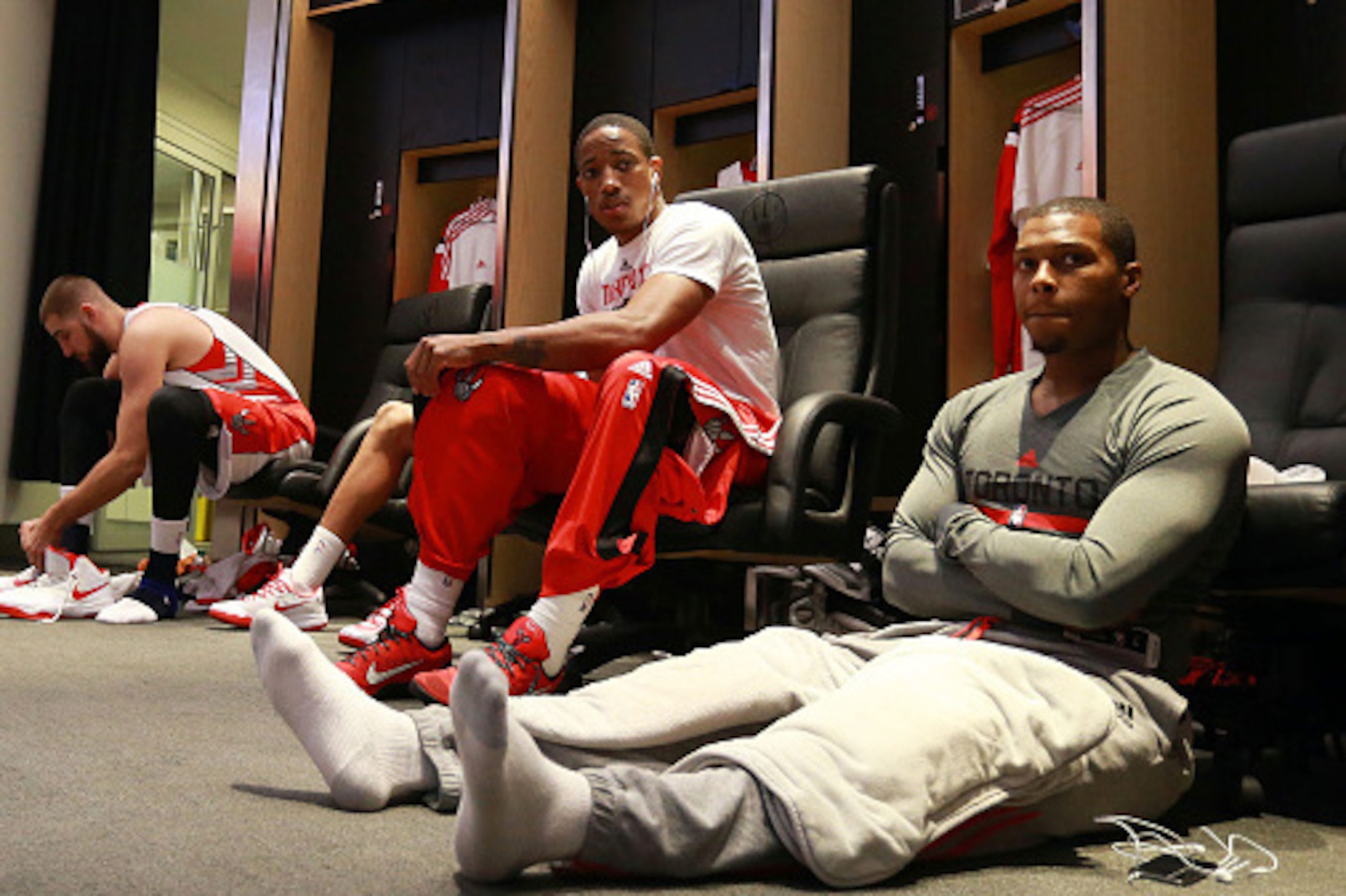
Not even the most cautious optimists can deny it: The Raptors are for real.
If their scorching-hot start doesn't prove it, and if last year's resurgence still cannot prove it, the rest of the Eastern Conference will, as Bruce Arthur of the Toronto Star writes:
"We are trying to stay cool here. But who else are you going to talk about? Cleveland is fascinating, but if you wanted to daydream, they have a long way to go, too. No depth, LeBron James is trying to lead guys who have never been in the playoffs, they aren’t passing. They’ll be good, but great? Maybe not. Chicago? Derrick Rose put it best last week when, dealing with two sprained ankles and coming off two years in the injury wilderness, he said, “It’s always going to be there. Even if I make it through the season healthy, my first playoff game is going to be like, ‘OK, this is a new journey, is he going to be healthy through the playoffs?’
"
Who else? Washington, Atlanta, Brooklyn maybe. If ever there was a year the Raptors could say why not us, how far can we go, it’s this year.
There isn't enough cause to doubt these Raptors. They are one of the few Eastern Conference teams that aren't dealing with significant turnover and additions.
Cleveland is trying to find its superstar medium; Chicago is banged up and still searching for its defensive identity; Beal's return is still weeks away for Washington; Brooklyn is dealing with its own warts; Miami won't ever fully recover from LeBron James' exit; Atlanta is still Atlanta; Charlotte is basement-shopping; Milwaukee's start won't stick; Detroit and New York are tactical tragedies.
Standing outside that group is the still-whole Raptors.
Tougher tests like the Bulls await. But there's every reason to think they'll pass more times than they'll fail, even after they couldn't grind out a victory against Chicago. They've been together long enough and played well frequently enough to see that their reign over everyone else—even if it's impermanent—isn't some mirage.
Consistency. Continuity. Balance. These are the qualities the Raptors engender. And if there was ever a year to believe those qualities hold serious weight, it's this one—the same one in which prolific rises, however early, mean everything within an Eastern Conference that is ripe for the taking.
Toronto's taking.
*Stats courtesy of Basketball-Reference and NBA.com unless otherwise cited.
.jpg?w=2560 "Every Trade's Best Trade Asset 🔁")
.jpg?w=2560 "Insiders: Cowboys Overpaid for Porter")
.jpg?w=2560 "Top NFL Trade Targets")