2014 Formula 1 Cars Are Getting Faster and Their Engines More Reliable
The last two Formula One grands prix, in the United States and Brazil, provided further evidence that the new generation of cars, powered by hybrid V6 engines, are closing in on the performance levels of their V8-powered predecessors. At the same time, reliability is increasing as the teams learn the intricacies of the new power units.
In Austin two weeks ago, Nico Rosberg's pole-clinching qualifying lap was 0.271 seconds quicker than Sebastian Vettel's pole lap from the 2013 race. Then, last weekend in Sao Paulo, Lewis Hamilton's fastest lap during the race was 1.881 seconds faster than the best lap from 2013 at the Interlagos circuit, set by Mark Webber.
TOP NEWS

One player each NFL team should cut
.jpg?w=2560 "Seahawks Camp Football")
Lawrence to Retire After 2026
.jpg?w=2560 "Cols Ravens Football")
Report: Colts Coach Suffers Serious Knee Injury
The Brazilian Grand Prix actually marked the second time this season that the fastest race lap eclipsed the best time from 2013—in Belgium, Rosberg topped Vettel's time from last year.
Unlike in Belgium, though, where only Rosberg's time was better than last season's fastest lap, every driver in Brazil this year clocked at least one lap quicker than the best 2013 time. This is partly due to Pirelli bringing softer tyres to this year's race and to a resurfacing of the track, but it also demonstrates that the performance gap between the 2013 and 2014 cars is closing.

Before the season, Auto Motor und Sport's Michael Schmidt (h/t grandprix.com) reported that F1 CEO Bernie Ecclestone was worried that the new, hybrid-powered cars would be up to five seconds per lap slower than last year's gas guzzlers.
Clearly, that has not been the case. The following chart compares fastest laps from 2013 and 2014 for each race. The Austrian and Russian grands prix are missing, as they were not run in 2013. Germany is not represented, as the race was run at the Nurburgring in 2013 and Hockenheim this year. Finally, the Japanese Grand Prix is also omitted, as a wet track throughout the 2014 race renders any comparison to last year moot.
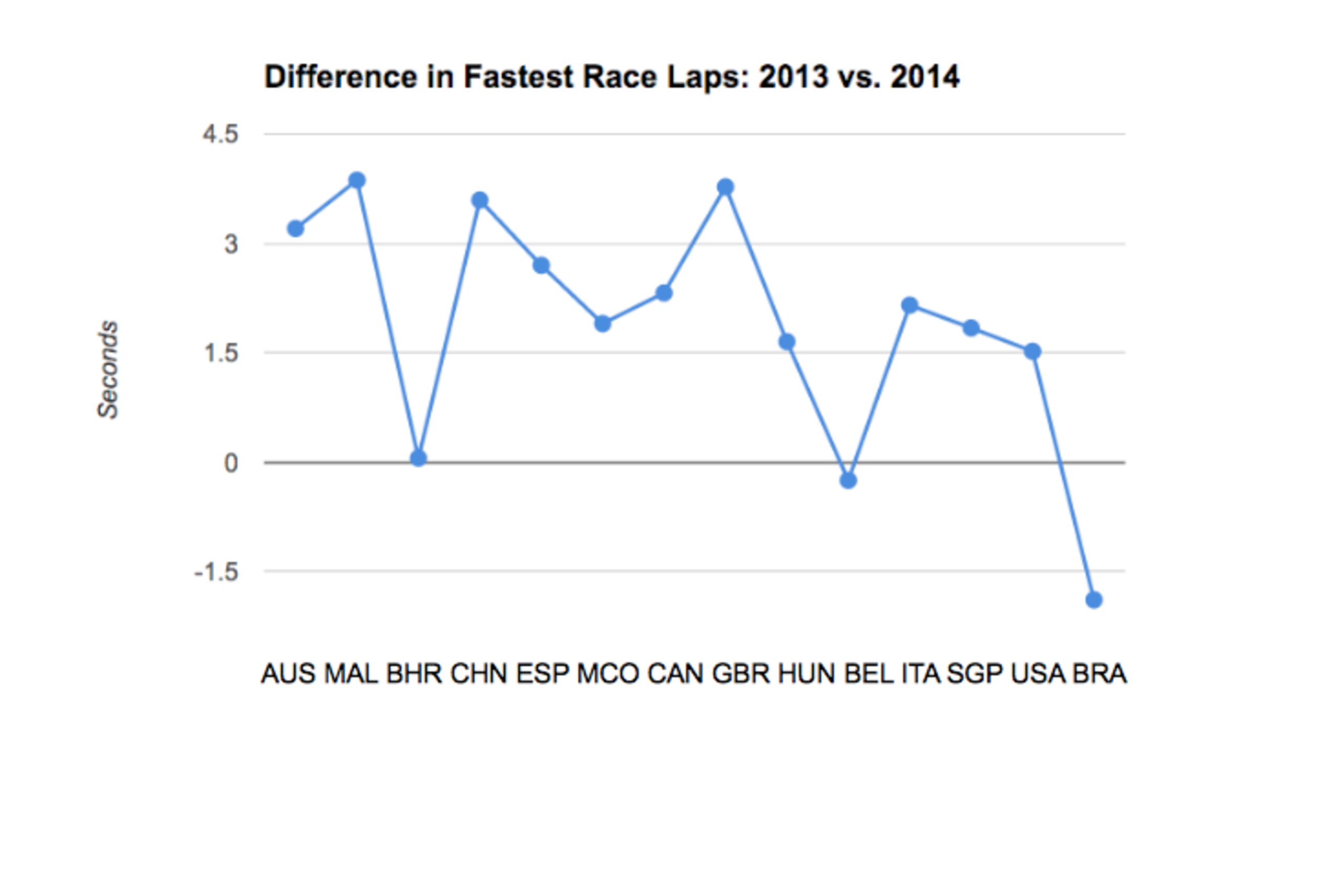
As the season has progressed, even at tracks with no changes since last year and where the same tyre compounds were used, the best times have been creeping closer to those from 2013.
It is particularly significant that the first pole time this year to better the 2013 mark occurred at the Circuit of the Americas (COTA) in Austin, a track with plenty of low- and medium-speed corners. It is significant because, along with the increase in power that the new engines brought, the 2014 regulations mandated a reduction in aerodynamic downforce—exactly what is needed for maintaining speed while cornering.
It was expected, therefore, for 2014 times to approach 2013 ones at high-speed circuits like Spa and Monza, but not necessarily at a track like COTA.

In addition to the increasing overall speed throughout the season, engine reliability has also improved. Before the first race of the year, in Australia, race director Charlie Whiting was answering questions about what would happen if no cars finished the race, such was the anticipated unreliability of the new power units.
Fortunately, we have not come close to that scenario.
In fact, in the race with the fewest finishers—Canada—only two of the retirements were due to problems with the power units (14 cars of the original 22 starters were classified, but only 11 actually finished the race).
Here is the breakdown, by race, of retirements from power-unit failures. The list may not be exact—for example, it includes electronic failures when post-race comments from the team or driver indicated that the issue was specifically with the power unit—but it does demonstrate that reliability has been improving.
| Australia | 4 |
| Malaysia | 3 |
| Bahrain | 0 |
| China | 1 |
| Spain | 0 |
| Monaco | 2 |
| Canada | 2 |
| Austria | 1 |
| Great Britain | 0 |
| Germany | 0 |
| Hungary | 1 |
| Belgium | 2 |
| Italy | 1 |
| Singapore | 3 |
| Japan | 1 |
| Russia | 0 |
| United States | 1 |
| Brazil | 1 |
For example, the first two races saw seven retirements due to power-unit issues. The last six races, from Italy to Brazil, have seen the same number.
The improvement in reliability is partly related to the wording of the regulations for the new engines. Developments to improve performance throughout the season are banned, but the manufacturers can apply for permission to make changes to improve reliability.
Another by-product of the new regulations is that the engines produce much less noise than the old ones; that noise is converted into more power.
At the beginning of the season, there were lots of complaints about the reduced noise levels, but those have largely died off in the face of an incredibly entertaining season on the track.
Overall, the new power units are a very positive development for F1. They are more powerful, more efficient and more relevant to road car technology. Honda has already decided to re-enter the sport as an engine manufacturer for 2015, enticed by the relevance of the new engine regulations.
True, they don't produce the same ear-splitting shriek of the old V8s, but the V8s were noticeably quieter than the V10s that came before them.
Going forward, the engines and cars will be developed further over the winter, and they will be even quicker in 2015 (and the FIA is even considering ways to make the engines louder). Next year, it is possible that the cars will regularly produce faster lap times than the last season of the V8 era.
Really, what more can you ask for?
Follow me on Twitter for updates when I publish a new article and for other (mostly) F1-related news and banter:
.jpg?w=2560 "Falcons-Pearce Football")

.jpg?w=2560 "Aikman Restricted Like Brady")

.jpg?w=2560 "Breaking News")