Overpaid and Underrated: Joe Johnson Will Quietly Carry Nets Back to Postseason
A merely good player on a max deal becomes everyone's target for criticism. No one knows that better than Joe Johnson.
When a quality performer receives an exceptional contract, we tend to pin blame on the player instead of the organization. But is it really the player's fault that a front office misevaluated him? That's how the absolute value of a guy like Johnson becomes forgotten, secondary to the paychecks.
Naturally, the first talking point when we see Johnson becomes that six-year, $119 million deal he signed with the Atlanta Hawks during the summer of 2010. But somewhere down the line, "overpaid" and "overrated" became synonymous.
In truth, Johnson isn't overrated. Actually, he's become a perennially underrated, perpetually overcriticized piece of the Nets offense, someone Brooklyn couldn't do without.
One of the better lineup moves Lionel Hollins has made since coming to Brooklyn is prioritizing Johnson, who could easily play small forward, as a shooting guard. We didn't see him play much 3 during the preseason, accentuating the size advantage the 6'7", 240-pound Johnson owns over virtually any other starting 2-guard.
Such brawn allows Johnson to dominate in one of the more subtle, yet imperative, parts of his game: the post-up.
Johnson post-ups are now a staple of the Nets offense, especially in last year's attack that loved back-to-the-basket hoops from him, Shaun Livingston and Paul Pierce.
Even with Pierce and Livingston gone, the Nets will and should continue to use Johnson in the post, considering that set was one of their best weapons a year ago.
Brooklyn averaged exactly one point per play when Johnson had the ball in the post last season, comparing favorably to the 0.93 points per play the team scored during all of its average half-court possession a season ago, according to Synergy Sports (subscription required).
One of Johnson's best games of 2013-14 came late in the year against the Orlando Magic. The Nets wing dropped 31 in that contest, adding five assists and four boards. And what was the main reason he found so much success? Orlando couldn't handle him in the post.
When Joe goes low, it's not just his scoring that takes over. Actually, it's more about passing than anything else.
Because Johnson is almost always larger than his defender, he often commands double-teams, and when he's having a good day, those double-teams come hard. But he's not a pounder or a ball hog like reputation may have you believe. In reality, he's one of the best passing guards from the low block the NBA has.
The Magic sent two guys at Johnson pretty much every time he went to the left block during that game. Here's how he countered:

Johnson slung the ball to Mirza Teletovic as soon as Kyle O'Quinn left the shooter on the outside. Instant recognition.
His mind is quick. And this wasn't just a one-time thing. He does this all the time. The play below is from just a few minutes later in the same game:

Johnson doesn't simply try to pass into assists, either, like plenty of guys who wait until the last second for a defender to rotate over, only to turn the ball over because they tried to get too cute.
He starts swings around the perimeter, which lead to open threes for his forwards. He kicks out to guards who have open dribble lanes because their defenders lost them in the journey to stop Johnson down low.
Sometimes, he creates so well around the block, teams end up adjusting and throwing a larger defender on him. But when the Nets are really feeling this type of offense, Johnson can negate that. He comes over to a guard (often Deron Williams), sets a hard ball-screen and drags the point guard defender with him to the post, like such:

Another way to combat Johnson's post facilitating is to call the doubling off—and that's when Johnson goes to town.
Late in the Magic game, coach Jacque Vaughn went to such a strategy, the "Forget This, We're Not Doubling Anymore Philosophy." Johnson proceeds simply to abuse Tobias Harris on the left block:

Johnson actually played better once he moved to the 3 last season, and Reed Wallach of NetsDaily explained why back in September: "His great offense was more the result of Paul Pierce coming on after a slow start, and that the small ball lineups gave him an opportunity to get more spacing and post ups."
Now, while playing the 2, he adds a wrinkle to the Nets offense that no one else on the roster can replicate. And he doesn't only throw his back to the basket, either. He's also one of the best floor-spacers Brooklyn has.
Back in Atlanta, we used to call him "Iso Joe." And that nickname has stuck with him like a college cheating scandal. You may have changed since your years in school, but all anyone remembers or sees is the old blemish on your ethical resume.
Johnson dribbled like a maniac in his Hawks days because he had to do so. He was the focal point of the offense, the main guy. That's not really the case anymore, and the 14-year vet has progressed because of it.
Like it or not, this is Deron Williams' offense (you could argue such a fact is why the Nets played under expectations last year), and as Johnson ages, he's learned to compensate for dwindling athleticism with increased skill.
Johnson doesn't really get the ball, face up his defender and dribble at him anymore. If he's not posting you up, he's probably waiting on catch-and-shoot opportunities around the wing. Because of that, he's turned into more of a jump-shooter than he was before.
Just under 40 percent of his field-goal attempts were three-pointers a year ago. His career rate was only 27.2 percent before he got to Brooklyn, though he did start to shoot more long balls during his final season in Atlanta.
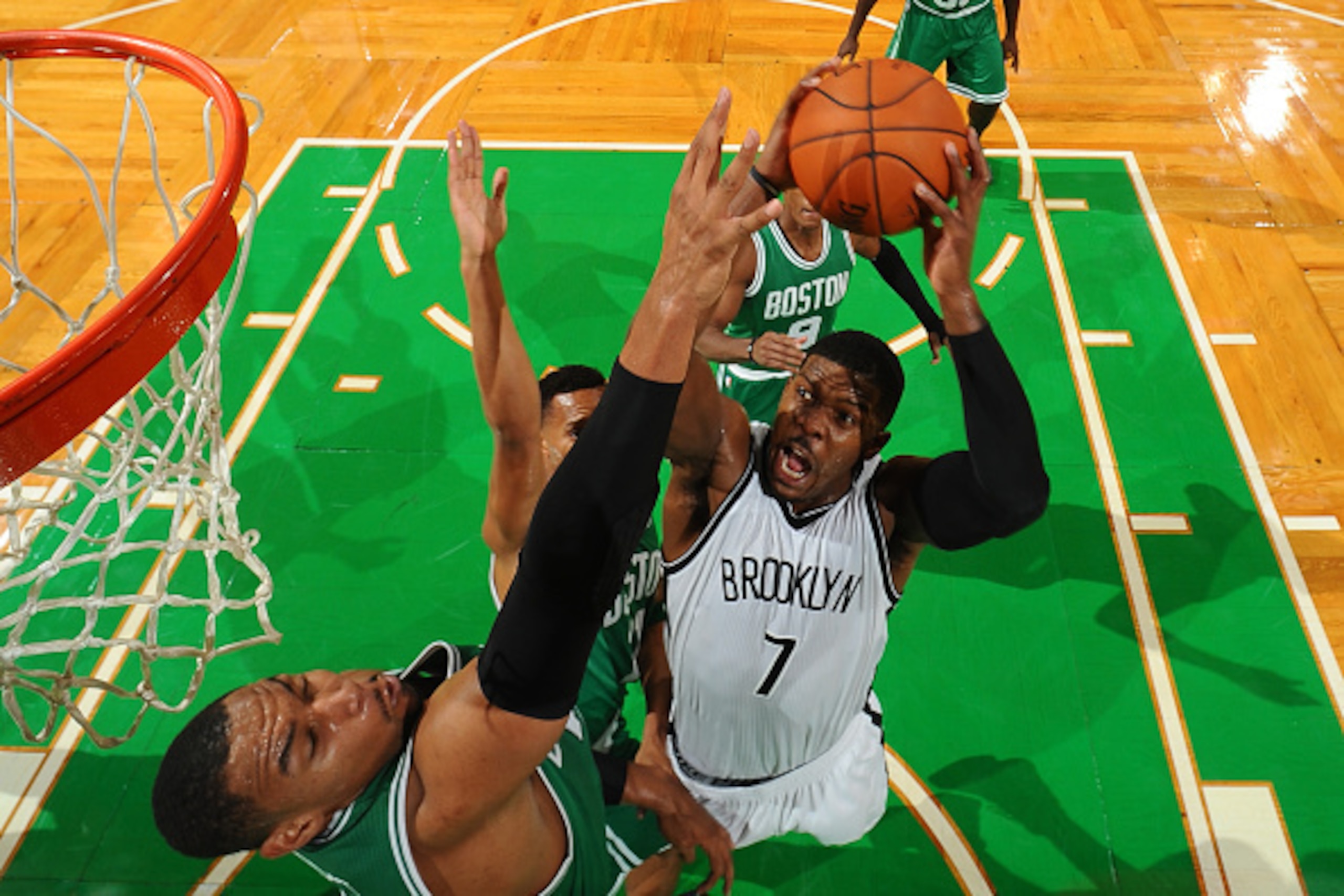
Johnson basically stopped taking those inefficient, mid-range attempts once he cut down on dribbling and started using himself as a floor-spacer. He's seen his three-point rate rise during each of the past four seasons coming into this year. And he isn't just taking more threes. He's making them, too.
He shot 40.1 percent from beyond the arc last season, his highest percentage since 2004-05. He also averaged 1.22 points per catch-and-shoot jumper, putting him in the league's 88th percentile, per Synergy.
"He’s one of the most versatile players [offensively]," Shaun Livingston told Tim Bontemps of the New York Post last season. "Being able to put the ball on the floor, being able to spot up and shoot, being able to post up, being able to play the pick and roll, make the pass of the pick and roll, floaters…he can do a lot of different things."
Any good player has to go through this phase near the end of his prime if he wants to remain relevant: changing his skill set and style to stay a major contributor. Johnson is doing it gracefully, maintaining as a top shooting guard, even if some fail to acknowledge it because of a bloated contract.
Posting up and shooting are traits that age well. Still only 33, why couldn't Johnson remain this effective for the next few seasons?
The Nets may be paying him more than his worth, but fans certainly don't give him the credit he deserves. Regardless of whether he makes max money, minimum money or anywhere between, Joe Johnson is still pretty darn good.
Fred Katz averaged almost one point per game in fifth grade but maintains that his per-36-minute numbers were astonishing. Find more of his work at WashingtonPost.com or on ESPN's TrueHoop Network at ClipperBlog.com. Follow him on Twitter at @FredKatz.
Unless otherwise noted, all statistics are current as of Oct. 30 and are courtesy of Basketball-Reference.com and NBA.com.
.png?w=2560)


.jpg?w=2560 "Report: Saints Trade For 49ers RB")
.jpg?w=2560 "Jeanty Avoids Major Injury")
.png?w=2560 "MLB Playoff Picture Shaping Up")