Oday Aboushi a Significant Upgrade over Brian Winters for Jets at Left Guard
Just like any other job in our capitalist society, the NFL is known to play favorites no matter how much the bosses insist they make decisions purely based on performance.
The New York Jets' latest example of this has been their insistence on forcing former third-round pick Brian Winters into the starting lineup, no matter how much he has struggled. Since his insertion into the starting left guard spot in Week 5 of the 2013 season, the Kent State product has been the root cause of more offensive breakdowns than he (or the Jets) would care to admit.
As cold as it sounds, Winter's recent season-ending injury could turn out to be a positive development for the struggling Jets offense, at least in the short term.
TOP NEWS
Preseason Contenders in Desperation Mode 🗣️
.jpg?w=2560 "Rams Broncos Football")
Stafford No. 1 on Pick-6 List
.jpg?w=2560 "APTOPIX Jets Lions Football")
Week 4 Waiver Wire Pickups 👀

While Winters was struggling each and every week without his starting job coming into question, patiently waiting on the sideline was fellow 2013 draftee Oday Aboushi, who was selected a mere two rounds after Winters' name was called.
Like Winters, Aboushi is a former college offensive tackle who has made the transition to guard at the NFL ranks. Unlike Winters, the position move has been relatively smooth for the Virginia product since officially making the switch this past spring. He was one of the early standouts of summer practices, impressive enough to steal a start in the second preseason game away from Winters (although Winters would inexplicably regain his job days later).
Numbers cannot do justice as to how much of a liability Winters was at guard last season, but the Jets still insisted on starting him week after week despite pumping out some of the worst grades in the league in both facets of the game.
Rated as the third-worst guard in football by Pro Football Focus, Winters has allowed a whopping 16 quarterback hurries in six starts.
In reality, Aboushi hardly has to be anything special starting at left guard for the rest of the season to be an upgrade over Winters—he just needs to be adequate, which is exactly what he has been through two starts.
The last game Winters played in was in a home loss to the Denver Broncos in Week 6. Since his injury, the Jets' offense has not-so-coincidentally developed more and more into a respectable unit.
The impact of Aboushi was even felt inside the confines of the game. Through three quarters with Winters in the starting lineup, the Jets managed just seven points. After his injury, the Jets scored 10 of their 17 points in just over a quarter of play.
Four days later, the Jets came within a blocked field goal of upsetting the New England Patriots in Foxborough—quite a turnaround for a team that was shutout less than two weeks ago in San Diego, with the only change in the starting lineup coming at left guard.
However, it would be inaccurate to claim that Aboushi is leading the Jets back on the path toward respectability because of his stellar play at guard. In his first full start of the season against the Patriots, Aboushi surrendered four pressures and a hit, according to Pro Football Focus.
While he did not exactly put together a report card grade worthy of the kitchen refrigerator, Aboushi made more of an impact in how he was able to handle exotic fronts and blitzes with little help—an area that Winters struggled most in.

On this long completion to Jeff Cumberland in the first quarter, the Patriots deploy an exotic front that makes it difficult for any offensive lineman, never mind a first-time starter, to identify where the pressure is coming from.
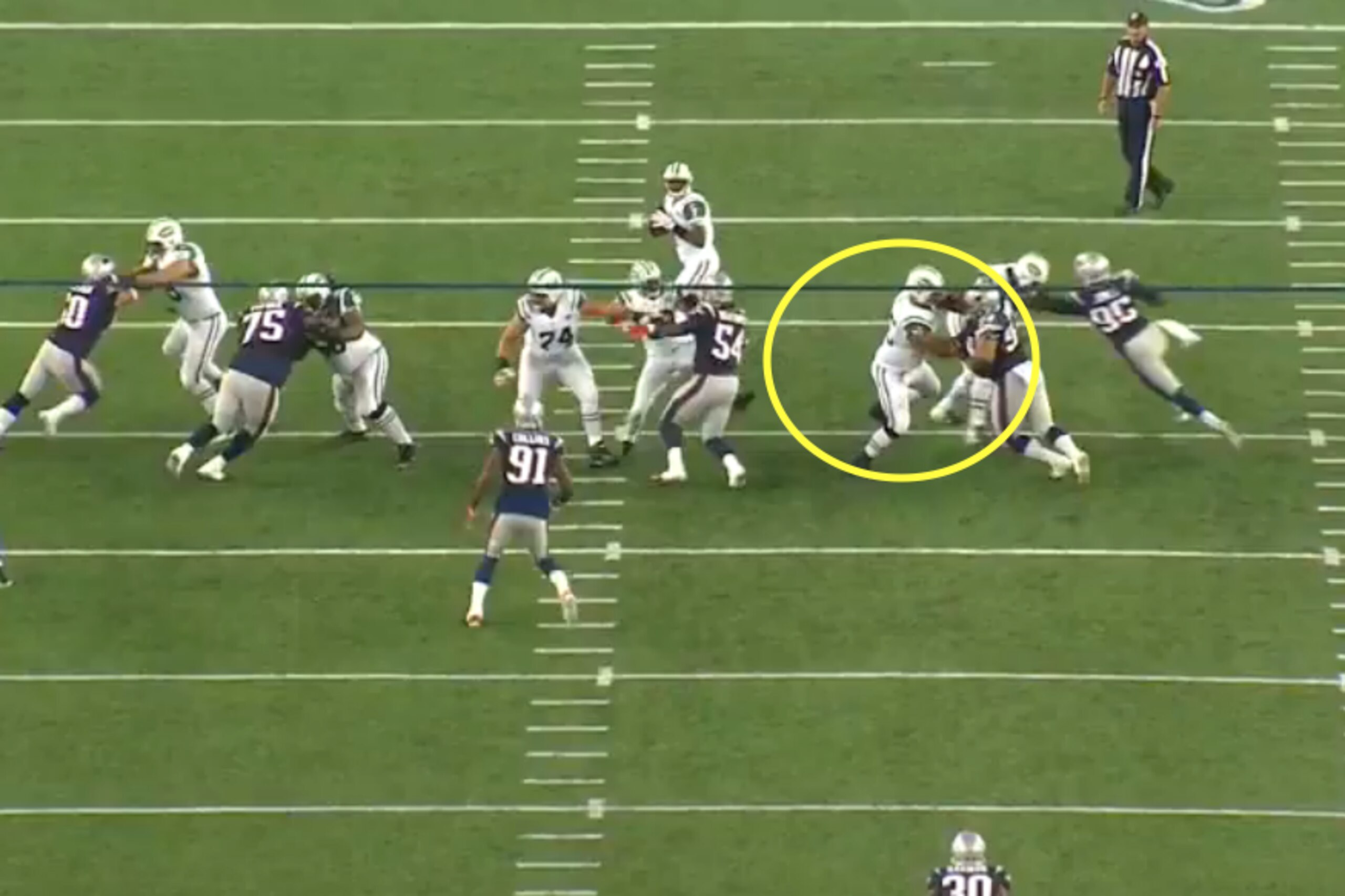
Aboushi remains composed and picks up the blitzing defensive tackle. Notice how his hips are square and his hands are perfectly placed inside of the chest, maintaining total control throughout the play. As a result, Smith has plenty of time to find his tight end for a long 28-yard gain.
These types of plays never wind up on the following morning's episode of SportsCenter, but these differences in play at the guard position are allowing the Jets to generate big plays (like the one above) while sustaining drives, which can have a positive rippling effect on the team.
The upgrade the Jets are getting from Aboushi are not limited to pass protection, as his effectiveness is showing up in the run game as well.
On this draw play to Chris Ivory, Aboushi get another sound block on defensive tackle Chris Jones. Again, his hands are placed perfectly inside Jones' chest, keeping him locked into the block while Ivory runs free. His feet are also wide enough to give him a good base while blocking, preventing him from being too easy to topple over with a quick rip move.

By the time Jones can fight his way out of the block to even get a hand on Ivory, he is already a few yards up the field.

Aboushi has shown plenty of promise so far in his second season, but he still has a lot to prove before the Jets can move forward comfortably with him as their starter.
For now, however, the sheer fact that he has not been a total catastrophe is giving the Jets a fighting chance on offense, no matter who is throwing or catching the passes. Aboushi does not need to be a bulldozer in the run game or a brick wall in protection—he simply needs to be adequate for the vast majority of snaps—something Winters was never able to do with his stint as a starter.
Without a doubt, the Jets will attempt to give Winters another crack at the starting job after the season. simply because of where he was drafted. In the meantime, the Jets find themselves as unusual benefactors from an injury to one of their starting offensive players.
Advanced statistics provided by ProFootballFocus.com (subscription required).
.jpg?w=2560 "Patriots Jaguars Football")