Bears' Loss to Dolphins Highlights Chicago's Fatal Flaws
The Chicago Bears dropped another home game Sunday, this one at the hands of the Miami Dolphins. The Marc Trestman-led Bears remain winless in three attempts at Soldier Field.
Chicago came into Sunday hoping to capitalize on the momentum created from last week’s win over the Atlanta Falcons, but the Bears came out limp on both sides of the ball. The momentum Trestman’s team could have carried into Sunday was nowhere to be found.
Jay Cutler and the offense went punt, punt, interception, punt on the Bears’ four drives in the first half; while the defense allowed Ryan Tannehill to complete his first 14 passes on the day.
While there was more to the game than just the first half, the tone was set early, and the Bears never recovered. Adjustments weren't made at halftime to combat the success Miami had in the first half, no adjustments were made on the offensive side of the ball.
The Bears' overall performance can be described in one word: stale.
On a day when the Bears needed to come out and show the league that they are more than an inconsistent football team, the now-3-4 Bears came out and showed the league exactly why they are an inconsistent football team.
Now let’s dive in and take a look at a few areas where the Bears misfired.
Where Was the Run?
1 of 4
Trestman might as well have abandoned the run before the game even began. In one of the more curious decisions of the day, the Bears ran the ball 14 times to 34 throws. Running the ball was never given a chance to succeed, either. The Bears only ran the ball twice in the first half, gaining 11 yards. Yes, it was only two whole carries. Forte finished the game with 12 carries for 49 yards and a touchdown.
Last week, Matt Forte and Co. ran the ball 28 times in the win over Atlanta. Despite averaging just 3.6 yards on those carries, the commitment to the run is what opened up the field for Cutler to turn the offense vertically up the field. This worked well for the Bears, too.
You know how well it worked for the Bears on Sunday? It actually worked really well.
So, after only two runs in the first half, Trestman came out and called three Forte runs to start the third quarter. The Bears running back gained 22 yards on those three carries, which, for the first time in the game, put Miami’s defense on its heels.
Cutler went on to lead the Bears offense down the field on a 12-play, 80-yard drive that resulted in a 10-yard touchdown pass to Forte. Of the 12 plays, seven of them were Forte runs, gaining 33 yards, to only five passes.
The Bears went on to have four drives after the first part of the second half. Twenty-one plays were run on those four drives, only three of which were run plays.
Now, there are times when you can blame a lack of runs on playing from behind, but that was not an issue Sunday. When Chicago trailed by 14 or less in the first half, the run was nowhere to be found.
Cutler, after the game, told reporters, via Dan Durkin of CBS Chicago, that only four of the Bears’ 18 first-half plays were called runs, two of which he changed at the line of scrimmage into pass plays.
Why the run wasn't part of Sunday’s game plan is somewhat baffling.
Who Cares If Shea McClellin and D.J. Williams Were Healthy?
2 of 4
Last week in Atlanta, the Bears found themselves without all four of the linebackers who had started games this season: Lance Briggs, Shea McClellin, Jon Bostic and D.J. Williams.
The Bears were forced to start three linebackers, Darryl Sharpton, Khaseem Greene and Christian Jones, who had never played together outside of practice. There was no reason to expect anything from the three replacements, yet it was the linebackers who played with the most fire. The linebackers, along with the improved defensive line play, were the stories coming out of the week.
So why didn’t Sharpton, Greene and Jones all start for the second straight week? Who knows.
Let’s talk this out. Prior to Atlanta, the Bears defense had been struggling mightily, having allowed 69 points in the previous two games. Against the Falcons, the Bears defense allowed just 13 points in four solid quarters of football.
While you cannot credit the linebackers for the overall defensive improvement, you cannot ignore the fact that the three new guys provided a spark to the entire team. And when you have a team full of talented players who are collectively failing to reach expectations, all you’re looking for is a spark. Yet, the Bears thought extinguishing the spark before Miami would be a better idea.
The Bears, right now, need every single spark they can get. Re-inserting McClellin back into the lineup after missing the previous three games with a hand injury is not going to provide a spark. McClellin has been a bust from the moment he put on a Bears uniform. Sunday’s performance was no different.
McClellin was embarrassed by tight end Charles Clay on the Dolphins’ first touchdown. Clay released off the line and gave McClellin a little fake that caused the linebacker to fall down, allowing Clay to catch an uncontested pass in the end zone. While you could blame the grass for his fall, the fall wouldn't have taken place had his footwork in coverage not been so poor.
Then there’s the play when Tannehill gained 30 yards on a read-action run play on fourth-and-one. On the fake to the running back, the Dolphins’ offensive line was able to seal McClellin away from the play, allowing Tannehill a free run for a big gain. In all fairness to McClellin, everyone on the Bears defense bit hard on the read action.
We really have no way of knowing whether or not a personnel change at linebacker would have made a difference against Miami, but it certainly couldn't have hurt. Why change a good thing, right?
Charles Clay Won the Day
3 of 4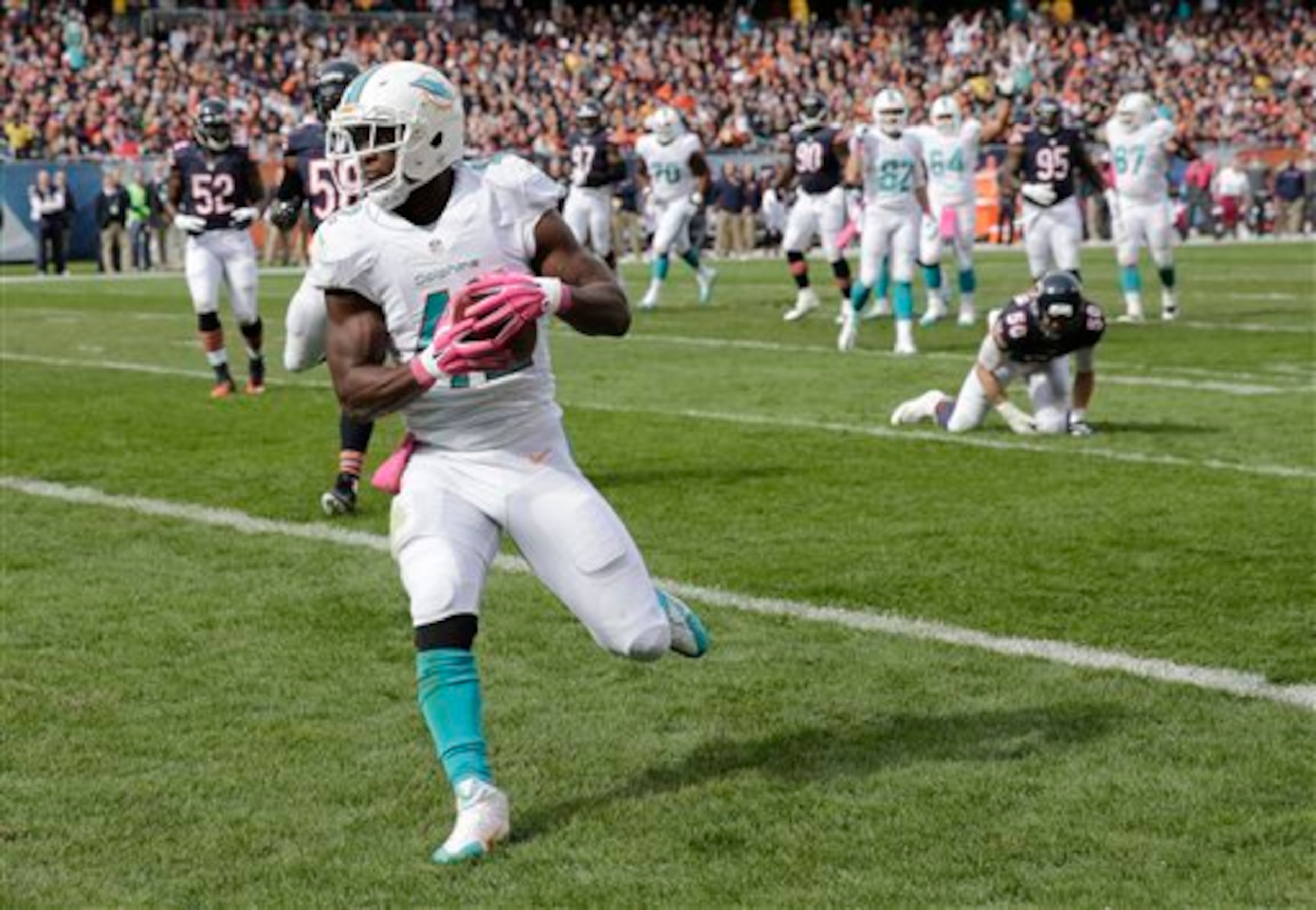
No, Clay didn't catch 12 passes for 200 yards and three touchdowns. The Dolphins’ tight end caught four passes for 58 yards and a touchdown on five targets. Clay scored the Dolphins’ first touchdown, and he made it look easy, too.
This matters because Tannehill is prone to making mistakes. The Dolphins’ quarterback had thrown interceptions in four of the five games entering Sunday, yet the Bears defense consistently allowed him to make low-risk throws across the middle to the tight end.
In theory, you want to take away the middle and force the quarterback who makes mistakes to take chances down the field or check down to the running back.
The Bears did none of these things. The middle of the field was open all day long. Tannehill found Clay when he needed a big play.
No adjustments were made by defensive coordinator Mel Tucker to combat the Dolphins’ success in the middle of the field. After three home losses, a lack of adjustments shouldn’t come as a surprise.
.jpg?w=2560 "Green Bay Steelers Football")
.jpg?w=2560 "Chargers Mack")
.jpg?w=2560 "Giants Football")
Didn't We Hear Something About a Height Advantage?
4 of 4
Unless Brandon Marshall and Alshon Jeffery shrunk before the game, there was supposed to be some sort of size advantage in the Bears’ favor.
Marshall (6’4”) and Jeffery (6’3”) are much bigger than those covering them, cornerbacks Brent Grimes and Cortland Finnegan, who both stand at 5’10”.
So much for a side advantage. Finnegan had four pass breakups on the day, while Grimes played a great game all around.
The pair of receivers, who are widely considered to be the best duo in the NFL, caught a combined eight passes for 57 yards on 17 targets.
Not one time did Marshall or Jeffery win a jump-ball situation against a Dolphins cornerback or safety. Early in the game, on 3rd-and-1, Cutler threw deep to Jeffery down the right side. Jeffery lost position on the ball, and it fell incomplete.
A few plays later, Cutler threw deep to Jeffery in the end zone, with Finnegan in coverage. Finnegan knocked the ball loose before Jeffery could come down with it.
“They did a good job on coverage; they really did, Cutler said after the game. “They mixed up, they took away a lot of the deep shots, took away a lot of the stuff 10 yards and beyond. Made it really difficult.”
Every team is going to have the ability to put together a few good coverages, but that is why you have big, playmaking receivers. Marshall and Jeffery needed to win more battles against Miami’s secondary.
The fact that Jeffery’s only two catches came on the first two plays of the game is completely inexcusable.
.jpg?w=2560 "Commanders Cowboys Football")
.jpg?w=2560 "Texans Patriots Football")