How Colin Kaepernick Controls Chaos for the San Francisco 49ers
San Francisco 49ers quarterback Colin Kaepernick is at ease when everything else around him isn’t. He lives within the chaos of quarterbacking, controlling and manipulating it to his liking.
But when he should feel even more comfortable, chaos happens.
Of his 201 passing yards in Week 5 against the Kansas City Chiefs, 129 came against at least five pass-rushers, according to ESPN Stats & Information. He completed 60 percent of his throws while blitzed, including his only touchdown pass to wide receiver Stevie Johnson.
.jpg?w=2560 "Chargers Mack")
.jpg?w=2560 "Green Bay Steelers Football")
.jpg?w=2560 "Giants Football")
Then something odd happened; as against a standard rush (four or fewer pass-rushers) during that game, Kaepernick’s accuracy and comfort declined sharply. His completion percentage dropped by 10 percent, and he averaged only 4.5 yards per attempt compared to 12.9 when the Chiefs sent an extra man (or men).
Or is it really that odd?
For most quarterbacks, having success and being clearly more comfortable when blitzed would indeed be bizarre.
Logic says that fewer men trying to crush you generally means more time to scan the field, and in turn that should lead to more balls landing safely at their desired destination. Being blitzed leads to a far greater chance that the play ends in a frantic mess, with a quarterback's rhythm and timing disrupted.
We’re not talking about advanced arithmetic here. But Kaepernick laughs at your common-sense thinking.
He regularly finds a way to make the complex seem routine and the ordinary feel difficult, which goes beyond Week 5. It’s in his DNA as a quarterback and an athlete.
Immediately when assessing how Kaepernick excels when faced with extra rushers there’s an assumption that he must run a lot, and he immediately morphs into Barry Sanders mode when the extra bodies start coming. While he certainly uses mobility to evade a rush, actually running when blitzed rarely happens.
Kaepernick has been blitzed 56 times through five games, according to Pro Football Focus (subscription required). Of his overall 43 rushing attempts so far that have resulted in 205 yards on the ground—the second most among quarterbacks and only four yards behind Seattle Seahawks QB Russell Wilson—only four have come after a blitz.
| Dropbacks | Rush Att. | Comp % | YPA | TD | INT | QB rating | |
| When blitzed | 56 | 4 | 61.7 | 8.3 | 4 | 1 | 107.7 |
| When not blitzed | 125 | 13 | 66.0 | 7.0 | 3 | 3 | 83.9 |
What we see there is the portrait of quarterback who uses the chaos created by a blitz to find opportunities that may not have existed otherwise.
NFL defensive coordinators are generally smart people, and they realize blitzing Kaepernick is ending badly. That’s why they’re not doing it nearly as often.
The frequency of blitzes Kaepernick has faced early this season is still high (30.9 percent) but down considerably from his first 23 regular-season starts prior to 2014.
Kaepernick is averaging over a yard more per pass attempt when blitzed; in that situation he’s thrown for more touchdowns and fewer interceptions. He’s been sacked only five times versus eight when not blitzed, and his passer rating against more than four rushers is on an entirely different level.
Earlier this season against the Chicago Bears, when Kaepernick threw three interceptions, he scrambled unnecessarily and made poor decisions. On that night a formula for success was revealed if executed properly.
Generating pressure with a four-man rush leaves more bodies in coverage and leads to more mistakes from Kaepernick when he’s forced to stand and read the defense.
With his elusiveness, blitzing simplifies the game for Kaepernick. Once he avoids a rush there’s no reading, only reaction. The field is often cut in half with fewer passing options remaining, and the decision facing Kaepernick is much easier.
A blitz forces Kaepernick to be creative and improvise, which is when he’s in his natural football habitat. There are examples of extra pressure ending badly for defenses nearly every week. One in particular from Week 3 against the Arizona Cardinals shows how Kaepernick’s athletic ability leads to an approach that looks harder, but for him it’s easier.
It came during the 49ers’ first drive of the game on a 3rd-and-1 just past midfield in Cardinals territory. Arizona sent pressure with six pass-rushers at the line of scrimmage before the snap and potentially more coming.
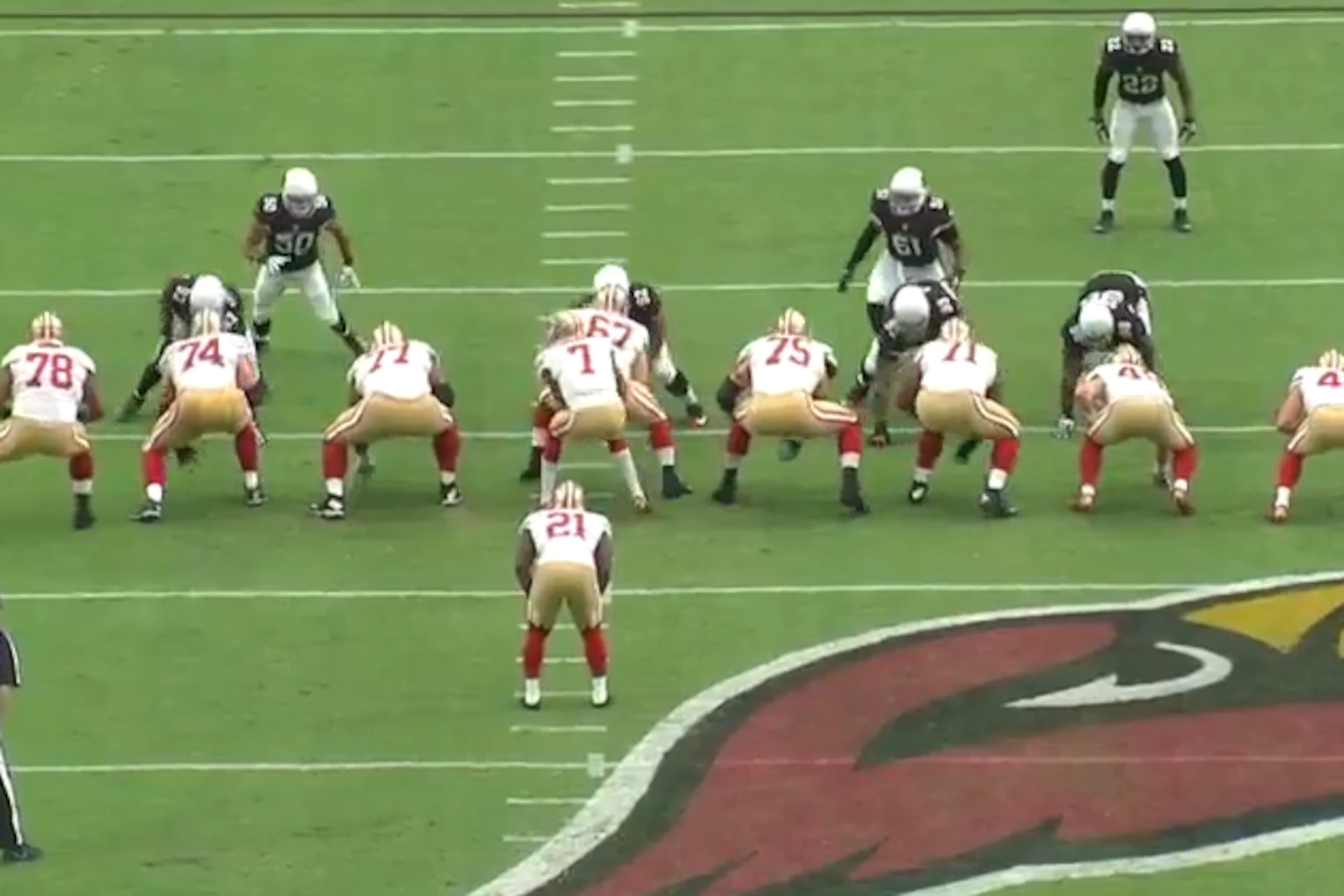
All six charged ahead, and immediately time was a bit of a problem for Kaepernick. Or at least it should have been.
Frank Gore held up the ox-like Tommy Kelly for a split second, though not nearly enough because football isn’t fair, and a running back can’t do much with a 310-pound human. So as both Kelly and tackle Frostee Rucker broke through, Kaepernick’s view looked like this almost immediately after reaching the height of his dropback...
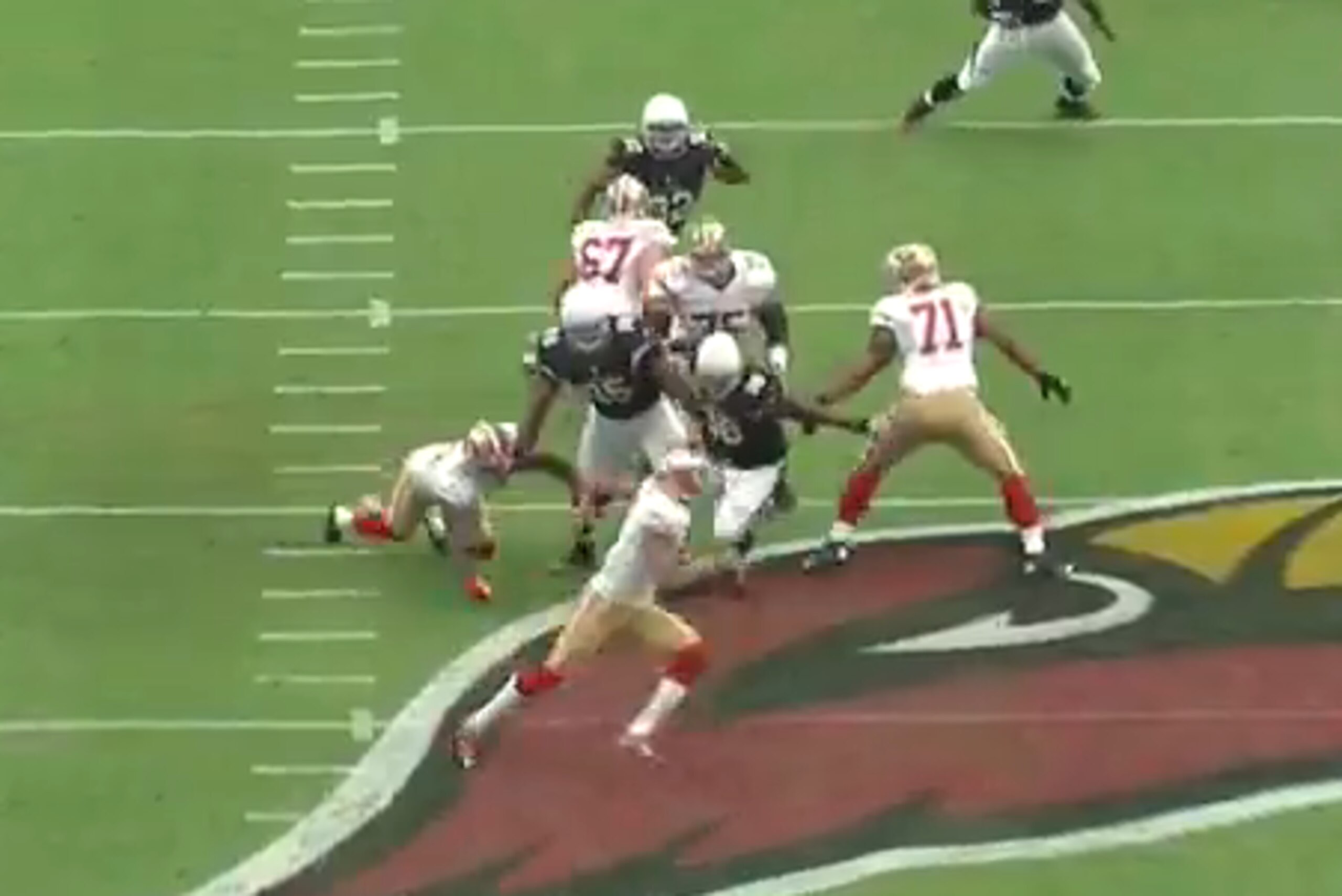
Only one direction was available then: head right, young man. There was no decision-making involved there or a split-second evaluation of options. Thinking was eliminated by the forthcoming pressure.
Then a few steps later the rush was nullified, and Kaepernick had found blissful freedom. An escaped rush meant plenty of wonderful green grass to his right and even more downfield with fewer defenders in coverage.
At this point, after neutralizing the pressure with his quickness, Kaepernick had found his comfort, reducing the play to the classic football version of "Where’s Waldo?." There’s always an open man after a blitz, and the trick is finding him.
For Kaepernick that's the easy part.
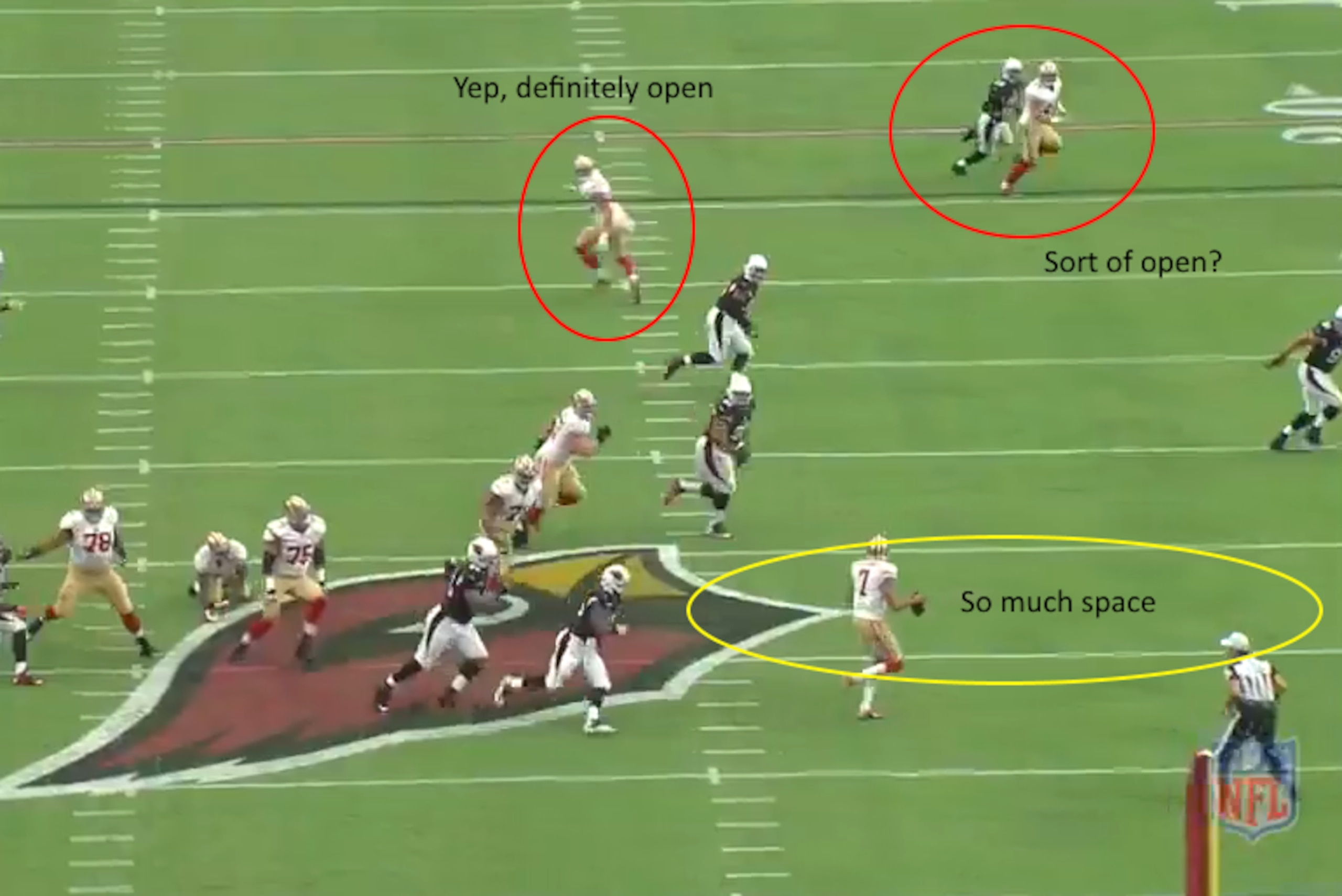
The result was a 23-yard completion to tight end Derek Carrier which kept the drive going and set up a touchdown four plays later.
The pass was a difficult one but still the sort off-balance throw while leaping we’ve seen Kaepernick complete repeatedly. He has more than enough arm strength to compensate for momentum taking him in another direction while on the run.
Conversely, in Week 4 against the Philadelphia Eagles there was an example of Kaepernick leaning too heavily on that arm with plenty of time in the pocket and taking an unnecessary risk.
On 2nd-and-6 from their own 24-yard line the 49ers looked to take a shot deep. Tight end Vernon Davis was the primary target on a post route up the middle, which is why Kaepernick focused on him and only him.
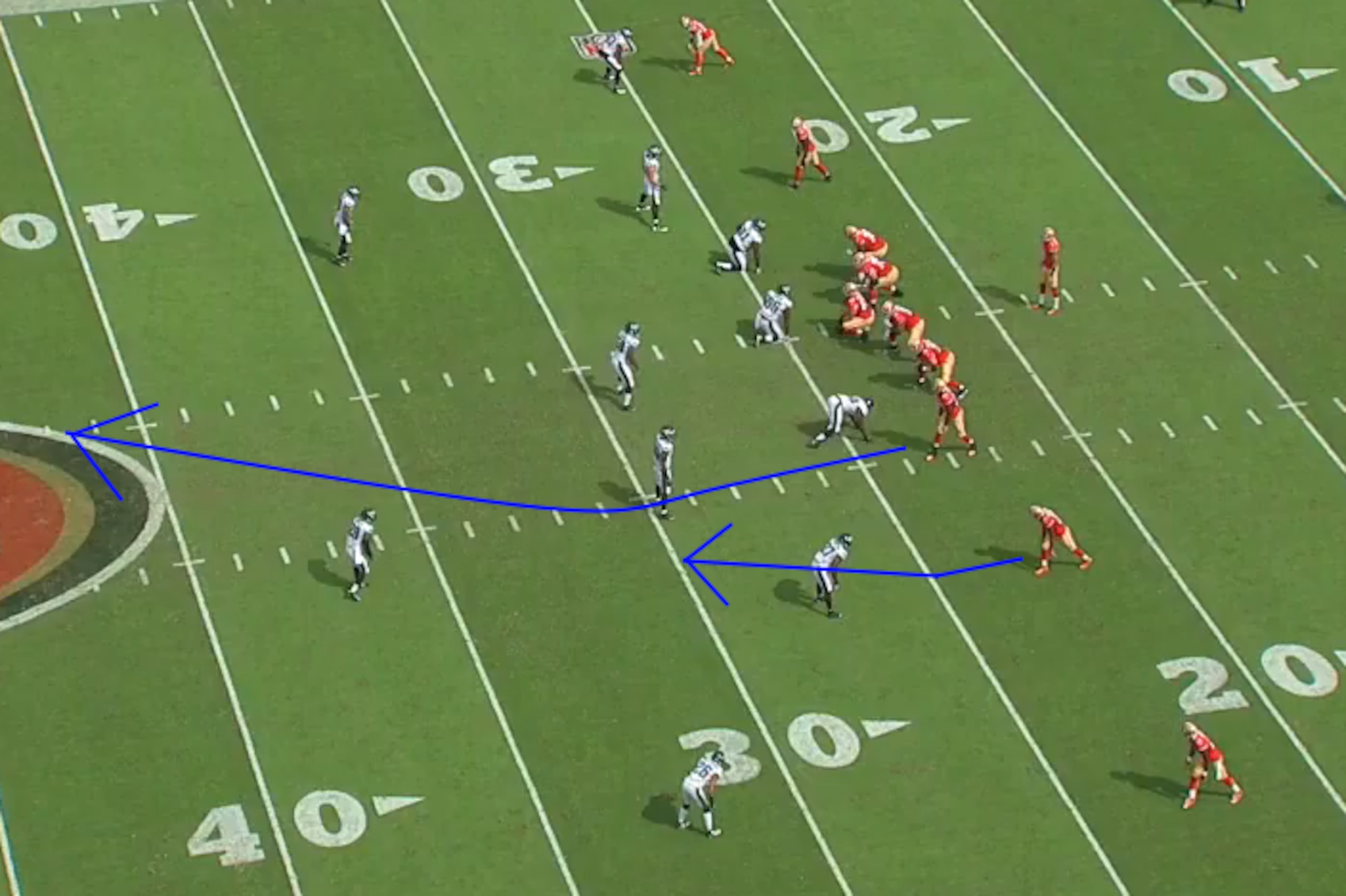
He didn’t see Bruce Ellington wide open after running a slant from the slot. The rookie would have had a first down easily and likely more with room to run.

Instead Kaepernick passed on the easy completion with eyes only for Davis.
His deep throw required lofting the ball over one defender and between two others. And he nearly did just that, with Davis predictably unable to hold on in traffic. But taking an easy, high-percentage throw is always the better option over narrowly missing elsewhere on a pass with a much greater degree of difficulty and a chance for an interception.
The comfort shown on the Cardinals play and the lack of it at times in the pocket is why defenses are sending less pressure whenever possible. Of course, that means a defense needs confidence in its front four and its ability to make life miserable for a quarterback without any help.
The division rival Seattle Seahawks have plenty of muscle and confidence up front, and those four pass-rushers alone were the driving force behind Kaepernick’s woeful outings in both 2013 regular-season meetings between the two teams (completion percentages of 46.6 and 51.7).
A strong front four is key in any defensive effort to limit Kaepernick. With the St. Louis Rams teed up for two of the 49ers’ next three games a test is coming, though somehow they’ve recorded only one sack so far. And in Week 7 San Francisco will be dealing with outside linebacker Von Miller and defensive end DeMarcus Ware firing off the edge.
Containment and pressure without reinforcements will be their goal because Kaepernick is at his best while evading.
.jpg?w=2560 "Seahawks Cardinals Football")
.jpg?w=2560 "Commanders Cowboys Football")