

Spain and Vicente Del Bosque Engulfed in Sense of Monotony After Slovakia Loss
Vicente del Bosque, it would seem, has an interesting perception of what constitutes as new.
"We'll have a slightly new system in place from the one we had against Macedonia so we should have more of an offensive presence," Del Bosque said prior to Spain's clash with Slovakia on Thursday, per Football Espana.
New things, inherently, tend to feature changes. Noticeable ones. But that's not what Spain's line-up contained in Thursday's damaging 2-1 defeat.
.jpg?w=2560)


Andres Iniesta and David Silva started as the manager's wide (a rather notional term in this case) attackers, with Cesc Fabregas wedged tightly between the pair. Behind them, Sergio Busquets and Koke rounded out the midfield.
New? It all felt extremely familiar for La Roja: A quintet of gifted technicians fluidly interchanging in the centre of the park, passing the ball around with ease—the only issue being that the end product amounted to very little.
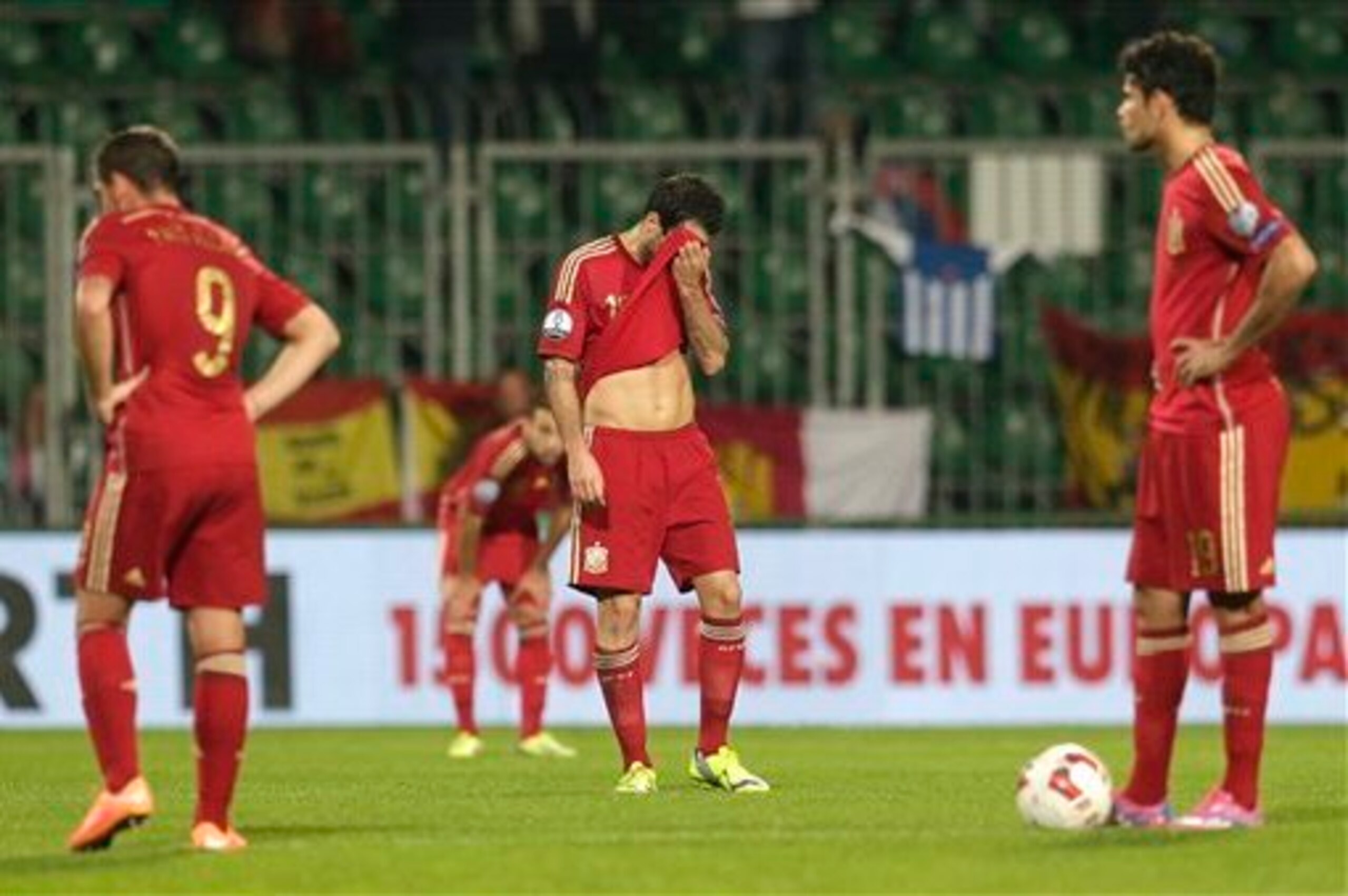
Naturally, the Spaniards dominated possession against their inferior opponents, finishing the night with a massive 73-27 percent advantage over the home side, per WhoScored.com. Koke, with 140 touches, had more of the ball on his own than Slovakia's entire midfield.
The hosts, however, were unfazed by Spain's control. In two tight banks spanning the width of the penalty area, Jan Kozak's men comfortably held their vastly more decorated guests at bay, safe in the knowledge that this La Roja outfit knows only one way.
And once Slovakia had grabbed an early lead thanks to Iker Casillas' blunder, how the play unfolded was alarmingly predictable: Spain passing and probing with little width and even less venom; the home side defending resolutely and happy to hit on the counter.
It's a template for success against the Spanish that's long since discovered. All Slovakia had to do was follow it.

There's now, if there hadn't been already, an overwhelming sense of monotony surrounding Del Bosque and Spain. The team's methods feel tired. The inspiration feels lost.
The metronome that is La Roja still ticks, but it does so at a pace that no longer aligns with the dominant music of the time.
The midfield, Spain's most obvious strength, is quickly becoming a weakness. In its current incarnation, the brilliant skill is tempered by a dearth of variety. Del Bosque's five central stars are masters of their craft, but as an ensemble, they're men trying to knock down concrete walls with feather dusters.
What's surprising—and damaging for Del Bosque's tenure—is that it's these very problems that were seemingly at the top of the list to be addressed after the side's abject failure in Brazil at the World Cup. The thrashing by the Dutch and subsequent loss to Chile were supposed to force a re-think not only in strategy, but in personnel, too.
While such a process will inevitably require time, the composition of the team's starting XI suggested Spain are still yet to learn their lesson, reluctant to move away from what they know even as they begin to take on the look of a fading power.

Yet, while the team's major issue—too much finesse, not enough force—appears blatantly obvious for so many looking on, it seems Del Bosque is either unwilling or unable to recognise the sense that his trusted Spaniards have struck a barrier through tedium.
"I didn't expect this result at all. It was unexpected," the 63-year-old said after his side's defeat to Slovakia, per AS.
"We pressed but it wasn't a great performance. We should've scored at least one more but they caught us on the counter. We had them pegged back," he added.

Those statements are certainly true. But if there's one way Slovakia was going to emerge triumphant against the Spanish, wasn't it going to be that? Pegged back against a talented but ultimately toothless opponent and seizing on the chance to break?
If you'd asked Del Bosque prior to Thursday what the dangers were, wouldn't he have said something about being exposed with too many slight-bodied players caught in an area too small?
In the lead up to the game, he made mention of the home side's threat, saying, "they play well on the counter-attack and with speed, whilst they have important players like [Marek] Hamsik and two very fast wingers."
It was obvious: There was only one way Spain could lose against Slovakia. Everyone knew it. And it happened, in just that way. The hosts knew precisely what was coming, yet while that knowledge once possessed significant intimidation, it's gradually becoming the source of a certain comfort.
The monotony has set in. Time for something new.
.jpg?w=2560 "Patriots Jaguars Football")
.jpg?w=2560 "Dolphins 49ers Football")

.jpg?w=2560 "Breaking News")
.jpg?w=2560 "NFL Coach Rips Maye 😬")

.png?w=2560 "NFL Week 3 QB Grades 🔠")