Green Bay's Loss to Seattle in Part to Be Blamed on Blocking in the Run Game
Entering 2014, the Packers looked to have the best offensive line since their 2010 Super Bowl team.
Their left tackle was second-year Colorado product David Bakhtiari, who in his rookie season looked like a young Jordan Gross. Green Bay's starting guard tandem, Josh Sitton and T.J. Lang, already was established in the league. The starting right tackle, Bryan Bulaga, was healthy again after a season-ending knee injury took away his 2013 season. Then, finally, J.C. Tretter, a former quarterback, tight end and tackle, was going to be the long-term solution at center for the squad.
In training camp, the offensive line looked the part. But that promise took a blow when Tretter sustained an injury in the third preseason game. Instead of Tretter, the Ivy League sophomore, the Packers would be forced to play Corey Linsley, a rookie who was drafted in the fifth round out of Ohio State. Linsley was a fine prospect, but depth on the offensive line was shallow already.
TOP NEWS
Week 2 NFL Power Rankings 📊
.jpg?w=2560 "Patriots Seahawks Football")
Report: Darnold Could Miss 3-6 Weeks
.jpg?w=2560 "Buccaneers Football")
Week 2 Start 'Em, Sit 'Em Decisions
There currently is no true center on the roster after Linsley, meaning that if Linsley goes down, starting right guard T.J. Lang would likely have to move over.
Tretter's injury wasn't the first to occur in the trenches for the green and gold. Don Barclay, the Packers' swing tackle and sixth offensive lineman in the offenses "big" packages, sustained a season-ending ACL injury. At the time, it was small news across the bottom of preseason sports tickers, but the setback ended up compounding the loss for Green Bay.
On Thursday night, during the season opener, Packers right tackle Bryan Bulaga sprained his MCL, which will keep him sidelined for several weeks. All together three of the Packers' top six offensive linemen, including two starters, will be out for a significant amount of time.
Against the Seattle Seahawks, the offensive line looked like they were missing pieces. The unit was projected to be a solid team in pass protection, but in Week 1, the cohesion and chemistry of a veteran line was nowhere to be seen. Some of the communication issues could be to blamed on the rookie center, who had to make the protection calls at CenturyLink Field.
Overall, Pro Football Focus gave Green Bay's blocking very poor scores: a -5.8 grade in pass protection and a -5.0 grade in run blocking (subscription required). In Seattle, three running plays stood out the most for exposing some of the issues Green Bay has on up front.
Play 1: first quarter, 1st-and-10. [4:32]
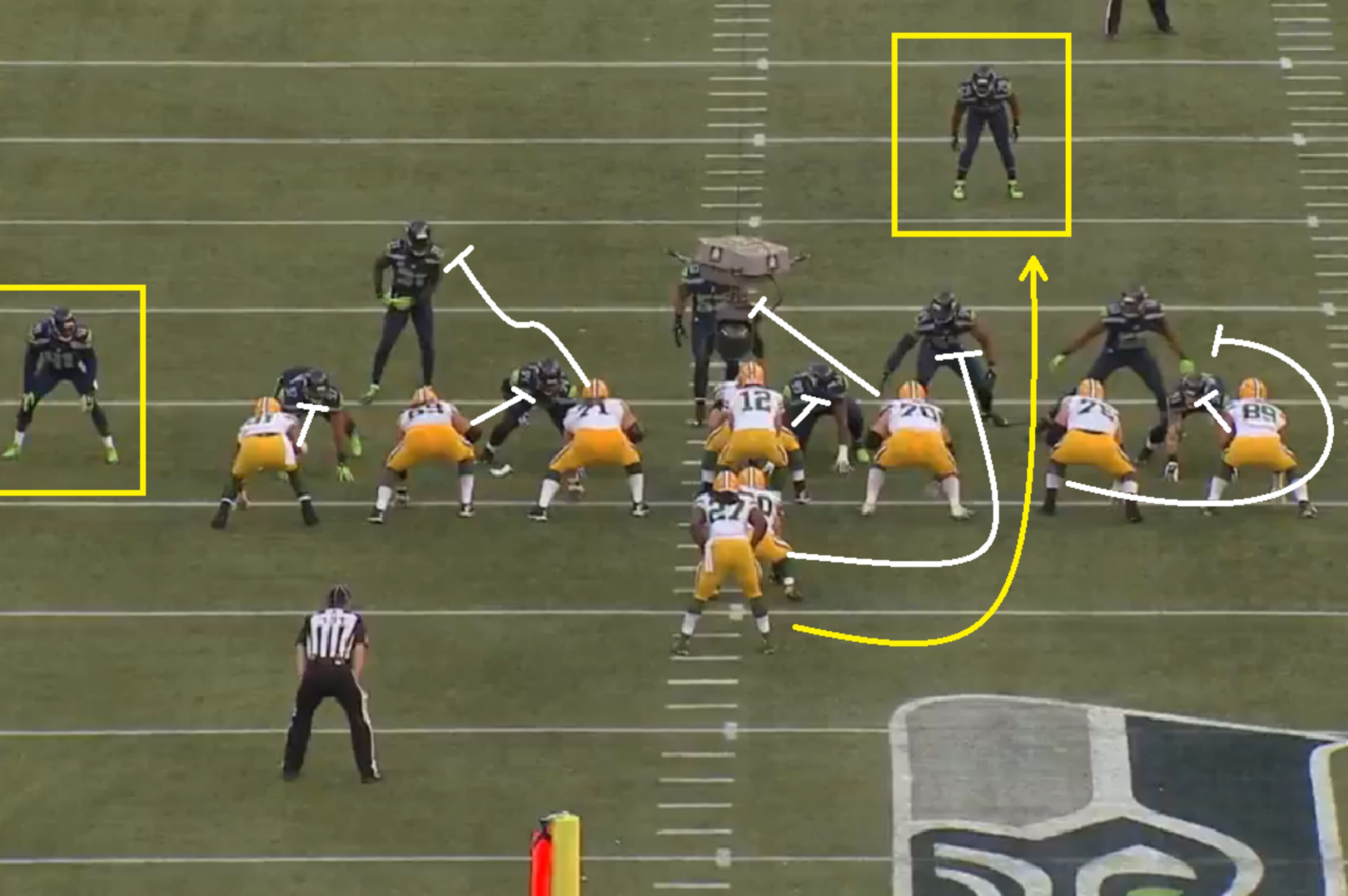
This first play is a fairly standard running play. It's mostly man-to-man blocking, outside of Sitton, who helped out Bakhtiari on a double-team before going to the second level. Bulaga also looped outside of tight end Richard Rodgers on his block. By the looks of it, though, it's unclear if it was designed that way, or if that was just how he had to get to his target once the snap was live.
Green Bay was in 22 personnel, meaning two tight ends and two running backs came out as the offensive skill players with a receiver. Richard Rodgers (right) and Andrew Quarless (left) were the tight ends; fullback John Kuhn and tailback Eddie Lacy lined up in the backfield.
With Kuhn designed to kick out the linebacker between the right guard and tackle, this play should have taken Eddie Lacy through the B-gap. With everyone assigned to a defender, if blocked correctly, the only two players who should have been able to make the play are highlighted: Earl Thomas (No. 29) and Byron Maxwell (No. 41.)
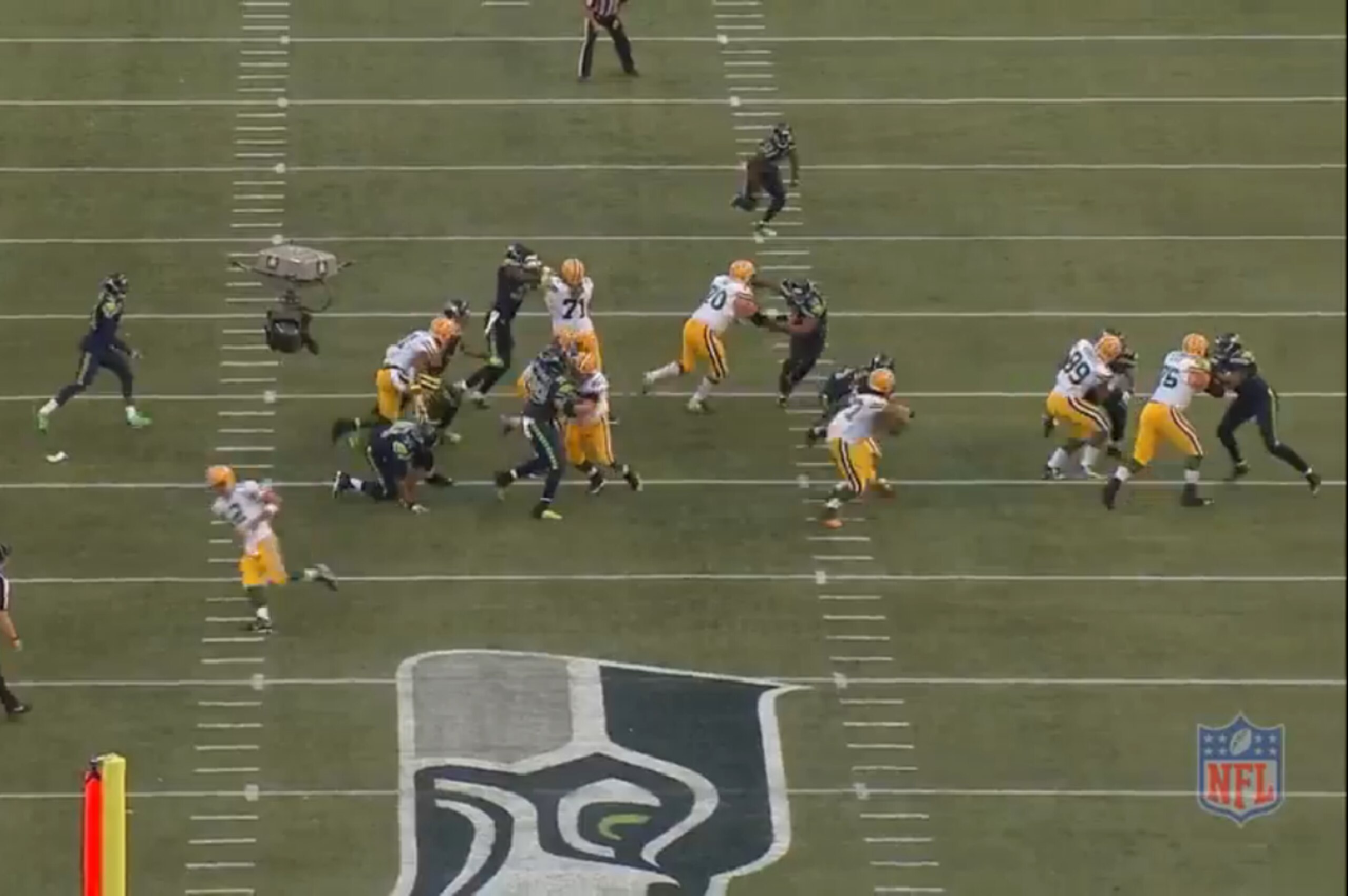
But the play sputtered. Above is a picture of when Kuhn engages in his kick-out block, which did stop the defender in the hole, but by then, Bulaga's defender was already coming off the block. Closing in on the B-gap, Lacy noticed his best shot was outside. He attempted to bounce it to the perimeter, where he was met by two other defenders shedding their blocks.
Green Bay's scheme was correct. The issue on this rush of no yards was sustaining quality blocks. By the time some were engaging, others were already losing their man. With a young line, this early in the season, it's expected that plays like this might be slightly out of sync, but it shouldn't be tolerated.
Play 2: second quarter, 1st-and-10. [3:04]

This play is slightly more complex. There's a lot of running and reaching to get to blockers on this play, as only Sitton is approaching a defender that is within five or so yards of him. Both tackles took the players closest to them, while center Linsley matched up against Kevin Williams, the Seahawk defensive tackle lined up on the outside shoulder of T.J. Lang.
Lang, in the meantime, pulled through the left-side B-gap, looking to kick-out linebacker K.J. Wright. Green Bay came out in 11 personnel on this play, meaning Lacy and tight end Andrew Quarless were the only offensive skill players involved in the play.
It should be noted that at this point, Bryan Bulaga was out of the game due to his knee issue, and Derek Sherrod had enter at right tackle. Richard Rodgers, who was also hurt on the same play as Bulaga, was replaced in the H-back role for this play by Quarless, who was supposed to kick out through the B-gap and take on Seattle linebacker Bobby Wagner.
Highlighted in the play are Kam Chancellor (No. 31) and Earl Thomas, who should be the only defenders in position to possibly make a play.
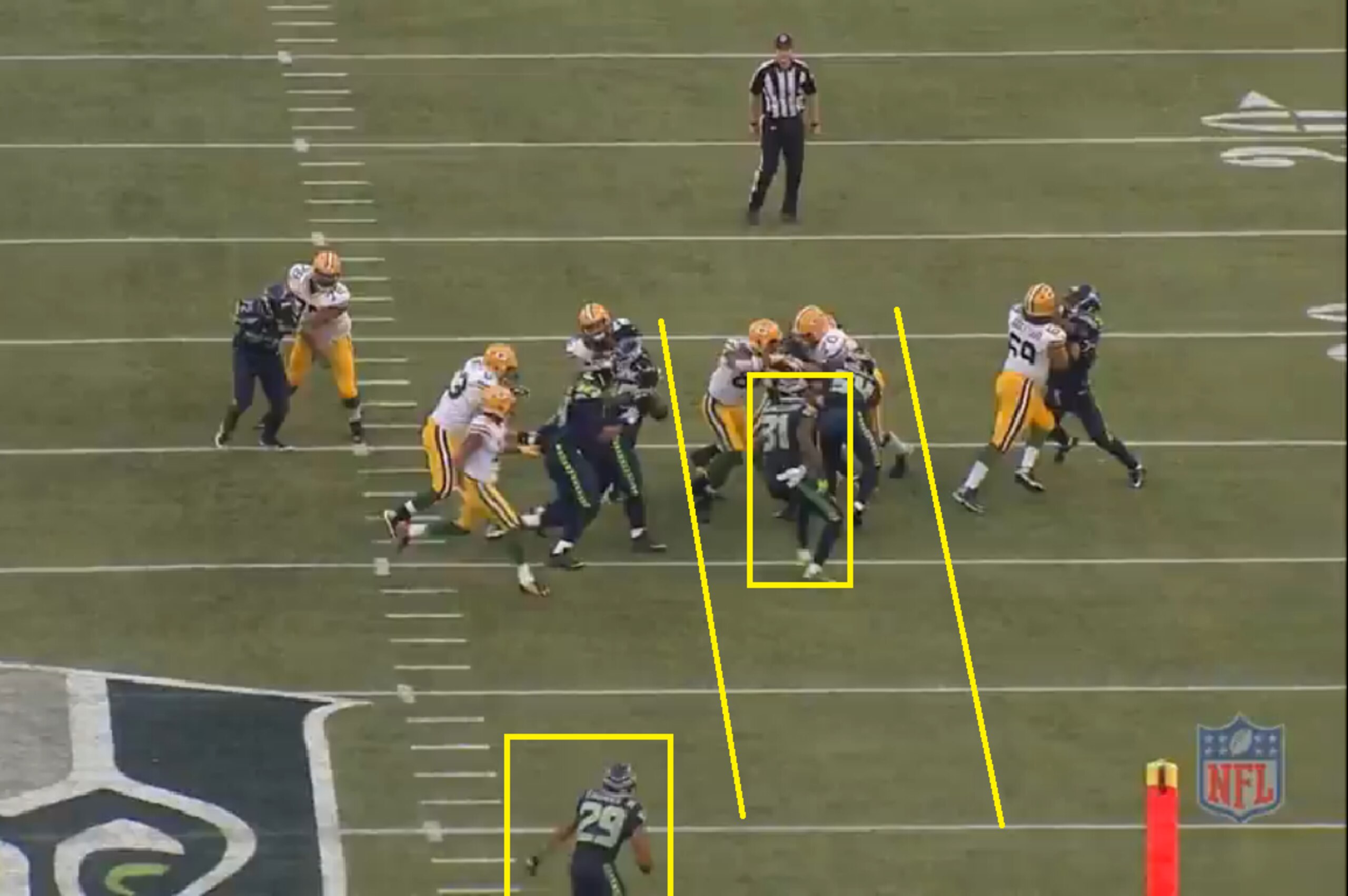
This rushing attempt failed in the hole, as neither kick-out block took defenders out of the gap Lacy was attacking. Lang and Quarless had failed in their assignments, leaving Lacy with nowhere to go. At this point, Chancellor had already filled the gap. Linsley couldn't sustain his block either, as his man was on the boundary of the alley, waiting to make a play.
This example embodied what could go wrong in a power running play against a tough, strong front seven. Lacy gained no yards on this play, either.
Play No. 3: third quarter, 1st-and-10. [9:07]
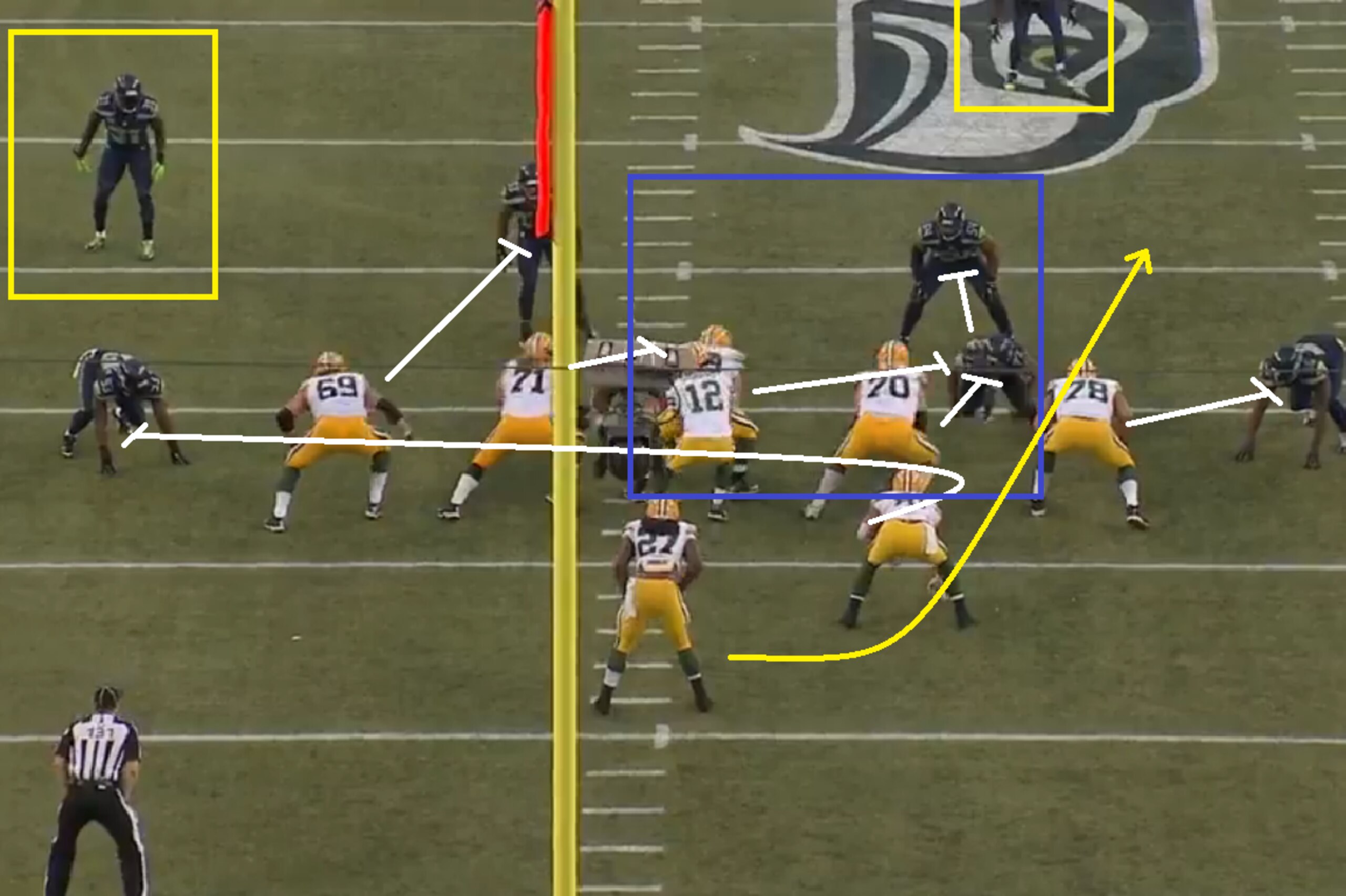
Green Bay's bread and butter used to be zone-running plays. With a new emphasis on man or power running plays, the Packers have been using the plays less often, but they aren't gone for good. This is a zone play Mike McCarthy called against the Seahawks.
The key to this play is the double-team by Linsley and Lang. Highlighted in blue are the two targets they're assigned to. Essentially, they double-team their first defender until one of them feels comfortable enough to handle him one-on-one, then one moves to the second level.
This blocking scheme works for two reasons. First, a double-team should blow the initial defender off the ball. Second, when it's time to move onto the second defender, two bodies are no longer needed to take care of the first.
Andrew Quarless was again the only other skill player in 11 personnel involved in the play. He lined up as an offset fullback on this play, taking a step to the play side before clearing out the back-side defensive end. The safeties, Chancellor and Thomas, should have made this play if the blocks are on point.
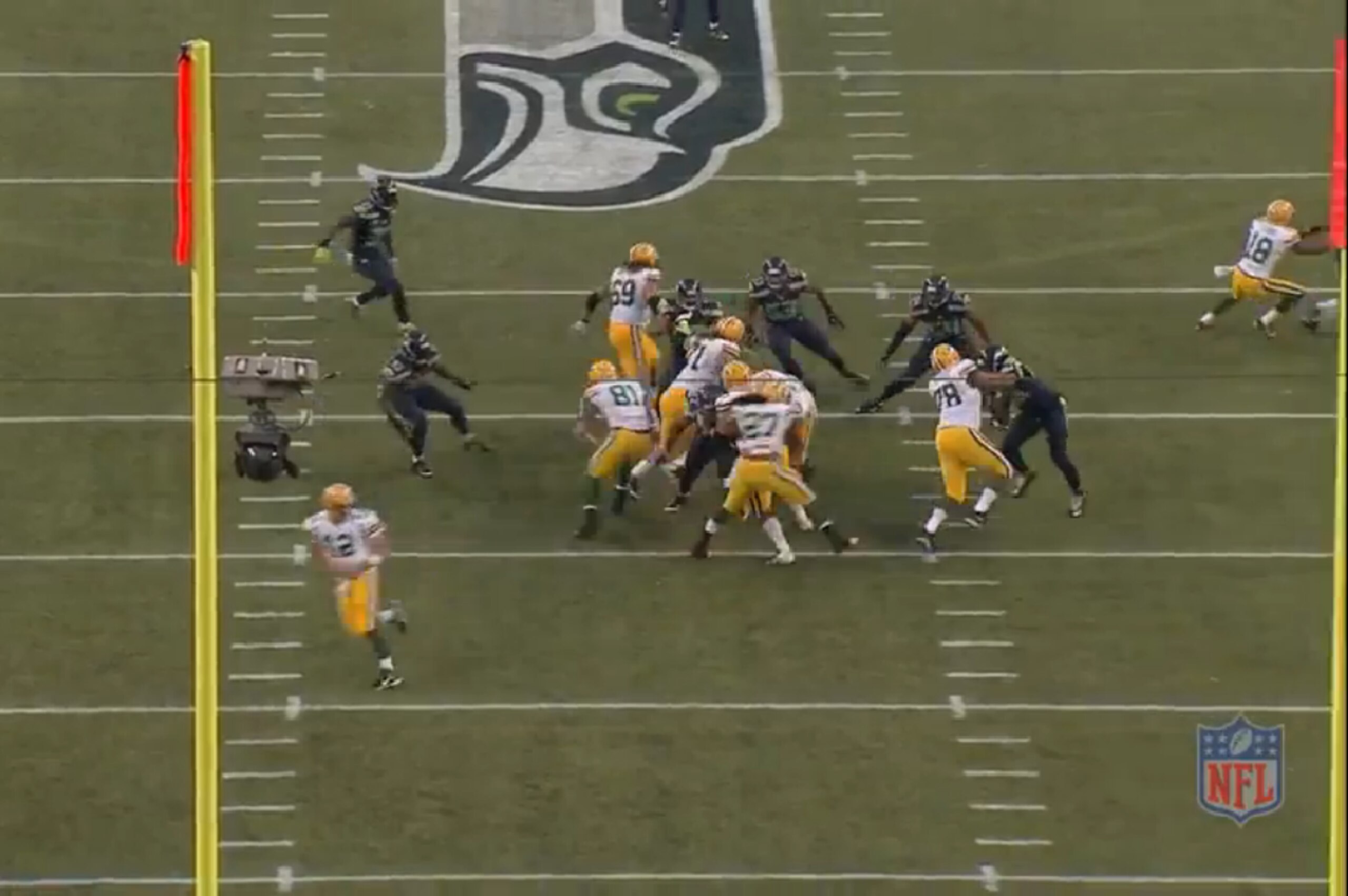
Unfortunately for Lacy, though, the double-team unfolded too slowly. By the time the running back hits the hole, neither Lang nor Linsley has moved to the linebacker. Instead, they were both still in the hole. Lacy, with momentum into the run, halted when seeing the behinds of his two linemen. Even worse, two unblocked linebackers were waiting to make a play once Lacy did choose where he wanted to go.
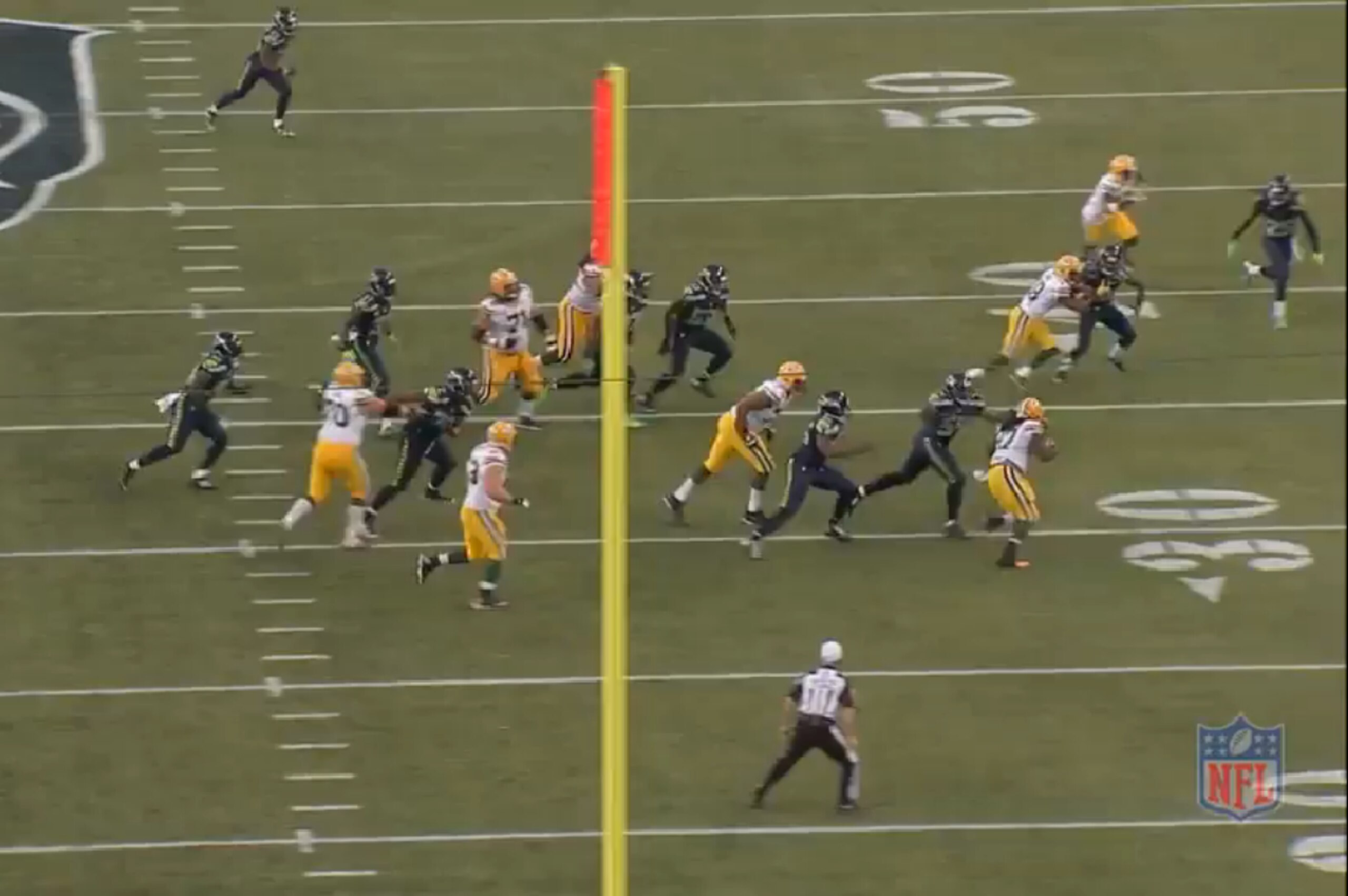
Lacy bounced it outside, as it was the only place for him to run. The two free linebackers chased him down, and he was held to a loss on the play.
Parting thoughts
Against Seattle, Green Bay's running game looking nothing more than average. Unless Packer linemen do a better job of getting on blocks quicker and sustaining them, it's hard to envision it getting much better in the short-term.
There weren't necessarily mental lapses, just subpar results. The team could take a jump when starters Bulaga returns to the lineup. Until then, watch for progression in Linsley and Derek Sherrod, who are the only question marks in the unit.
.jpg?w=2560 "Packers Jacobs Plea Football")