


Projecting Bradley Beal's NBA career is a difficult, almost scary, proposition.
Not just because he's so young and so much could change over the next 15 years or so, though that's at least a small part of the worry with any prediction. No, what's frightening about Beal is that his accomplishments to this point practically beg for sensationalist claims.
And that's always a little dangerous.



Consider: Beal just completed his second NBA season and is still only a couple of months into his 21st year on earth. Plenty of similarly youthful players have logged a pair of professional campaigns, but precious few have done so in as distinguished a fashion as Beal.
According to Basketball-Reference, no player in NBA history has ever made more three-point shots in his age-19 and -20 seasons than Beal, who nailed 229 triples over the past two years. In addition, Beal's combined accuracy rate of 39.6 percent is the highest of any player who made at least 100 combined threes in his age-19 and -20 seasons.
OK, so Beal can shoot. Can he perform when the games actually count?
Turns out, he sure can:
Isolated performances aside, Beal used the entirety of the Washington Wizards' 2014 playoff run as his own personal breakout announcement. Beal started 11 postseason games as a 20-year-old last year, making him one of just two players in NBA history to play as part of a postseason first unit that many times at that age. Tony Parker (24 starts as a 20-year-old) is the only player to top him.
Of 20-year-olds to log at least five starts in a single postseason, Beal's scoring average of 19.2 points per game trails only Derrick Rose (19.7 in 2008-09) and Kobe Bryant (19.8 in 1998-99), according to Basketball-Reference.
Despite his inexperience, Beal acted like a player completely comfortable with the playoff stage. It's hard to know where that confidence came from, but based on his own explanation, it seems like Beal is just one of those rare talents for whom pressure equals opportunity.
"The way I think about it, I’m 20 years old, playing in the playoffs, something I always dreamed about, so why not embrace it? Why not accept that challenge?," Beal rhetorically wondered after a brilliant Game 1 effort against the Indiana Pacers in last year's Eastern Conference semifinals, per Michael Lee of The Washington Post.
Plenty of "what about John Wall" jokes surfaced when Beal's Nike ad proclaimed him a first option.
But after playing more minutes, shooting more accurately and scoring more points per game than Wall in Washington's postseason run, the jokes lost their punch.
| Beal | 41.6 | .424 | 19.2 | 16.1 |
| Wall | 38.2 | .366 | 16.3 | 14.9 |
Looking back a bit, it's also intriguing to note that Beal—not Wall—was named to the 28-player pool that would eventually be pared down to Team USA's FIBA World Cup roster. USA Basketball corrected its oversight and invited Wall after an excellent season. But it says something that barely one-and-a-half seasons into his career, Beal had more appeal to Team USA than Wall did.
Let's stay on task, though. This is about Beal's NBA ceiling, not where he sits on the Wizards' team totem pole—even if that latter issue figures to be an interesting one going forward.
Because of his age, we simply can't presume we're anywhere near knowing what else might be in store for Beal. He's still developing the parts of his game that don't involve standstill shooting, and there are real signs that point to him becoming a well-rounded offensive player.
During the 2013-14 season, he averaged .75 points per play as a pick-and-roll ball-handler, good enough to rank in the top quarter of all NBA players and, notably better than Wall's average of .73, per Synergy Sports (subscription required).
Beal also improved his ability to recognize when defenders had overcommitted to stopping his jumper on curls and pindowns, utilizing an increasingly effective up-fake to quickly get himself into the lane against shifting defenses.

So, what do we make of a guy who has had nearly unprecedented success at his age but is still getting better?
Let's come right out and say it: We want to assign a Ray Allen ceiling to Beal, and that's an uncomfortable inclination. Allen is a 10-time All-Star. He's made more threes than anyone (ever) and is still a remarkably effective role player coveted by championship-caliber teams.
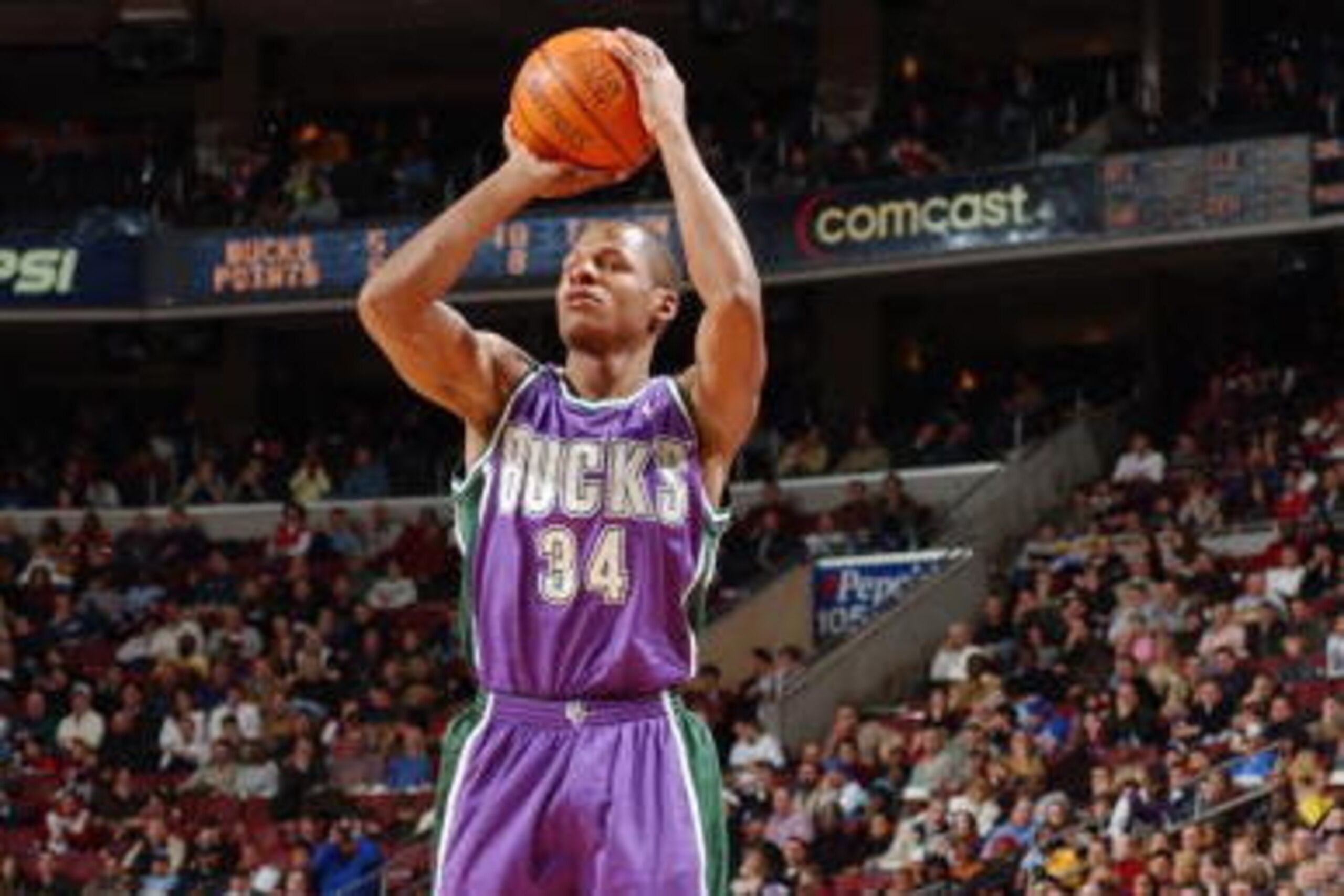
Almost by definition, there is no "Allen Type."
There are, however, some obvious similarities: the position, the textbook effortlessness of the stroke, the smooth game, the sneakily athletic all-around skills. They're all there in Beal, and if you look back at an early snapshot of Allen, the resemblance is hard to ignore.

So, why not?
Why can't Beal be the next Allen?
He's already ahead of the all-time great in a couple of respects by virtue of putting up two impressive NBA seasons at an age when Allen was still in college. The numbers Beal produced in his first two years are comparable to Allen's, despite the former's youth:
| Allen | 16.7 | .429 | .377 |
| Beal | 17.1 | .416 | .396 |
Clinging to the idea that any player is one of a kind, no matter how special or unique they might seem, is a mistake. Eventually, basketball evolution improves on every design.
Someday, we're going to see the next Allen—a guy with a beautiful long-range stroke and a broader-than-you-thought offensive repertoire, and we don't get to decide when "someday" is.
As it turns out in this instance, someday might already be here.
.jpg?w=2560)


.jpg?w=2560 "Raiders Could Start Mendoza")
.jpg?w=2560 "Rodgers Iced Out on Plane 💎")
.jpg?w=2560 "🚨 Week 8 AP Top 25 Poll")
