Eight Sports Conspiracies That Prove Professional Sports Are Fixed

By (Correspondent) on May 9, 2010

8,724 reads

28

Previous
1 of 11
Next
80030214

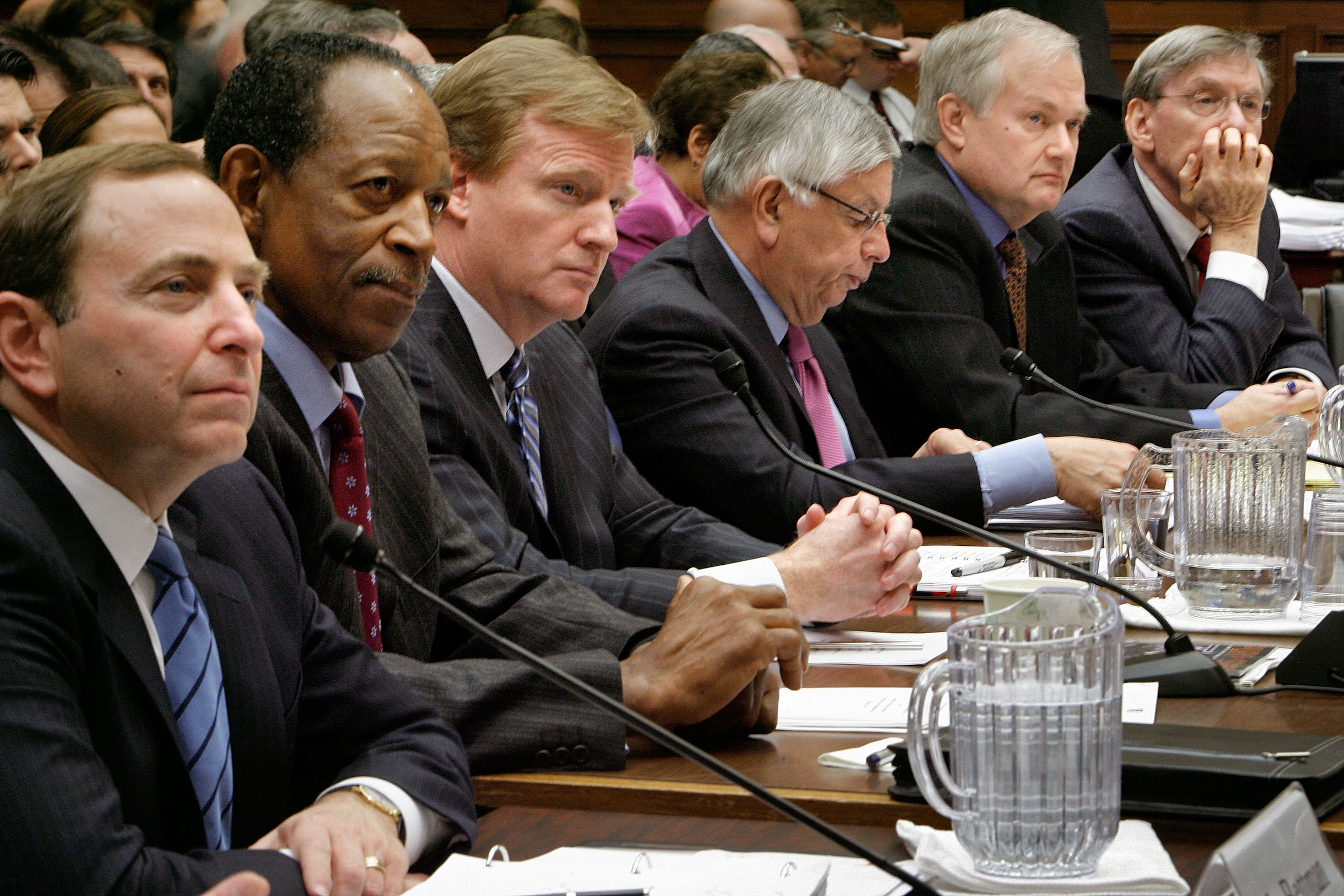
The five major professional sports leagues (NFL, MLB, NBA, NHL, and NASCAR) and their commissioners always tell their fans that "all is well" even when that isn't the truth.

It always seems that when an athlete, coach, or referee is caught using drugs or committing a crime or gambling on games, it is an "isolated incident" and those guilty acted alone and were punished accordingly.

League investigations (if actually conducted) never find more culprits than were already under suspicion.

Fans, for the most part, seem gullible enough to believe these lies.

Occasionally the truth about professional sports actually leaks out. Often these truths take the form of a "conspiracy theory," spun that way by a sports media machine that profits from the games as much as the leagues do.

But in the case of the eight "conspiracies" put forth here, more evidence exists to prove them than to disprove them.

If all of these stories are true as presented, then there is no doubt that games have been fixed and outcomes altered by leagues and owners more interested in turning a profit than winning championships.

Every fan should take heed of what is presented here.

Super Bowl III

83443843

Not many fans remember what was at stake in January 1969 when the Baltimore Colts battled the New York Jets in Super Bowl III. The truth is that the future of the NFL was on the line.

The 10-year-old AFL was merging with the NFL and fans were not accepting the upstart league as legitimate contenders.

If the Colts won, which seemed to be a forgone conclusion as they were the most dominating team the NFL had ever seen, the NFL stood to lose millions in future TV revenues.

Thanks in part to five Colts' turnovers, the Jets pulled off a miracle and won 16-7.

Not only did the victory legitimize the AFL to NFL fans, but the drama surrounding the game cemented the Super Bowl in the public's mind.

Had the Colts won, the Super Bowl may have ceased to exist (and that's not hyperbole).

But was the game on the level?

Bubba Smith, who played for the Colts in the game, came out and publicly stated that Super Bowl III was "set up" for the Jets to win.

If one examines the game, Smith's belief seems to be proven as huge question marks surround both Colts' QB Earl Morrell's play and Colts' Head Coach Don Shula's decisions.

The fact is there was too much on the line for the league to allow the Colts win. Having the Jets win was a wise business decision; one that allowed every team owner to profit millions of dollars and essentially create the modern NFL.

Collusion

98434460

In the mid-1980s, Major League Baseball had a revenue problem. Its new commissioner, Peter Ueberroth, gathered the owners and explained to them how to once again become a profitable league.

Ueberroth's solution? Don't sign any free agents.

Remarkably, that is exactly what the owners did. Prior to the start of both the 1986 and 1987 season, MLB owners (all of them) refused to sign another team's free agents...unless the team in question didn't want the player back.

The players caught on, and through their union, sued the owners. While waiting for the results, the owners altered their plan slightly prior to the 1988 season, but the results were the same: no free agents were signed.

As player salaries decreased from the owners' frugality, their profits rose significantly. Wins and losses didn't matter...money did.

The owners lost what became known as the three collusion cases and were forced to pay the players' union $280 million.

But that didn't stop owners from attempting it again (and losing) in a little publicized battle between 2002 and 2003.

But here in the MLB's collusion cases, fans can witness a true conspiracy involving every owner that affected wins, losses, and even championships in the years in question.

Think games can't be altered? Think again.

Game Tanking

98314326

Is it possible that bad teams intentionally lose games to make themselves worse? Well, if there's something to be gained from being the worst of the worst (such as a prize like the NBA's No. 1 draft pick), then the answer is yes.

The NBA instituted its draft lottery to put the notion of game tanking to rest. It altered the lottery on more than one occassion to make it the weighted pool it is today.

But that doesn't mean being worse than the other teams still doesn't have its advantages. Having the most ping pong balls in the hopper makes a team's odds that much better to claim the number one pick.

Most sports writers and analysts will admit game tanking takes place. But none dare take it the step further and ask what that means.

Who decides games need to be tanked? The players? No. The coaching staff? Not likely.

The demand comes straight from the team's owner.

What kind of meeting needs to take place to ensure a winnable game is intentionally lost? And if that meeting can occur without question in one instance, it means any game can be "tanked" on an owner's demand.

The slippery slope starts with bad teams losing supposedly inconsequential games, but where does it end?

Wayne Gretzky's Trade

1480150

Perhaps the biggest, most shocking trade in sports history occurred in the NHL. In August 1988, the NHL's biggest star and most recognizable name, Wayne Gretzky, was traded from the Edmonton Oilers to the Los Angeles Kings.

Why was the trade made?

One reason is that Oilers' owner Peter Pocklington needed cash. In an interview with the CBC in Canada, Pocklington admitted that Gretzky was seen as nothing more than a commodity and therefore could be dealt with accordingly (something every athlete today should consider).

As for Gretzky, he had fallen in love. His new wife was actress Janet Jones, and Wayne wanted to be closer to her.

In trading The Great One to the Kings, both sides seemed to get what they wanted. Yet then, and even now, each side points a finger at the other in making the trade a reality.

Why are there still questions surrounding how this deal went down? Because the entity that profited the most from the deal is likely the one that actually brokered the deal: the NHL itself (Gretzky basically said as much in the tear-filled trade announcement and press conference).

Gretzky in Hollywood opened the league up to a entirely new fan base. His black-and-white No. 99 Kings jersey became fashion staple. But most importantly, since Gretzky's arrival in L.A., the NHL has completely changed its makeup.

No longer is it a Canadian league; more teams inhabit the American South than Canada.

The NHL could not afford to have its biggest star, its greatest player exist solely in the northern outpost of Edmonton. His trade to the Kings resulted in millions of dollars for NHL owners and the trade's effects are still felt today.

Dale Earnhardt Jr's Win at Daytona

80172426

The death of Dale Earnhardt Sr. at the conclusion of the Daytona 500 in 2001 was NASCAR's biggest tragedy. It rattled the sport to its core.

Yet just five months later, when NASCAR returned to the site of Earnhardt's death, the racing league's most heartfelt story occurred.

Dale Earnhardt Jr. overcame the huge odds and emotions surrounding the Pepsi 400 at Daytona and won. But his victory wasn't without questions.

For one, the Pepsi 400 was the first race broadcast on NBC after the network and NASCAR signed a multi-million dollar TV revenue contract, the biggest in NASCAR's history.

The race was also a night race, shown live in prime-time and NBC instructed the NASCAR teams to whoop it up at the conclusion...no matter who won the race.

As for the race itself, Dale Jr's car seemed to be more powerful than the others out on the track with him - something that shouldn't be possible in a restrictor-plate race.

With six laps to go, Junior was in seventh place. Coming off a yellow flag, he zipped to the lead and never looked back. One driver, Johnny Benson, actually questioned the legitimacy of Earnhardt's car (if only momentarily) prior to expressing his happiness at Junior's win.

But what raises the biggest red flags about Earnhardt's emotional win is the fact that the drivers that came in second and third behind him (teammate Michael Waltrip and Elliot Sadler) were both quoted as saying they had no intention to beat Earnhardt. They let him win.

If the second and third place drivers let him win, who else did the same? Clearly when Earnhardt brought home the checked flag and every pit crew ran out to congratulate him (following NBC's orders), it appeared as if a Hollywood script had just been broadcast live from Daytona.

Steroids

98926204

When the 1994 World Series was cancelled due to the labor dispute between MLB owners and players, many fans swore off the game.

Four years later, when Mark McGwire and Sammy Sosa were hitting home runs at an unbelievable rate, the fans returned in droves.

Baseball knew its players were using steroids. They knew performance enhancing drugs like speed had been part of their athletes' diet for decades, and when steroids seeped into the sport in the late 1980s, it came as little surprise.

MLB owners never cared that the drugs had become part of their sport. Players were breaking new ground each and every season because of their usage, and more importantly, fans were paying more and more attention. Money was being made...big money...and it was good business.

Never mind that the owners knew, or that the GM's knew, or that the coaches knew, or that the players knew, or that the hallowed Baseball Writers of America knew...the secret had been kept by all (a definition of conspiracy if ever there was one) and all were profiting.

Yet only once that good business turned into bad business, thanks to Barry Bonds assault on all that appeared pure in the game, did MLB change its tune on steroids.

Suddenly, steroids were the demon drug that needed to be banished from the game.

Baseball made its investigation. It outed the guilty players. And now all is once again clean and pure in the league...if you believe its drug testing program and ignore all the performance enhancers (like HGH) it doesn't test for.

Michael Jordan's Gambling

98690564

After winning three NBA championships and enduring the murder of his father, Michael Jordan suddenly retired from the NBA.

Or did he?

At the same moment in time, Jordan was under investigation by the NBA for his off-the-court gambling problems. Problems like owing over $100,000 to a known drug-dealer from a gambling debt accrued on the golf course.

It didn't end there. Jordan owed $100,000+ to yet another golfing associate. This one claimed to have overheard Jordan talking to an unknown person about the gambling line on a sporting event.

Jordan was not just another NBA player. He was the NBA. He was also McDonald's, Nike, Chevrolet, and more. He meant a lot of money to a lot of people and none of them wanted to see Jordan go the way of Pete Rose.

NBA Commissioner David Stern approached Jordan at this point, and I believe, offered him a deal: "retire" and seek help for the gambling addiction (which has proven to continue to consume his post-NBA career) and if "cured," be welcomed back to the league.

This makes sense in light of what Jordan talked about in his retirement speech. He claimed to want to spend more time with his wife and children...by playing AA baseball for six months of the year.

He had accomplished all he wanted to in basketball, yet he needed to return not just once, but twice to the NBA.

But perhaps the most telling statement Jordan made was when asked if he'll return to the NBA, Jordan said "if David Stern lets me back into the league."

Why make such a statement if the retirement was legitimate and not an under-the-table suspension for his gambling problems?

Jordan would return to the NBA, win three more championships and make millions for both himself and the league. But the full story of his legendary career continues to remain in the shadows.

Tim Donaghy

57489829

Tim Donaghy was a 13-year NBA referee when the FBI busted him for associating with gamblers and profiting from giving them inside information with which to bet on NBA games.

Donaghy and his crew won 80 perccent of their bets, something unheard of in professional gambling (pros are lucky to win 60 percent of their wagers, most are satisfied with 56-58%).

Despite monitoring both its referees' on-the-court calls and off-the-court actions, the NBA had no clue of Donaghy's behavior until the FBI came calling.

Since then, the NBA has admitted all of its referees had broken their collective bargaining agreement by engaging in various forms of gambling.

The league stated it wouldn't punished its officials for this, instead the NBA would rewrite its rules to allow refs to gamble.

Despite that, the most incredible part of the Donaghy story came from the former referee himself.

Through his lawyer, Donaghy made public the fact that the NBA has intentionally altered the outcomes of its own games through its referees to garner better TV ratings and make more money.

This story was so believable, federal authorities lowered Donaghy's prison sentence based on the evidence he provided.

Why didn't the FBI then investigate the NBA? Because if the NBA is fixing its own games, it's not illegal because the NBA (like all pro sports leagues) are entertainment entities.

There is no fraud occurring because all the league offers is entertainment - whether fixed or not.

Who Is Being Played?

98929679

These eight "conspiracies" are but the tip of the proverbial iceberg in the sporting world.

Games have been and continue to be fixed - not just by the mafia and gamblers (who have been proven to fix games even today), but by the leagues themselves. Why? Because the leagues have the most to gain from doing this.

The leagues' profits rest in TV revenue which is based on ratings. No ratings, no money. Would you leave those billions up to chance or coincidence? No smart businessman would.

What's worse is that sports fans are being led astray by these leagues. Like the ancient Romans, people today are being distracted by meaningless sporting events while they watch their lives - and the world around them - drift away.

If you know the league are lying to you - and they have proven to be excellent, yet pathological liars - then why watch? What are you really getting back from the sports to which you pay your hard earned money?

For more, visit: www.thefixisin.net

Begin Slideshow
Keep Reading
Flag
Props (3)
This article is

What is the duplicate article?

Why is this article offensive?

Where is this article plagiarized from?

Why is this article poorly edited?

Flag This Article
Crop_45x45
or to post a comment

28 Comments

There are no comments yet. Get the conversation started by leaving the first comment

Loading comments...
just now posted just now
  • Loading...
  • Nobody has liked this comment yet
Cancel

This comment and all replies have been deleted This comment has been deleted Undo delete

Follow B/R on Facebook

Fans of bleacherreport

Follow @BleacherReport on Twitter
NFL

Subscribe Now

We will never share your email address

Thanks for signing up.

Got something to say?

The 20 Best "Beast Mode" Moments in Sports Hint: you can use arrow keys to navigate through this channel.