How much more can we possibly heave onto Gordon Hayward’s awkwardly gangly but deceivingly powerful shoulders?
As the Lucas Oil Field clocks went to 0:00 Monday night, this kid was just trying to make a shot, albeit a game winning shot, from half court, for a National Championship, in front of a hometown crowd, against America’s love-hate team…
I have wanted to say something about this game for two days now. I don’t have the words yet.
In so many ways, it was perfect basketball. An offensive albatross caught in a defensive vice. It was a forty minute battle that was played within the confines of one possession for 31 of those minutes. And then it ended. An inch off of a miracle.
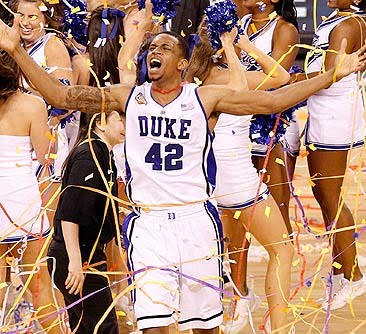
Hollywood hung her head. America stood stunned. Hayward walked silently pass the broken body of Matt Howard. And Duke, alone, cheered their fourth national title.
Then something weird began to happen. You can call it a phenomenon but not one unique to the sport of college basketball. The pain of the loss, the agonizing what-ifs, they all just melted away.
In a matter of moments, perspective filled the air. People were trading stories, everyone was sharing reactions, and you had to tell people what you were thinking as that ball sailed towards the rim.
Duke wasn’t the enemy anymore. They were just the team that Butler almost beat, the lesser half (oddly enough) but essential none-the-less piece of the near perfect moment. We didn’t mind Duke accepting the trophy. Somehow, this story felt like it had its bookends, even with Butler huddled beneath the party in their visitor’s locker room.
And what more could you ask from a game? But, yes, unfortunately, Monday night was more than just a game.
The tides are changing in college basketball. Influxes of forces are merging to cyclone status and I can not tell you for sure what the end product will look like except that it will look different.
This is what was present in my mind as Hayward tried to finish the dream.
We were treated to the best of college basketball this March. So many enduring images are going to last through the years whether its Huggins cradling a hysterical De’Sean Butler; Korie Lucious being carried off the floor as Coach Izzo gave ways to tears after beating Maryland; the Farokhmanesh dagger against Kansas; the Prince salute, or the 40 foot Crawford bomb (complete with Gus Johnson backing vocals) to force double-OT.
Call me nostalgic, but everything about this experience matters to me from the charming piano interludes of the Masters to the final images in One Shining Moment. I feel as if I am spending time with old friends again and again.
When I was a kid, the Final Four was the ultimate, and I mean the ultimate, fan experience. Kids walking on clouds, getting their one shot. The build up was so epic and the moment so surreal. It all came to a crescendo at that jump ball on Monday night.
No one will ever understand how much Miles Simon or Anthony Epps or Scotty Thurman or Toby Bailey or Donald Williams mean to me. I have seen the Chris Webber game well over 20 times. I cried when Camby’s Minutemen ran into the Kentucky Train in East Rutherford. I still wish Edgar Padiglia and Donta Bright got one more chance.
I remember not believing my eyes when Vince Carter pulled his jersey out of his shorts and bent down to kiss the Alamo-inspired Final Four emblem in his last college game, or the time the “Comeback Cats” ended Wojo’s career in a sea of tears. The NCAA tournament has always just meant that much to me.
And here we are in 2010, and it will all change.
The chaotic expansion of the most beloved tournament in sports is all but a formality at this point. We will see 96 teams battle it out next year. The entire landscape of the game will change and that is just the beginning of the problem.
College basketball is far from perfect. Where do we start? The Calipari chop-shops? The Tim Floyd/OJ Mayo scandal? The one-and-doners? It is all there for us to see, but it has always been digestible due to the fact that this perfect tournament brought it all back home.
A 96 team tournament completely alters the college basketball landscape.
So what makes 64 (read: 65) so special? Why not go back to 32 or 48? 64 is special because of the way the game is played. You have 32 conferences. That is 32 Automatic bids. Then there are 33 At-Large Bids. These At-Large teams deserve a chance because they earned it through the season.
Michigan State and Purdue lost in the Big Ten tournament but dominated the regular season. They deserve to play in the tournament. I think we can all agree on that. And where 64 beats 48 is in symmetry. 64 teams need to win six games to win a national title. No byes. High seed vs. lower seed. Survive-and-advance. It works.
Expansion hurts the game in profound ways. Take this years NIT tournament. North Carolina played in the NIT Final. At the selection of the field, Carolina was 16-16 with a 5-11 record in the ACC. Ah hem.
That is not a year to be celebrated with a title shot. But next year's North Carolina will be playing for a national title. I’m sorry, they do not deserve it. Could you make arguments that Dayton or Mississippi State deserved it? Yes, absolutely, and I would say both teams could have made dents in the brackets.
What will happen in a 96 team tournament is more mediocrity will be introduced. OK, so we lose the NIT. Am I supposed to be excited about Ohio University playing Seton Hall? Seton Hall was laughed out of their home arena in the NIT by a Texas Tech team that was far from impressive. Please, please, please, leave that in the NIT where it belongs.
No offense, but it is not National Championship basketball.
The lowest seeded at-large bid this year was a 12. If you add an additional 31 at-large teams, you won’t be stuffing them at the bottom of the bracket, you will be fitting them in the mix.
What this does for the game is it cheapens the regular season. You can argue the regular season has already been cheapened by conference tournaments but at least we have seen a rise in strength-of-schedule and out-of-conference play.
Bubble teams from the ACC and Big 12 won’t touch a road game in the Missouri Valley and they certainly will never step foot in Hinkle because they have too much to lose. But this is not cause for overhaul.
You can argue that more mid-majors will get their chance. OK, I will approach this idiotic line of reasoning from two angles. First, no. Mid-majors make the tournament for being exceptional. As much as I love them, another 16 mid-majors in the tournament won’t increase the Cinderella-magic, it will cheapen it.
Second, we know for sure, without a doubt, that this decision is completely about money.
When Butler and Duke met Monday, it wasn’t the difference in school size that made it such a David and Goliath event. It was the difference in budgets. Duke resides in the ACC which is one of the most fertile money-producers in all of college sports. The ACC had an athletics budget this year of over $58 million. For basketball alone, their budget was just under $6 million.
Compare that with the Horizon League where Butler plays and the entire budget for all Horizon League athletics was $9.7 million with just over $1.5 million going to basketball.
Money equals recruiting breadth, state-of-the-art facilities, sponsors, quality coaching staffs and trainers, large on-campus arenas, etc. The reason I bring this up here is because it is documented that the NCAA earns the majority of its money from the men’s tournament.
So with expansion looming large and budgets being cut everywhere you look, what makes you believe that open slots will go to small schools? No. Sorry, what you will see is 13 of the 16 Big East teams in the tournament (total number who participated in the Dance and NIT this year). Money speaks.
Really, where does it end? We all let out a collective “aw” when we learned Gordon Hayward was in class Monday morning before the National Championship game but the term Student has all-but been severed from the title ‘student-athlete.’
Another week of games for the tournament means another week of missed classes for these kids, further straining that delicate line.
So this is where we are. As we speak, the fate of this sports future is being decided and its happening no where near a basketball court. Besides the NCAA Tournament changes, we have a pending lockout in the NBA in 2011.
Chances are we will see a huge surge of underclassman going to the pros this year because there may not even be a draft next year. As much as I hate to see it, I am sure this will include Duke's Kyle Singler.
Name three guys from Memphis’s last four years. You probably can’t.
You can tell me Derrick Rose and some guy named Dozier.
These one-and-doners aren’t improving the college landscape, they are exploiting it. And if you open the flood gates this year due to the fear of uncertainty in the NBA, it will be hard to close them again.
All you will need is one or two of these guys to earn guaranteed lottery money and there is no going back.
And this is what we will be left with. Big School A will hire Mr. Hot-Shot-Young-Coach for their basketball program. He will go out and recruit top-tier talent (at whatever means necessary) and bring them on campus for one year. They will get him his 20+ wins and a weekend or two in the Big Dance. Off they will go to the NBA and the next crop will show up.
This is the revolving door we are heading towards.
Money rules the day. As we speak, the CEO of Nike is instrumental in negations to lure Butler coach, Brad Stevens away to coach the Oregon Ducks. Nike is in bed with Oregon University athletics so much its hard to tell where one ends and the other begins.
College basketball will survive in some shape or form and we will still cheer. There will be another De’Sean Butler to fall in love with, another Ronald Nored to shake our heads at when we wonder how the “big schools” let him go, and surely another Duke team to love or hate, however you feel.
Gone will be the peripheral fans who get excited every March, the old school fans who despise change, Laurie from accounts payable who fills out her bracket based on places she’d like to visit. I guess we can consider them collateral damage.
As worried as I am, there is no doubt in my mind I will still be there twenty years from now. But I really wonder who will be there with me? Will my son be there? And if he isn’t, how can I ever show him how good this one shining moment once was.

.jpg?w=3840 "Former Basketball Player Charged")
.jpg?w=3840 "Biggest FA Mistakes of the Century 💸")