
The Converts: Five Rugby League to Rugby Union Success Stories
By (Correspondent) on April 5, 2010
806 reads
It isn't uncommon in Australia or New Zealand to see a Rugby Union player change codes and try their arm at the more lucrative Rugby League. It is, however, a bit more uncommon to see a League player convert over to Rugby Union.
The games are so similar, yet so different. They require similar skills in the way you run, pass, and kick the ball, but the way you use these skills varies between the two codes.
Rugby Union is a lot more technical than League, which is where most converts find they struggle. They find that they're unsure when to commit to the break down and when to hang off. They can also be a bit "brainless" at times, trying to do fancy things that they might get away with in League, but in Union they are scorned for simply trying it.
This article profiles five of the most successful players to convert from Rugby League to Rugby Union. There haven't been many who have done it successfully and it was hard filling the last few spots, but I think this list is a good representation of the most successful converts of all time.
Just a footnote, I decided that in order to qualify for this list the player had to have played at the top level in both codes. For example they might have played NRL and Super 14 or Super League and Heineken Cup.
Lote Tuqiri
OK, so he wasn't the greatest Union player. But he did have a big impact on the game and was influential in the Wallabies World Cup team in 2003. Tuqiri debuted for the Brisbane Broncos in 1999 as a 20-year-old. He was part of a formidable side that included fellow convert Wendell Sailor, Darren Lockyher, and the great Allan Langer amongst others. It didn't take Tuqiri long to fit in with these legends of the game however, which was proven as he was voted the Broncos Rookie of the Year. In the coming years Tuqiri would make his name as one of the most dangerous players in the game, winning the 2000 premiership and gaining selection to the Maroons State of Origin team and the Australian National Side. It came as a surprise to many then, that Tuqiri announced he would be switching to Rugby Union and playing for the New South Wales Waratahs for the 2002 season. His transfer was initially a success as he proved to be a handful for opposing teams and seemed to be a likely candidate for a Wallaby jersey. He got his jersey in 2003 as he was part of their World Cup side that came second, scoring a try in the Final against England. Tuqiri continued in Union for the next four years, but things didn't go as smoothly as his first two seasons. He was criticized for being brainless, and it seemed teams had worked out how to handle him, as he became less influential. In saying that, this happens to everyone as other teams analyze a player's game. Tuqiri's contract with the ARU was terminated in 2008 for violation of team rules. This spelled the end to Tuqiri's Super 14 and Wallaby career. He proceeded on to sign a deal with the Leicester Tigers for 2009. In 2010 Lote Tuqiri re-signed with the NRL, signing a three year deal with Wests Tigers.
Andrew Walker
Andrew Walker's stint in Rugby Union was a successful one. He was a player who could have been more prominent had he decided to specialize in it from a younger age rather than in League.
Walker made his debut at the top level of Rugby League for the St. George Dragons in 1992 as an 18-year-old. He played 18 games for the Dragons before moving to the Sydney City Roosters to play under the great Phil Gould. This turned out to be a successful venture, becoming noticed and establishing himself as one of the NRL's top fullbacks.
He played out the decade with the club before deciding to challenge himself further and switch codes to play Rugby Union. He signed with the ACT Brumbies and by doing so would take the field alongside the likes of Stephen Larkham, George Greagan, and Joe Roff.
His first Super 12 was outstanding, impressing from the back in a Brumbies side that came within a point of being crowned champions.
This was not unnoticed by the Wallaby selectors as he was selected for the national team. He made his test debut in 2000 against the All Blacks in Sydney in arguably the greatest test ever played. He played 10 minutes, marking the great Jonah Lomu.
He would go on to earn seven caps for the Wallabies. His career became shadowed by a drug test that showed him positive for cocaine use and he copped criticism from the public for his drinking.
In 2004 he switched back to League, signing with the Manly Sea Eagles. This was short lived however as he was banned for two years following the positive drug test.
In 2007 Walker switched back to Union again where he played out the remainder of his career.
Berrick Barnes
Berrick Barnes began his career in 2005 playing nine matches for the Brisbane Broncos in the NRL.
He played just one year of League however, before opting to try his hand with the Queensland Reds in the Super 14. Barnes has never looked back and looks to have a promising future in Rugby Union. He played with the Reds from 2006 through to 2009 before transferring to the Waratahs for the 2010 season.
He debuted for Australia in 2007 but really stamped his authority on the test stage in 2009 after having a stellar Tri-Nations. He was one of the bright lights in what was a dark year for Australia rugby.
His ability to play both first and second five-eighth adds to his value and provides a good kicking option outside Matt Giteau for the Wallabies.
Watch this space. This kid is going to be good.
Brad Thorn
Not many forwards even attempt to transfer between the two Rugby codes given the vastly different nature of their involvement in each game and the different body types required.
This didn't stop Brad Thorn, though, who proved he is just as good at one as he is at the other.
Thorn made his NRL debut for the Brisbane Broncos in 1994. Over the next few years he was to make his mark on the game and was rewarded with his selection in the 1996 Maroons State of Origin team. He played in all three matches of the series.
In 1997 he was part of the rebel Super League Tri-Series. He regained his Origin spot for one match each in 1998 and 1999 before playing all three games in 2000.
In 2000 he won the NRL premiership with the Broncos before deciding to return home to New Zealand to play Rugby Union for the Crusaders in the 2001 season.
Thorn established himself as a hard man of the game in the coming years, throwing himself into everything and making his presence felt every time he played.
He was rewarded for his efforts by being picked to play for the All Blacks in the 2003 World Cup. Despite his best efforts, the All Blacks were unsuccessful and lost to Australia in the semifinal.
In 2005 he announced he would return to Rugby League with his old club, the Brisbane Broncos. He stood out once again, playing in all three Origin games in 2005 and winning another premiership in 2006.
2007 saw Thorn switch back to Union yet again, and in 2008 resumed his role as New Zealand's premier lock. To me he has been more prominent the second time round in the All Black jersey as he plays so hard and rarely has a bad performance.
Jason Robinson
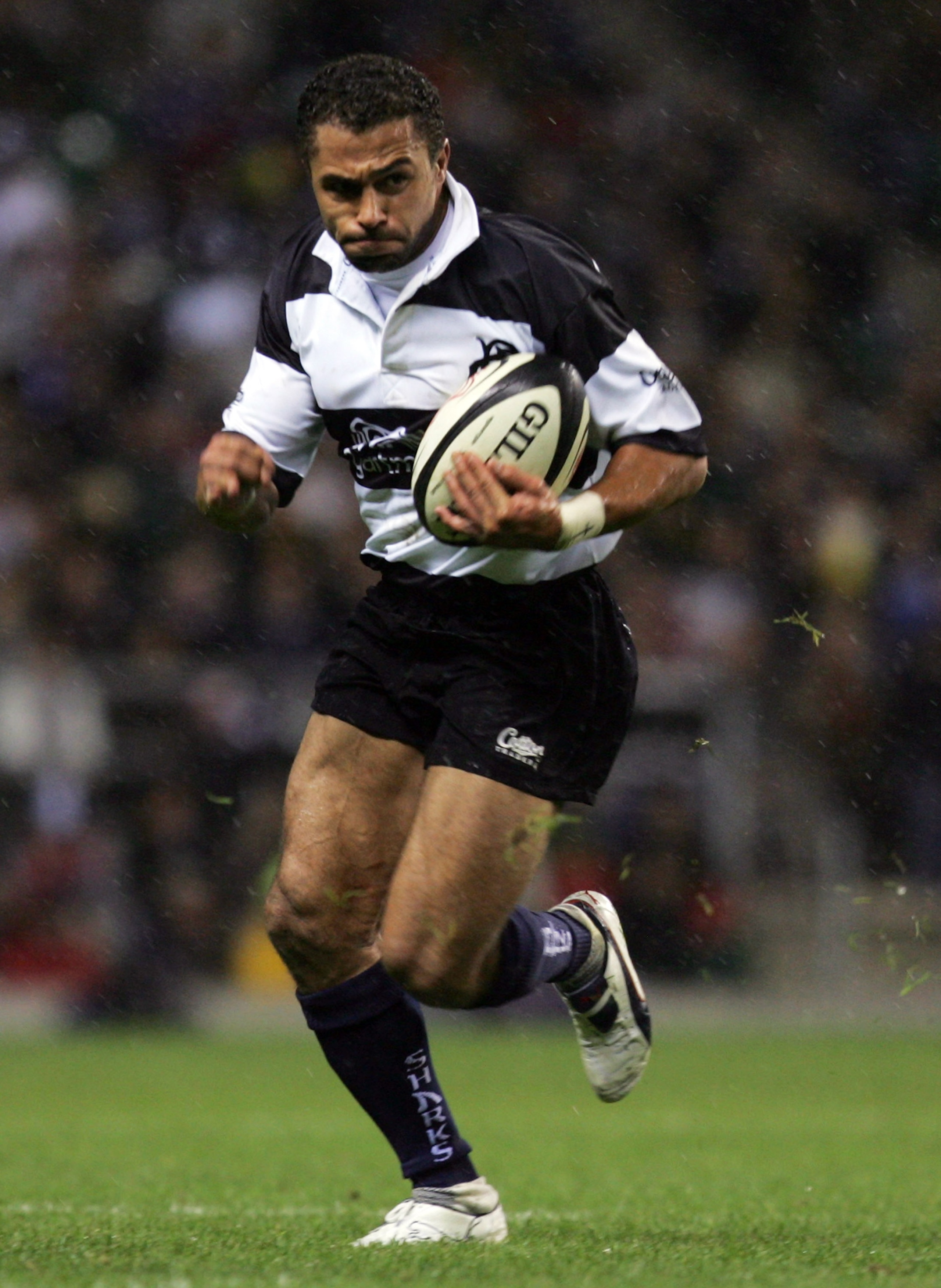
Jason Robinson has been the most successful convert ever.
He hasn't been as good at Union as he was at League—he's been better. His terrific acceleration made him a nightmare for defenses, and he had a good skill base.
He made his first appearance at the top in Rugby League in 1991 for Hunslet. This was short-lived, however, as he transferred to power house Wigan in 1992 after some good performances for Hunslet. He made his test debut for Great Britain in 1993.
When rugby turned professional in 1996 he was offered a contract with Bath. With Rugby League becoming a summer sport in Britain he opted to play both, accepting his deal with Bath. He played just one year with Bath though, choosing to continue to concentrate on Rugby League.
After contract negotiations with Wigan broke down in 2000, Robinson decided to have a second dab at Rugby Union, signing with the Sale Sharks. He impressed straight away, and it didn't take him long to be picked for the England side in 2001. Good performances here saw him included in the 2001 Lions side who toured Australia, playing all three tests and scoring two tries.
In 2003 Robinson was part of the England World Cup winning side, scoring a memorable try in the final where they beat Australia 20-17.
He was once again included in the 2005 Lions side that toured New Zealand.
After being inactive from test rugby in 2006, Robinson staged a comeback to play for England in the 2007 Rugby World Cup.
His form here was sublime and could have been better had it not been for a hamstring injury. His performance against South Africa in their first match of the tournament was to me, his best ever.
He was simply sensational.
On a day that the rest of the side could do nothing right, he didn't put a foot wrong. He left the field in the second half with a hamstring injury, receiving a standing ovation from the crowd.
He returned to the side for their quarterfinal against Australia where they produced an upset, beating the Wallabies 12-10. He played in his 50th test in the semifinal against France, a game England went on to win 14-9. The run came to an end in the Final against South Africa as the side went down 15-6 in Robinson's last test appearance.
Jason Robinson played his last game of first class rugby on Dec. 1, 2007 for the Barbarians. He was a great player of both codes of the game and that is why I believe he is the king of the converts.
What is the duplicate article?
Why is this article offensive?
Where is this article plagiarized from?
Why is this article poorly edited?
Flag This Article


8 Comments
Loading comments...
This comment and all replies have been deleted This comment has been deleted Undo delete