Colin Kaepernick Has a Job
Any given weekend, being allowed to enter the Vintage Lounge seems highly probable, so long as you are 21 years of age and follow the rules of the sign on the door: no ball caps and no beanies, no loose-fitting T-shirts or oversized T-shirts, no baggy pants or baggy shorts, and no saggy pants and no saggy shorts and no sleeveless shirts and no biker vests and no sportswear. The Vintage Lounge is not open on Sundays.
Staring at the poster in the street-facing window here, wondering which clothes are left to wear, I move my hand from up near my heart down into my shorts pocket, grasping for Tanya’s business card. Yes, just three hours ago I ate cheese grits in a West Oakland breakfast haunt called Brown Sugar Kitchen, and yes, the cooks were brown and the servers were brown, and yes, “Harvest For The World” by The Isley Brothers was stuck in my head, and yes, the owner was a black woman named Tanya who had given me a hug because my friend Ryan is her friend Ryan, and yes, the restaurant was on a parkway named after Nelson Mandela—yes, this had all just happened, just this morning, I was sure of it. But grasping reality doesn’t make it any easier to see this sign of the times, during this very moment. In the summer of 2017, following the 2016 that so many endured, to be surprised by discrimination masquerading as the rules of the game, as tradition, is to be harmfully naive.
TOP NEWS
.jpg?w=2560)
New 2027 NFL Mock Draft 🔮
Caleb Changes IG Profile Pic 👀
.jpg?w=2560 "Tyreek Hill Verdict")
Jury Finds Tyreek Hill Liable for 2 Battery Counts (AP)
But if you stop paying attention, even for a moment, you can still get caught with your guard down. Here in America, in the year 2017.
Those grits and smiles and hugs moisturized all five senses as I drove from Oakland to San Francisco 49ers training camp in Santa Clara, and then deep into the torso of Northern California—to a town you’re only ever in for a reason, a place called Turlock. I had come here, having taken note of interactions with dozens of friends and confidantes, following months of unsuccessfully waiting for a sit-down, to gather more perspective on the town’s most famous export: a 29-year-old named Colin Kaepernick.
I park my Kia Soul rental—as appropriately basic as it is blindingly white—on Main Street, across from a hair and nail salon called Paulished, which is promoting a “Botox Party” to take place in three weeks, from six to eight in the evening. The party includes something known as a Juvederm Filler, priced at $475 a syringe, the word “syringe” sitting to the left of the building’s American flag. I stroll across town, rapidly beginning to appreciate its charm, listening. Songs by Train and The Band Perry play through speakers attached to downtown telephone posts. I had never considered a town having a soundtrack, but Turlock certainly has one. “You Found Me” by The Fray whispers above the street, and I almost let the soft rock hypnotize me into giving this town the benefit of my doubt. Walking around, sipping an iced latte, I can understand how someone could live here, almost without a care in the world.
Suddenly, I see another black man in Turlock. I hope he’ll look up from his book so I can catch his eye—so we can do the nod thing—but he never does. Was that “another,” or was that the other black man in this town? My hand is back inside my pocket now, busily searching for Tanya’s business card. It’s gone, as is the charm this street once oozed. Yes, this is a good town, and yes, it is filled with good people—fine people—but this is not the full story; like any strong family with a reputation to maintain and everything to lose, they will put their fingers in their ears, in an effort to erase their secrets and hide their pasts.
Snapping back into consciousness, the desire to uncover the truth becomes addictive—the process telescopic—so I keep walking and find Jura’s Pizza Parlor, which used to display a red 49ers jersey, autographed by the hero of Turlock, in its largest dining area. The number seven hangs upstairs and around the corner now, easy to miss above an arcade claw machine.
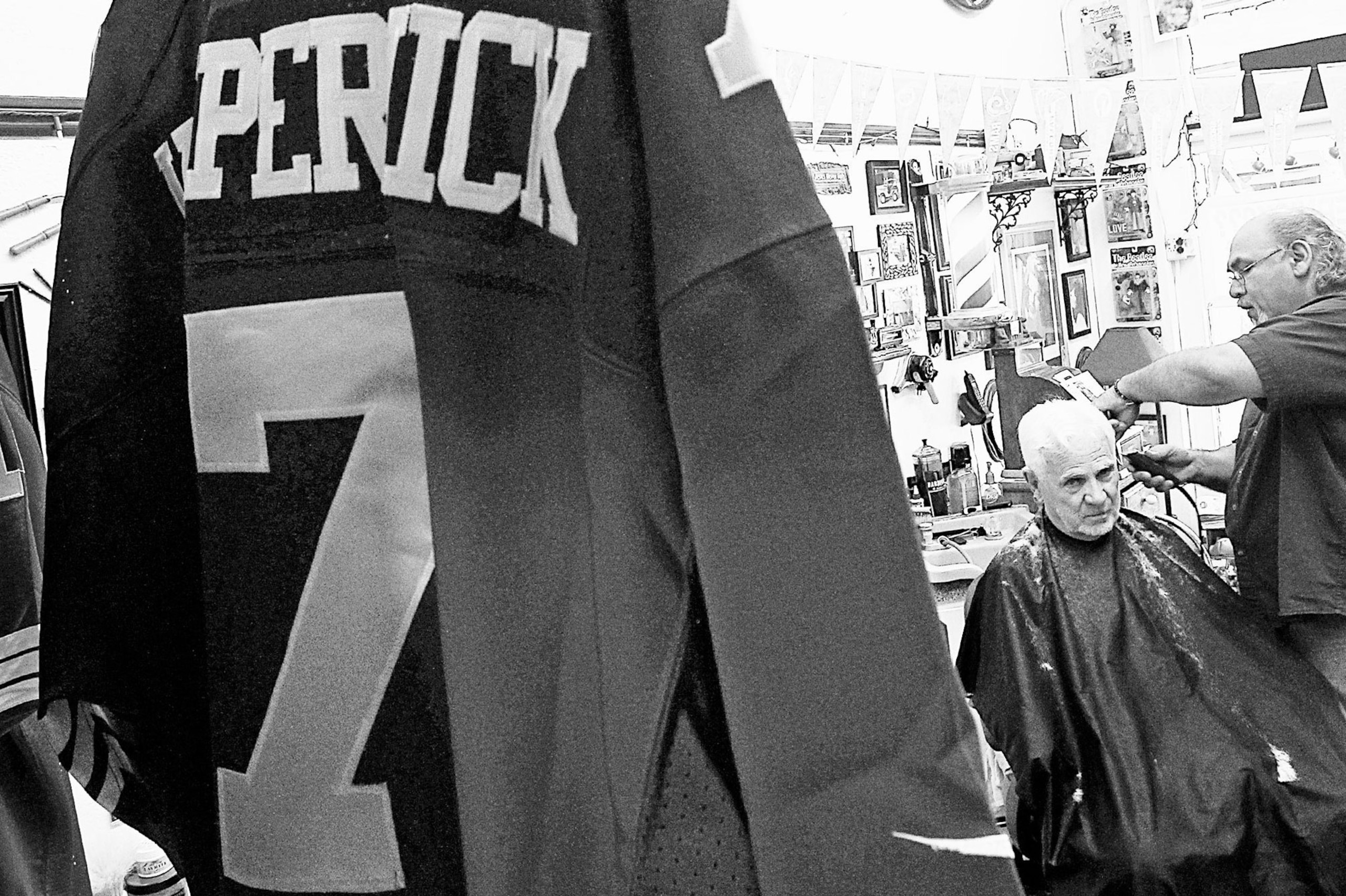
Further down Main Street, past the Vintage Lounge and inside Hauck’s Grill, a signed KAEPERNICK jersey is still mounted in the main seating area. To the left of the bar, in a frame, a collage—the football player’s smile is identical in each photo, Captain America-perfect, atop his sculpted build, like it was on the cover of GQ, the September issue, in 2013. Also in the frame, a ticket for the 21st Annual Mayor’s Prayer Breakfast eight months later, during which Mayor John Lazar refers to the 49ers quarterback as “our favorite son” while presenting Colin Kaepernick, close-shaven in a brown sport coat, with the key to the city. He was loved, once.
Here in Turlock, he absorbed every survival skill necessary to live phenomenally among white people, so expertly that they begin to make assumptions—not that you think you’re white, but that you’ve stopped concerning yourself with That Race Stuff, that you are finally content. It is a commonly unfair expectation thrown upon many an agreeable non-white person in a white space in America. But as a black man with a black biological father and a white biological mother, adopted by loving white parents who raised him in a majority white town to become a star three-sport athlete, a God-fearing Christian and a model citizen, this went well beyond the experience of a privileged American jock. This was a unique finesse, somewhere between Orenthal and Obama.
“I’ve said what I meant,” former President Barack Obama told me once, with a tone. “I might not say it the way I say it if I’m on the basketball court with some of my buddies. But the trajectory of what I’ve said, what I care about around policy, I haven’t had to bite my tongue.”
Colin Kaepernick was treated so well in Turlock, he had an out: Just deny you have a tongue to bite. Don’t be black; just be Colin. Why go the difficult route of being the loud fly in the buttermilk? Chances are that fly drowns, after all.
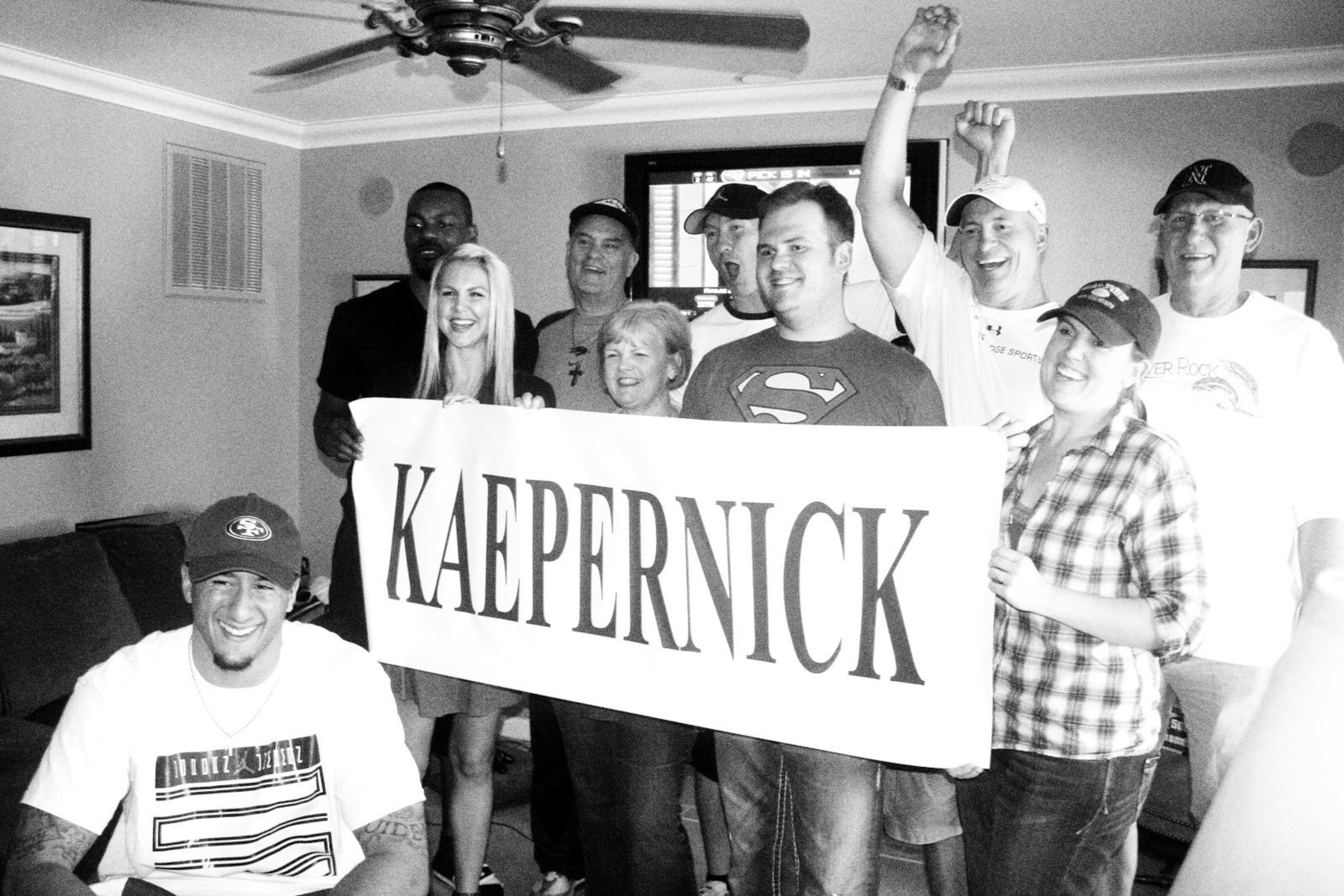
In 1958, two years after the Montgomery Bus Boycott concluded, James Baldwin described the silent indignation he witnessed watching black bus riders sit where they pleased: “The whites, beneath their cold hostility, were mystified and deeply hurt. They had been betrayed by the Negroes, not merely because the Negroes had declined to remain in their ‘place,’ but because the Negroes had refused to be controlled by the town’s image of them. And, without this image, it seemed to me, the whites were abruptly and totally lost. The very foundations of their private and public worlds were being destroyed.”
So when Colin Kaepernick knelt during the national anthem, people here in his hometown were angry—people were angry all over the damn place. Sure, their emotions were tied up in various tendrils of patriotism, but many of them felt burned, duped, hoodwinked, bamboozled. Settling up my tab, the Hauck’s Grill bartender says: “I mean, I don’t know what it is, why he’s got this big head now. When he was in college, he was a gunslinger. And he came out, they went to that Super Bowl against the Ravens. And he blew it. He blew it, man.”
To many white Americans—either irate or disgusted—that is the convenient post-betrayal history of Colin Kaepernick’s year adrift, the narrative that keeps their world spinning on its ever-precarious axis: once a hero, now bad, previously talented, then lost the Niners the Super Bowl, recently radicalized, currently hates the United States of America. And when you add it all up, the solution to the equation: He never existed. It is indeed a drastic change to have happened, at such a murmur, in such a short period of time. For a hero to disappear, after the opportunity of a lifetime—complete acceptance by white America—and with that afro, on that knee, in front of all these people, during blond-haired Jesus Christ’s favorite song, for the black man to turn all these people down. But these are drastic, bombastic times.
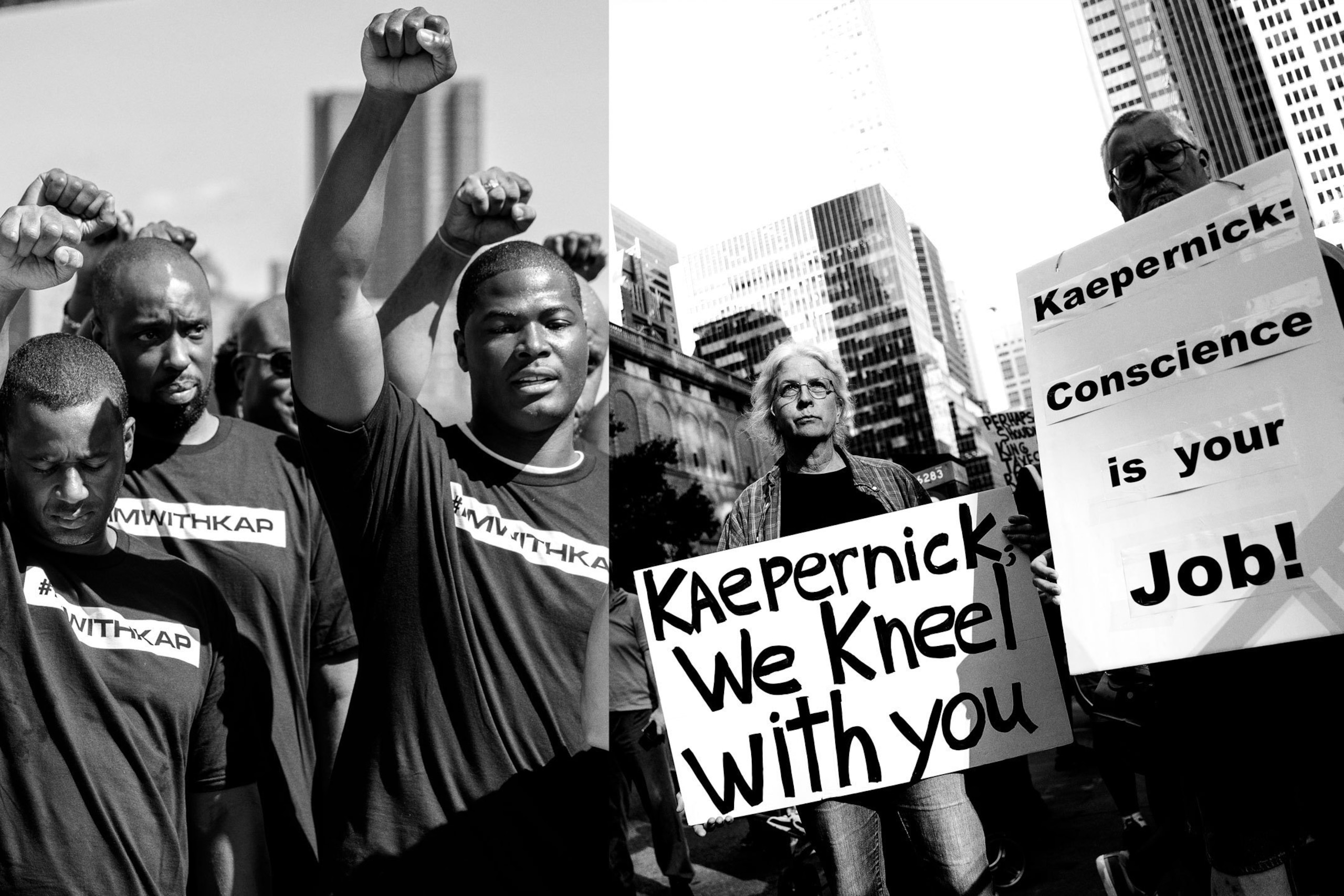
Listen closer, though. Remember everything that has happened to him in these past 12 months, and everything that he has done—a courageous witness in this hostile world. Pay attention to the black and brown people speaking privately with him when he was silent. Take note of the black people, aligning his silence to their public lambasts. Watch, as white people continue the hallowed tradition of undermining a black person with conviction, unafraid. And contemplate what it all means, that people of all backgrounds have taken to the streets to protest his absence from the current NFL season, on his behalf.
You can’t help but feel for this place—America, approaching its 250th year overdue for rehab, damned by the denial that its past is directly responsible for this country’s problems in the present. You feel bad for Colin too, of course, driven away from the game that he loves, the game he was willing to risk it all for. But right now, even and especially if you don’t care about the injury status of starting quarterbacks and the inexperience of their backups, you will realize that the least important important issue is Colin Kaepernick’s employment. This is bigger than him, which is something Colin seems to understand, but so many of us forget. And even if his leadership was clumsy at first, right now he is very much built for this, the life that he has brought upon himself, that he has imposed upon his home, that he has forced upon America.
"The real question which faces the Republic is just how long, how violent, and how expensive the funeral is going to be...
—James Baldwin, 1961
"
“You know when you’re hooping, and somebody’s talking shit?”
I couldn’t wait to hear where this story was going. This was Ameer Loggins on the other line, the Ph.D. candidate at the University of California, Berkeley, known to his people as Left. He was gearing up to make a point about his friend Colin Kaepernick, to whom he’d given guidance for some time, especially over the last year, with whom he’d traveled throughout Africa for a trip most people know only from an Instagram post.
“Or you’re talking shit, and you want to get in their head? So you try to figure out, What angle can I use?”
I was loving this—one moment talking about Critical Race Theory, and in the next, making fun of racist white dudes and calling out opportunistic black folk by name. It was like talking to Dick Gregory, and then talking to Dick Gregory again.
“So you’re like, That’s why your ass can’t go right—you ain’t got no fucking jumper! You’re just trying to figure something out. Just throwing shit out there, hoping something sticks. That’s what they’re doing to Colin, to try and break his silence. Every week, they’re hellbent on trying to throw something out there to egg homie to speak out, to lash out. It keeps them relevant. They’re nervous.”
After spending the end of 2016 speaking on the record—vacillating between sophistication, work-in-progress and nah—Colin went considerably quiet (aside from social media posts), leaving us with months (and months, and months) of opinions, and speculation, and anonymous statements, and conspiratorial conjecture about his motives and his future: Was he the leader of a movement? Simply a cause of it? Or was Colin in fact the movement itself?
It took an aerial photograph, tweeted by a beat writer, to kick-start a movement. It’s a bit like Where’s Waldo?, but this is the artifact, from August 2016, during Colin’s third act of silent activism—his publicly black baptism—that started the avalanche of shit, the longed-for tidal wave of justice.

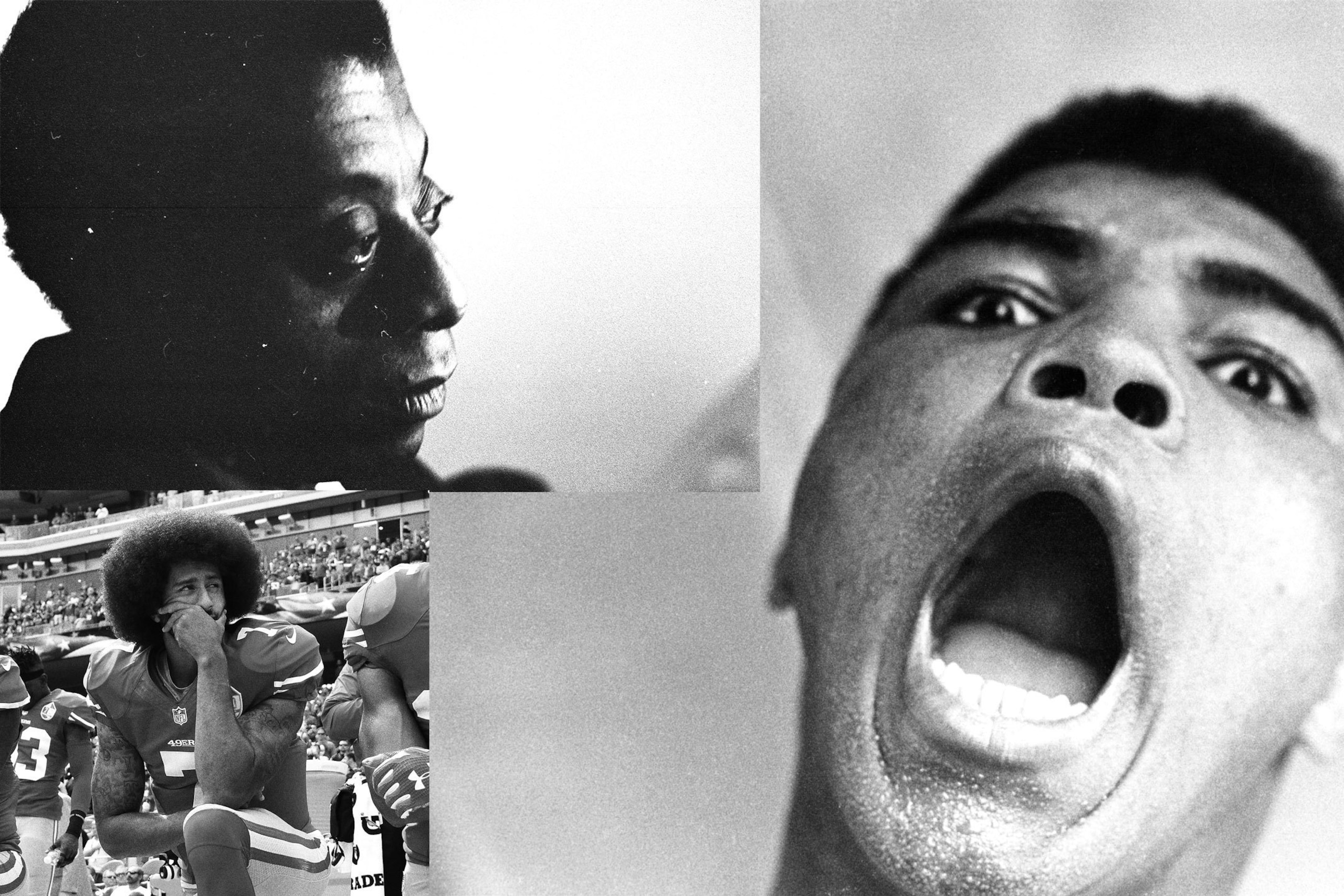
After the game, Colin told the media he declined to stand for “The Star-Spangled Banner” to protest both continued police brutality and the overall oppression of black people and other people of color. Overnight, this sitting on a metal bench rivaled the United States presidential election for public attention, both the inane and the intelligent. The rabid trajectory continued when other players joined him in kneeling closer to the sideline, closer to the gigantic American flags—on his team, and then on opposing teams, and then in non-49ers games, and then in non-NFL professional sports, and then in non-professional sports.
With each passing game, Colin continued to make statements, with his words and his actions. He said he’d donate $1 million of his salary to various organizations. (With another $100,000 pledged on the first day of the 2017-18 NFL season, to organizations focused on supporting the homeless and lobbying for immigration rights and supporting young baseball players and ending child incarceration, he almost has.) He addressed false rumors that he was Muslim. (Which were spread by people who treat that as an insult.) “I don’t want to kneel forever,” he said, but he also knew change doesn’t happen “overnight.” He received death threats, but he also wore socks with police officers depicted as pigs. (He’d been practicing in the socks for weeks.) “Cops are being given paid leave for killing people,” Colin said out loud. “That’s not right. That’s not right by anyone’s standards.”
All of this happened in just two months, between August 14 and October 14.
The country was divided. To discuss Colin was to pick sides, loudly, on and off the field. In one moment, you had 49ers fans chanting We want Kap! during the fifth game of the team’s already abysmal season; a week later, at a Donald Trump rally in Green Bay, portions of the crowd chanted Kaepernick is a bum! At a rally in Greeley, Colorado, Trump claimed NFL ratings were down because of politics, but also because of Colin Kaepernick. The next week, Colin had the best first-half performance by a 49ers quarterback since Steve Young in 1997. It was a breakout game, one that should have been widely discussed. But it wasn’t. Because two days later, Trump won the presidency, after an election in which Colin chose not to vote.
“The nuclear option has never benefited us,” DeRay Mckesson, the activist who first spoke with Colin in 2016, years after his own stint as White Supremacy’s Public Enemy No. 1, tells me. “And when Colin went nuclear on the election, it was just like, You’re not performing blackness, because that’s not fair to you—but you are only starting to understand everything in play.”
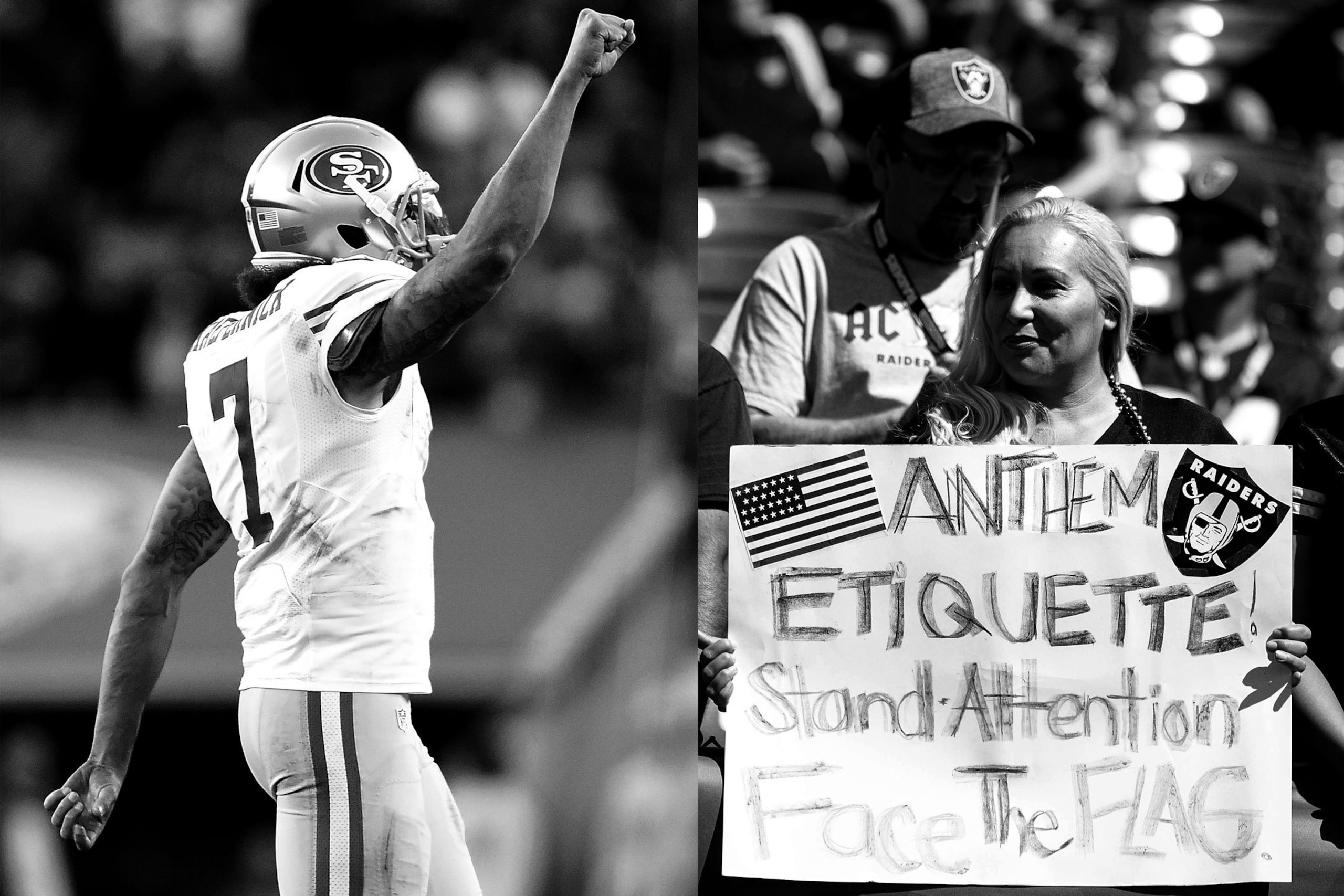
By March of this year, Colin had opted out of his contract with San Francisco (he was going to be cut if he didn’t, according to the 49ers general manager) and had grown quiet—about football. On March 20, apparently citing a column in Bleacher Report, Trump bragged “that NFL owners don’t want to pick him up because they don’t want to get a nasty tweet from Donald Trump. Do you believe that? I just saw that. I just saw that.”
Believe this: When the Seattle Seahawks general manager reached out to his people on May 12, Colin had been working out five days a week, sometimes more. The Seahawks flew him out 11 days later, but did not have him pick up a ball. It seemed like a great fit: a playoff team, a progressive city, teammates who had followed his anthem lead and spoken out about politics and criminal justice. But would that cause a rift in the locker room, with politically active players feeling more aligned to their politically active backup than their notoriously silent starter, Russell Wilson? Was this the type of “distraction” teams feared?
One person familiar with NFL team dynamics stressed to me the importance of coaches finding allies and leaders within the offense and defense, but also among the white players and black players. This person, a white man, says that the issues surrounding Colin’s NFL unemployment aren’t as complex as the media has made them out to be—that teams feared he would further complicate the already strained race relations in any locker room in the National Football League. That Race Stuff was already a thing, apparently.
Steve Wyche, the black NFL Network journalist who broke the anthem story into the open, tells me he believes the exact opposite to be true: “It seems to me that, the more the conversations that take place, it’s become less polarizing. I’m not saying Colin Kaepernick would work in every locker room, but that’s with any player—who knows if Aaron Rodgers would work in every locker room, or Russell Wilson? But I can only say that, in San Francisco last year, Colin Kaepernick was not a divisive element in the locker room. His teammates accepted him. It wasn’t a distraction.”
These two football insiders highlight the reality inside white American culture: a crippling fear of the potential for discomfort, coupled with an insecure relationship alongside the unknown. As much because of his protest, then, as what his mere presence represents—the truth—Colin became a liability. And even among those who espouse a desire for equality, most would rather hope for progress to materialize from a comfortable distance, for us all to just shout “unity” at the same time, than be inconvenienced with the hard-hitting reality of our past.
Three days after a public vote of confidence in the controversial would-be backup from head coach Pete Carroll, the Seahawks signed quarterback Austin Davis, who had previously lost his job to Johnny “Football” Manziel, a quarterback with seven career passing touchdowns and seven career interceptions.
When 49ers general manager John Lynch spoke out on July 1, he insisted Colin “make a compelling case as to how bad he wants to be in the league.” It was a convenient campaign to continue, both couched in concern and dripping with deflection, that would leave Colin Kaepernick asking—begging—for a job. Through this lens, it’s easy to assume that’s how players typically get work—by showing repentance, so things can go back to normal.
When you are a minority and refute the notion that you were charitably allowed into a club—that you were being done a favor, not that you earned it—you will be punished, until it has been determined that you have learned your lesson. This has long been sport for white America, long before football. Slavery was for sport. Laws laced in hatred and hypocrisy were for sport. The invisible ceilings and roadblocks and hurdles—sport. The real tradition of this country is a testing of the limits of people of color, to see how far we can be pushed until we either give up (and give in) or fight back (and die).
The remaining option—to persist—is the one that has always been inconvenient for white America. Colin Kaepernick is inconvenient. To persist is to show strength, but also to be unpredictable, hard to define, impossible to control. And to grow stronger with every lash is to become dangerous—a threat not only to power, but to inspire others to follow suit. Leaders of color in this country have long been mythologized by white America when they teach their own to thrive within the confines of current rules, not when they demand that every rule be called into question. “In many ways, he is the quintessential sacrificial lamb,” Loggins says of his friend. “And we’re just trying to not let him get sacrificed.”
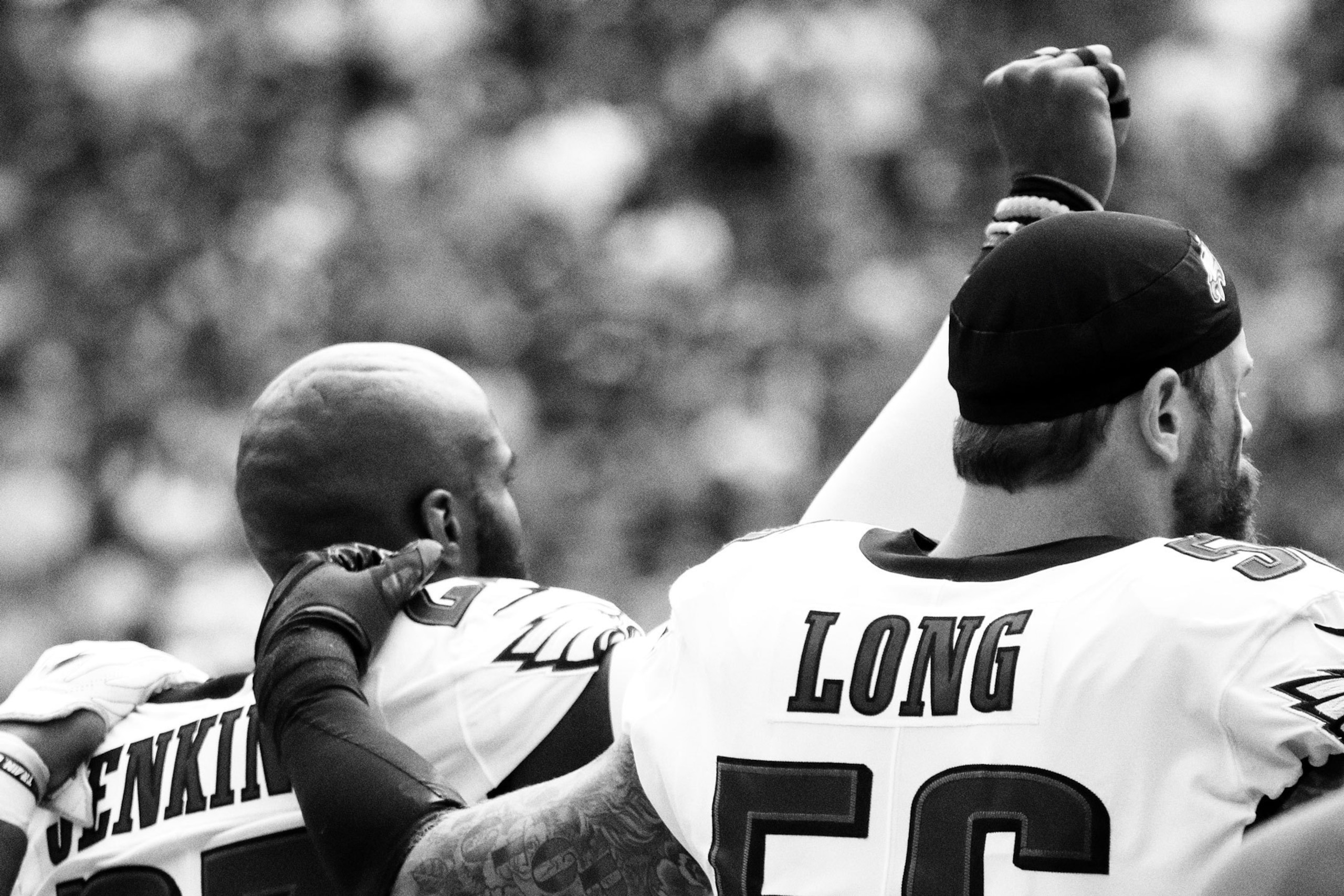
But Colin kept his cool and, thankfully, has still not learned his lesson. Because of that, he still does not have a job in the National Football League. But when the 2017 preseason began, Michael Bennett sat with a towel over his shoulders, during the national anthem. And Malcolm Jenkins raised a fist, during the national anthem. And, yes, the white defensive end Chris Long put an arm on Jenkins’ shoulder, during the national anthem, a song written by Francis Scott Key—a slave owner by inheritance—the song containing a third verse that’s as racist as nearly everything else created before 1865.
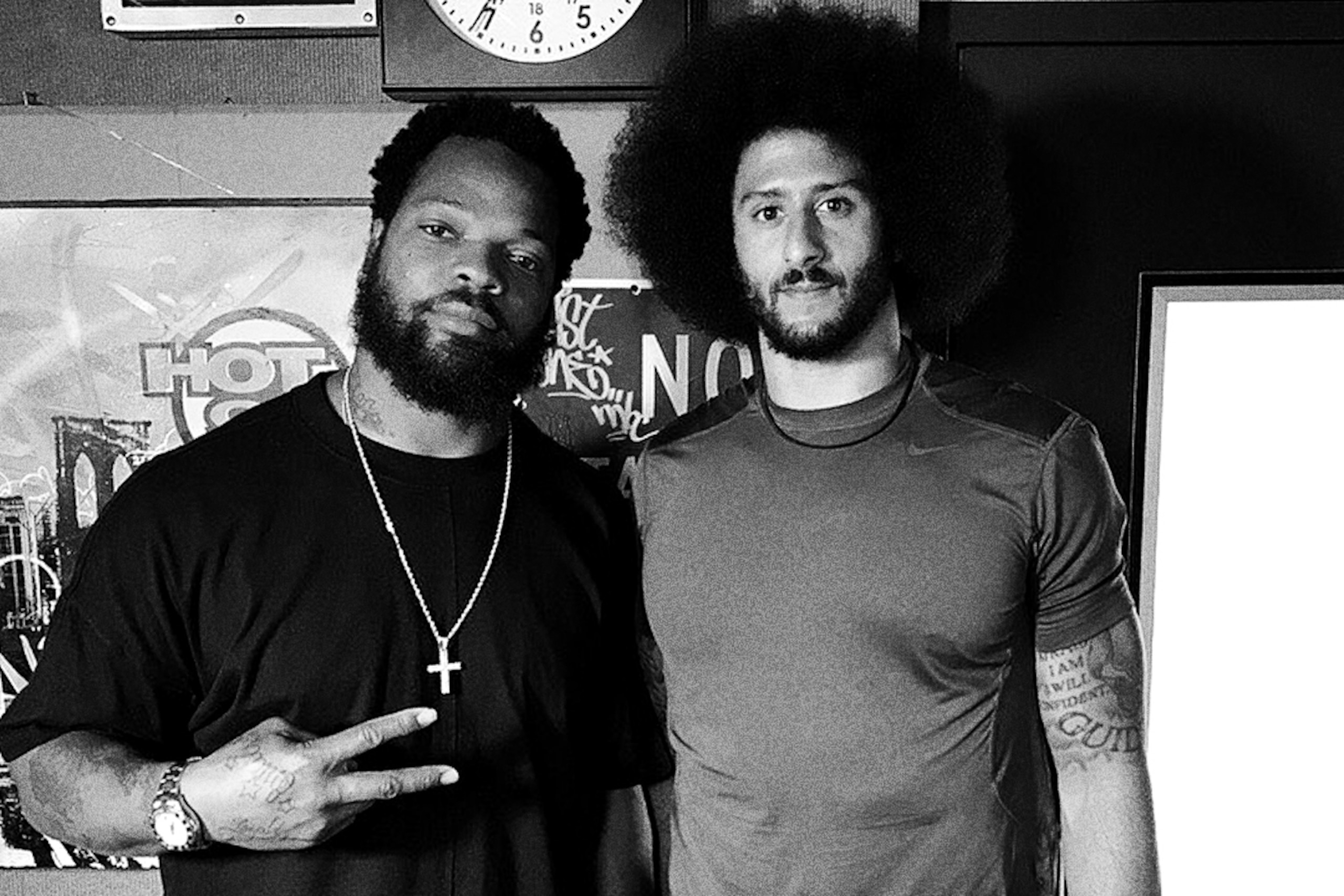
Colin Kaepernick was gone, but he was not forgotten.
I might not get there with you.
But it really doesn’t matter with me now.
I don’t mind.
Martin Luther King Jr. knew his fight was nothing, if it started and ended with him. And while Kaepernick is no King, he may similarly not finish the fight that he began, on the field. But begin it, did he ever. It’s a business, the NFL, well behind the American professional basketball leagues in terms of activism. The WNBA in 2016 became center stage for bold statements about race and policing—on the court, in the locker room, through social media. And not just from the black players, but from full teams. After threatening fines to teams and individual players for speaking their minds, WNBA president Lisa Borders said the league was rescinding its punishment “to show them even more support.” And in the NBA, just this August after the unrest in Charlottesville, LeBron James acknowledged that he “has a voice of command” and used it to call Trump “the so-called president.” The most famous athlete in the world said: “It’s about all of us looking in the mirror and saying: What can we do better to help change?”
NFL players needed Kaepernick to defibrillate the notoriously fossilized league. And they are, with a new group of leaders ready to carry—carrying—his torch on the sidelines, sparked by the endless news cycle of racially motivated violence, of ethnic discrimination, of immigrant fearmongering. Jocelyn Benson, CEO of the Ross Initiative in Sports for Equality, sees the sheer number of players still employed by the NFL—70 percent of whom are black, as of this time last year—as an activist advantage. “You’re going to see a diversity of tactics, opinions, priorities,” she tells me, “and it’s great to see these players expand in the number of ways they’re using their voice to advance change.”
That was where this story was going, a year after Colin first sat during the anthem. And then, on the eve of a nerve-wracked new season, video surfaced of Bennett pinned down by a police officer as he screams, declaring innocence. The same Seahawks player who had sat during the national anthem—who planned to keep sitting, who was “not going to be standing until I see the equality and freedom”—was now on the other side—on the sidewalk—as an alleged victim.
“I don’t think this is going to end,” Wyche, who spoke to Bennett before the start of the regular season, tells me. “As much as the police killings of Philando Castile and Michael Brown inspired Kaepernick and this first wave of people to protest, Charlottesville was kind of a trip wire for a lot of other players—and now, with the situation with Michael Bennett in Las Vegas, I just think it’s going to crank things up even more.”
He was right. Because four days later in Green Bay, I knelt in front of Bennett, both towering and soft-spoken, following a Seahawks loss to the Packers, before which he sat during the national anthem. The public support for his ongoing protest, Bennett told me, “has motivated me to keep going—keep pushing.”
"The fact that King really loves the people he represents and has—therefore—no hidden, interior need to hate the white people who oppose him has had and will, I think, continue to have the most far-reaching and unpredictable repercussions on our racial situation.
—James Baldwin on Martin Luther King Jr., 1961
"
“There’s a lot going on, intelligence-wise, between his ears, that some people just don’t seem to give him credit for. He was real serious about things, he wanted to be the best—it was probably always there.”
A longtime friend of the Kaepernick family from Turlock was off to the races, telling me Colin’s life story. There was a calm in his voice when he stuck to the facts, but the apprehension of small-town pressure arose when he waded into the waters of opinion, even as he spoke with unshakable pride. He told me about how, growing up, Colin had been recognized less for football than for baseball. (He once threw a no-hitter, with pneumonia, and was drafted by the Cubs.) The friend told me how, growing up, Colin loved Brett Favre. (He had a No. 4 jersey.)
The family friend’s excitement was a reminder of who Colin once was—before he really was on his own, before he really had fame, before he really had money, before he’d been championed, misrepresented and villainized, in front of an entire nation—as a boy in Turlock, California; as an educated young man in Reno, Nevada; and who Colin yet may be, as an activist in New York City.
Colin wasn’t just another star quarterback; he was his school’s first star. John H. Pitman High had been in existence for just four years when, in 2004, he won the town’s football rivalry game against Turlock High, the Harvest Bowl. He won it again the next year and, after an assistant football coach at the University of Nevada watched Colin excel in a Pitman basketball game while running a 102-degree fever, headed to Reno on a football scholarship.

His football success began a trajectory to the NFL. (He also won the Wolf Pack’s “Fireman Award” for stepping up to replace the injured starting quarterback as a freshman.) But at under 4 percent black (the city of Turlock, according to the 2010 census, is 1.7 percent black), the University of Nevada-Reno was Colin’s Black Mecca. Here, he found black people, but also physical spaces, like the Center for Student and Cultural Diversity, to be comfortably black.
As a junior in 2010, much later than most and rarely for a quarterback at the university, Colin joined a historically black fraternity, Kappa Alpha Psi. He pledged, alongside his teammate Brandon Marshall—currently a linebacker on the Denver Broncos—who knelt for the anthem last season, lost two endorsements and continued to kneel. Joining a black Greek letter organization at a primarily white college is an act of resistance—it’s fringe, it’s typically exclusionary and, most dangerously, it’s founded in pride through a lens unconcerned with white America. These are the decisions that make you confusing, that make you difficult to be controlled, that can prepare you to exist, comfortably, in both a black and white world, unafraid of both black and white people. Turlock did not see this, and neither did football fans.
“He still talks to us, he’s still our friend, we’ll go out to his house and hang out with him,” Gregory Elliott, a sophomore Kappa at the University of Nevada, told the school’s website during the 49ers’ Super Bowl run in 2012. “I do see him as a positive figure to young black men and young men in general, just to show what hard work can do, and how a person can persevere through life.”
If you become so engulfed in the present, it’s easy to forget just how immense the popularity of Colin Kaepernick was, once. During that Super Bowl run—after 49ers quarterback Alex Smith went down with a concussion and Kaepernick stepped in, and showed out—“Kaepernicking” became a thing, an ancestor of the dab, only with the added flair of a kiss to the bicep. GQ deemed him the most stylish player in the league. He became a very visible spokesman for Beats and secured an endorsement with Electronic Arts. He was likable, but he also exuded a confidence many took as flash without substance, the undertone being that Colin was dumb, that his motives were not to be trusted. His array of tattoos (they’re mostly religious) led one columnist to write: “NFL quarterback is the ultimate position of influence and responsibility—he is the CEO of a high-profile organization, and you don’t want your CEO to look like he just got paroled.” Colin was a target.
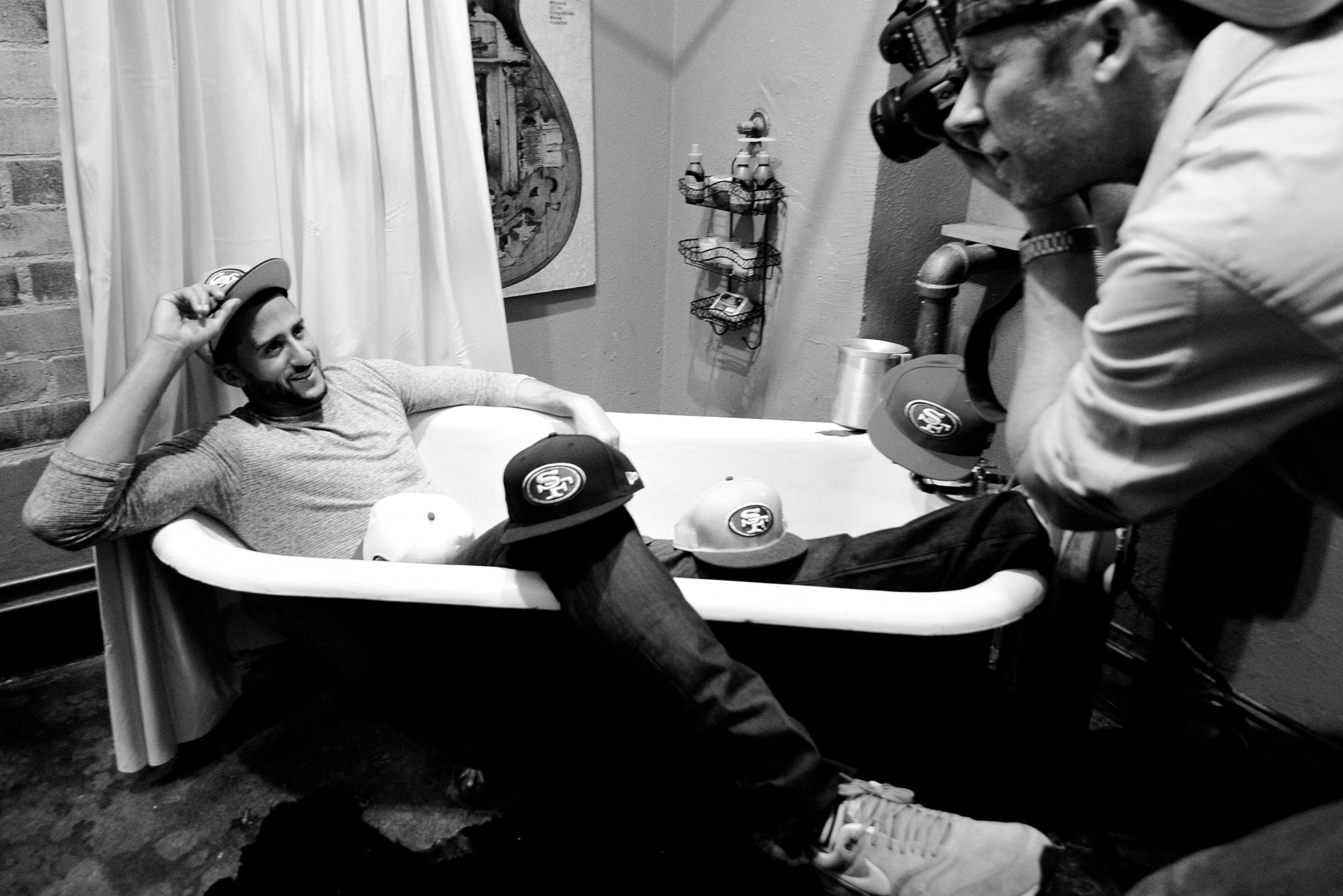
The 2014 NFC Championship Game was an important game, culturally, in football—two young black quarterbacks were vying to make the Super Bowl—but it was also meaningful, in the way their existence—and assumed values—were pitted against each other as archetypes. There was the side-by-side comparison of their Instagram photos, with captions outlining the “good” (Russell Wilson) and the “bad” (Colin Kaepernick). There was the caption pointing to Wilson “Hanging Out With His Best Fans,” and then a “Hanging Out With His Best Friends” next to an image of Kaepernick with clothes and shoes, some of which bore his likeness. There was Wilson, hanging out with a dog, next to Kaepernick, hanging out with J. Cole in what appeared to be the club. A Russell Wilson charity event, next to Colin Kaepernick with a private jet. And Wilson, in military fatigues, with the caption “Semper Fi”—next to Colin Kaepernick, Kaepernicking, with the caption “Semper Sigh.” With today’s thirst for polarity, this went viral, obviously.
In just a matter of years, Russell Wilson had become, on the surface, Turlock Kaepernick, while Colin floated into territory we’d never seen before—that of the black athlete who could simultaneously absorb the stereotype of a black “thug” and a white “bro.” During this moment, he was sandwiched between two Seahawks, Wilson and Richard Sherman, who was being labeled a thug, with people coming to a defense of Sherman’s character by way of “he went to Stanford.” Suddenly, the only one who didn’t fit into a convenient slot was Colin Kaepernick.
Unless he was your team’s quarterback, it was easy to not buy into the public brand Colin was building. I certainly didn’t. But I also ached for him, a tough reminder of the reality of being biracial in this country: While often seen as a privilege, because it often is, it can often feel like you are homeless.
Colin was navigating life in the public eye, and most of the judgments surrounding him were based on what you saw, publicly. But the reserved young man, that curious guy from The Center in Reno, he never left. And there is yet—or is yet to be—another side of Colin Kaepernick. If self-discovery and black pride and education are part of one’s past, do not be surprised when they are a part of one’s future.
"They were both very distinguished and promising young people, which means that they were also tense, self-conscious, and insecure. They were inevitably cut off from the bulk of the Negro community and their role among whites had to be somewhat ambiguous, for they were not being judged merely as themselves—or, anyway, they could scarcely afford to think so. They were responsible for the good name of all the Negro people.
—James Baldwin, on the early courtship of Martin Luther King Jr. and Coretta Scott
"
“I like smart, intelligent, good-hearted—a woman that’s gonna stand up for something. Is that you?”
This was 45 days before we first elected Obama, and the rapper Common was answering a question, out in the Bay Area, about why it’s important for “us youngsters” to vote, from the on-air personality—the life force—Nessa Diab. But she just goes by Nessa. And you don’t fuck with Nessa.
Nessa, the DJ, prodded the banter. “Does that attract you to a woman, if she goes and votes?” But the earnestness was true: “I think it’s important that we hear it from you,” she told Common. “Celebrities always make an impact on the youngsters.” Nessa, the activist, brought up his pledge to stop using “nigga” and anti-gay lyrics in his songs.
While her future boyfriend, Colin Kaepernick, was still in college, passing and running for touchdowns and just beginning to scratch the surface of his identity, Nessa was already in the early stages of an accomplished career in radio, questioning famous people about who they were, really, or wanted to be. At 20 years old, she had earned political science and mass communications degrees from Berkeley. She had experience—exposure—in politics and culture by the time she began dating Colin in 2015, at age 31, while splitting her time between MTV and the legendary New York radio station, Hot 97.
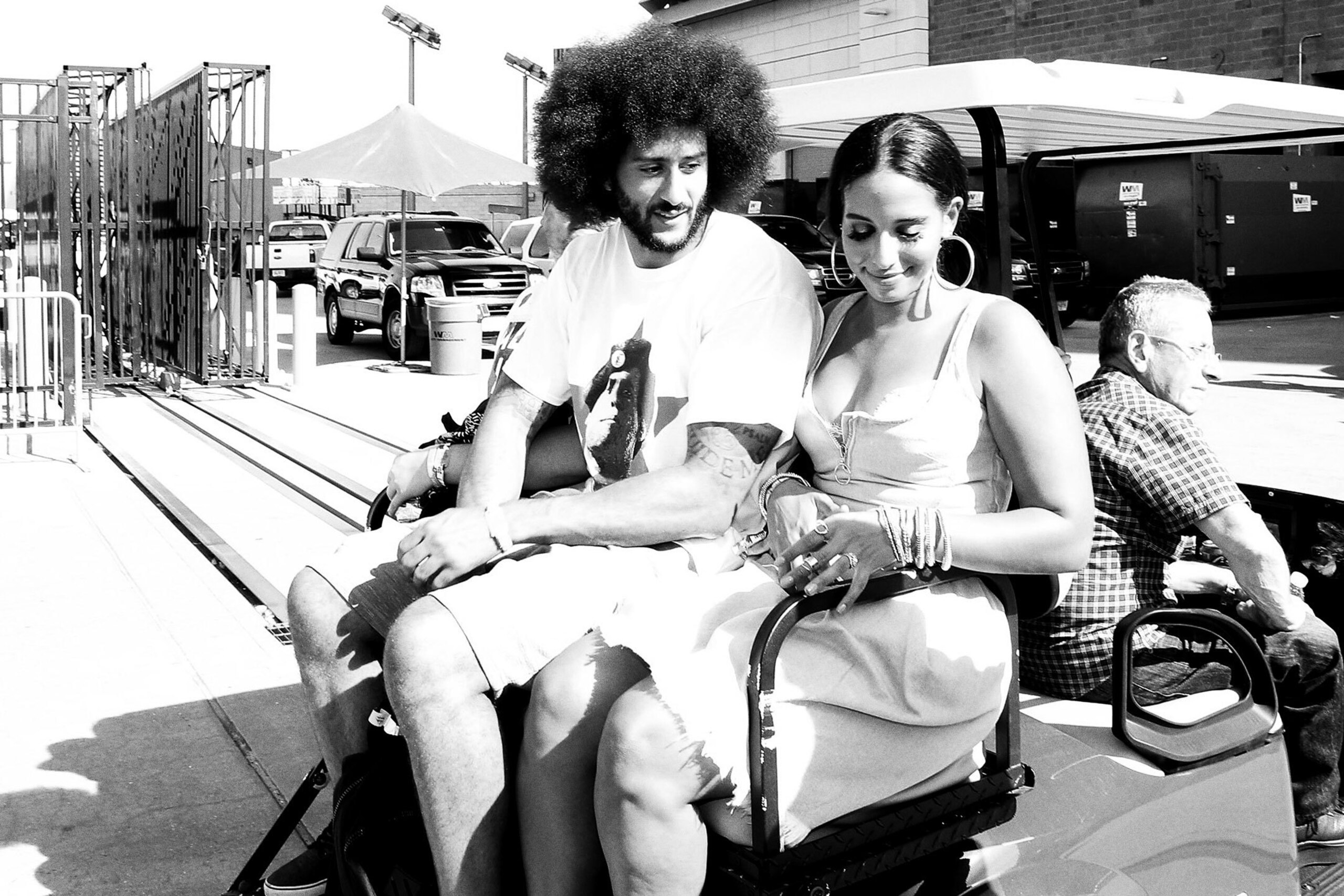
As their relationship began to blossom, Nessa introduced Colin to a classmate of hers from Berkeley who held a master’s in African-American Studies and was pursuing his doctorate in African Diaspora Studies: Ameer Loggins. Left.
“Nessa wanted to have him in contact with people who she could trust not to steer him in the wrong direction,” he tells me, “but also to not exploit him to use him as a stepping stone for some capitalistic gain.”
Loggins took on a role as Kaepernick’s educational advisor, influencing less what his opinions should be, guiding more toward which ideas and beliefs exist. “Me and Colin started talking,” says Left. “And I gave him The Autobiography of Malcolm X. Black Feminist Thought by Patricia Hill Collins was a text. Frantz Fanon’s The Wretched of the Earth was a text. I might have said Ain’t I a Woman. But what I was really trying to do was give a well-rounded presentation—to develop a more nuanced framework to build upon.”
These conversations—this exposure—took place before Colin ever took a knee. Before the protests, while he was still studying the 49ers playbook and doing game-tape sessions and thousands and thousands of stomach crunches in the summer of 2016, Colin audited one of Loggins’ classes at Berkeley on black representation in popular culture. “He was on time every day,” Loggins says, “and then would drive back to San Jose.”
When Colin’s protests began a few weeks later, a common reaction was that something—or someone—had gotten to Colin Kaepernick, to make him break the rules. That he’d changed, been brainwashed—that this isn’t the Colin I thought I knew. And this is not just in the increasingly open borders of the right-wing conspiratorial internet, where the Obama Is Kenyan section, which became the Black Lives Matter Is A Terrorist Organization section, is now the Kaepernick section. This is Steve King, who sits on the Subcommittee on the Constitution and Civil Justice of the United States Congress, saying, “I understand that he has an Islamic girlfriend that is his fiancee and that this has changed him and has taken on some different political views along the way” as well as “this is activism that’s sympathetic to ISIS.” This is Ray Lewis, who met with the president-elect at Trump Tower and who still has a job talking about football on television, saying that the Baltimore Ravens decided not to give Colin Kaepernick a multimillion-dollar job playing football because “his girl goes out and put out this racist gesture” on Twitter, which is a mess if a lie, a mess if the truth.
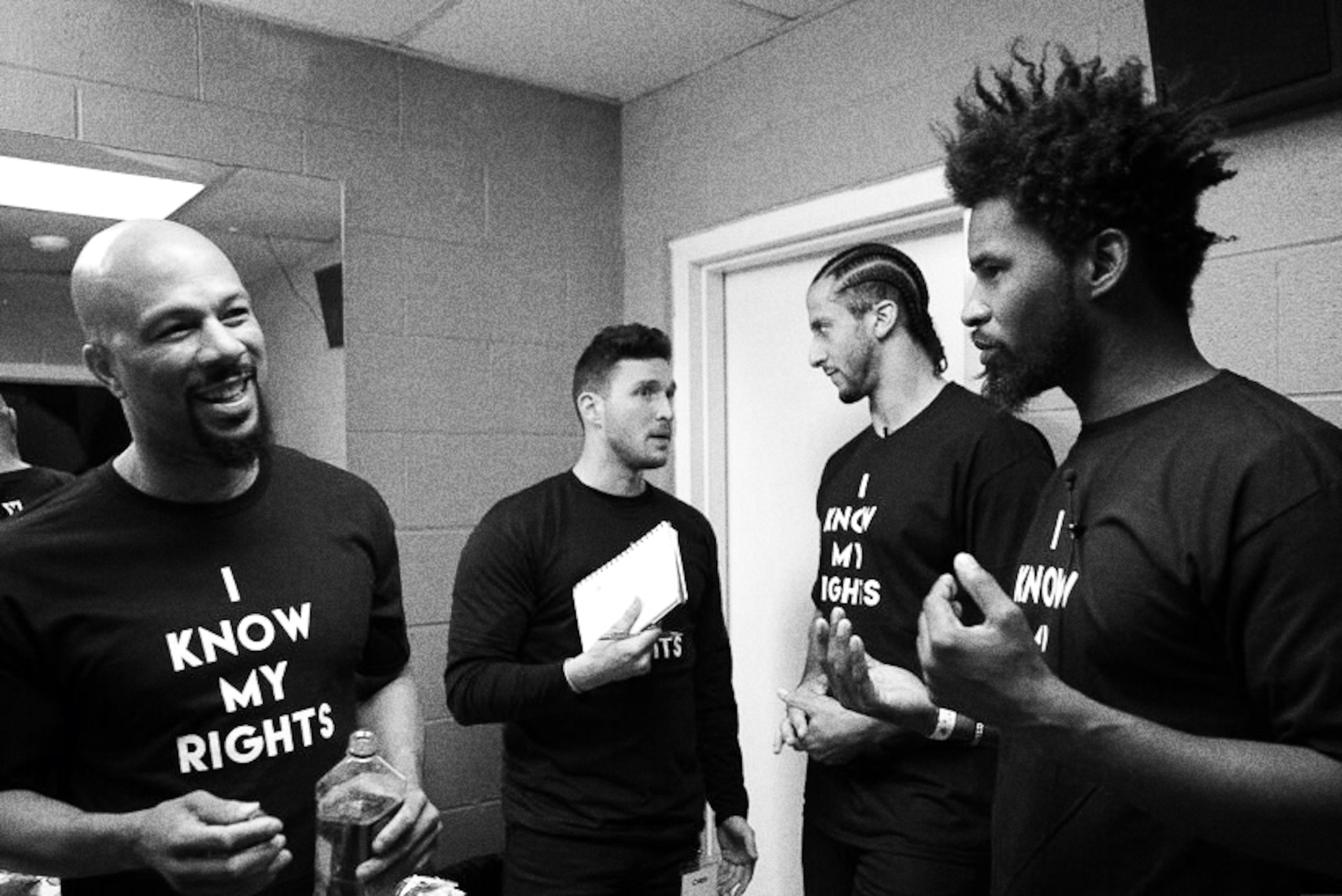
I’d been told theories about the brains behind Team Kaepernick, sometimes as a compliment, sometimes as an insult: “It’s Colin, but it’s really Nessa”; “What he’s doing, it’s all that dude Left.” The ideological homonyms echoed the simple sentiment—that a guy like Colin Kaepernick, intellectually, is easy prey. And when those kinds of assumptions are made in your direction, deriding your credibility and jumping to the assumption of either ignorance or radicalization, the natural human urge is to defend yourself.
But as the negative commentary piled up, Colin retreated. He bit his tongue a little, in the way Obama falsely claimed he himself had not—inviting not just attacks but legitimate questions about his mission, about a long-term strategy that no one could see, that we all thought we needed to see, that none of us deserved to see. What is he doing? What is he learning? What is he?
After a spring of being pitched to Team Kaepernick, as “the writer” of “his profile,” I began to allow the persistent hesitation of his people, their public clumsiness, to allow for an objective summer. When Nessa hosted a block party in Brooklyn with Reebok, I strolled through—and stuck around—even after I was told she had left. One morning, hours before her afternoon show at Hot 97, I hovered around the studio on Hudson Street, not far from her and Colin’s TriBeCa apartment building. As the summer, and Colin’s football unemployment, dragged on, a mutual acquaintance was asked by Team Kaepernick to decline an interview with me. Again and again, still, I’d float to people in Colin and Nessa’s inner circle that they still hadn’t talked to me—we’d talk about how foolish they were, how they didn’t get it, how it was important that we heard it from him.
Behind the skepticism of his public silence, however, Colin was speaking with people, making friends with figures he thought he needed to know. Colin wasn’t campaigning as an attempt to win over the court of public opinion. Colin Kaepernick just needed to get much better at thinking and speaking on behalf of Colin Kaepernick.
Mckesson likens his early role to being a “celebrity switchboard” of sorts. “He asked me to put him in touch with Kareem Abdul-Jabbar, Mike Brown’s mom—I put him in touch with Solange, Jesse Williams; it was random,” Mckesson tells me. “But wait until you talk to him—he’s so malleable and he’s so kind. That’s why I feel bad for him: He’s like, ‘I just want to do right.’”
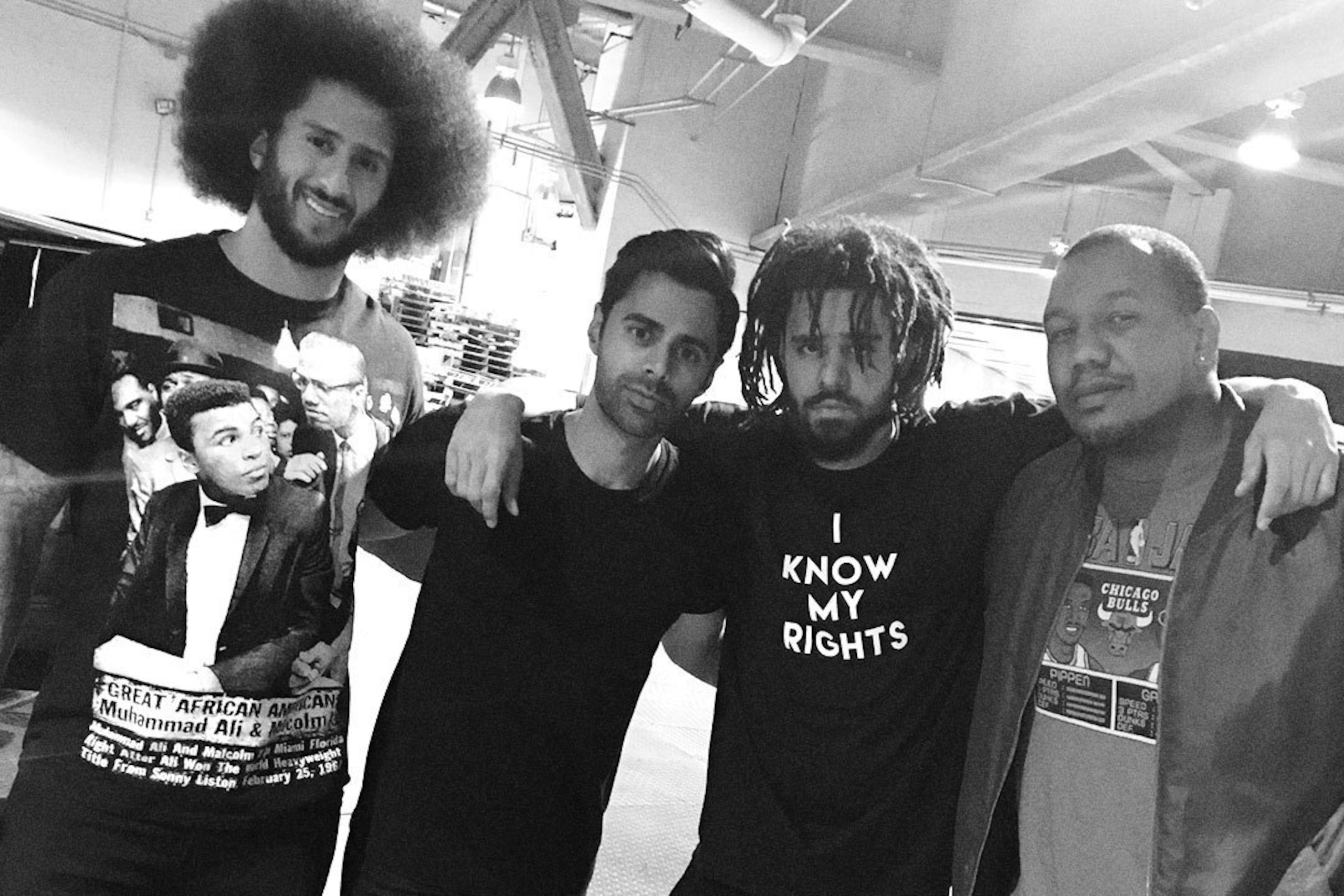
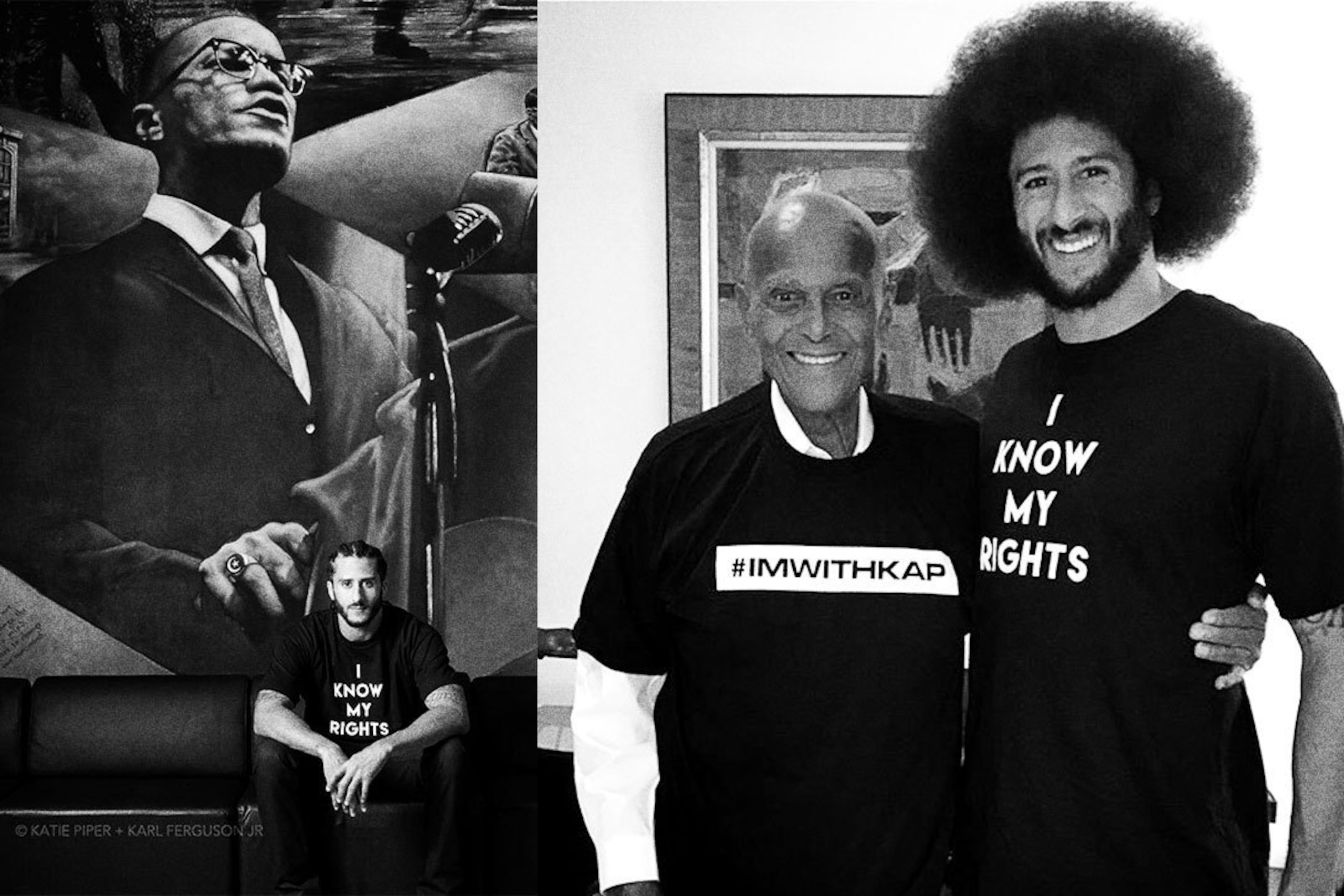
In August, for example, the Full Frontal with Samantha Bee writer Travon Free posted a photo of himself, along with the Daily Show’s Hasan Minhaj, Colin and J. Cole, backstage at the rapper’s concert in Brooklyn. Looking at these guys—two comics, a jock and an MC, scrolling by on your feed—you could have mistaken it for a photo opportunity. But look closer—at Ali and Malcolm on Colin’s shirt, at I KNOW MY RIGHTS on Cole’s, at the shorts that say, in sports-jersey cursive, “Dreamville”—and it becomes clear that a necessary conversation ensued. Of course it did. The stakes are too high, and the instances all too infrequent, for four prominent adult men of color not to talk about how we are to survive, in America.
Even the people standing atop the avalanche of shit—at the forefront of the retweeting, free-flowing forum of hateration—can agree that Colin has the “right” to kneel, even though he doesn’t want to kneel forever. By that logic, the same should be true for his silence: that he has every right to grow in private, before he steps out in public. Being black is hard enough. And public blackness is not something you just put on comfortably, like a football jersey. Being publicly black is especially difficult if blackness wasn’t a topic of conversation throughout your upbringing—your home, your school, your church—which, for Colin and his loving, adoptive, white parents, it wasn’t, which makes Colin’s activism on behalf of black people and our systemic oppression all the more intriguing. But here in America, in the year 2017, the kneejerk reaction to becoming, gradually, publicly black—eventually, a public black leader—is that, in silence, you are hiding, not preparing. You either stay inside, until you’re a perfectly formed human being, or you step out and stay out until you slip up and are forced back in. Until you are forced to beg.
And the internet does not know a lamb who’s difficult to kill, so few things are riskier than stepping out before you’re fully polished. That catch-all “woke”—meaning everything and nothing—is overused now, not as a sticker for the well-informed and -intentioned, but as a stamp of disapproval for those who have messed up, and therefore aren’t. To be a work-in-progress is nearly unacceptable, because the currency that drives our culture is not self-improvement, but instead the ongoing erosive process of each person, on each side, designating who is wrong and who is right.
“You’ve got to give people space to develop thought, mature, change course,” the political commentator Angela Rye tells me, about Colin, about all of us. She, like many, was a vocal supporter of Colin, but had a moment of skepticism after he proudly spoke about not voting. The days (and weeks, and months, the year) after the election were an easy time to point fingers, considering the outcome. “But after the anger,” Rye says, comes the process of remembering the people who truly caused change in this country. “All of our advocates and protesters and agitators don’t come from perfection.”
"The real role of the Negro leader, in the eyes of the American Republic, was not to make the Negro a first-class citizen but to keep him content as a second-class one.
—James Baldwin
"
“I tweeted about it,” the singer John Legend told me this past July—it being “The Star-Spangled Banner,” the reason being to question its history, to suggest perhaps a different song for this country to rally around, to show solidarity with Colin. Reflecting on the responses, Legend noted a frequent undertone—“this sense that we should be grateful to this country. Like we’re guests here, and should be more gracious guests, with the tone that we should be grateful that they tolerate us being here.”
“There have been a lot of great things that have happened for black people here,” Legend went on. “But it’s always going to be a bit of a conflicted feeling, because America has been really shitty to black people, for a long time.”
Legend was riled up for Colin—about how “it’s challenging to be this bold, publicly, about something like this,” and how proud he still was of Colin, whom he’d met when Colin was doing press at the Super Bowl, with whom he’s emailed over the last year. (Legend has not played the anthem publicly since, he tells me, and he’s still not sure he will.)
I thought about Colin’s many conversations with this intelligent black celebrity cohort after August’s unrest in Charlottesville, as a friend of my own—Asian-American—described being called a racist by his liberal, white, self-proclaimed-as-woke colleague, due to my friend’s online criticism of white America. “They need to tell you about everything they’re doing to reduce and fight racism,” he says, “like I should give you a cookie for cleaning up a shit you took in the corner.”
We talked, just hours before I’d had lunch with a new friend, multiracial by definition, black to the stranger, and treated by his elite white cohort as anything but—due to his success, the way he speaks, the company he keeps. “I’m the exception,” my new friend said. “I hate it.”
The clear, overt racism is a beast in itself to fight, without the faux-liberalism further complicating the matter. But the race to unity is, and has always been, a trap. The inconvenience that is Colin Kaepernick brings this denial to the forefront, a presumption that this country is anywhere near a hug. We’ve talked about shit, but we haven’t talked through anything. For white Americans to accept that things are bad—and then just jump ahead to kumbaya and #ImWithKap—is a profoundly deep-seated defense mechanism for hiding from what white America did, and continues to do, to the rest of us. The artist Kara Walker recently wrote “You Must Hate Black People As Much As You Hate Yourself” as a subtitle for a new work, but it could be this country’s permanent headline.
The truth hurts white people. Colin Kaepernick has hurt white people, and that is why it’s convenient to banish him, because he holds America’s worst nightmare: the mirror. And while the genuine apologies from the most Black-Lives-Matter-sign-in-the-front-yard white person are endless, there is a real difference between guilt and understanding—understanding that nothing will change unless you and people like you fix the mess that you unfairly inherited, from which you so unfairly still benefit, right now.
Of white liberals, Baldwin said that “our racism situation would be inconceivably more grim if these people, in the teeth of the most fantastic odds, did not continue to appear; but they were almost never, of course, to be found at the bargaining table.”
It rings, when you consider those who scold Colin Kaepernick for dividing us. And it stings, when Colin Kaepernick is castigated for the distraction of juggling activism and football. But Colin’s continued silence is a reminder that the bargaining table exists off the field, that the true battle is not about the potential backup quarterback for the Seattle Seahawks. Being white and progressive and putting your arm around a black player—that is necessary, proof that there is empathy for the situation that black Americans are facing right here, during this very moment. But to think that that’s it is to think unity is next, that the only direction to go is forward, not sideways or backward or any of the directions in the hard, difficult work that is progress.
It’s the worst thing about that word—progress—that it is some kind of get-out-of-jail-free card on the past. In the future, there’s hope, while the past represents baggage. For a long time, this was simply something that represented white America. But there’s also a black person, for whom only looking blindly forward brings a great deal of relevance, of power—to publicly square things up with white people is to gain favor that few people ever experience, with anyone. It’s levelheaded, it’s intelligent, it’s a relief—proof these black people exist.
I spent years not understanding the appeal of a black person’s catering so callously to conservative whites. I had many of the same questions people have about Colin Kaepernick. Who got to them? Were they lost? Had they been radicalized, by a country club membership? But then, six months before seeing Get Out, it all made sense, and it wasn’t hypnosis. In Cleveland, I found myself 10 feet behind Ben Carson at the Republican National Convention, as he did a lap inside the arena. The anxiety that I carried with me, as one of the handful of black people in the building, he did not show. Quite the contrary: Doctor Ben seemed as comfortable as ever as white people walked up to him to thank him, to remind him they’d given him money or to just touch his shoulder.
Dr. Ben Carson, once a staple in the Black History Month new school greatest hits section, had now even surpassed his standing in black America. To us, he was someone we could hold up as further proof that black people could excel at anything. But in that room, Doctor Ben was the Messiah, the black man who came down to clear the sins of any white person who would listen. He wasn’t black, that day. He was just Ben.
And it made sense, in an age when the wrong side of history doesn’t last as long as it used to: If you’re black and you criticize Colin Kaepernick’s tactics, from his kneeling to his silence, you will be a trending topic—which was better than before, when no one cared about you; which is a safe gamble, because other news will replace you, should there be a backlash.
On Saturday, May 6 of this year, while President Trump was deciding how to fire the FBI director, and the white police officer who shot and killed the 15-year-old black football player Jordan Edwards was returning home on bail, Colin Kaepernick was hosting his third Know Your Rights Camp. (It was also the last. They got expensive to pay for, out of pocket, for a guy without a reportedly $400,000-per-week paycheck anymore.) This was Chicago, South Side. Common was there, and so was Loggins, the academic, the apparent brains behind the operation. The Nation columnist Dave Zirin chronicled the event, including Colin’s speech to the kids, wherein he spoke about how to deal with the cops, about how he loves his family back in Turlock, but also saying that “when I looked in the mirror, I knew I was different.”
Aware of what is assumed—speculation by those who don’t see Kaepernick in moments like these, or behind the scenes—Loggins is quick to explain what Colin’s role is, as well as where everyone else’s influences stop. “They were actually Colin’s concept,” Left says of the camps. “Behind the scenes, people want to discredit Colin by way of affixing him to the stigma of the black athlete as being dumb. So, I become this straw man of sorts so people can say, ‘Nah, it ain’t Colin, it’s the smart nigga that goes to Berkeley.’
“He’s not a figurehead. That dude makes these decisions.”
Yes, he has an act in kneeling that has been mimicked, all the way down to youth athletics, a powerful sign of trickle-down activism. Yes, Colin will have masses of followers, because bravery inspires those who want, who can’t and who might. And yes, Colin will be iconicized to a degree, from hashtags to outspoken celebrities such as Chance the Rapper and Dave Chappelle donning shirts of his defiant act, his afro doubling as a black fist of power. But ultimately, so far, Colin’s most defiant act of leadership has been educating himself—and offering a mirror into his consciousness. He may be unemployed, but being Colin Kaepernick, the leader, is very much a job. Full-time.
"Somewhere I read that the greatness of America is the right to protest for right. And so just as I say, we aren’t going to let dogs or water hoses turn us around, we aren’t going to let any injunction turn us around. We are going on.
—Dr. Martin Luther King Jr.
"
“More Bob Marley!” A drunk old man is yelling at the one-man act Jamus Unplugged as he sings “Because I Got High” by Afroman, the Saturday night soundtrack for the dining area here at the Holiday Inn Express.
From the Detroit airport bar to this godforsaken hotel, I’d flown to a city you’d only ever visit for football Sundays, an American holy land known as Green Bay. I had come here, having spent months concerning myself with Colin Kaepernick, to witness the beginning of a season in which he is not yet a participant, to watch and speak with the man carrying his baton: a 31-year-old named Michael Bennett.
A place like Green Bay gives you perspective on why football matters. It’s for sport, but it’s also community—an entire town, excited to spend months together, once a week, in celebration of its home team. Running up South Oneida toward Lambeau Field shortly after 8 a.m., there are already Packer fans, preparing. Strolling up that street again at noon, pancakes and eggs and bacon and sausage and toast and hash browns and coffee and orange juice and water from IHOP deep in my belly, it’s already a carnival of green and yellow. Talk of activism seeps into my head—a boycott for Kap!—but that all disappears once I step inside the stadium.
Sitting at the back of the press box, with a Where’s Waldo? view of the Seahawks’ sideline, I can see the Blues Traveler frontman John Popper launch into “The Star-Spangled Banner” with his trusty harmonica. This moment—this is the America that could be sold in hell, disguised as fire.
Within a few notes, the majority in the front row of the press box pull out binoculars. You don’t need them for the flag, which is 40 yards long and 16 people wide. We are paying attention for the sideline—once a place of ritualistic unity, now the site of individualism. And on this legendary field, during this time-honored song, on one side, Seattle’s Michael Bennett, sitting on a metal bench; on the other, Green Bay’s Martellus Bennett—his brother—raising a fist.
It is a moment, but it is also one that will pass. In the first half, Martellus makes a catch for 12 yards and Michael gets a sack on Aaron Rodgers, punctuated by a pro wrestling-inspired pelvic thrust. It is a new season, and with it come new expectations. The on-field protests are now a thing that we do, which means—even with more frequency—that they are easier to block out. It’s what happens after these newfound leaders retreat to their locker rooms, their quiet spaces, that will dictate our path forward.
“Everybody wants to think that there’s not something going on,” Michael Bennett says to me while sitting in his locker, which is punctuated by a statue of Black Santa Claus. “But you’ve got to be able to show the truth and shed light on the things that are happening outside of sports—pushing that message that there are so many inequalities out there, and so many things happening to people of color, whether it’s African-Americans, Muslims, Hispanics.”
It’s one thing for a player to prioritize equality over football, away from the field, wherever Colin Kaepernick is today. But to sit in a locker room, here in the football holy land, here in the state that put Donald Trump over the top, just minutes after the conclusion of a game—to think freely and courageously—that’s absolutely necessary.
“Boycotting is a form of protest,” Bennett tells me. “I think if there is a boycott, it kind of shows that the consumer has power. But then it’s like: What’s the next step?”
Colin Kaepernick may never again play in the NFL. He also might, and if he does, protesting will be allowed. (“Players are encouraged but not required to stand during the playing of the national anthem,” the NFL had to say for itself, for this story.) Either way, he’s opened the door, one that people—not players, people—like Michael Bennett are willing to walk through. It’s a dangerous door for America, one we aren’t supposed to walk through—and one we were never supposed to find.
One of these days
When you made it
And the doors are open wide
Make sure you tell them exactly where it’s at
So they have no place to hide
Langston Hughes told Nina Simone that, before he died. And while Colin is no Langston (and Bennett no Simone), what’s behind that door has always been the true history of this country.
Through that door, the true history of this country. Through that door, the unpleasant reasons behind this country’s greatest success and failures. And through that door, flashbacks to all the times this country’s ways have helped you and the ones you’ve loved, all the ways it’s hurt.
Colin Kaepernick found that door. He’s been showing us where it is, for a year now. And it’s on us now—all of us: to invite discomfort enough to take that walk, down this dangerous road that so few travel, and understand that you could experience all this hurt, all this pain, then you could walk back out into the same America you left behind.
“I’m a combat veteran from the Vietnam war and I could not be more proud of what Colin has chosen to do,” the Kaepernicks’ family friend tells me, before hanging up the phone from Turlock. “It’s what I fought for, the opportunity for someone who has a firm conviction in their beliefs to stand up and speak their mind, or in this case take a knee for what he truly believes. And if anyone wants to make a negative comment about it, feel free. I frankly don’t give a shit. I admire him. He stood by his convictions. To be honest with you, I admire him more for what he’s done in this past year than what he accomplished going to a Super Bowl or football stats. To me, this is more admirable.”
Rembert Browne, a former writer-at-large at New York magazine and an alumnus of Grantland, is a contributing writer at B/R Mag. Follow him on Twitter: @rembert.
Click here to get B/R Mag on the go in the new B/R app for more sports storytelling worth your time, wherever you are.
.jpg?w=2560)