Tupac, Glocks and In-N-Out: A Football Team's Run-in with the Rapper, Revealed
There were two yellow school buses, both battered and worn. Both overflowing with the testosterone and heartbreak of teenagers experiencing the aftermath of unexpected defeat.
In any other circumstance, a stop at In-N-Out for hamburgers and fries would be cause for celebration. A good number of the Long Beach Poly varsity football team’s players were relatively unaccustomed to the baseline delicacy of a grilled meat patty and bun prepared outside the home. These were poor kids; teenage boys often lured from the athletic fields to the streets and to Long Beach’s notorious mid-1990s gang activity. So, yeah, a Double-Double and a strawberry shake—those were items to cherish.
TOP NEWS
Jaren Jackson Jr. Has Torn MCL
Kittle's Post for Buckner 🔥
Yankees legend doesn't 'feel welcome' back
Yet here, off the Lenwood Road exit along Interstate 15 in Barstow, California, the 50 or so players, coaches and trainers were in anything but a celebratory mood. Seventeen hours earlier, on the night of September 6, 1996, the Jackrabbits opened their season with a performance as ugly as it was listless, falling to Las Vegas’ Green Valley High, 16-10, in a game Long Beach Poly coach Jerry Jaso had presumed to be an easy triumph.
Though young and inexperienced, his roster was overflowing with talent. More than a dozen players would ultimately receive Division I scholarships, and five of them— Marques Anderson, Larry Croom, Samie Parker, Ken-Yon Rambo and Darrell Rideaux—landed on NFL rosters.
“The school we played was severely overmatched,” says Tim Richmond, Long Beach Poly’s then-assistant coach. “We were far superior in all areas, and we knew it. So to kick things off with that sort of junk…well, no one on those buses was in a celebratory mood.”
The drive from Las Vegas to Long Beach is, under ideal conditions, an excruciatingly dull 283-mile slog that offers non-breathtaking views of dirt, sand, rock, dust and roadkill. Located 157 miles to the west of the strip, Barstow serves as an oasis to wearied travelers. So Jaso made the decision to stop here; to give his players a rest and to fork over $8 a head in the name of salvaging something from an otherwise miserable endeavor.
After the two buses pulled into the allotted parking spaces along the northern side of the In-N-Out, players wearily rose from the green vinyl seats, when Robert Hollie, the Jackrabbits’ backup quarterback, gazed out a window and said, softly at first, “Yo, it’s Pac!”
What?
“It’s Tupac!” he yelled. “It’s Tupac!”
Tupac Shakur did not know he would be fatally shot that night.
There was always the fear of losing his life, of course. Tupac expressed it with blunt verbal force in at least 50 of his songs during the early ’90s. Just four months earlier, Tupac filmed a video for the single “I Ain’t Mad at Cha,” which opened with him being murdered while exiting a club.
Of all the rap stars walking the earth in 1996, Tupac offered the most complicated messaging in matters of existence and termination. On the one hand, he lived a lifestyle that included multiple arrests and a 120-day prison sentence for violating parole connected to his assault-battery conviction. He surrounded himself with violent actions and violent men; owned an arsenal of weapons and walked with a certain “Go fuck yourself” machismo that was simultaneously attractive and dangerous. He was shot five times in the lobby of a New York City recording studio in 1994 and gladly flashed the bullet scars to prove it. Other hip-hop stars, from Ice Cube and Dr. Dre to Ice T and Jay Z, would rise from dangerous environs, make their money and escape to safer pastures. Tupac Shakur did not.
And yet, Tupac was in no rush to be dead. He always traveled with a small brigade of armed security, and spoke enthusiastically about a future in both music and acting. Yes, he understood the risks that came with living—in words tattooed across his stomach—a “thug life,” but he hardly longed for the grave.
That’s why, as he traveled via black SUV from his home in Los Angeles to Las Vegas for that night’s Bruce Seldon-Mike Tyson heavyweight title fight at the MGM Grand, the siren call of In-N-Out’s large plastic roadside sign was almost certainly just that: a siren call for grub. Though Tupac took pride in a famously lithe physique, he was far from America’s healthiest entertainer. He smoked both cigarettes and marijuana, listed chicken wings and macaroni as his favorite foods and Fanta orange soda as his preferred recreational beverage. So, 114 miles into the journey, it’s not hard to imagine an old-fashioned hankering for meat.
As was almost always the case, Tupac did not travel alone. As an artist under contract with Death Row Records, he was generally protected by a security team provided by the label and its controversial president, Suge Knight. On this day, however, the Death Row bodyguards were already in Las Vegas. According to Reggie Wright Jr., the label’s chief of security, the men needed to go early to apply for temporary Nevada gun permits. Hence, Tupac was accompanied by a half dozen or so members of the Mob Piru, a Compton-based street gang affiliated with the Bloods and often employed—and allegedly armed—by Knight.
Although it’s long been reported that he met Suge that night in Las Vegas, several witnesses confirmed to B/R Mag that Knight and Tupac were both at the In-N-Out earlier that day. According to those accounts, the Death Row CEO was part of the three- or four-car caravan that pulled into the In-N-Out parking lot. The Seldon-Tyson fight, which would decide the WBA heavyweight championship, was scheduled for approximately 8 p.m. Pacific Time. Tupac, who loved boxing and considered Tyson a close friend, was looking ahead to the evening.
Jaso, on the other hand, could only look back. This whole trip had been the coach’s idea, and even In-N-Out failed to lessen the pain. In its 88-year history of organized football, Long Beach Poly had never before played an overnight away game. The main issue was budgetary. California’s public school system has long struggled when it comes to funding, and Poly, located in one of the most blighted sections of one of California’s most blighted cities, was always fighting to make ends meet. According to the U.S. Census Bureau, 16.8 percent of Long Beach residents lived in poverty in 1989—the highest figure among comparison areas. Another study found the median household income, measured in 1995, was $30,899—below the California average of $36,767.
“There are some very wealthy neighborhoods that bring the statistics up,” says Jaso. “But there is also a lot of poverty.
“I thought it was important to get our kids out of Long Beach and show them something different. We were very mixed on our team when it came to household income, and a lot of these guys never knew anything outside of our city.”
Because it was exciting and reasonably close, Jaso considered Las Vegas a natural destination. So he arranged a matchup with Green Valley, the defending Nevada Interscholastic Activities Association state champion. Long Beach Poly players and their families held various fundraisers to cover expenses.
Yet not long after the buses—one filled with offensive players, one filled with defensive players—departed the Poly parking lot on Atlantic Avenue, Jaso knew he was in for a long weekend. He had given his players a stern lecture that morning, explaining that if they aspired to play football at the next level, they needed to behave as adults now. “But that went over a lot of heads,” says Joe Veach, an offensive lineman.
"“We were all thinking one thing—Vegas!”
"
The problems commenced when, not long into the drive, two juniors were caught smoking marijuana on the offensive bus. “We pulled over the vehicle, took away the drugs and handled it,” says Raul Lara, the defensive coordinator. “But was that a good omen? Not really.”
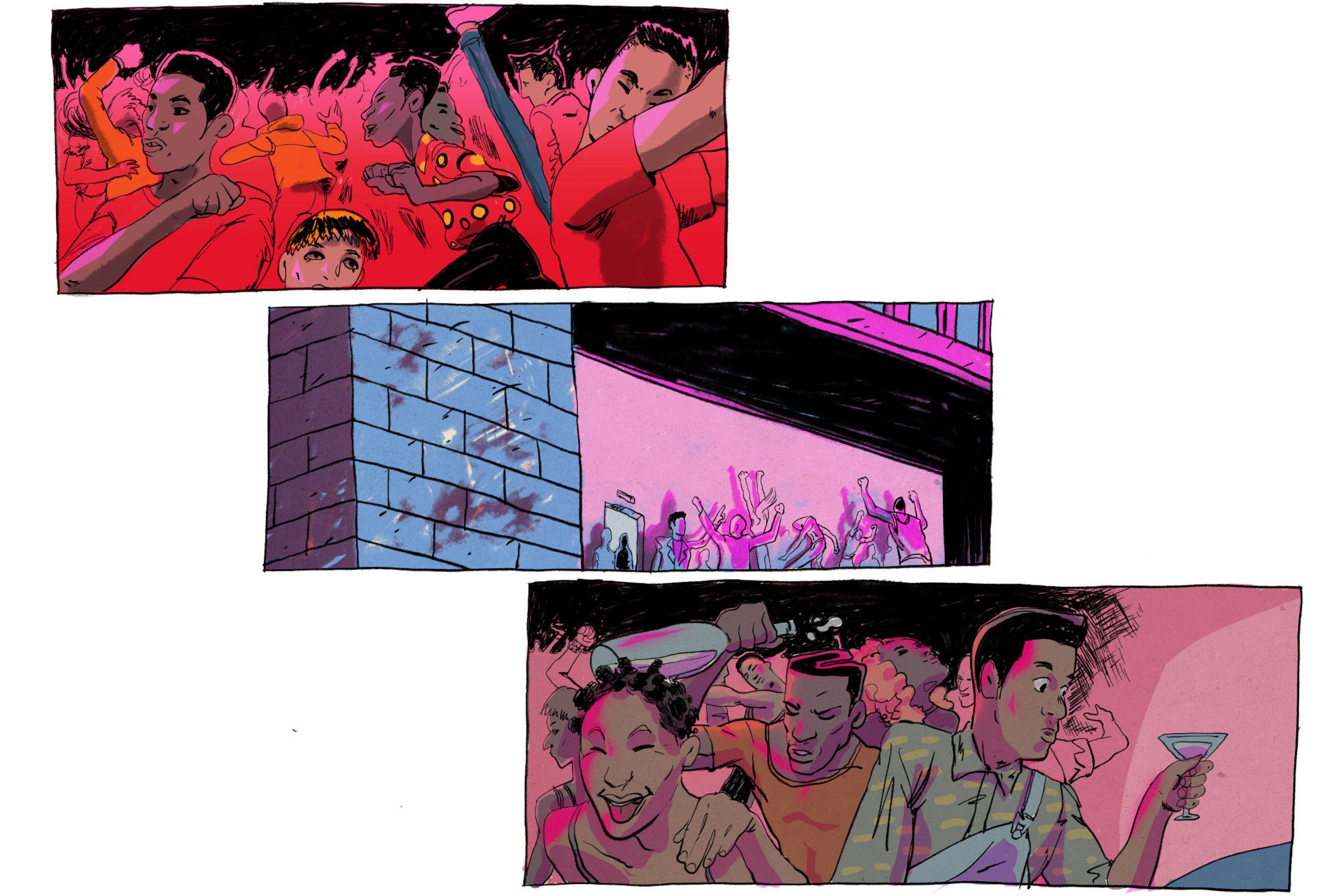
Jaso had booked the team at the Circus Circus Hotel & Resort, located on Las Vegas Boulevard in the heart of the strip. When he made the reservation, it was emphasized to the booking agent that the attendees were minors and all the rooms needed to be confined to two floors. “My idea was we’d put the assistant coaches and myself at opposite ends of the floor, so we could have eyes everywhere,” Jaso says. “Well, that didn’t happen.” According to multiple Long Beach Poly coaches, Circus Circus botched the request, and the players were scattered throughout the 3,767-room facility of over 101,000 square feet. “I was not happy,” Jaso says. “Because I knew what could transpire.”
While the official curfew was 9 p.m., members of the team were sneaking inside casinos, roaming the strip, patronizing clubs and restaurants until the wee hours of the morning. “I found all of my linemen in the basement of the casino with the biggest plate of chili fries I’d seen in my life,” says Tim Moncure, the offensive line coach. “I had another kid walking up to strangers and handing them quarters to play on his behalf. As I recall he was up about $3.”
“I was out on the strip,” says Chris Lewis, the sophomore quarterback. “I won’t lie all these years later. We were all running around.”
“It was a mess,” says Larry Croom, the sophomore running back. “We had a team of sophomores, of kids getting out of the inner city for the first time. So to expect everyone to stay in their rooms and sleep was probably a little unrealistic.”
The following morning was unkind to the Jackrabbits. They met for breakfast, and Jaso saw the red eyes and slumped shoulders and knew—absolutely knew—this entire trip was a mistake. “The whole team reeked of alcohol,” says Darrell Rideaux, a sophomore defensive back. “We couldn’t handle the responsibility.”
An easy season-opening win was now, at best, an uncertainty. Once kickoff came, the odds turned even worse. Players were tired, disinterested and wobbly. Lewis and Hollie split quarterback duties, and together they threw three interceptions with zero touchdowns. The team’s best running back, Herman Ho-Ching, was a bruising straight-ahead ball-carrier who would ultimately wind up at the University of Oregon via full scholarship. Against Green Valley, he fumbled five times. “We looked like the Bad News Bears out there,” says Ken-Yon Rambo, the Jackrabbits’ star wide receiver. “It was very sloppy. Very.”
The lone standout was Rideaux, a future USC star who says he was one of the few to adhere to Jaso’s curfew. The sophomore intercepted four passes, blocked a kick and recovered a fumble. “It was the game of my life,” he says. “If the inmates hadn’t run the asylum the night before, we win by 30 points. Maybe more. But we blew it with immaturity and a lack of discipline.”
And now, heading west back from Vegas, here they were.
And now, heading east to the fight, here was Tupac Shakur.
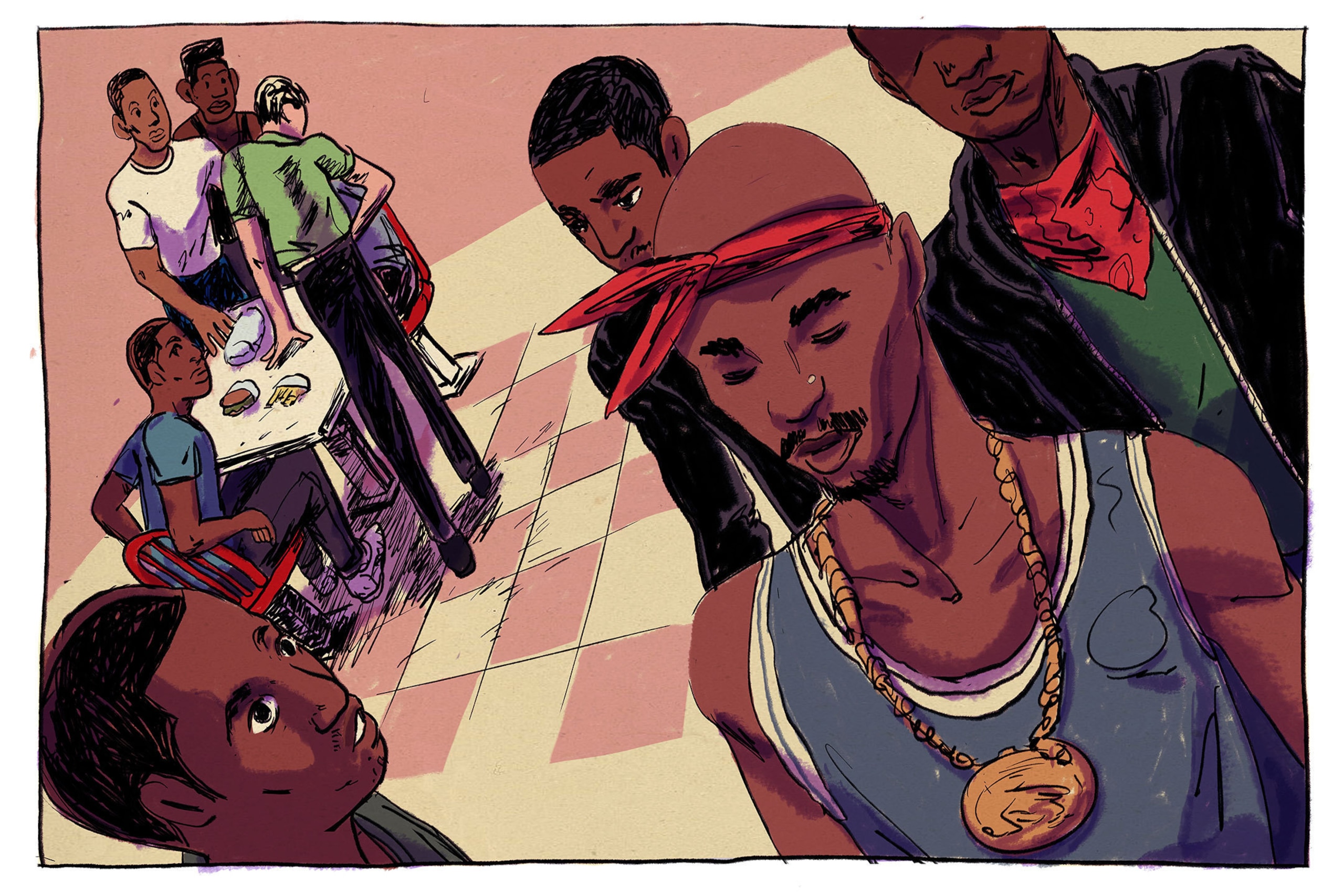
As soon as “It’s Tupac!” escaped Hollie’s lips, a gaggle of Long Beach Poly players converged at the bus windows for a glance. And, indeed, it was the rap superstar, easily identifiable by his shaved head, his trademark bandana and his distinctively delicate features.
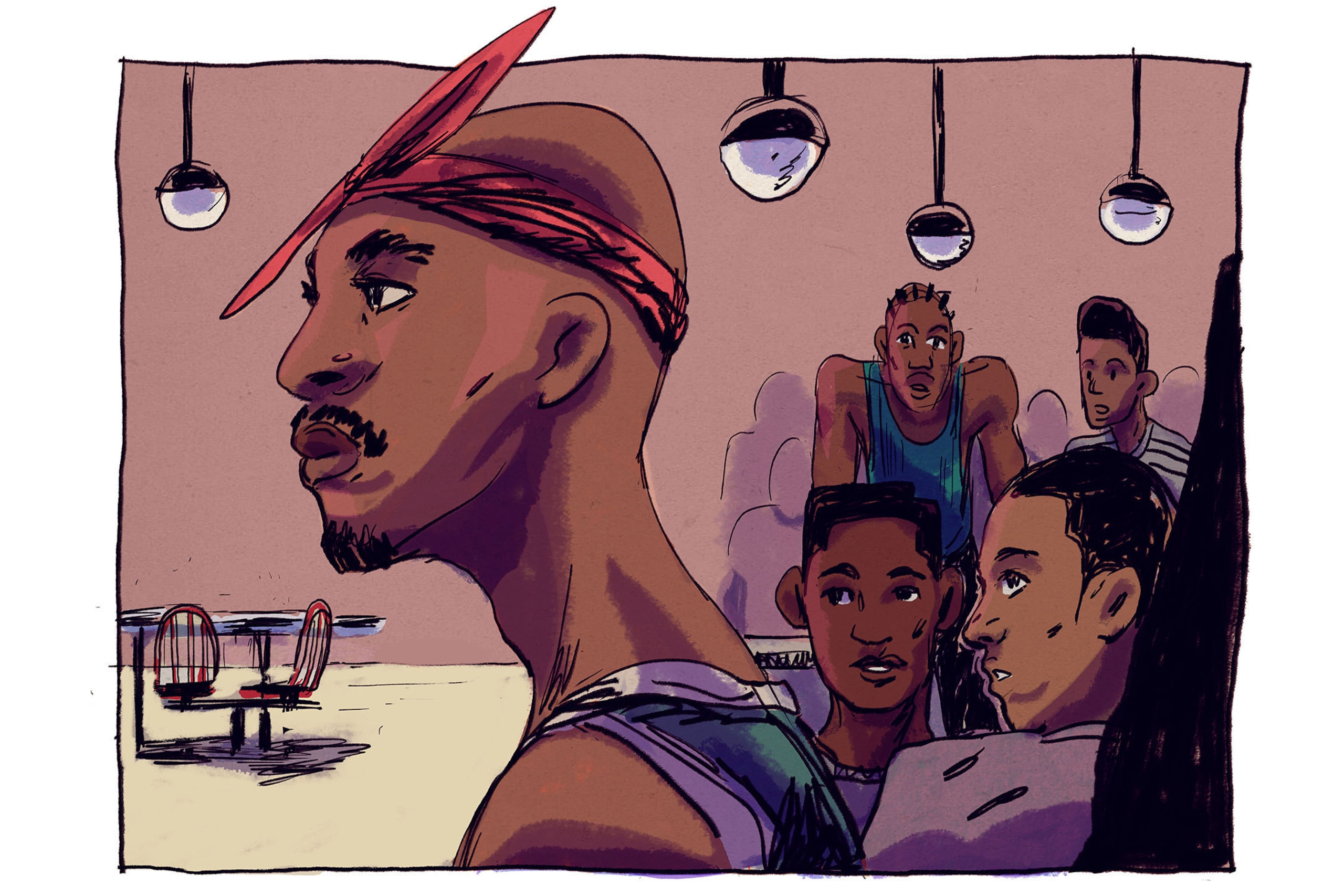
Though Long Beach Poly had a magnet program that drew students from across the city, a high number of Jaso’s players were neighborhood kids who had grown up hanging out at World Famous V.I.P. Records around the corner from the school. The music shop first opened in 1979, and by the early to mid-1990s emerged as one of Southern California’s hip-hop meccas. There was a recording studio in the back, and on any given day one could run into Long Beach products like Snoop Doggy Dogg, Nate Dogg and Warren G.
“I wanted kids to have something to do away from the violence,” says Kelvin Anderson, the owner. “So I gave them music.”
As a result, rap was a second language to many of the students. And Tupac was Duolingo. “He was as big as Michael Jackson or Prince,” says Anderson. “That’s no exaggeration. He was a living icon.”
As Long Beach Poly’s players and coaches filed off the two buses, the majority headed inside, where they waited in line behind the mountainous Knight.
“He was right in front of us,” Lara says.
""You can’t miss someone like Suge Knight. He ordered a bunch of hamburgers."
"
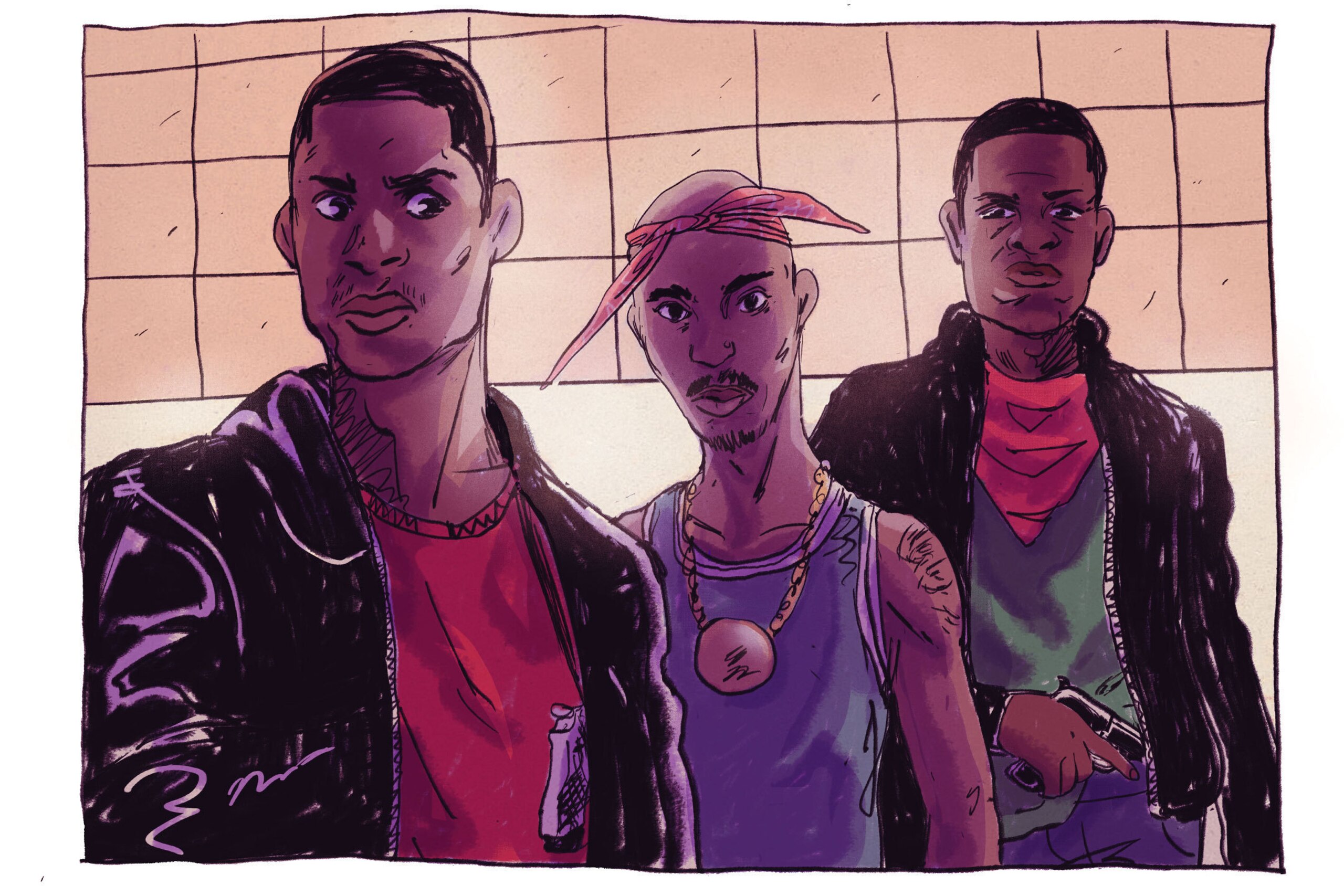
Outside, meanwhile, the remaining players split up. About half went to the nearby outlet shops. Hollie and Gary Barnes, a nose tackle, led a dozen or so teammates toward Tupac. According to multiple witnesses, the rapper had his back toward the players and was speaking loudly—and animatedly, with his hands—to the small number of Knight’s Mob Piru members beside him. They were leaning against the black SUVs. At one point, Tupac heard the approaching footsteps and spun. Meanwhile, two of his colleagues pulled out what looked to be Glocks. Hollie, Barnes and the others stopped in their tracks. “Bloods, you can’t be walking up on me like that!” Tupac yelled. “You don’t know me like that!”
“He was extremely paranoid,” Croom says. “He started cursing—he was irate. We were just kids, so it was definitely an overreaction.”
“He yelled, ‘Don’t run up on me!’” Lewis says. “The guys with him were big dudes. Really big.”
According to Rideaux, Tupac looked over the Long Beach Poly group, noted the collective youth and seemed to calm down. Around this point Knight had returned from inside the In-N-Out, and the players were equally shocked to be in his presence. “It was crazy,” Lewis says. “Not your ordinary rest stop break.” Tupac realized the teenage boys did not pose a threat.
“Where are all y’all little niggas from?” he asked.
“We’re from Long Beach,” Hollie replied.
“Oh, so y’all know my homie Snoop?” Tupac said.
A few nodded. They did indeed.
Everyone seemed to take a deep breath. The Glocks were put away.
“When we first approached Tupac, I wasn’t star-struck—I was scared,” recalled Rideaux. “There was this feeling of anxiety and unease. Growing up in Long Beach, you had these moments when the police would pass you and slow down to question you, even though you did nothing wrong. And you get that anxious feeling in your stomach. That’s how this felt at first.
“But because of the way Tupac embraced our group, it got a little lighter. A couple of guys peeled off as soon as they saw the guns and heard him talk angrily. But those of us who stayed around connected with him. It was brief, but it was a little connection. So that was nice.”
All told, the exchange lasted four or five minutes. Some of the players who immediately bolted the scene informed the coaches of the guns, and the remaining Jackrabbits were ordered back to the buses. “We had to shoo them away from Tupac,” recalls Richmond. “School trip, the kids are your responsibility.”
With that, the Long Beach Poly entourage set off on its way back home. As the buses pulled out from the In-N-Out lot, a couple of players yelled toward Tupac, who was well out of shouting distance.
“Yeah, go fuck yourself, Pac!” a Jackrabbit said.
“Fuck you, Pac!” said another.
“There was one guy coming on our bus, and I won’t give up his name,” Croom says. “But he screamed, ‘That’s why you got shot! And the next time I hope you die!’”
A pause.
“That stuck with me,” Croom says. “It really stuck with me.”
Later that night, Tupac was shot in Las Vegas. It happened at 11:15, not long after he watched Tyson knock out Seldon in 109 seconds. The rapper was sitting in the front passenger seat of the black BMW 750iL driven by Knight, and as they stopped at a red light at East Flamingo Road and Koval Lane, Tupac was hit by four .40-caliber rounds fired from a Glock. Although much mystery remains over some of the circumstances, the general consensus (and conclusion of the 2006 follow-up investigation) is that Tupac was shot by Orlando Anderson, a Crip he had attacked earlier in the evening. “Most people are comfortable with the resolution,” says Greg Kading, the former Los Angeles Police Department detective who worked on the case. “People like mysteries, but to me this isn’t one.”
When Long Beach Poly’s players and coaches learned of the shooting, they felt a range of emotions. Shock. Confusion. Sorrow. Mainly, an uncomfortable connection. Many of the Jackrabbits loved Tupac’s music, but they also loved the music of Snoop Doggy Dogg, Dr. Dre and Ice Cube. What made this different—made it real—was that they had been in Tupac’s presence on the day he was shot. “You see someone, then he’s dead,” says Pisith Vunn, a Long Beach Poly running back. “That’s a lot for a young mind.”
A handful of players asked themselves, in hindsight, whether, when members of Tupac’s entourage flashed guns, someone should have called the police. Could such a decision have possibly prevented Tupac’s shooting? Yet there was no chance that would happen. According to Rideaux, 70-80 percent of the Long Beach Poly roster was affiliated with one of the city’s three major gangs: the Rollin 20s Crips, the Insane Crips and the Bounty Hunter Bloods.
“No one was going to dime him up,” Rideaux says. “Maybe at a parochial Catholic school. But at Long Beach Poly? No way.”
The Jackrabbits had Sunday off, but returned Monday for school and practice. Normally, much of the time would be devoted to reviewing the game tape. Yet Jaso knew the loss to Green Valley was an aberration and saw the opportunity to teach a lesson. Although he was, by title, the head football coach, Jaso viewed himself as a life coach and guide to young men often facing long odds. Tupac’s shooting had shaken the roster—that much he knew. Here was the opportunity to transform tragedy into a positive. With his players gathered around in the team’s locker room, the coach held the VHS video tape aloft and said, “This game was not who we are, and I see no reason to watch it.” He threw the video in the trash, then turned the topic to Tupac, now clinging to life inside Las Vegas’ University Medical Center.
“Life,” Jaso began, “is all about decisions ...”
Four days later, Tupac Amaru Shakur was pronounced dead.
Jeff Pearlman is the New York Times best-selling author of seven books. His latest, GUNSLINGER: The Remarkable, Improbable, Iconic Life of Brett Favre, is is available here. He podcasts daily here.
Click here to get B/R Mag on the go in the new B/R app for more sports storytelling worth your time, wherever you are.