The Process May Be Interrupted, but the Future for Joel Embiid Is Becoming Clear
To many, the fact that Joel Embiid emerged this season as perhaps an even better player on the court than he is a must-follow on social media was a revelation. To Kansas assistant coach Norm Roberts, it was a return to form.
It was only four years ago that Roberts recruited the then-lanky Cameroonian teenager to Lawrence, Kansas. Embiid was "this big brownie-eating, chocolate-loving cat" who would come to Roberts' home and devour his wife's homemade brownies by the tray-full.
"Great personality, fun-loving kid," Roberts says. "The coaches loved him, the coaches' wives loved him."
TOP NEWS

Bill Simmons: LeBron Was Going To Cavs
Players Who Should Be Traded 🔀
Marcus Smart Blasts Lakers 😡
By October 2013, when the Jayhawks held their annual "Late Night in the Phog" preseason tipoff event, Kansas fans fell in love, too. Roberts explained the concept to Embiid, how part of the night's attraction was the players dressing up to entertain the crowd: "I'm telling him, 'You're going to have to dance.' And he goes, 'But I don't like to dance, Coach." Roberts imitates Embiid's voice, heavily accented and a bit whiny in the retelling.
But when the time came, there was Embiid, at center court in the packed gym, in a tuxedo and sunglasses alongside classmate Andrew Wiggins. "This dude starts dancing—kicking his legs up, sliding around, and everybody's going bananas," Roberts says. "I'm like, 'I thought you said you didn't dance?' He says, "Aw, Coach, I didn't want you to know.' That's how he was. He tripped me out."
Indeed, the engaging young Embiid was still surprising people this season as he cast aside two years lost to injury to look every bit the transcendent force the Sixers imagined when he was taken No. 3 overall in 2014. Though sidelined indefinitely this week, in just 31 games he energized a desperate fanbase and reminded sane, veteran observers of Hakeem Olajuwon.
Nearly as important, he appeared to be having a blast doing it, delighting fans with his play, his winking nickname and an often-hilarious social media presence. It would take a committed curmudgeon to watch Embiid's impact on Philadelphia, and on NBA fans in general, and not be thoroughly charmed.
"The game's supposed to be fun," Embiid said after a recent shootaround, in the plodding monotone he uses with the media. "I just want to have fun and get the crowd into it."
It's easy to forget that as recently as last summer, and despite his reliably entertaining presence on Instagram and Twitter, Embiid was still largely a mystery, even to his teammates. What changed?
The short answer, of course, was that he was on the court, finally able to play the game he's still learning even as he often dominated. The longer answer hints at what makes Embiid special, maybe uniquely so: his personality, his intelligence and his seemingly limitless potential.
Justin Harden saw it earlier than most. The head coach at The Rock School in Gainesville, Florida, says he hadn't met or even heard of Embiid before the then-18-year-old arrived at the small Christian school in the late summer of 2012.
Embiid took an indirect route to campus: Born in Cameroon, he grew up playing volleyball and soccer before being spotted at a basketball camp by his countryman, Luc Richard Mbah a Moute. Introduced to the game just months earlier, he impressed Mbah a Moute with his combination of size, coordination and instinct.
Before long, Mbah a Moute had paved the way for Embiid to come to the U.S. and attend his alma mater, prep power Montverde Academy, just outside Orlando.
Embiid would only last a year at Montverde, stuck behind a slew of vastly more experienced players (many of them bound for Division I colleges) and relegated mostly to the junior varsity squad. As Harden recalls, it was Mbah a Moute who reached out to say he had a player—a project, but a promising one—looking for a home and a chance to play.
"Luc said the kid was quiet, kind of keeps to himself," says Harden, who took Mbah a Moute's word that Embiid would be worth taking a chance on. Only later did Harden get a chance to see him on the court.
"I knew," Harden says, "the first time I saw him in our gym, that he was an NBA player."
Embiid's senior year was modest but nonetheless confirmed he was a unique talent. When scouted, opposing coaches couldn't help but notice his ability to run the floor, his hands, his instincts. But Harden says that what seems at a distance like Embiid's breakout season was still, in many ways, a struggle.
His English still spotty, Embiid spent that year at a school he hadn't chosen, and he was living with an unfamiliar host family that required him to attend church whether he wanted to or not.
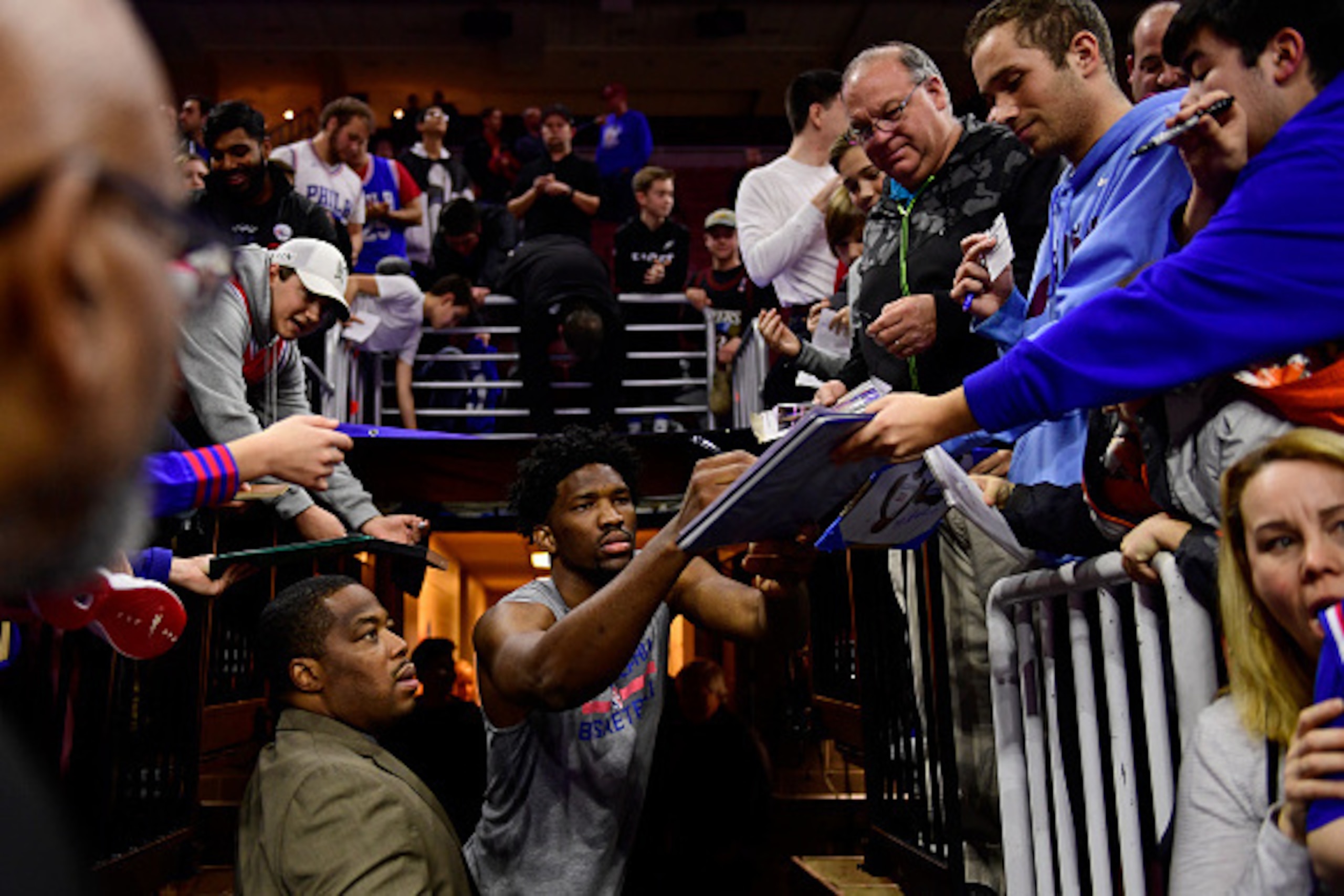
"He seemed kind of introverted—he was pretty quiet and stayed in his room," Harden says. "It made it seem like he was immature, but I think it was just a different social dynamic that he was trying to get used to. You could see his intelligence, and he'd always have something witty to say, but mostly he stayed to himself."
But Kansas—the school that, for the first time, Embiid chose for himself—was different. Kansas was where he blossomed, and Kansas is the parallel for all the fun he seems to be having now that he's finally proving himself on an NBA court.
Bill Self and his staff knew they had an unpolished gem, but it wasn't immediately clear just how good Embiid might be.
In an early conditioning test—the entire team running line drills—Embiid was the only one who didn't finish on time. Self lit into him, questioning his toughness, and Embiid pouted a bit before his teammates convinced him he could go back out and try again. Sheepishly, he did—and this time easily finished the drill.
His days as the pouty weak link didn't last long. Practicing in the preseason, the staff would put in a new play, and Embiid would pick it up immediately. "After a while," Roberts says, "he's yelling at the guards, 'Cut! Cut!' telling them where to go." At one intrasquad scrimmage, Self put Embiid with the reserves and ran them against the starters, giving clear instructions: Throw the ball to Joel every time. And Joel, try to score every time you get the ball.
"No lie," Roberts says, "he scores like 16 points in a row. You see the other guys standing there, all thinking, 'Oh, s--t. This guy is really good.'"
In just his third year of organized basketball, Embiid was dominating practices at a top-10 college program. He started the season coming off the bench, but by the Jayhawks' ninth game, Self couldn't justify not starting him.
Not unlike his senior year at The Rock, his numbers weren't eye-popping—11.2 points, 8.1 rebounds, 2.6 blocks in 23.1 minutes per game—but his impact was massive. He won Big 12 Defensive Player of the Year, and when a stress fracture in his back caused him to miss the Jayhawks' NCAA tournament run, a team ranked in the top 10 much of the season flamed out in its second game.
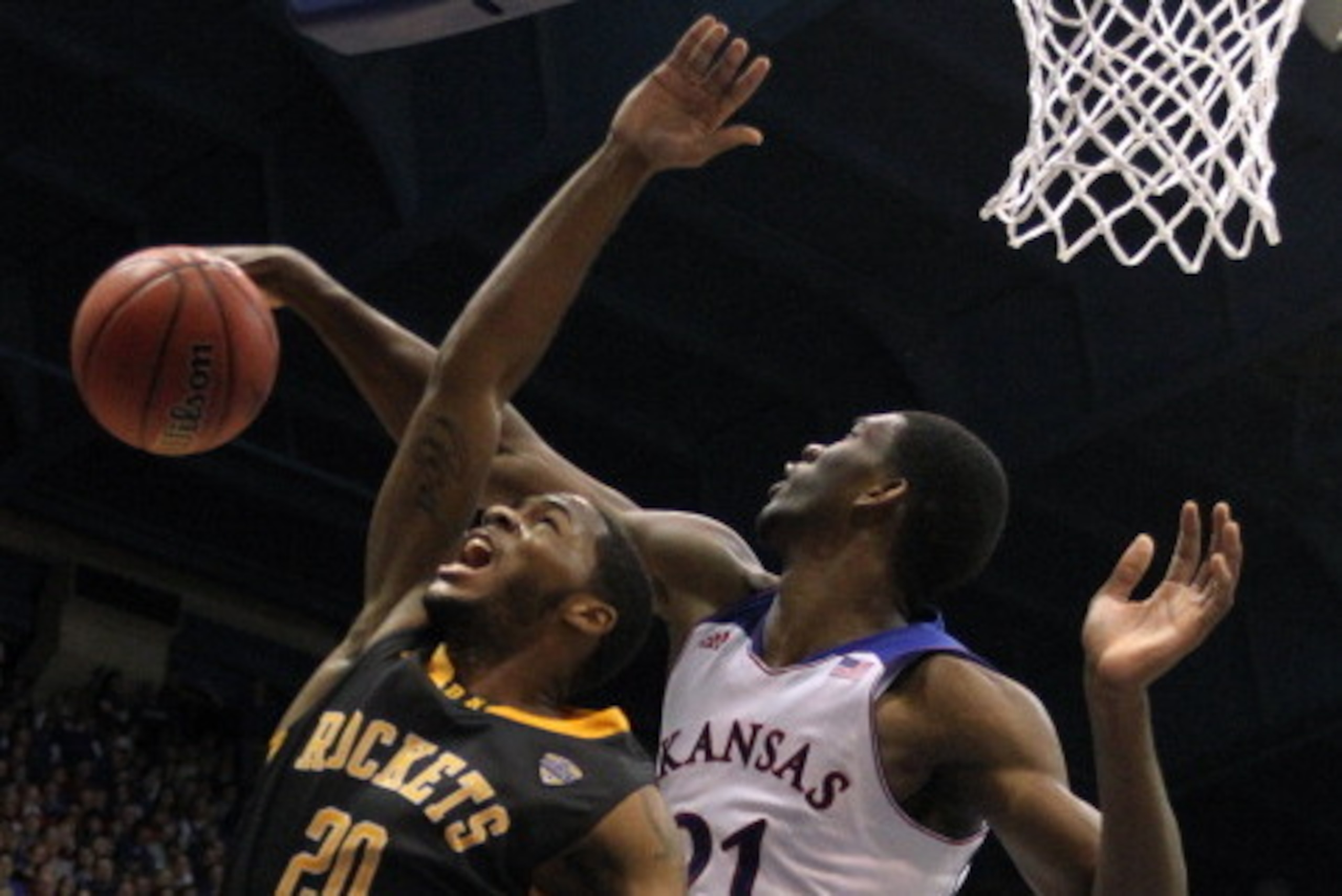
It wasn't the ending he wanted to what would be his sole year of college ball, but it didn't diminish that he'd played awfully well, or that he'd had fun. Kansas felt like home, and Embiid thrived, showing the first signs of his knack for social media hilarity. And he felt comfortable enough with the language and the game to start letting his personality shine through.
The introvert from The Rock School was long gone.
It helped that he could see the progress in his own game and chased improvement at every opportunity. Inspired by old Olajuwon tapes he'd started studying before he left Cameroon—and by their shared history as African big men with soccer backgrounds and preternatural instincts—he worked on mastering Olajuwon's footwork and signature Dream Shake.
He also found lessons in less likely sources.
Struggling with foul trouble as his minutes increased that season, he came to Roberts for pointers. When the coach put in a tape of former Jayhawks big man Jeff Withey blocking shots, Embiid asked if he could take it home to study it on his own. "He was great to coach because he wanted to be coached," Roberts says.
That desire—that need—to chase greatness is one of the things that caught Sam Hinkie's attention. Scouting his potential top pick, Hinkie was naturally smitten by Embiid's physical gifts, but sources close to the former Sixers general manager say he raved about Embiid's less tangible qualities: the intelligence that allows him to be funny and culturally relevant in a second language in which he's only recently become fluent; a competitiveness that he considers on par with the likes of Michael Jordan and Kobe Bryant; a knack for scouting (and knowing how to exploit) opponents' tendencies; and the fact that Embiid is a passionate student of the game, something Hinkie considered rare among big men.
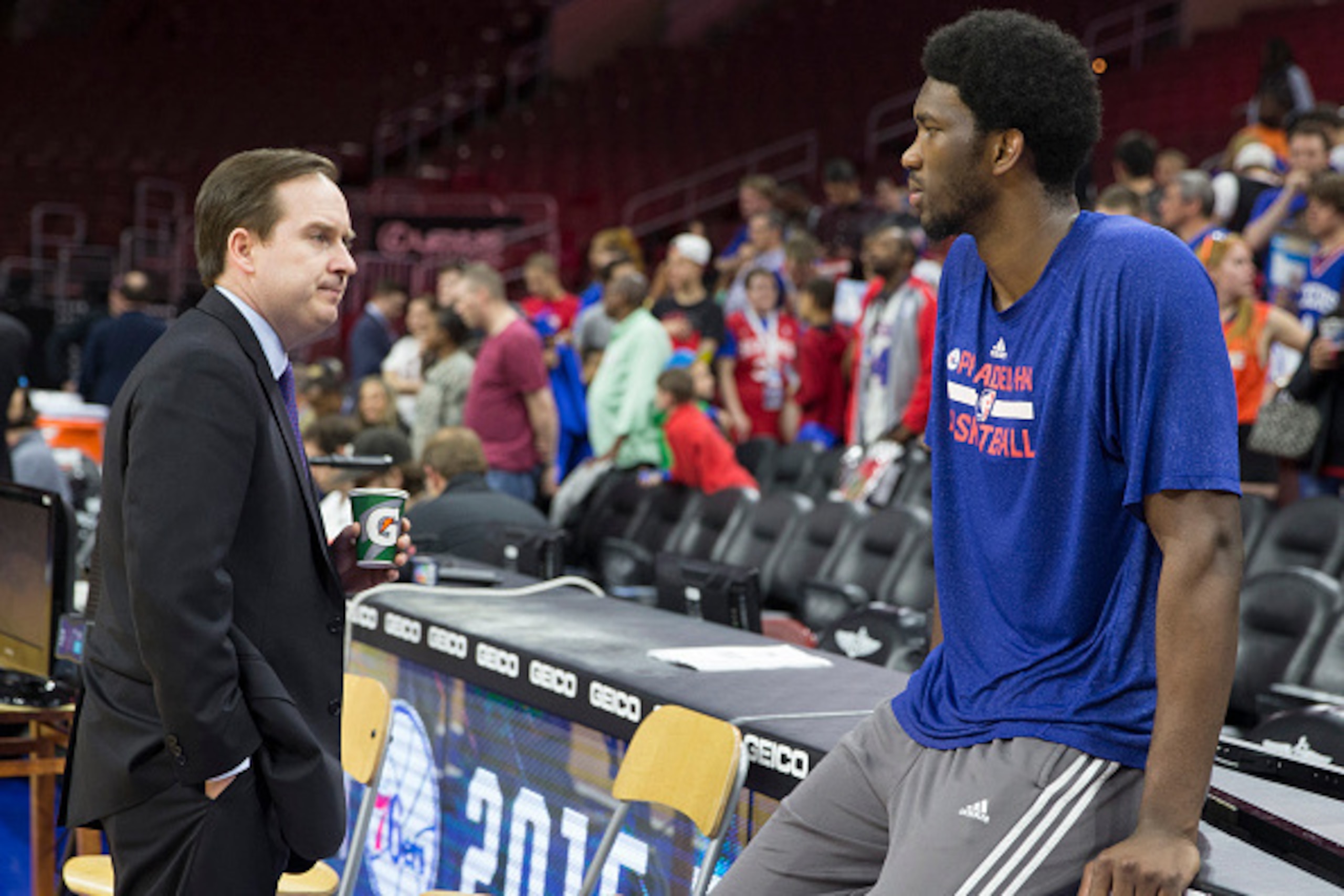
All those potential traits Sixers fans would have to wait to see, as Embiid's highly anticipated NBA career was delayed first a year, and then two, by recovery from a broken bone in his foot. Over the course of those two seasons, members of the Sixers press corps say Embiid could come off as "grumpy."
Since their access to him was limited, they had little to go by but the snippets of moodiness they often encountered. And it wasn't only the media that felt a disconnect.
"To be honest, I didn't get to know him that well last year, either," says guard Nik Stauskas. "He never practiced with us, he never really worked out with us. He seemed quiet."
In the same way that Justin Harden saw Embiid wither socially during that difficult year of high school, Sixers insiders say Embiid's apparent unhappiness the previous two seasons can be chalked up to his understandable frustration with the monotony of rehab and missing out at being on the court.
Says one, "Put him on the training table, he'd rather be doing something else, and he's going to be a little moody about it. But give him a ball in the gym, even with a cast on his foot, and let him hang out, have a shooting contest, whatever, he's happy."
Let him actually play and start to realize his potential? As the 2016-17 season showed, Embiid was thrilled.
There is something fragile about him still. Apparently up to 7'2" and 260 pounds now, Embiid doesn't look fragile, not when he's standing still, and certainly not when he was making the sort of plays that quickly redefined the term "athletic big man."
Blocking shots, collecting impossible rebounds, dunking off the dribble, he looked like an indomitable basketball monster. It's when he walks that you see it: A slightly awkward gait and an impression informed less by what you see than by what you know about all the games he's already missed, and why.
Now Embiid is out again, this time with a partially torn meniscus in his left knee and no certain return date. Still, it has been an eye-opening season for both the Sixers and Embiid as both have come to understand each other a little better and see what could be.
He's still at it on social media, hyping teammate T.J. McConnell as "the clutchest player in the history of the NBA?" after a second game-winning shot in the space of a month. Stauskas, the teammate who admits he couldn't get a read on Embiid during his extended rehab stint, confirms the obvious when he says, "I think everyone around here loves him. He's a funny, down-to-earth guy, almost like a little kid. We all love his personality—we feed off it."
The Sixers need him on the court—to be compelling, let alone competitive. There's a sense that the whole league wants to see him playing; even opponents like DeMarcus Cousins, with whom he traded enthusiastic slaps on the rear a few weeks back, appreciate the energy and fun Embiid brings to the game.
More than anyone, Embiid needs it for himself. When he's healthy and comfortable in his surroundings, he's the life of the party, the guy who lights up a gym as easily as he lights up a room.
Ryan Jones is a writer living in Pennsylvania. He's the former editor-in-chief of Slam magazine and has written about sports and culture for XXL, Spin, Vibe and Esquire.com. Reach him on Twitter: @thefarmerjones.

.jpg?w=2560 "MHJ Aware of the Criticism 👀")
.jpg?w=2560 "Buzz: Teams Monitoring MHJ Trade")
.jpg?w=2560 "Breaking News")
.jpg?w=2560 "Davante's Taco Bell Card 💳")