
NFL Combine 2017 Notebook: Magnificent Myles Garrett and the Next-Gen Defenders
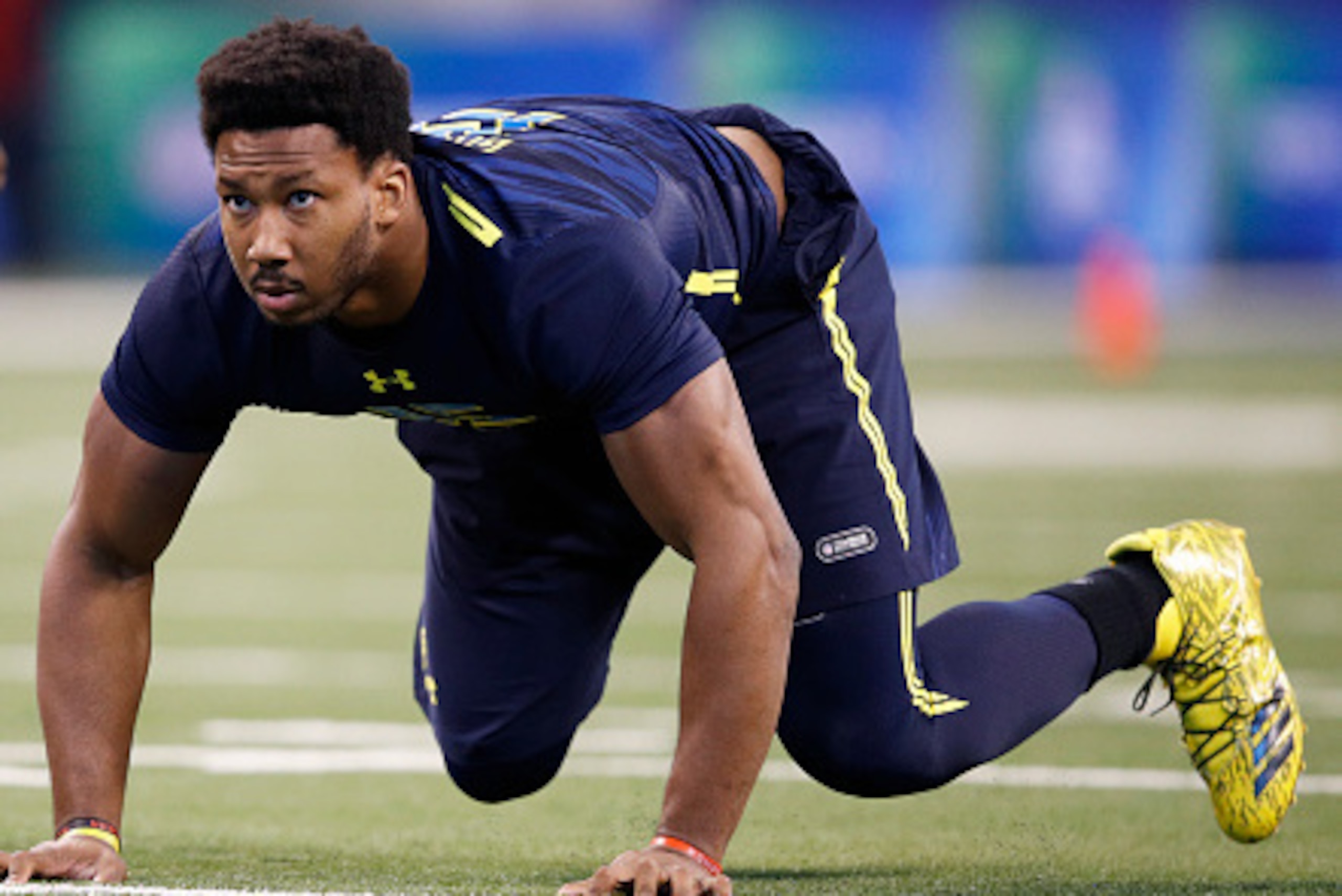
There is no question where Myles Garrett will play in the NFL: First on the edge of the defensive line, then in the offensive backfield, then over the crumbled remains of a fallen quarterback.
After Sunday's performance at the NFL Scouting Combine in Indianapolis, Garrett cemented himself as the best prospect in this year's draft class. He may be the best of the decade. And there has never been a doubt about what position he will play in the league.
Other great defenders, however, entered Sunday's workouts facing that very question. Michigan safety/linebacker/returner/Wildcat quarterback Jabrill Peppers is the most famous of the bunch, but other top prospects don't fit the prototype of any traditional NFL defensive position.
Luckily, those traditional positions are out of date, and several defenders who stood out Sunday are perfect for the new roles required by the NFL's new matchup-heavy, nickel- and dime-oriented schemes.
Let's get to know some of these next-gen defenders. After we take a moment to gape at the magnificent Myles Garrett, that is.
Garrett Ahead of the Pack
1 of 7
With the first pick in the 2017 NFL draft, the Cleveland Browns will either select Texas A&M edge-rusher Myles Garrett or make the biggest mistake in franchise history (which would really be saying something).
Garrett tore the combine in half like an old phonebook this weekend. The 272-pounder ran the 40-yard dash in 4.64 seconds. He benched 33 reps, second among defensive linemen to Auburn's Carl Lawson. He crushed the vertical and broad jumps and breezed through position drills. He faced the press with quick wit and aplomb; by all accounts, he did the same during team interviews.
So this is a no-brainer for the Browns. No Moneyball trades. No quarterback reaches. Call Garrett's agent and start the negotiations now.
Garrett's electrifying workout did bring out some nitpickers and naysayers on social media. Some were Tennessee fans frustrated that Vols edge-rusher Derek Barnett, a true top-10 talent in his own right, has been reduced to second-fiddle status. Other Garrett skeptics are designated contrarians who think bucking conventional wisdom automatically makes them sound edgy or insider-y.
Yes, Garrett recorded "only" 8.5 sacks last year, 4.5 of which came against Texas-San Antonio. Typing "Myles Garrett statistics" into a search engine isn't the same as evaluating a player.
If Garrett's sack total worries you, load up A&M's season opener against UCLA. Garrett had just one sack, but the Bruins were so dedicated to running their offense away from him that it looked like they were playing pool on a tilted table. Sprint-out right, sweep right, swing pass right, repeat. Teams avoided Garrett the way they avoided throwing at Deion Sanders.
The lesson here is that overanalyzing Garrett can lead to a silly mistake. His combine performance solidified his status as the best overall prospect since Andrew Luck. He may be the best defensive-line prospect since Bruce Smith.
The Browns already have some promising defensive-line prospects, including Emmanuel Ogbah, Carl Nassib and Danny Shelton. Add Garrett to the equation and they instantly become a threat to win their share of 16-13 games while continuing their endless search for a quarterback.
It's a simple formula: Draft the best player available, a once-in-a-decade player, and gain instant credibility. Even the Browns can't screw that up.
Right?
Next-Gen Defender: Jabrill Peppers, Michigan
2 of 7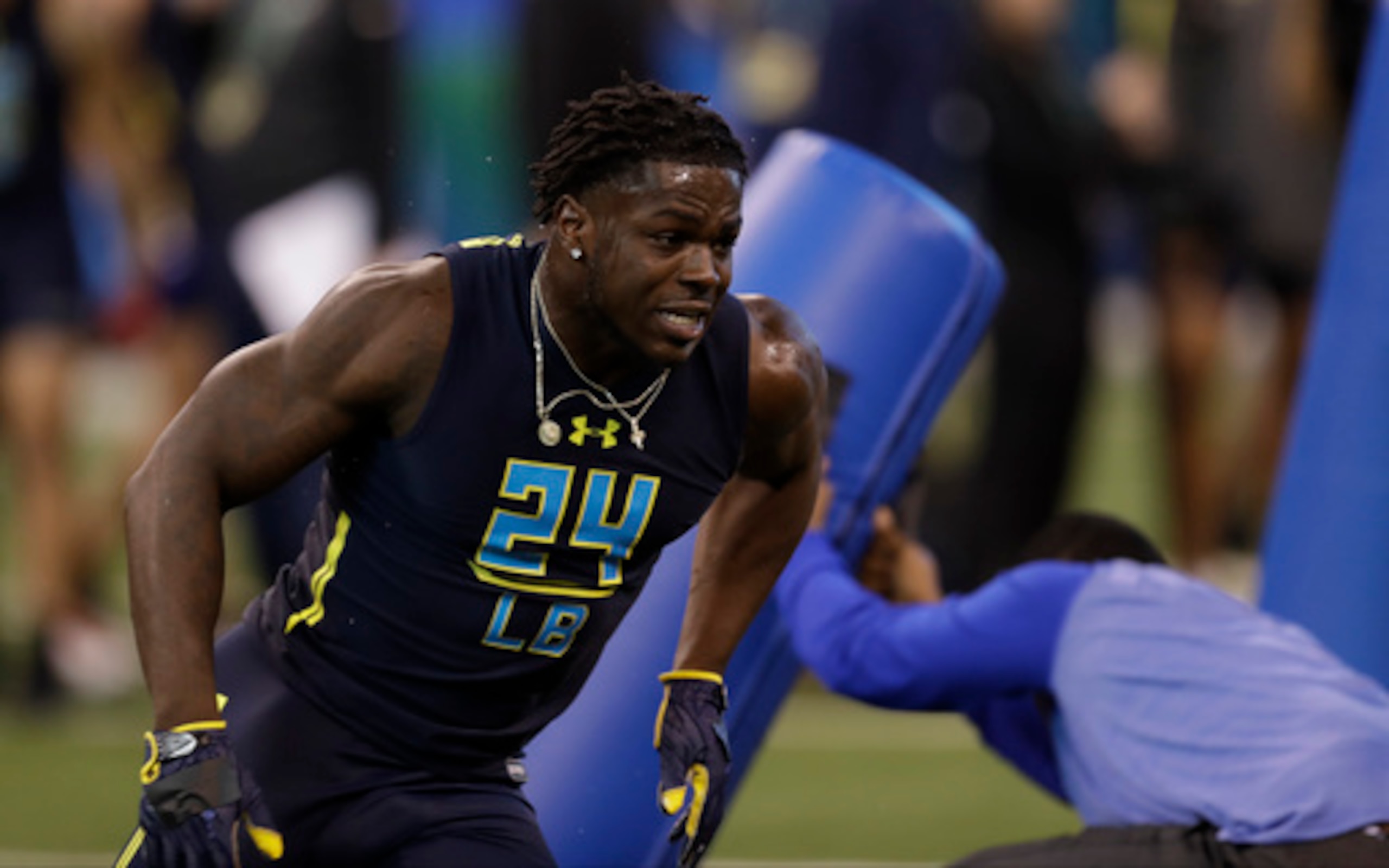
The Numbers
Peppers ran a 4.46-second 40 at 5'11" and 213 pounds. His other drill results were all worthy of an elite safety prospect, no matter where Michigan lined him up.
The Dilemma
While Peppers lined up as a hybrid linebacker-box safety for Michigan's defense while taking Wildcat snaps on offense, the "Gosh, it's so hard to figure out what position he will play in the NFL" controversy is ridiculous and, frankly, a little contrived.
"What do I look like? I'm a safety," Peppers said Saturday. "I'm a safety. Yes, I'm a safety."
Peppers on Peppers
Peppers explained why his coverage technique looks so raw on the game film: "I hardly worked on it during the season because I was asked to fill the void at linebacker. So it was more inside run, nine-on-seven [run-stopping drills]. I couldn't participate in one-on-ones and seven-on-sevens as much as I could have.
"But it's all part of the process, man. I'm a winner, and that's what the team needed me to do. So that's what I did."
Overall Impressions
This is simple, folks:
- Peppers is a free safety/nickel defender. If you don't think that's a "position," watch the Eagles' Malcolm Jenkins for a few games.
- As a rookie, Peppers should return kicks and play in dime packages as a blitzer while he masters his fundamentals.
- By year two, he should be a starting safety who moves to the slot based on matchups and packages.
- By year three, he should be an All-Pro.
What I like best about Peppers, aside from his all-world athleticism, is that he knows his coverage skills are weak. He knows he cannot coast on talent at his most natural position, which means he should take his practice reps and film sessions seriously.
Some patient team is going to draft a superstar. Others will pass him over because he doesn't fit into any of the outdated depth-chart slots they have been photocopying since 1974.
Next-Gen Defender: Haason Reddick, Temple
3 of 7
The Numbers
Reddick led all defensive linemen with a 4.52-second 40. That blazing result comes with a small asterisk, however, because the 237-pound Riddick is unlikely to be a pure edge-rusher in the NFL. But Reddick also benched 24 reps, a large total for a small defender.
The Dilemma
Reddick walked on at Temple as a defensive back. He then bulked up to defensive end. At the Senior Bowl, he switched to linebacker and looked like a seasoned coverage defender in drills. He's not a defender without a position. He's a defender with too many positions.
Reddick shed some light Saturday on what teams think of him, position-wise. "Some want me at outside linebacker," he said. "Some want me inside. Some are willing to let me play both: inside on first and second down, and outside on third down."
His preference? "I'm hoping to do both. I'm looking to take on a challenge. I want to dominate two positions."
Reddick on Reddick
A pair of knee injuries ended Riddick's high school football career. He was not recruited at all coming out of South Jersey's tiny Haddon Heights High School.
"I thought my football career was over," Riddick said. "It just so happened my father, he was poking around, trying to see if there was any way I could get on the football team. And Coach Francis Brown [then at Temple, now at Baylor]…was a good friend of my uncle and my father.
"I actually did a couple workouts with him. He was coaching DBs back then. He got me on as a preferred walk-on. From there on out, there goes my career at Temple."
Overall Impressions
A 40 time in the Dalvin Cook/Leonard Fournette range reinforced what scouts saw in Senior Bowl practices. Reddick has the athleticism to be a coverage linebacker, the tenacity to be effective as an edge-rusher and the IQ to master a multifaceted role.
Look for Riddick to go late in the first round to a team that runs a 3-4 defense and slides its linebackers all over the formation, such as the Chiefs or Packers.
.jpg?w=2560 "Antonio Brown Shooting")
.jpg?w=2560 "Seahawks Cardinals Football")
Next-Gen Defender: Malik McDowell, Michigan State
4 of 7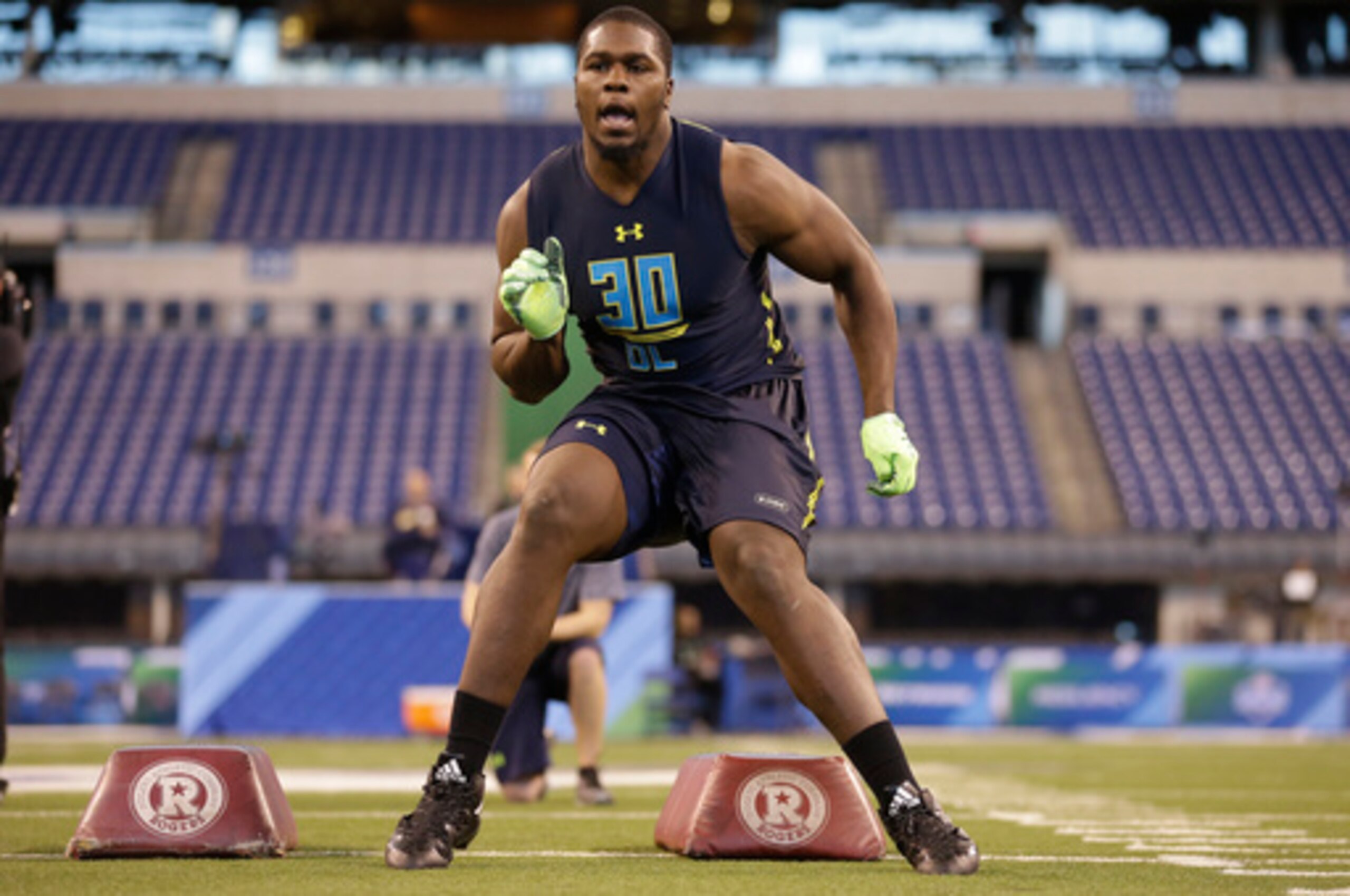
The Numbers
McDowell ran a 4.85-second 40 at 6'6" and 295 pounds. That's a remarkable size/speed profile until you check his game tape and realize he may play even faster than that.
The Dilemma
Is McDowell a king-sized edge-rusher, an interior disruptor or a super-talented tease?
McDowell on McDowell
McDowell said he doesn't think his arm-whirling, Tasmanian Devil-like technique is particularly unique. But he did say that his coaches tried in vain to make him a little more conventional.
"At first, they weren't really with it until I started making plays and everything," he said. "They tried to help me out, but I really couldn't get it right. I tried to tweak the technique a little bit, and after a certain point, they just started teaching me my own style of play.
"Once I started making plays, they really just said 'Go ahead and do you.'"
Overall Impression
On tape, McDowell looks like no other defensive lineman I have watched in years. His style reminds me of a pitbull trying to get past a backyard fence. Sometimes he goes over it. Sometimes he goes under. Sometimes he goes around; sometimes he barrels straight through. And sometimes he tries to do all four at once and winds up falling flat on his face.
McDowell tried to explain away questions about his work ethic by citing minor injuries, but concerns about his habits and wonky fundamentals will keep draft-board builders busy through the early spring. If he plays anywhere close to his potential, McDowell will have Jason Pierre Paul-like impact in the NFL.
Sunday's Secret Superstar: Jordan Willis, Kansas State
5 of 7
The Numbers
Kansas State's Jordan Willis finished second among defensive linemen to Myles Garrett in the vertical jump at 39 inches. He finished second to Hasson Reddick in the 40 at 4.53 seconds. He won the three-cone drill at 6.85 seconds and tied for third in the 20-yard shuttle at 4.28 seconds.
The outstanding workout results were crucial because for all of his college production, he often looks stiff and sluggish on tape.
Willis on Willis
During Saturday's interviews, Willis addressed one common criticism of his game: a slow initial "get-off" step at the snap.
"Sometimes, with my takeoff, it will be very explosive," he said. "It looks good. Obviously when I get tired, taking off seven or eight times in a row, two-minute situation, which is every turn, it looks a little bit slower. Then I have a longer stride, so it looks like I'm not really taking off the ball that much."
Willis has been working on shortening his first-step strides to get off the ball quicker. He is also taking pointers on how to attack offensive linemen from Hall of Fame guard Will Shields.
"He just teaches me hand work, what to expect from offensive linemen. All the small things like hip work, foot speed and things like that."
Overall Impression
Willis looks like a left end on his game tape—the kind of complementary pass-rusher who bats down some passes and gets clean-up sacks but isn't twitchy or agile enough to win many one-on-one battles with top left tackles.
The combine results, particularly the cone and shuttle drills, tell a different story about Willis' lateral agility and athleticism.
Willis may well be an impact pass-rusher in need of some strength-and-conditioning tweaks and technical fine-tuning. Great workouts will make evaluators take a second look at Willis, which could move him up a round or so in April's draft.
That's what the combine is all about, folks.
The Combine Is Strong in This One
6 of 7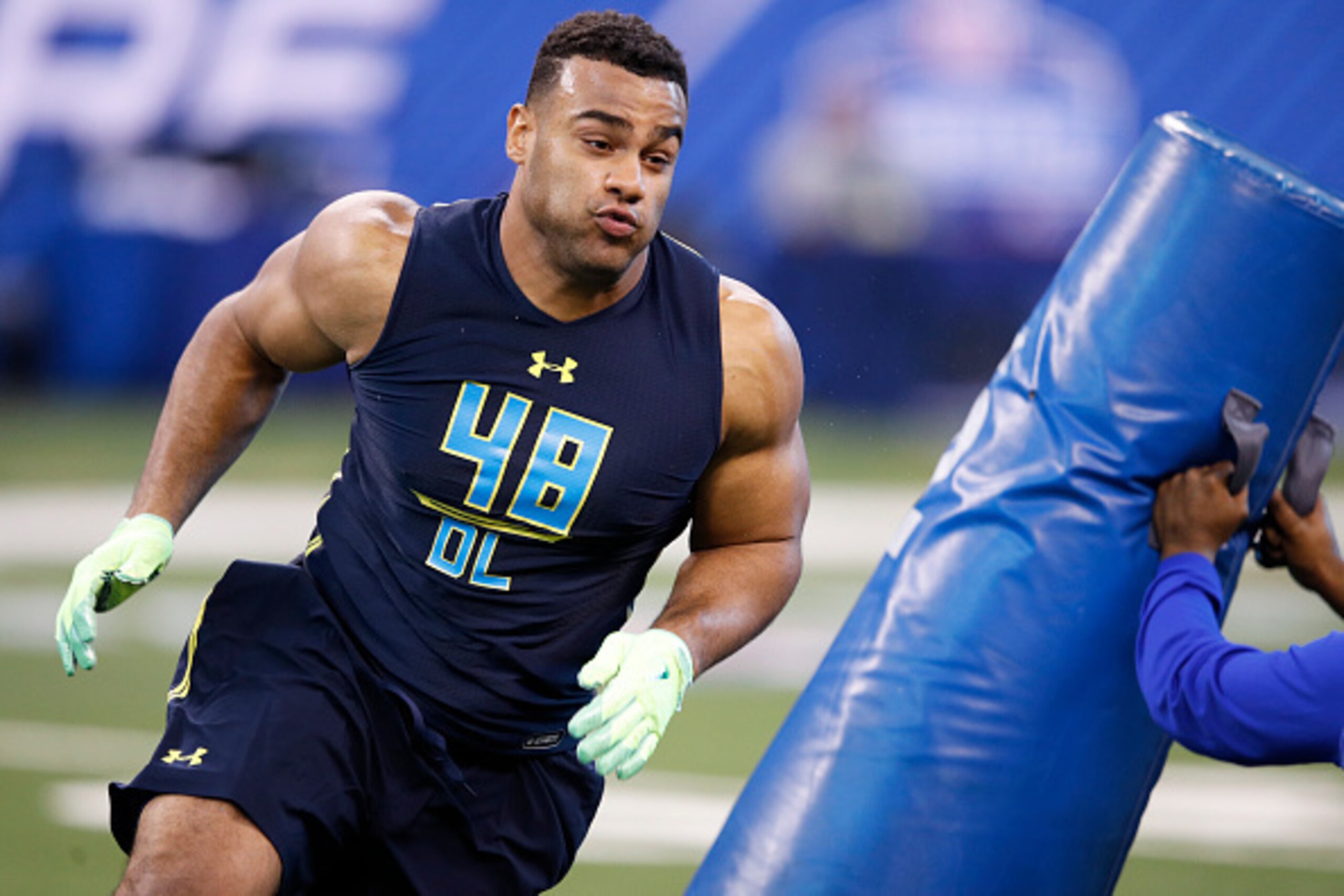
Stanford's Solomon Thomas is a tremendous prospect who assembled a full sampler platter of impressive workout numbers—30 reps on the bench, a 126-inch broad jump at 273 pounds, tremendous cone and shuttle results for a huge man—to reinforce his status as a top-half-of-first-round pick.
Thomas would be an exciting addition to any team, which can become a real problem during a brief press conference.
One of the semi-seedy things sportswriters do at the combine is try to get top prospects to talk about specific NFL teams. If a beat writer for Team X can get Prospect Y to say that he met with Team X officials and would love to play with them, the writer can then whip up a short, simple article that generates lots of local buzz and sweet, delicious page views. (Even though every team meets with every major prospect at some point.)
If the prospect-team pairing is juicy enough—think "Myles Garrett Loves the Cowboys and Therefore HATES THE BROWNS, THE FIEND"—all of us can feed on it for a solid week.
However, prospects know gushing too much about any one team is a potential trap, so they often clam up. That leaves some writers flailing desperately, sounding like they're trying to make conversation while a blind date goes south. Have you spoken to the Titans? No? What about the Saints? No? Um...er...have you spoken to the Chiefs?
Other interviewers get more creative. Which brings us back to Thomas and this three-question exchange he had with a reporter Saturday.
"REPORTER: I hear you are a big Star Wars fan. Are you more of a Sith or a Jedi?
THOMAS: A Jedi.
REPORTER: What Star Wars character would you base your game off of?
THOMAS: I would say Mace Windu.
REPORTER: Have you spoken to the Broncos?
"
Ah, the old Jedi Mind Trick. But Thomas is strong of will. As Yoda would say, speak to the Broncos he did not.
But that doesn't mean he never will.
Different Edge-Rushers for Different Schemes
7 of 7
Sunday's workout numbers were largely outstanding at the edge-rush positions. So, perhaps we should step back for a moment and remember there is more to generating sacks than being huge, fast and strong.
Falcons head coach Dan Quinn, who comes from the Seahawks school of defensive philosophy, explained this week what he looks for at the edge-rush positions.
"The No. 1 thing is get-off," he said. "I want to see: Can a guy beat you to the punch? As a pass-rusher, [it's] having that get-off to stress the offensive tackle right off the bat, and to break down a guy's technique based on that initial quickness. Past that, you want to find a guy who has a finisher's mentality. Very rarely do you just beat a guy one time with one move.
"It's the strain, the battle, the finish to go the extra step, win the last yard. Those guys who have that kind of fight, that kind of speed and get-off, generally you hear their names called early on.
Not every team uses the Seahawks-Falcons scheme. The Steelers deploy an old-school 3-4 front (more of a 2-4-5 these days, but let's not get too technical) where the edge-rushers are outside linebackers.
Steelers general manager Kevin Colbert explained the unique challenge of scouting players for that role.
"Outside linebacker in our defense is probably the most difficult because 80 to 90 percent of them don't play on their feet in college, and we have to project whether a guy can stand up and do the extra things beyond pass rushing that he's gonna be required to do in our defense," he said. "So the margin for error at the outside linebacker position is really greater than at any other position. … You're looking for someone who can rush the passer, play on a tight end or a tackle and drop into coverage on occasion.
"The dropping part, a lot of times we won't see that until we get in here for the initial workouts and follow it up with some pro day."
But how do the Steelers assess coverage ability at a pro day when there are no offensive players to cover?
"We just watch their feet, their hips, their hands, their awareness when they drop. You're really not going to get into whether they understand or know what they're doing. You're just looking at the physical ability to do it. "
But when does a team like the Steelers learn whether their edge-rusher really understands what he is doing in coverage?
"Usually when they line up on a Sunday."
Yikes.
No one said evaluating prospects was an exact science.

.jpg?w=2560 "Giants Rams Football")