

The Advanced-Stats Case for and Against Edmonton Oilers Defenceman Kris Russell
Kris Russell is a player who draws a lot of criticism from people steeped in hockey analytics. Even an analytics-based approach to the game, though, recognizes that he does some things well. Edmonton Oilers head coach Todd McLellan seems to have identified what those things are.
The problem is that the things Russell does well are generally not appreciated. At the same time, many of the arguments raised in his defence are specious.
Take, for example, Oilers general manager Peter Chiarelli. Chiarelli has repeatedly argued that Russell is an exceptional transition defenceman, even telling Sportsnet’s Mark Spector that he makes more passes leading to zone entries than almost anyone else.
TOP NEWS

Re-Ranking the Messiest Breakups 💔

Song Lyrics for Every Team 🎶
Hellebuyck Suspension Timeline
“He was second in the league behind only Niklas Kronwall last year,” claimed Chiarelli, “ahead of players like Duncan Keith, Kris Letang, Cam Fowler, Ryan Suter, Mark Giordano, Niklas Hjalmarsson and Erik Karlsson."
An internal metric that says Kronwall and Russell are the two best puck-moving defenceman in the league is obviously ridiculous. There isn’t a stats geek or an old-school hockey man who would take the passing of a Kronwall/Russell pairing over a Keith/Karlsson tandem.
The likely explanation for Chiarelli’s odd statistic becomes clear when we take a longer look at the data. Oilers blogger WheatNOil has manually tracked puck movement by Edmonton’s defence all season:
"All Defensive Zone Passing. (This doesn't include games 1-3 as I only started tracking ALL passes from game 4 on) pic.twitter.com/hXSpcguC5N
— WheatNOil (@WheatNOil) December 7, 2016"
Russell handles the puck a ton and doesn’t make a lot of turnovers. Yet even here we see that a relatively low percentage of his puck movement is to forwards; only fellow Chiarelli acquisition Adam Larsson makes fewer of those passes.
This second chart is where the real problem lies. Mainstream analytic thought puts a lot of value on maintaining puck possession because that drives shots and goals. It’s not enough to just advance the puck without a blatant turnover; a good puck-moving defenceman needs to keep clear control. Russell doesn’t do that; instead he dumps the puck to the neutral zone more than almost any other player on the team.
The end result is a player who does a really good job of getting the puck out of his own end safely, but a bad job of sustaining the attack. In short: Russell handles the puck a ton and avoids catastrophic errors, but he does so by consistently making suboptimal decisions with the puck on his stick.
Russell as an elite puck-mover is a myth. Another is the idea that he does a great job of limiting opposition shot quality, resulting in a higher save percentage for his goalie.
We’ve already seen his strong save percentage number from early this season collapse:
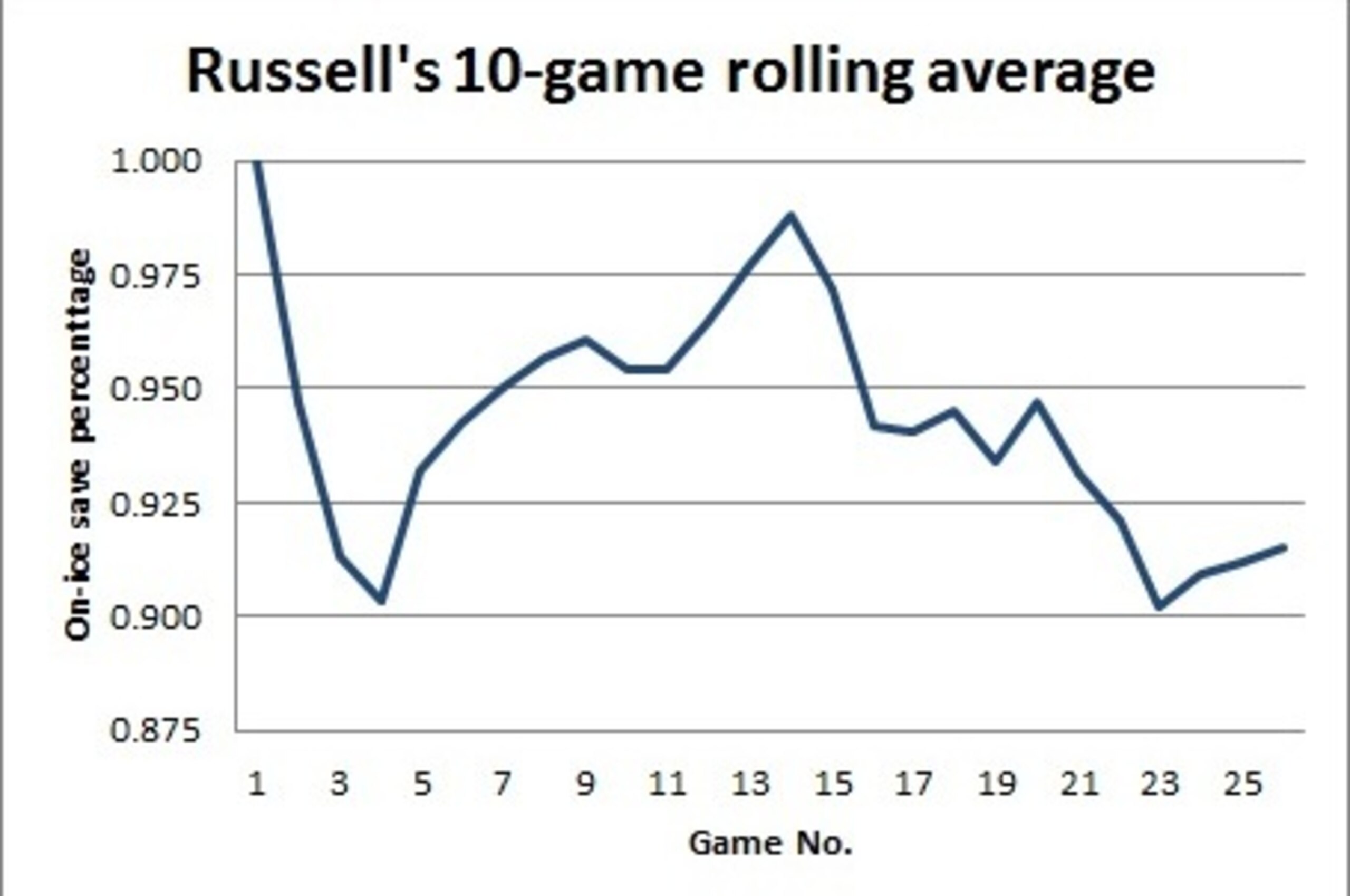
The league average save percentage at five-on-five is 0.924. Russell started the year below that, rode a hot streak from Games 5 to 15 and has been falling ever since. Over his last 12 games, his on-ice save percentage is a miserable 0.897, 27 points shy of the league average. These peaks and valleys happen for all NHL players, and it’s a terrible idea to read too much into 10 hot games.
The bigger problem with arguing that Russell boosts save percentage is that he’s been in the league for years and he doesn’t do it consistently. He’s had ups and his downs, but over time he’s pretty close to every other defenceman in the game. Last year his PDO was almost exactly 100, and his on-ice save percentage was worse than his team average.
Over nine years before arriving in Edmonton, Russell played for a lot of bad teams and had an on-ice save percentage a tiny bit better than most of his teammates and a tiny bit worse than the NHL average. He had a 49.7 percent career Fenwick rating entering this year and a 50.7 percent career on-ice goal differential. It’s not impossible that the gap between those numbers is skill-based, but even if we assume that difference is 100 percent due to Russell, it’s not a big gap.
Yet there are some things that Russell does very well, and they’re rarely discussed.
Although Russell’s low-risk game limits his team’s on-ice results a lot of the time, there are circumstances where a coach demands exactly that kind of approach. Two obvious ones are when a team has the lead or when it’s killing a penalty.
For the entirety of Russell’s career, his teams have done well with him on the ice in shorthanded situations. Entering 2016-17, his teams have allowed six fewer shot attempts and nearly two fewer goals per hour with him on the ice than they do with him off it. The first number puts him among the 10 best NHL defencemen over that span; the latter puts him among the top 40. Either way, he’s very effective.
Score situation is also important. No other Oilers defenceman comes close to Russell in terms of deployment. McLellan loves using the defenceman when Edmonton has the lead in games, and there’s a case for that. The chart below shows how the team’s Fenwick rating (shots and missed shots) changes per hour when Russell steps on the ice in various score situations:
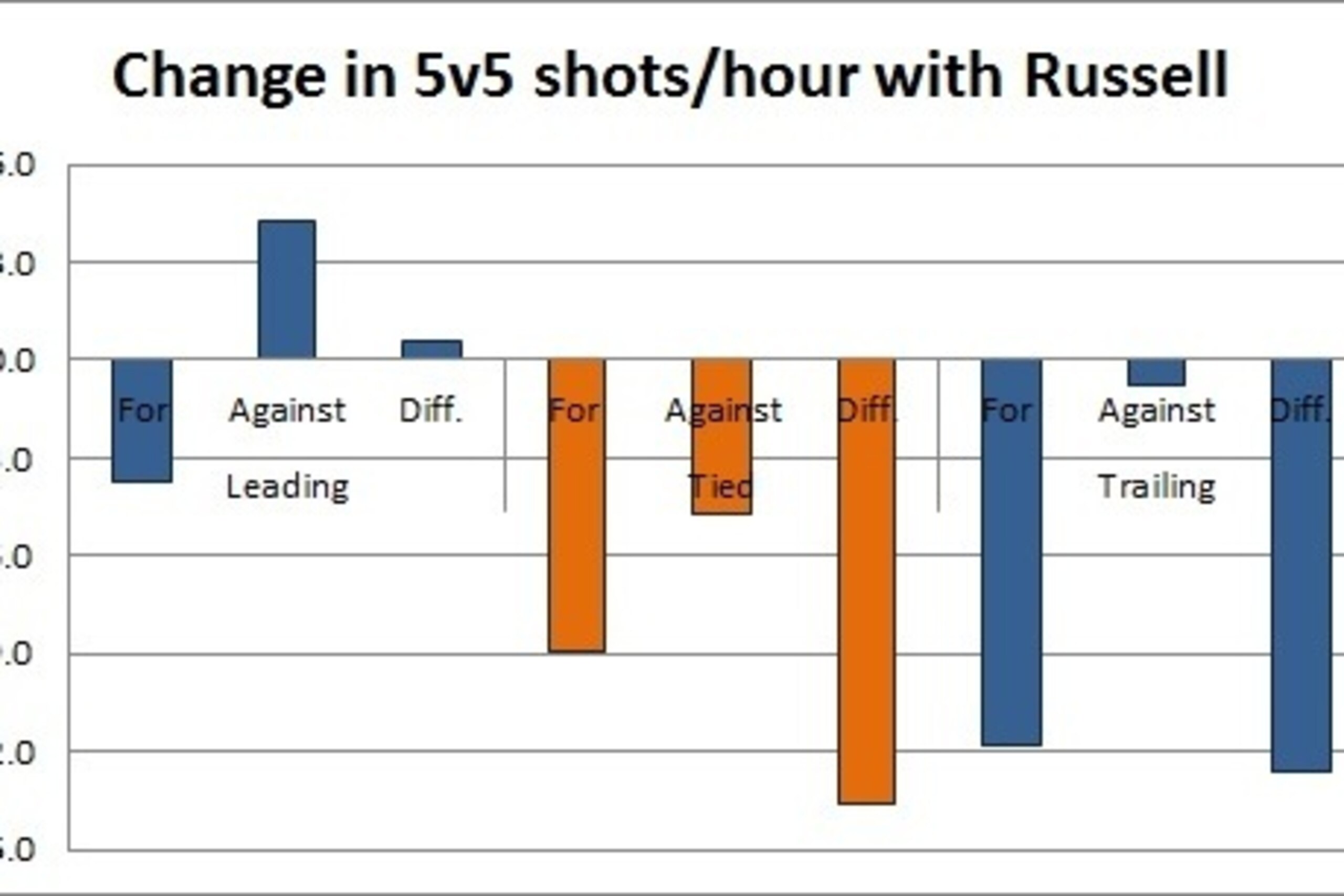
Russell’s numbers when the Oilers are trailing or tied in a game are miserable, and he’s been flat-out bad in those situations this season.
However, when Edmonton has the lead, Russell excels. Edmonton’s shot differential improves, and more importantly the team allows far fewer shots. Russell has been extremely effective this year at defending the lead for the Oilers, and McLellan has used him a ton in those situations.
In a nutshell, Russell’s strengths and weaknesses both come down to his ultraconservative game. Most of the time, it’s a weakness; he prioritizes low-risk plays over puck possession. He outperforms his teammates in situations where the low-risk play is seen as desirable, such as when killing a penalty or holding a lead late in games.
Overall, Russell is an unremarkable NHL defenceman. He has real and significant weaknesses which deserve attention. At the same time, he can be highly useful in specific situations, and that's well worth remembering.
Statistical information courtesy of Hockey-Reference.com, Corsica Hockey, Puckalytics.com and Natural Stat Trick.
Jonathan Willis covers the NHL for Bleacher Report. Follow him on Twitter for more of his work.
.jpg?w=2560)
.jpg?w=2560)




.jpg?w=2560 "Every Team's Biggest Surprise So Far 😲")
.jpg?w=2560 "Caleb Williams Starting Sunday")