

Derrick Rose Creates Looming Decision for New York Knicks at Point Guard
NEW YORK — Every now and then, he flashes a glimpse of the player he once was.
Sometimes, it will come in a quick crossover followed by an acrobatic finish at the hoop. Other times, he’ll leap off the floor on one side of the rim—only to emerge on the other end of the basket to smoothly spin the ball off the glass and through the net before landing.
These days, though, most of Derrick Rose’s work is done with his feet closer to the ground. The daily displays of gravity defiance are no more. They’ve been replaced by a subtler style of manipulation, a head fake here, a dipped shoulder there, maybe a quick change of direction followed by a funky-looking toss.

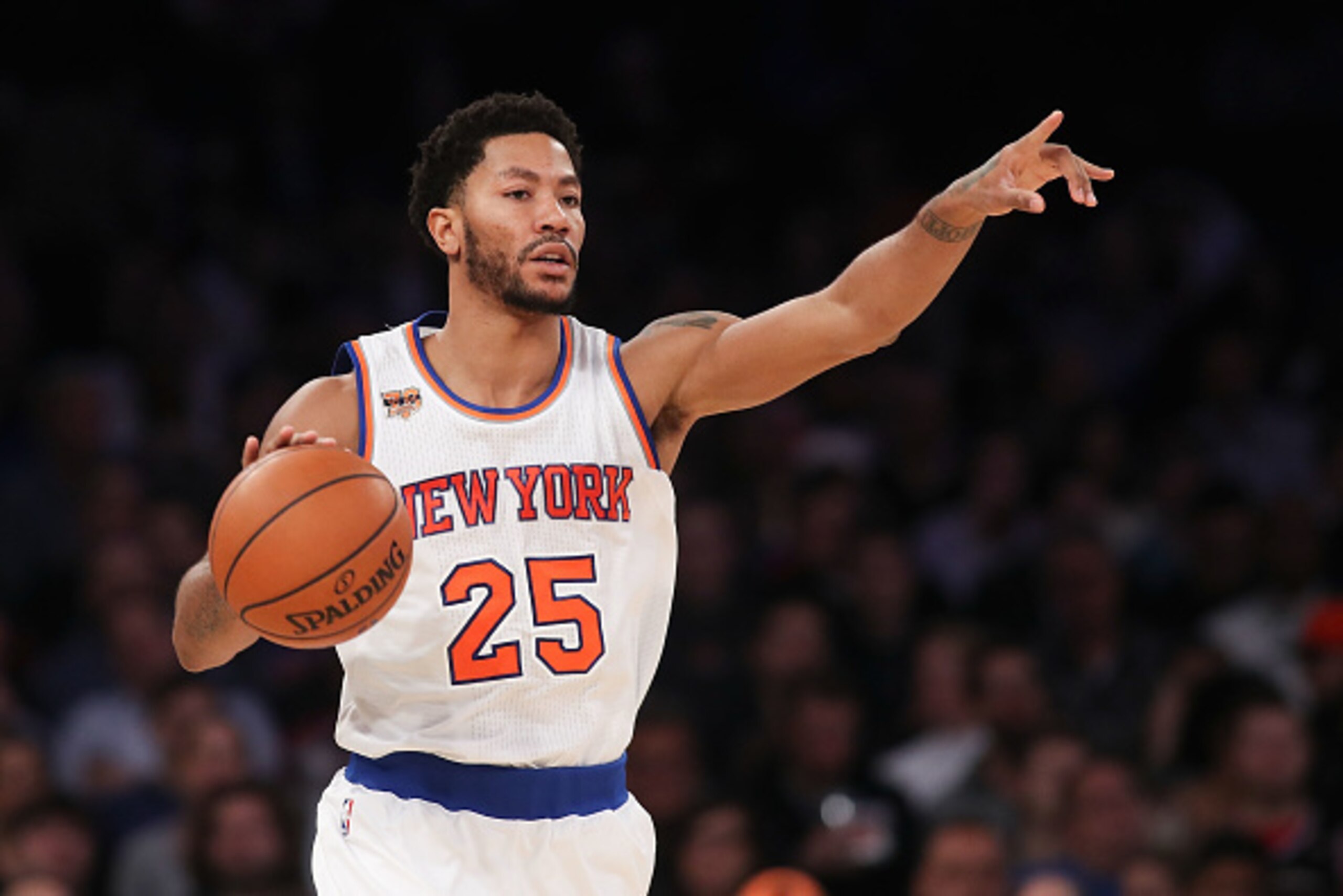
"That vintage is gone, man," Rose said to reporters recently. "The question should be: Can I hoop? I can hoop. It shouldn’t be like, 'He’s playing like his old self.' If I can hoop, I can hoop, no matter if I did that when I was younger or now. I can play the game of basketball."
There are different ways to play basketball, different levels to do so, too. Some players are able to single-handedly vault teams deep into the playoffs. Rose, a former league MVP and All-Star, used to be one of those guys. Today, he’s a flawed facsimile of his former self.
He also happens to be the best point guard the New York Knicks have employed since Jason Kidd retired in 2013.
Rose’s presence on the floor elevates the team (the Knicks are 6.4 points per 100 possessions better when he plays), despite what you may be hearing on Twitter or in local bars. Nuance, after all, has never been the sports fan’s strength.
Rose is no longer a stud, so therefore he must stink? Or so the logic seems to often go, as if no large swath of gray area exists between the two extremes.
"He seems to be getting better as the season goes on," San Antonio Spurs scout Pops Mensah-Bonsu wrote to Bleacher Report in a text message.
There are likely others around the NBA seeing the same thing, which maybe could explain the strangely timed report from the New York Post's Marc Berman stating, courtesy of an anonymous "NBA source," that the Knicks may or may not (are there any other options?) offer Rose, who will be an unrestricted free agent this summer, an extension before his contract expires.
Rose told the Post that he’s yet to discuss his contract situation with the Knicks. His agent, B.J. Armstrong of Wasserman Media Group, declined to comment to Bleacher Report.
At this point, it's silly to dive into predictions of who Rose signs with and when. The Knicks can't ink him to an extension until six months have passed from the day they acquired him. That makes Dec. 22 the earliest a deal could be signed. The NBA's collective bargaining agreement prohibits Rose, due to his veteran status, from signing an extension that lasts more than three years and pays him more than around $25 million per year.
If he were to wait for free agency, Rose could sign a four-year deal with another team or a five-year pact with the Knicks, both worth the maximum amount allowed under the CBA.
All that makes the equation sound more complex than it actually is.
Here's what matters: As the season has progressed, so too has the 28-year-old Rose. His first step has gotten faster. His familiarity with his teammates has gotten better. The rust he accumulated while spending the majority of training camp and preseason attending his civil trial in Los Angeles is wearing off, revealing a player who could wind up forcing the Knicks into a trying offseason decision.
"[He’s] getting more and more comfortable with the team and his role on it," Mensah-Bonsu added. "He may not be the D-Rose of old, but he has a great ability to get to the basket and can still finish at a high level. He isn't dunking the ball or finishing over people, but he is still very explosive."
Rose has remained relentless attacking the rim. His ability to blow past his man has provided the Knicks with a dynamic that they’ve sorely lacked since Jeremy Lin left town. The 10.5 drives he averages per game are 12th-most in the league, and the rate with which the Knicks are scoring on these drives is right in line with what the Cleveland Cavaliers are putting up when Kyrie Irving takes the ball to the hoop.
Rose is also doing this while pounding the ball into the floor less frequently than he did last season.
"His explosiveness is there," Knicks head coach Jeff Hornacek said following Rose’s 30-point outburst in the Knicks’ Monday night home loss to the Oklahoma City Thunder. "You saw tonight he’s getting back into his form that he always is. I think that when he really feels comfortable with taking the ball to the basket like that, that’s going to open up [the offense]."
Rose has been even more potent when given a screen. He’s a master at reading the body of an opposing big man, finding an opening and then attacking downhill. He's made a point of hunting out the rim and only settling for jump shots as a last resort. The 0.95 points per possession he’s generating when handling the ball on pick-and-rolls is better than 78 percent of the league.
Of course, Rose remains far from perfect. He's never been much of a distributor and still struggles finding open teammates while on the run. That wasn't his job in years past.
This is his first season not being one of his team’s two primary scoring options, and it’s clearly been an adjustment. But again, there are have been signs of progress.
"He’s feeling more comfortable with the plays. He missed a big set of time right before the start of the season," Hornacek told reporters this week. "We crammed things in for him. We threw a lot at him quickly to comprehend and figure out. I think he’s getting more comfortable with what we do out there."
Rose is handling the ball less than ever before but has yet to publicly gripe once. He’s working on defense: ESPN’s Real Plus Minus has him ranked as one of the league’s worst point guards on that end of the floor; NBA.com’s player tracking data paints a much more favorable picture; this writer’s eye test says Rose has been mostly solid, with the occasional mishap mixed in.
And clearly, he's making a concerted effort to find wunderkind Kristaps Porzingis more often.
Nobody on the Knicks passes to Porzignis or sets up his buckets as frequently. The two are developing a nice pick-and-roll chemistry, with Rose increasingly learning when and how to find the Latvian behind the three-point line at the top of the key.
"I think we’re just starting to actually get a feel for each other; it can get still much better, much better," Porzingis said Tuesday. "But, yeah, Derrick, he’s always trying to find me. He’s trying to be aggressive, and I try to set good screens for him to get open. We’re still working on it. I think we have a long ways to go, and we can get much better at the pick-and-roll."
That won't happen if Rose doesn't soon prove he can connect from the perimeter. His shot remains a flat line drive that often barely makes it over the front of the rim. He's made just 24.5 percent of the 94 jumpers he's launched this year. Defenders are already sinking off him; soon they might muck up the Knicks' spacing and abandon him entirely.
"It’s a strange thing, because I almost think sometimes when he’s tired, he shoots it better because he shoots it on the way up," Hornacek said Tuesday. "Like in practice, he shoots it on the way up and gets the arc. He knows, he wants to get it up higher, but sometimes I think that adrenaline gets flowing in the games and he’s got all this energy and he jumps high. And that’s when his shot tends to be flat."

Rose did drill 35 percent of his jumpers following last season's All-Star break, plus 37.5 percent of his triples. He's been working on his shot every day at practice and is frequently the last Knick player to leave the court.
"Your whole life, you’re used to a one-two rhythm," Rose said. "You have one injury, and that kind of resets everything, let alone you have three," Rose said recently, referring to the two ACLs he's torn and the orbital fracture he's suffered.
"You’ve got to find your one-two. How high you want to jump on your shot? How high you want to jump on your threes? I missed preseason. All those little things count. Like, this entire time, these three or four years, I’m playing catch-up."
We know Rose is no longer one of the NBA's top guns. That's OK. But can this lesser version of Derrick Rose, who is averaging 32.6 minutes and has yet to miss a game, be good enough to get the Knicks back into the playoffs for the first time since 2013?
If he is, then he very well could be worth keeping around for a few more years. But there's no need for the Knicks or their fans to rush to judgment. Instead, just sit back and let the season play out.
The answers will likely reveal themselves.
Knicks Insider Notebook
Fun With Lineup Numbers

It's still early, so take all these numbers with a grain of salt and whatever other cliche you like to sprinkle onto your sportswriting. But the Knicks have also played 17 games, which means we can start deriving some knowledge from lineup data.
So guess what five-man group has been deadliest for the Knicks? Nope, it's not the starting five, and, no, surprisingly, it doesn't include Joakim Noah watching from the bench.
Thus far, the Knicks' top five-man lineup has been the unit of...Rose, Justin Holiday, Carmelo Anthony, Porzingis and Noah. That group has shared the court for 23 minutes over six games this year—again, small sample size—and outscored opponents by a ridiculous 32 points per 100 possessions, mostly thanks to a blistering 136.2 offensive rating.
Why is this lineup so potent? The guess here is that it has to do with Holiday, who can defend positions 1-3 and shoot from deep (41 percent on threes). Also, these numbers are probably a bit of a mirage.
That said, it could be a good idea for Hornacek to try giving this lineup some more run.
As for a lineup he should start avoiding—how about Rose, Courtney Lee, Anthony, Porzingis and Kyle O'Quinn, which, per 100 possessions, has surrendered a ghastly 124.3 points and been outscored by 25.1 in 43 minutes of action?
Bigs Need a Little Help

The Knicks are last in NBA defensive rebound rate and second-chance points surrendered, both of which have contributed to them owning the league's fourth-worst defensive rating.
These problems were on full display Monday against the Thunder, who abused New York in the paint. Oklahoma City pulled down 17 offensive rebounds and had 28 second-chance points.
Tuesday after practice, one where the Knicks watched the game film together, Hornacek was asked what he believed led to these struggles on the defensive glass. He said he felt his bigs needed to do a better job of using their "rears" to box out but also added another interesting point.
"If you're going to be wrestling with that guy, that's when the emphasis is on the guards. They've got to come in there and jump over the top," he said.
The Knicks' best rebounding guard is Holiday, who is reeling in 4.6 defensive boards per 36 minutes, according to Basketball-Reference.com. That could be why the lineup mentioned in the section above—which has been strong on the defensive glass—has been so successful.
All quotes obtained firsthand unless otherwise noted. All stats from NBA.com and accurate as of November 30.
Yaron Weitzman covers the Knicks, and other things, for Bleacher Report. Follow him on Twitter @YaronWeitzman and listen to his Knicks-themed podcast here.

.jpg?w=2560 "WWE Raw Live Grades 🔠")
.jpg?w=2560 "Chiefs, Steelers Eye WR Trades")
.jpg?w=2560 "🚨Jay-Z Headlining Super Bowl")

.jpg?w=2560 "Cowboys Handle Eagles on MNF 🤠")