Diagnosing Houston Rockets' Remaining Roster Flaws
The Houston Rockets are such a different team than they were last season.
In one sense, they’re different because of their composition. According to Basketball-Reference.com, only 61 percent of the minutes this season were used by players who were on last year’s roster, which is the 11th lowest in the league.
But even that doesn’t fully convey how much turnover there has been. K.J. McDaniels, Montrezl Harrell and Sam Dekker were all on the roster in 2015-16, but they only accounted for 3.1 percent of the team's total minutes.
TOP NEWS
Vid of Oladipo's Private Workout
Valančiūnas Leaving NBA
Grading Every Team's Summer-League Rookies 🔠
This year, they are playing a significantly greater role with 15.7 percent. If you consider those three as "new" players, Houston has the fourth-highest turnover in the league.
Additionally, they have a new attitude with a new coach and a new system; they’re flowing freely and having fun. Jenny Dial Creech of the Houston Chronicle wrote before the season:
"The vibe of the team is positive. The players seem to like each other, to want to play for each other, to want to win for each other.
From the outside looking in, that was missing last season. (James) Harden and (Dwight) Howard shared talent, but they lacked the chemistry a great team needs to win.
The Rockets have that chemistry now.
"
While the team, as a unit, is playing better and happier, there are still a few holes to fill; though how and when to fill them varies.
It’s James Harden’s Team Now
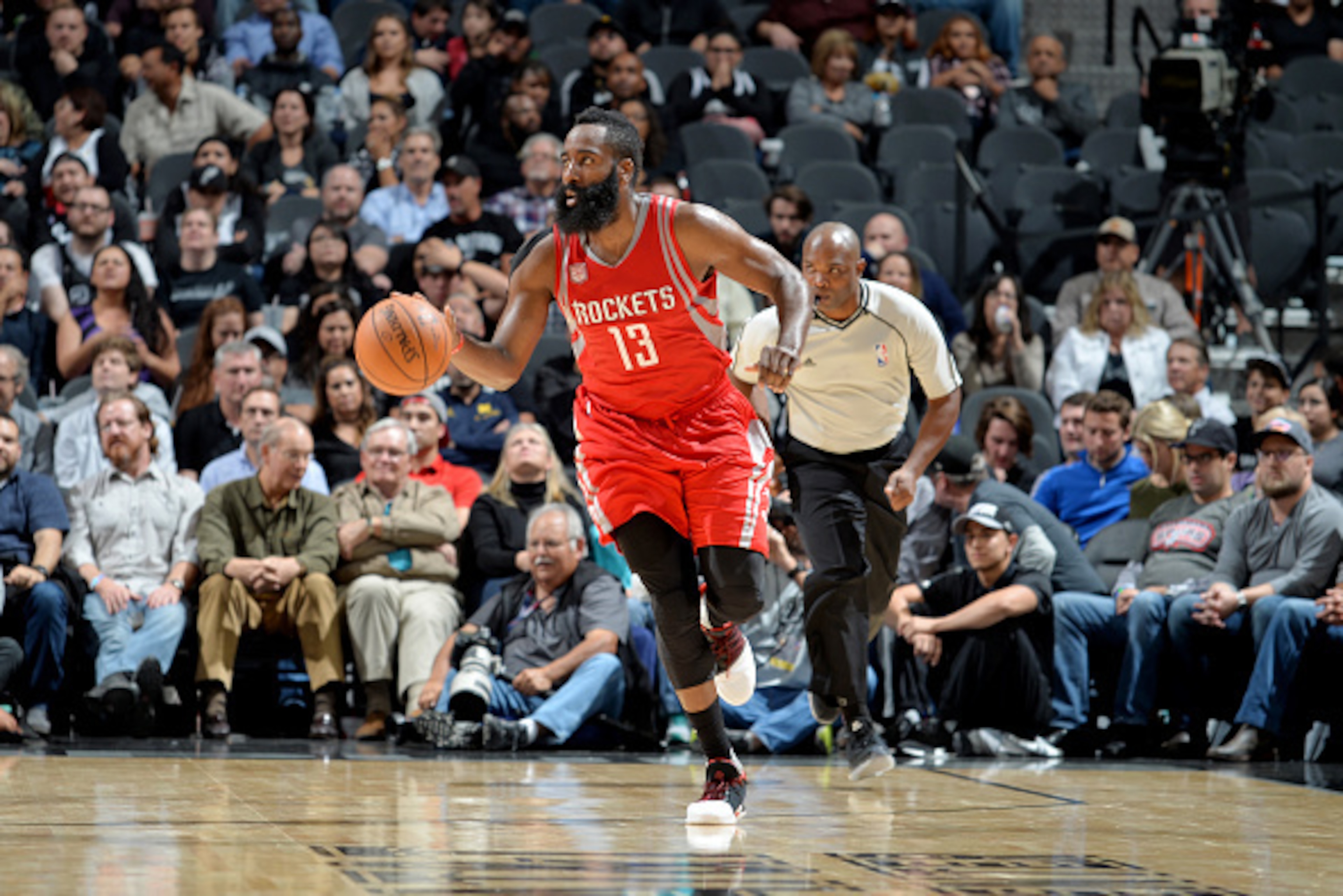
Before we dive into the major holes and how to patch them, it's important to establish the identity of this roster and what is going right.
James Harden is now the unquestioned leader of the team, and as such, he’s performing on a historic level. Through his first eight games, he has more combined points, rebounds and assists than any player since at least 1983-84.
From what the Elias Sports Bureau is reporting, we can also conclude that Harden is the first player since Jason Kidd in 1999 to notch a triple-double against the San Antonio Spurs, and the first ever by a visitor at the AT&T Center.
Harden seems to be the only one who isn’t impressed with the ridiculous numbers he’s putting up, according to Jonathan Feigen of the Houston Chronicle: "I'm a playmaker. I'm a basketball player," Harden said. "The things I do, I don't get excited. They don't surprise me, anymore. I just go out there and hoop."
Plus, his new teammates can hit shots. According to NBA.com, Ryan Anderson is an absolutely eye-popping 55.9 percent from deep this season. Eric Gordon is making 52.5 percent. Combined, they are netting 3.9 treys per game just off Harden passes. That’s almost 25 percent more than the whole team averaged last year.
That’s a key consideration because in trying to fix what’s not working, you don’t want to mess with what is.
The Hole: Defense
It doesn’t take a "Rocket scientist" to figure out defense is their biggest issue, with them being ranked 26th in points surrendered per 100 possessions (107.5), per ESPN.com.
Where it gets trickier is trying to figure out what the defensive problems are and how to fix them. The way to do that starts with looking at how opponents score their points.
The following pie chart, based on data from Synergy Sports Technology, shows the different play types and how opponents have derived their points. Scroll over the category for more details:
While this is helpful, it doesn’t tell us everything we need to know. For example, it might seem that transition defense is an issue, but when you’re playing an up-tempo system, transition points are going to happen both ways.
In total, the Rockets are giving a good chunk of their points in transition. But in terms of average points per possession, they’re a solid defensive group, yielding the 11th fewest average and the 11th fewest total points.
What's more, most teams score their points more in the same way. Just because the Rockets are giving up a chunk of points to the ball-handler on the pick-and-roll, doesn’t mean they’re defending it badly. In fact, their .754 points per possession is seventh best.
Looking at the chart below helps put things in perspective. The bars show total points, the dots show points per play: The darker the color of the dots, the worse they are ranked. What we want to see is where the Rockets can improve their defense the most.
In layman’s terms, what we’re looking for are areas where both the dot and the bar are high, and the dot is a dark blue. That’s a trifecta of bad defense. That means they’re bad at getting stops where most teams like to attack. That, in turn, means any improvement will be the most impactful.
There are two areas that jump out: spot-up and isolation. There are other areas where the defense is inefficient, but opponents get so few points that way (hands off, for example), it’s not a big priority to fix them.
The Patch: Patience

Houston is just going to have to be patient in both isolation and spot-ups because bulldog defender Patrick Beverley is returning to the lineup. Last year’s starting point guard has missed the beginning of the season due to arthroscopic knee surgery. The initial three-week timetable for his return is ending soon.
He ranked in the 66th percentile last year, which was "very good" by Synergy’s standards, so getting him back will be a big help.
In a surprising way, he can help with the isolation problem, as well. This season, Harden is yielding .867 points per possession in iso compared to last year when he gave up only .729. More surprising is that Harden not only was Houston’s best perimeter defender on such plays last year, he was in the 75th percentile league-wide.
When Beverley and Harden were on the court together, the Rockets' defensive rating was 3.3 points better than with Harden alone and even 0.2 points better than with Beverley alone.
This year, 140 of the points Houston has yielded have come from opponents passing out of iso or the pick-and-roll. That’s where offenses are doing the bulk of their damage on the spot up.
Having Harden meet the point of attack with Beverley there to defend the jump shooter should go a long way toward filling this hole.
Meanwhile, coach Mike D’Antoni changed the lineup by starting Corey Brewer against San Antonio so Eric Gordon could run the second team (more on that later).
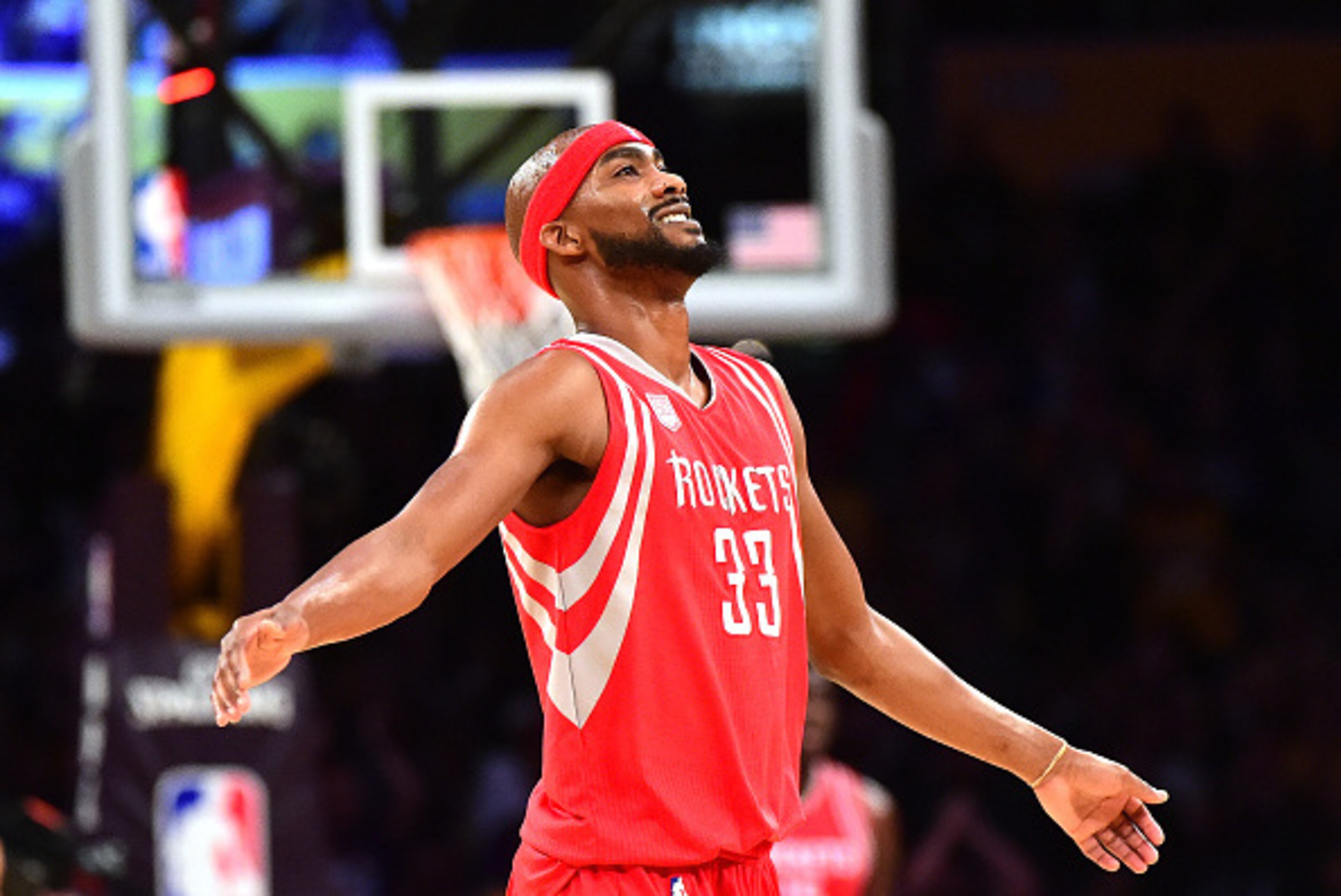
This was the right idea, but the wrong execution. Brewer gives up a ghastly 1.42 points per possession on spot-ups (seventh percentile) and K.J. McDaniels gives up 0.611 (88th percentile). McDaniels might not have much of a shot, but his 33.3 percent from deep and 0.6 makes per game double up Brewer’s 15.4 percent and 0.3 makes.
Thus, it makes more sense for McDaniels to start. However, there is an argument that Brewer is more valuable when playing with Harden than with Gordon:
That would probably even out with a larger sample size, though.
While McDaniels and Brewer would help the problem, it wouldn’t hurt to shop Brewer’s salary along with a draft pick to find a lockdown defender, even if it’s one who isn’t a great shooter. Alternatively, signing another "three-and-D point guard" could be the answer. Mario Chalmers is still available and would fit the bill as he recovers from last season's Achilles surgery.
The Hole: Bench Scoring
Houston’s offensive rating plunges when Harden sits. The defense does too, surprisingly.
In the absolute, "you can’t make this up" number of the day, the Rockets’ net rating goes from plus-9.1 with Harden to minus-31.4 without him. That’s a combined difference of 40.5.
In raw numbers, they have outscored opponents by 63 points with Harden on the court and been torched for 54 when he’s sat. For Harden, it’s got to be rough to watch the lead evaporate every time he catches his breath.
MVP much? How about TVP, as in Too Valuable a Player.
The Patch: Gordon off the Bench

The other guys need to step up when Harden sits, and that’s the thinking in letting Gordon come off the bench. That strategy didn’t work out so well in its first try against the Spurs.
San Antonio outscored the Rockets by nine points in seven minutes with Gordon on the court and Harden off, according to NBAWowy. But we’ll give that a few more tries before making too much of it. The Spurs have legendary depth and defense, after all.
Gordon is the next-best scorer and ball-handler on the team, and once Beverley returns, the hope is that there will be enough scoring between the two of them.
Another fix could include giving Sam Dekker more run. Playing with Gordon and without Harden this season, the second-year player has a true shooting percentage of 59.1 and is hitting 50.0 percent from deep. And during the 71 minutes the pair played together without the Beard, they’re comparatively competitive, having been outscored by just five points: 147-142.
Dekker’s defense is mildly troubling, but he’s seemingly growing by the game and plays with the energy and enthusiasm of a kid trying to lock down a roster spot. His focus is commendable from a youngster, too; when he gets beaten, it’s normally not because he’s made a mistake.
The thought in getting Gordon was always that he’d run the second unit, but Beverley’s injury threw everything for a loop. When Beverley returns, Gordon will have another spot-up shooter to pass to.
There’s hope here yet. It’s better to let this plan play out before scrapping it.
Once again, Chalmers makes sense as a cheap temporary fix, too. He’s a decent enough defender and three-point shooter. He is coming off that torn Achilles, which is why no one has signed him yet, but what’s there to lose at this point?
Any major moves beyond the aforementioned tweaks would disrupt the growing chemistry and could have a counterproductive effect.
All stats for this article are current through Nov. 11 and obtained from Basketball-Reference.com, NBA.com, NBAWowy.com and SynergySportsTech.com.
.png?w=3840 "B/R")