

NY Knicks Notebook: Can Jeff Hornacek Save Phil Jackson's Triangle Offense?
WEST POINT, N.Y. — It was the summer of 1988 and Jerry Colangelo, then the general manager of the Phoenix Suns, was looking for a new head coach.
He had pieced together a talented roster. A trade the previous winter had delivered the Suns a future All-Star point guard, Kevin Johnson. Eddie Johnson, an electric scorer on the rise, would share backcourt duties. Colangelo was also close to signing Tom Chambers, a free-agent All-Star, to a multiyear deal.
They also had an undersized, underwhelming prospect out of Iowa State who Colangelo had drafted two years earlier with the 46th pick: Jeff Hornacek.
TOP NEWS

Pic of LeBron's Helicopter Commute 🚁

Duren Calls Out 'False' Rumors

NBA Power Rankings Entering Preseason 🔢
But first Colangelo needed to a find a voice to mold everything together. He tabbed Cotton Fitzsimmons, the longtime NBA coach who had enjoyed a successful run with the Suns in the early ‘70s. Earlier in his career at Kansas State, Fitzsimmons was an assistant to Tex Winter, the famed architect of the triangle offense and future mentor to current Knicks president, Phil Jackson.
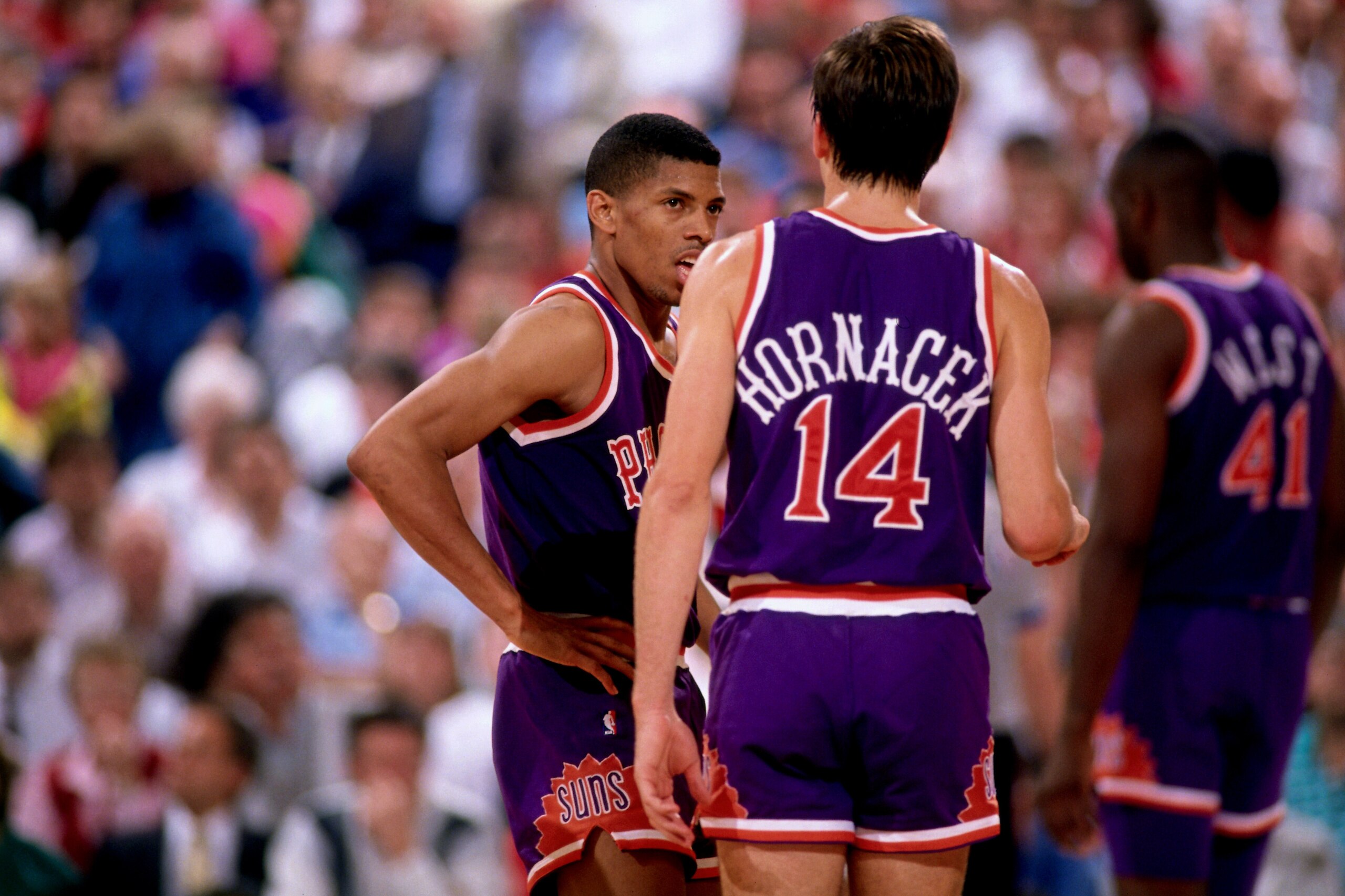
“Cotton ran the triangle in his first period with us,” Colangelo, now an adviser to the Philadelphia 76ers and director of USA Basketball, said in a recent phone interview. “But what I liked about him was that I saw a flexible guy who was willing to adjust to his players as a coach.”
The Suns went on to win 55 games that year—nearly as many as Hornacek had combined to win (64) during his first two years in the league. Under Fitzsimmons, Hornacek saw his minutes, scoring output and three-point shooting percentage all climb.
Fast-forward 28 years. Hornacek, now 53, is standing on the sidelines of West Point’s Christl Arena and playing the role of Fitzsimmons. He’s wearing baggy blue New York Knicks shorts and a black zip-up sweatshirt with a whistle around his neck. His face alternates between attentive looks and smiles. Save for an occasional pointer—“more screening, more screening”—he relegates himself to the background as the two scrimmaging teams dash up and down the floor.
His job is not an easy one. He’s taking over a team that won just 32 games last year and missed the playoffs for the third straight season. His roster includes multiple big-name stars (Carmelo Anthony, Derrick Rose and Joakim Noah) coming off injuries. He’ll need to manage big egos, develop franchise wunderkind Kristaps Porzingis and nudge Jackson’s beloved triangle into the 21st century—all with Jackson looking over his shoulder and eyeing every move.
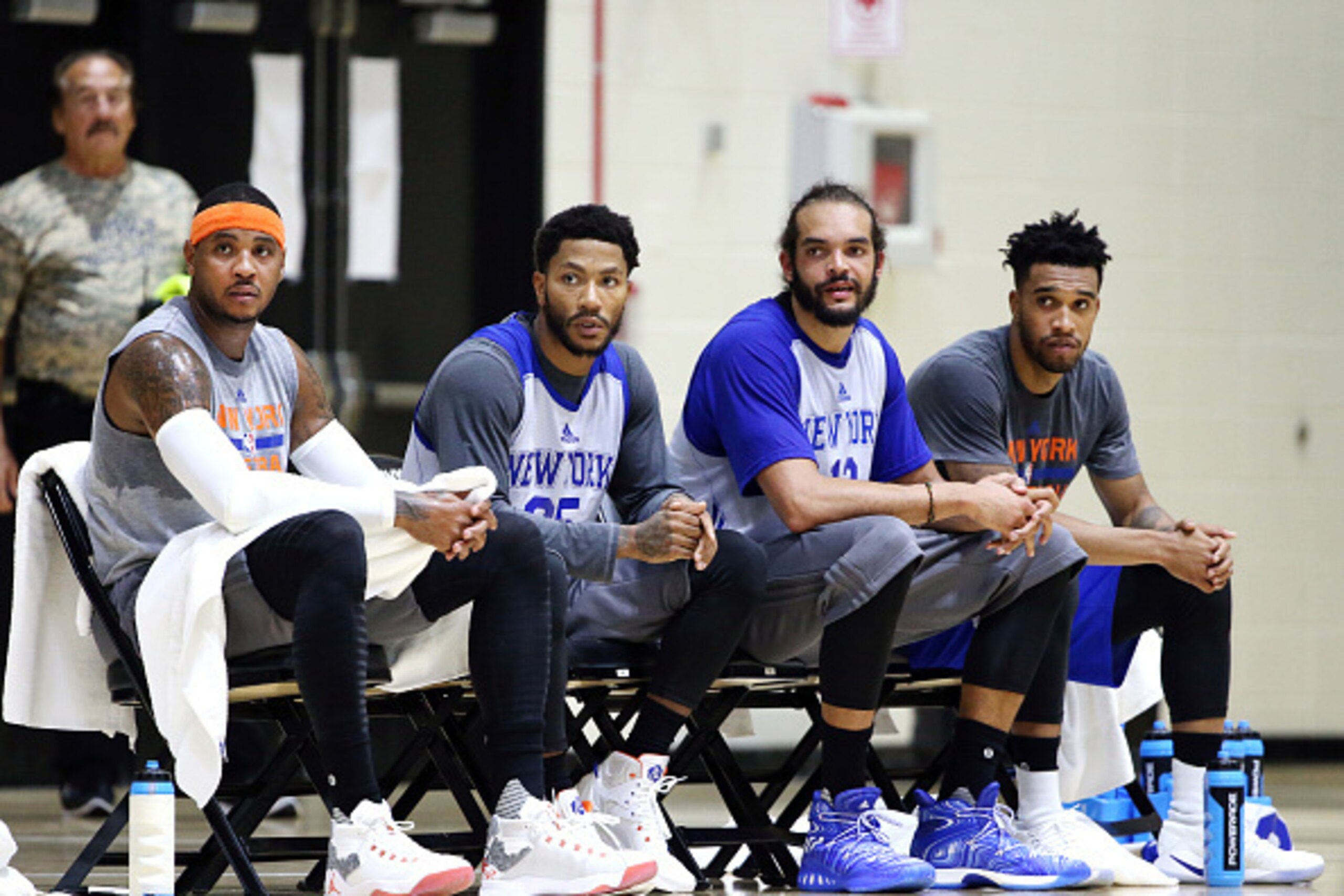
The Knicks’ most pressing problems are on offense, where Jackson’s triangle-shaped shadow looms largest. They’ve ranked in the bottom five in points per 100 possessions during each of the past two seasons.
If you pop the hood, it’s easy to see why.
The Knicks have taken more mid-range jumpers (considered the least efficient shot in the game) than any other team in the league. Last year, according to NBA.com’s player tracking data, just three teams ran more isolations and only one implemented fewer pick-and-rolls. The Knicks have also finished last in fast-break points during each of the last four seasons.
In a league where uptempo, three-point-chucking, isolation-averse teams have thrived, the Knicks are a NASCAR driver racing in a 1950 Volkswagen Beetle.
Enter Hornacek, who the Suns fired last winter after compiling a 101-112 record during two-plus seasons as head coach, much of which was the result of constant roster upheaval. The Knicks hired him to replace Kurt Rambis—who in February replaced the deposed Derek Fisher—and inked him to a three-year, $15 million deal.
On the surface, the hire looked odd: Hornacek was not a Jackson acolyte. His Suns teams pushed the pace and chucked threes.
“Statistics say in the first eight seconds, you shoot a much higher percentage,” Hornacek told ESPN’s Zach Lowe in a 2013 interview. He also discouraged his teams from taking long jumpers inside the arch. “We gotta get rid of that long 2,” he added in that same interview.
Will Jackson allow Hornacek to bring these principles to the Knicks?
During the team’s second practice of the season, the answer seemed to be an emphatic “yes.” Jackson sat in silence on a far-off sideline at West Point while the Knicks’ players darted back and forth.
“Phil’s given us the ability to run it any way we want,” Hornacek said. “We talked about what we feel is a good working way to run it with different options. We’ll get to all those as the year progresses, but it should be pretty easy.”
Since being hired, Hornacek has been consistent with his comments. He wants the Knicks to play fast—then, if an opportunity doesn’t present itself, they’ll settle into a modified version of the triangle, an offense Hornacek is more familiar with than many realize.
In addition to his stint playing for Fitzsimmons, he also kept a copy of Jackson’s latest book, Eleven Rings, on the desk of his Phoenix office and built much of his Suns offense around basic triangle concepts: tossing the ball into a forward on the elbow (the “pinch post”), dribble handoffs, point guards cutting down the lane.
There were a number of differences, though: Hornacek encouraged his players to position themselves behind the three-point line. He used triangle placements as a means for springing pick-and-rolls. He also implored his players to run at every chance, earning their trust and respect as a result.
“He’s a big-time players coach,” Grizzlies center Brandan Wright, who played for Hornacek in Phoenix, said in a phone interview. “He knows what buttons to push, when to back off and he’s a great communicator.”
It’s (very) early, but his new players already feel a similar way.
“He’s just a real cool and calm guy,” said Brandon Jennings, who added that he remembered watching Hornacek when he was battling Michael Jordan and the Chicago Bulls as a member of the Utah Jazz. “He just wants us to hoop. He’s definitely different than other coaches I’ve had.”
That the Knicks will look to push the ball more this year is a given. Both Courtney Lee and Lance Thomas said Hornacek, during offseason conversations, encouraged them to work on their conditioning.
As for the amount of freedom Hornacek will have to diverge from some of Jackson’s principles, well, that’s the giant unknown.
After all, part of Fisher’s undoing in New York last year was reportedly his desire to alter the offense Jackson had hired him to run. Jackson hasn’t been able to keep to himself on the sidelines this year, either. During the Knicks’ morning session on their second day at West Point, he pulled his balky 6’8” frame out of his seat, halted practice and walked onto the floor.
“He got mad at us one time we were running the offense and didn’t throw the ball into the post,’’ Rose said afterward. “He came over a little grumpy. First time I ever saw him like that.”
Rose then proceeded to call the triangle offense “complicated” and “foreign.” It was exactly the type of quote New York’s tabloids eat up (New York Post headline: “Derrick Rose sees Phil Jackson’s cranky side in rude triangle intro”) and the type of interaction that perfectly illustrated the time bomb Hornacek is now tinkering with.
Jackson and the triangle aren’t going anywhere, at least for another year (he can opt out of his contract next summer but has no plans of doing so, according to his girlfriend, Jeanie Buss). Part of Hornacek’s job will be to massage his boss’ ego while putting his players in the best position to succeed.
The man who brought Hornacek into the NBA 30 years ago has faith he is capable.
“In my opinion, because of his intelligence, I expect Jeff to adjust to his talent and not to be locked into playing a certain way,” Colangelo said. “I’ll say this: If you’re looking for a guy who has a good basketball mind to represent your franchise in a respectful way, Jeff’s a good pick.”
Knick Knacks
Hornacek’s Eagle Eyes
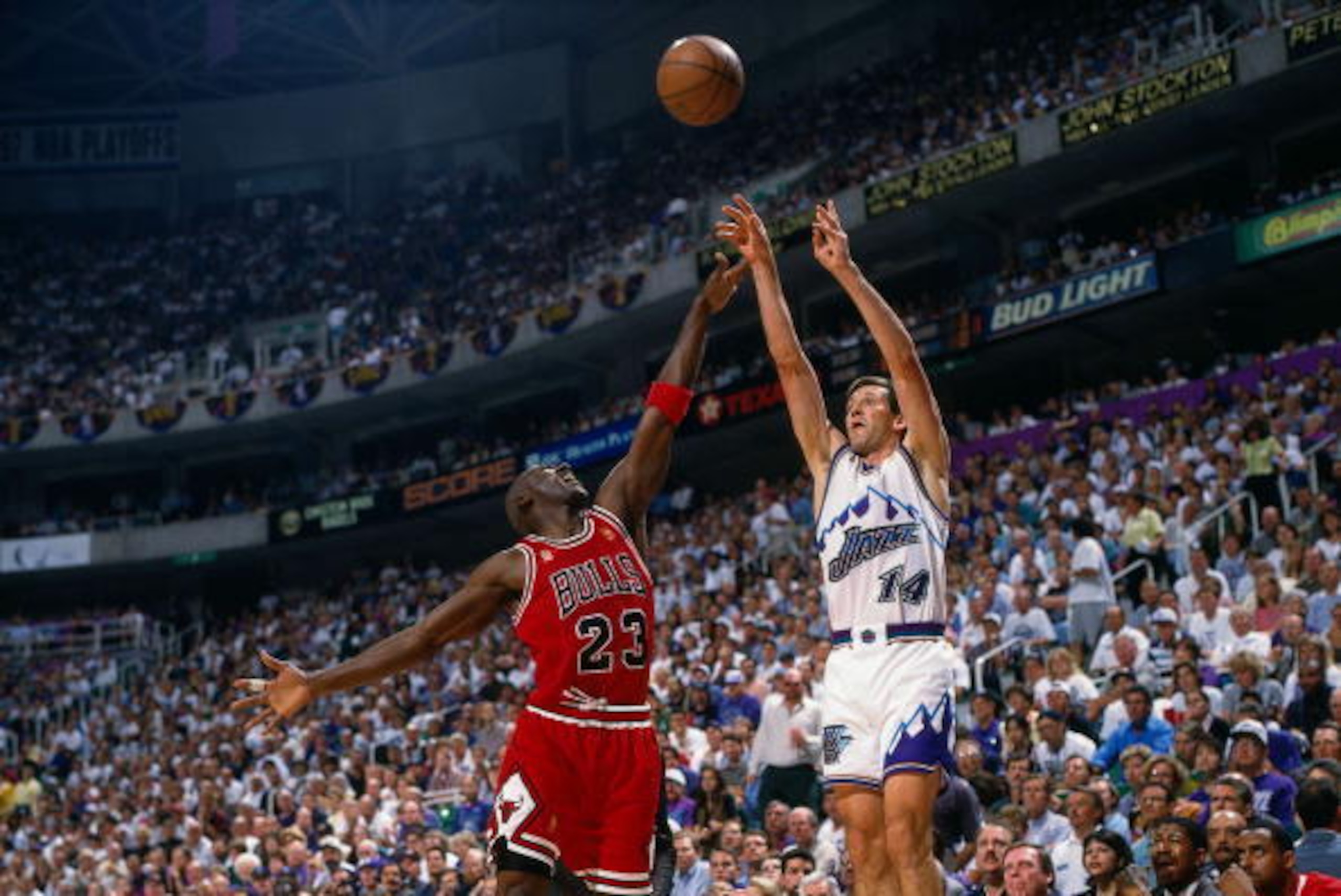
Following his retirement, but prior to being named head coach of the Suns, Hornacek spent three seasons as an assistant for one of his former teams, the Jazz. He worked closely there with Kyle Korver.
“He was such a smart player,” Korver said in a phone interview. “He knows all the little nuances of the game. We spent hours just talking basketball.”
One time, Korver asked Hornacek where he used to aim when shooting.
“He said he would pick a spot on the rim and just focus on that spot and shoot right over it,” Korver said. “I figured he meant he’d look at the rim, but no, he actually meant he’d find a spot on the rim. And he did this during games.”
Korver said this story made him question his own vision.
“I told our trainer afterwards that I think I need to get my eyes checked,” Korver said. “And I told the eye doctor that story—he said he didn’t know how that was possible.
“I don’t know, I guess Jeff has eagle eyes or something.”
There’s no triangle on D

The offense and the triangle are getting most of the preseason attention, but defense could very well be how the Knicks win games this year.
The Knicks surrendered 104.8 points per 100 possessions last season, the 18th-best mark in the league—not a strong number, but not an awful one either, especially for a team that gave major minutes to geriatrics such as Jose Calderon and Sasha Vujacic, along with Arron Afflalo, who ranked 80th among all shooting guards in ESPN’s Defensive Real Plus Minus statistic.
“We got different personnel out there this year,” Anthony said last week. “With [Joakim] Noah, he’s more of a quarterback out there, Courtney [Lee], Lance [Thomas] guard the perimeter, Derrick [Rose] can put pressure on the ball.”
In Lee and Noah, the Knicks added two above-average defenders to their starting lineup. Rose has never been much of a stopper, but he has a strong defensive background, having spent years playing for Tom Thibodeau. He’ll do a better job of staying in front of opposing point guards than the stone-footed Calderon.
The starting lineup of Rose, Lee, Anthony, Porzingis and Noah is big, long and quick. There’s no reason the Knicks can’t finish as a top-10 defensive squad with that unit. At the very least, they should force more than last season's league-low 11.7 turnovers per 100 possessions.
One with nature
Knicks fans could be forgiven if they’re not familiar with Maurice Ndour.
A 6’9” small forward out of Senegal, Ndour signed a guaranteed two-year deal in July after spending the past season with Real Madrid. He is an energy guy, a hustler and slasher who enjoys playing defense and finishing around the rim. He has impressed his new coach thus far in training camp, too.
“He's that guy that provides activity,” Hornacek said last week. “I really like the way he moves without the ball, cuts to the basket. He rolls and catches. That's really what we want with him.”

All fine and dandy, but Ndour’s best attribute is, without a doubt, his overall chill.
“I enjoy the outdoors, man,” he said last week. “This is Mother Nature, you have to get out and appreciate it. It brings me peace and joy.”
Ndour, who spent two years at Monroe College in New Rochelle, New York, before transferring to Ohio University, said he frequently returns to Westchester to take in the scenery and go for a nature walk.
“Sometimes you just need to get out and get some sun,” he said. “It’s good for you.”
These days, of course, he’s focusing on basketball. And while his deal is guaranteed, Hornacek made it clear last week that the Knicks would be fine cutting a player with a guaranteed deal if they felt there was a better option available.
Still, letting Ndour go would be a mistake. Not because he’s such a great basketball player, but basketball seasons are long and arduous.
Every team could use a little chill.
Advanced data obtained from NBA.com. All quotes obtained firsthand unless otherwise noted. Follow Yaron Weitzman on Twitter at @YaronWeitzman.

.jpg?w=2560 "NFL investigating 2 referees for separate viral exchanges")

.jpg?w=2560 "Report: Chiefs Contact Hill's Agent")
.jpg?w=2560 "OBJ Calls Out Giants After Release")
.jpg?w=2560 "Tyreek makes another cryptic post amid Chiefs rumors")

.jpg?w=2560 "Greenlaw Talks Payton Exchange")