Carlos Hyde in Position to Assert Himself as One of NFL's Top Backs in 2016
After his showing against the Los Angeles Rams on Monday Night Football, you can make the case that San Francisco 49ers running back Carlos Hyde is one of the breakout players from Week 1's action.
The third-year running back out of Ohio State posted 88 rushing yards, good for seventh league-wide, and two rushing touchdowns, tied for the NFL lead.
When you look at how he was able to produce like he did, though, it's even more surprising than his raw statistics.
TOP NEWS
.jpg?w=2560 "Green Bay Steelers Football")
NFL Preseason Week 1 Winners/Losers 📊
.jpg?w=2560 "Patriots Camp Football")
Gonzo Not Happy with Kraft 😬
.jpg?w=2560 "Dolphins Bears Football")
NFL legend calls plays during preseason
Last year, Hyde was a popular fantasy football back, and after rushing for 168 yards in Week 1 against the Minnesota Vikings, many thought they had struck gold. Unfortunately, Hyde cracked over 55 rushing yards just once after Week 1 as teams forced the 49ers to throw the ball, their offensive weakness.
Hyde eventually went on injured reserve after missing five straight games due to a stress fracture in his foot.
At least against the Rams, it looked like San Francisco head coach Chip Kelly was able to balance the offense out a little more than the team could under Jim Tomsula's guidance, and Hyde looked to return to pre-injury form, if not better. According to ESPN's Total Quarterback Rating, 49ers QB Blaine Gabbert finished second league-wide in the stat in Week 1, but his 4.86 yards per attempt meant there were very few explosive plays in the 49ers passing game, something Hyde brought to the team on the ground.
Hyde had 23 carries, 17 of which were for four or fewer yards, including several tackles in the backfield due to the matchup of his offensive line and the Rams' talented defensive front. With that being said, Hyde proved several times that he could single-handedly bring a home run aspect to the 49ers offense.
He had four rushes of over 10 yards against Los Angeles, a very good mark considering some entire teams didn't have a 40-yard rusher in the league's opening weekend. One run came off a well-blocked counter-play, while three were saved by him on designed inside zone runs.
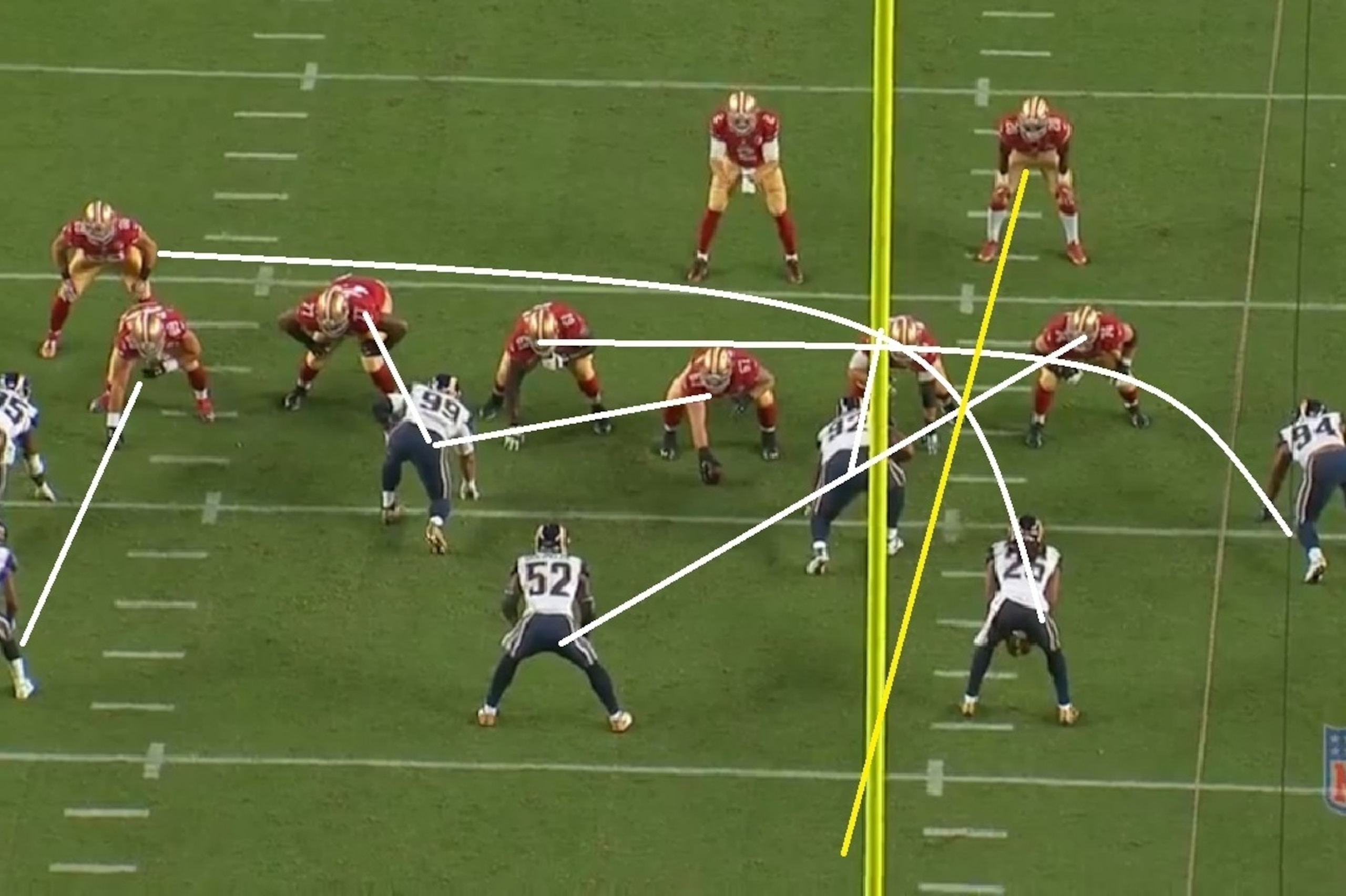
From the 11-yard line, Hyde was able to take in a Counter Trey concept in for a score. The 49ers got the right look, a two-high defense near the goal line, which essentially forced defensive backs who were 12 yards off the line of scrimmage to make a play.
Counter Trey concepts are fairly simple: The backside guard pulls along with another offensive player, in this case the backside H-back, to kick out the play-side defensive end and play-side off-ball linebacker. Everyone else has down blocks, other than the backside tackle, whose job it is to close down the B-gap.
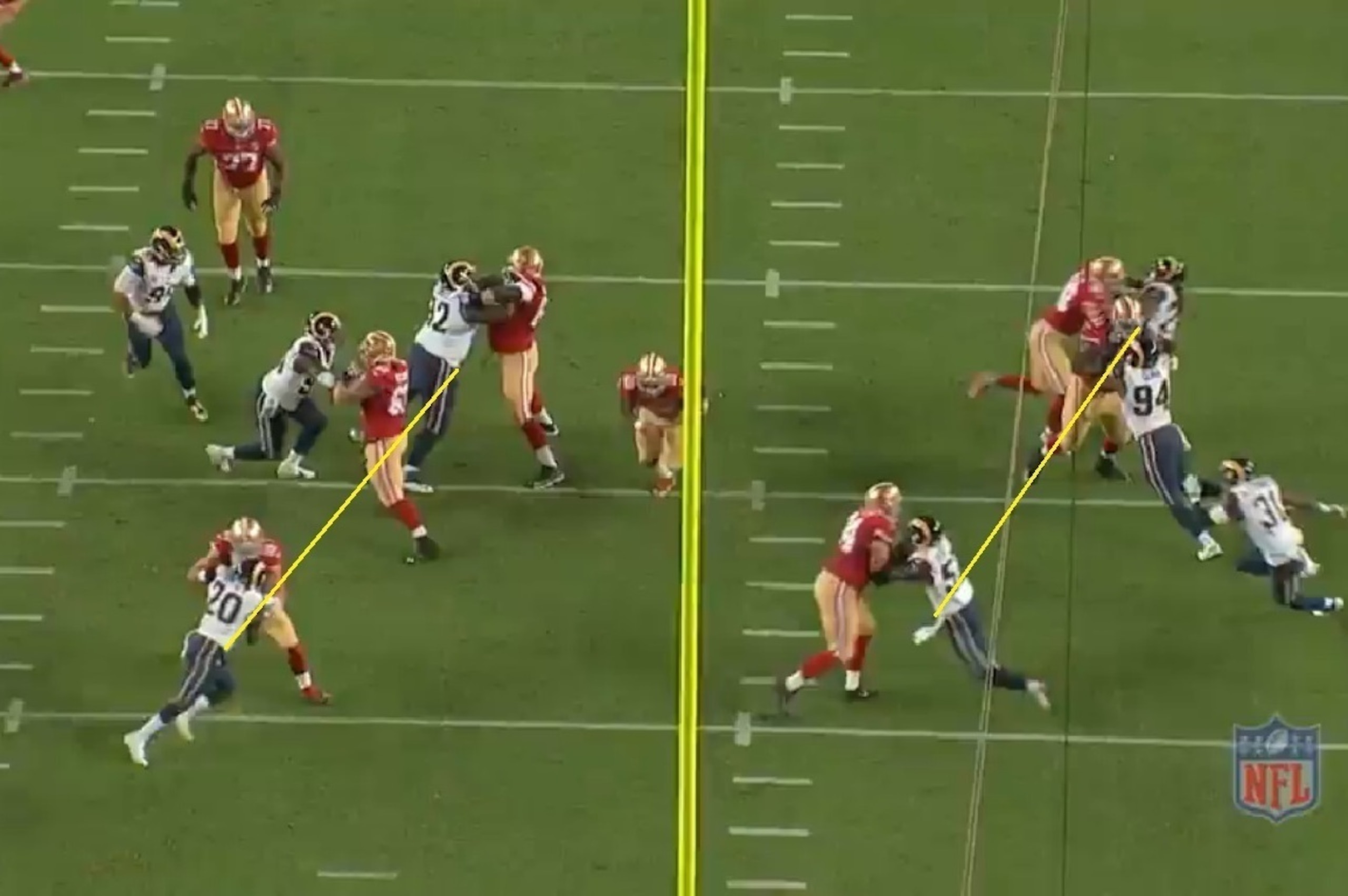
With a massive alley in a perfectly designed and executed play, Hyde burst to pay dirt and established the threat of a running game in the first quarter.
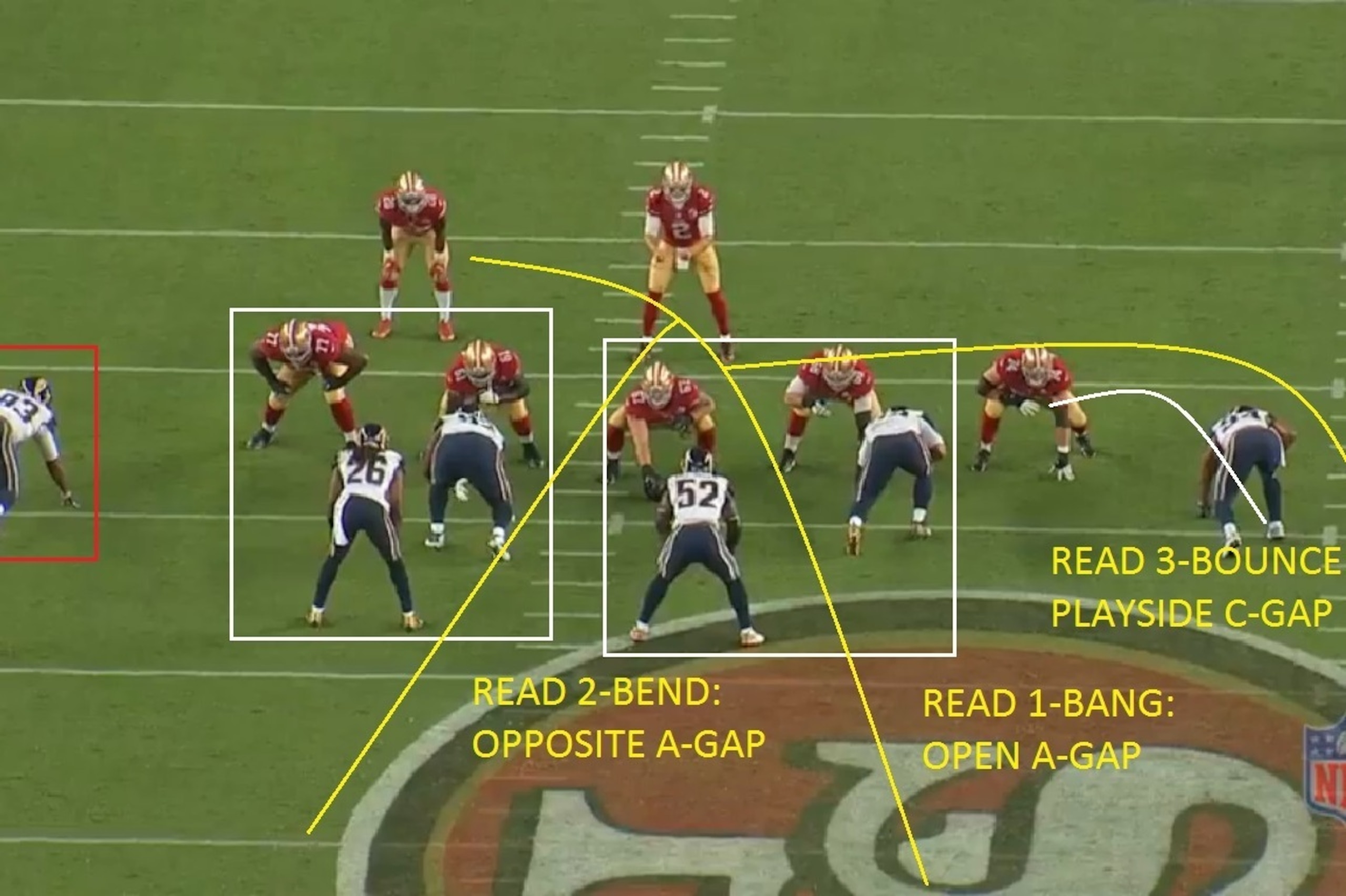
As mentioned before, though, the rest of his explosive runs stemmed more from his own individual ability to read blocks and determine the leverage of defenders, rather than his linemen playing at a high level.
On inside zone-option plays, everyone is moving in the same direction. There isn't the folding, down-blocks and pulling as with power and counter-runs. You don't have an assigned man as a blocker, but rather a zone or gap. It takes some level of chemistry, but there are built-in answers to prevent stunts and blitzes.
The basics are: The backside defensive end is going to be the option man, an unblocked defender who can never be right. He either crashes down to play the running back, taking himself out of position to tackle the quarterback, who should pull the ball and run in the open field, or he stays square at the line of scrimmage, allowing the running back to run with a numbers advantage of blockers and with the patience of knowing he won't be run down from behind while reading his blocks.
In most cases, inside zone-blocking concepts consist of the play-side tackle taking on the play-side defensive end, while the play-side guard and center work the play-side defensive tackle and linebacker and the backside guard and tackle work the backside defensive tackle and linebacker. The idea is that those combinations should land, no matter how a defense slants or stunts to get into its designed run fits.
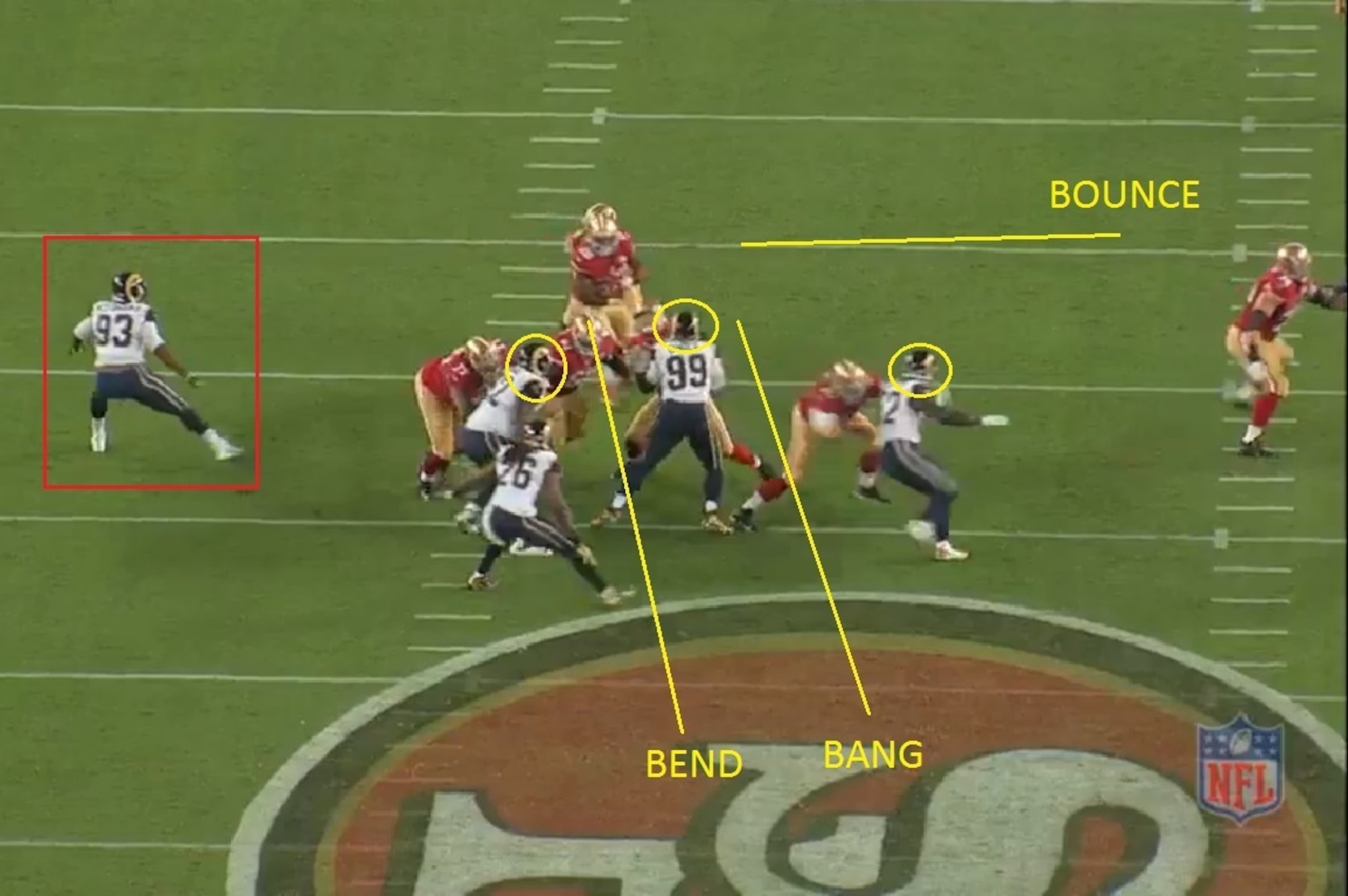
The Rams' defensive end, Ethan Westbrooks, played the quarterback on this rep, meaning that Gabbert correctly gave the ball to Hyde. Unfortunately for the back, his blocks didn't land.
The play-side defensive end, play-side defensive tackle and backside defensive tackle all had their heads to the play side, cancelling out the back's natural bang (play-side A-gap), bend (backside A-gap) and bounce (play-side B-gap to C-gap) reads all at once. It's a blown-up play, only made worse by the fact that neither the right guard nor tackle worked upfield to the Rams' backside linebacker.

Trying to make the best out of a bad situation, Hyde stuck his foot in the dirt to attack the backside C-gap, which was well-sealed because that guard-tackle combo basically turned a combo block into a double-team. From there, he ran through the backside defensive end, who was supposed to be "wrong" by design, and the backside linebacker, who should have been blocked, for an 18-yard gain.

By the time Hyde's third explosive run of the night came to fruition, Los Angeles had changed their approach on early downs. Instead of playing their typical penetrating 4-3 over defense, which allows under tackles like Aaron Donald to use their athleticism to their full advantage, they elected to play "Bear" fronts.
Bear fronts in essence are fielding two defensive linemen in the B-gaps while also placing a nose tackle right over the center. With that nose tackle "two-gapping" as a primary run defender, any inside run should be blown up by alignment.
More often than not, you need to run outside plays against that look, which is how squads like the Ohio State Buckeyes have attacked Bear fronts at the college level, but Kelly continued to call inside-zone plays. This time, Eugene Sims was the option defender, and Gabbert rightfully handed the ball off to Hyde.
The poor play call against that front was apparent from the jump. Not only were there no holes to run into on the inside, with bang and bend options showing up dead on arrival, but the 49ers offensive line was actually moved back, with the Rams re-establishing the line of scrimmage a yard into the backfield.
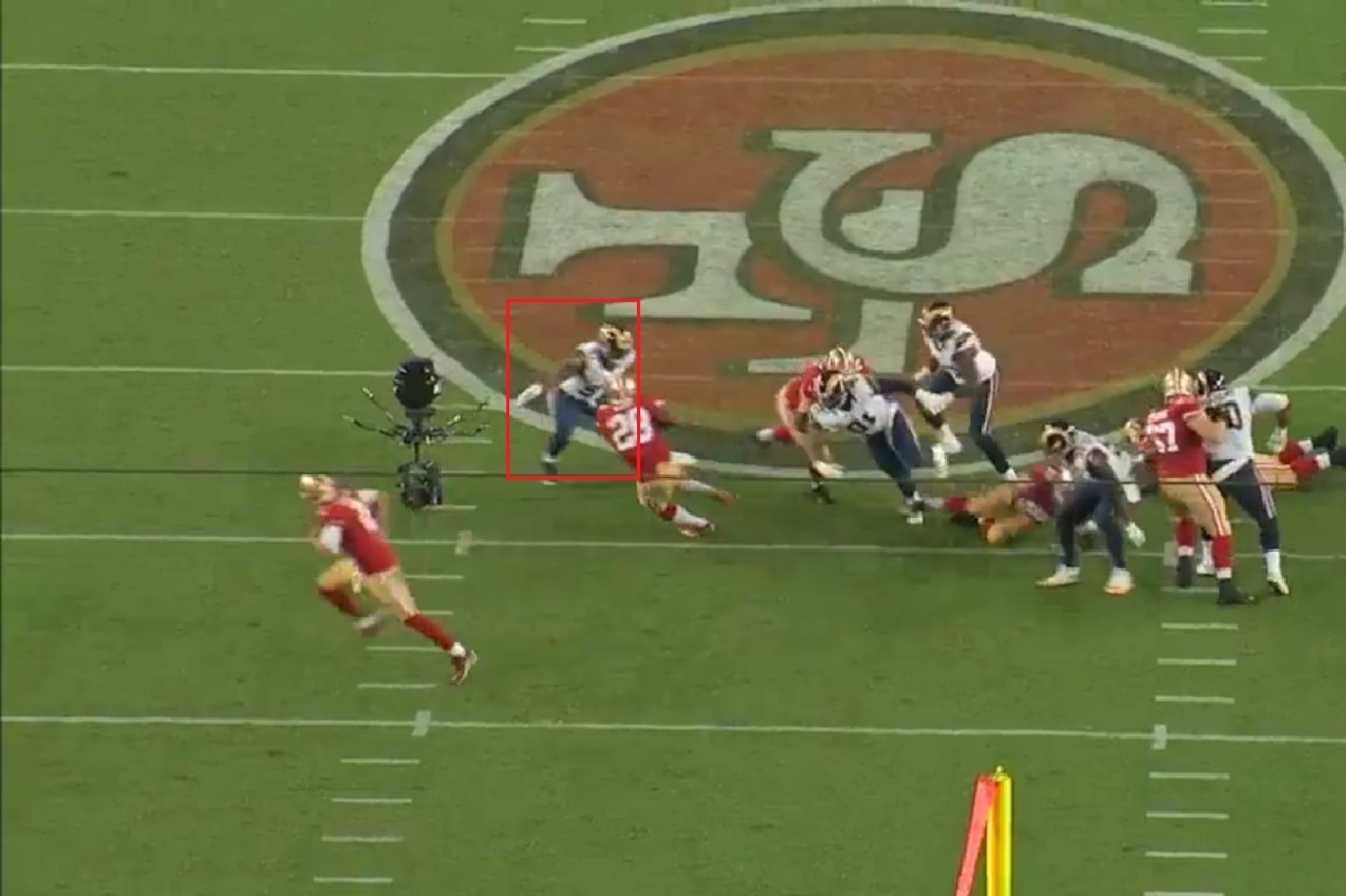
Hyde once again shocked just about everyone in Levi's Stadium by cutting to the backside C-gap, where he shook an NFL defensive end in the open field, as Sims barely touched the back. Once he saw green grass, Hyde hit a sprint for a first down and a 16-yard gain.
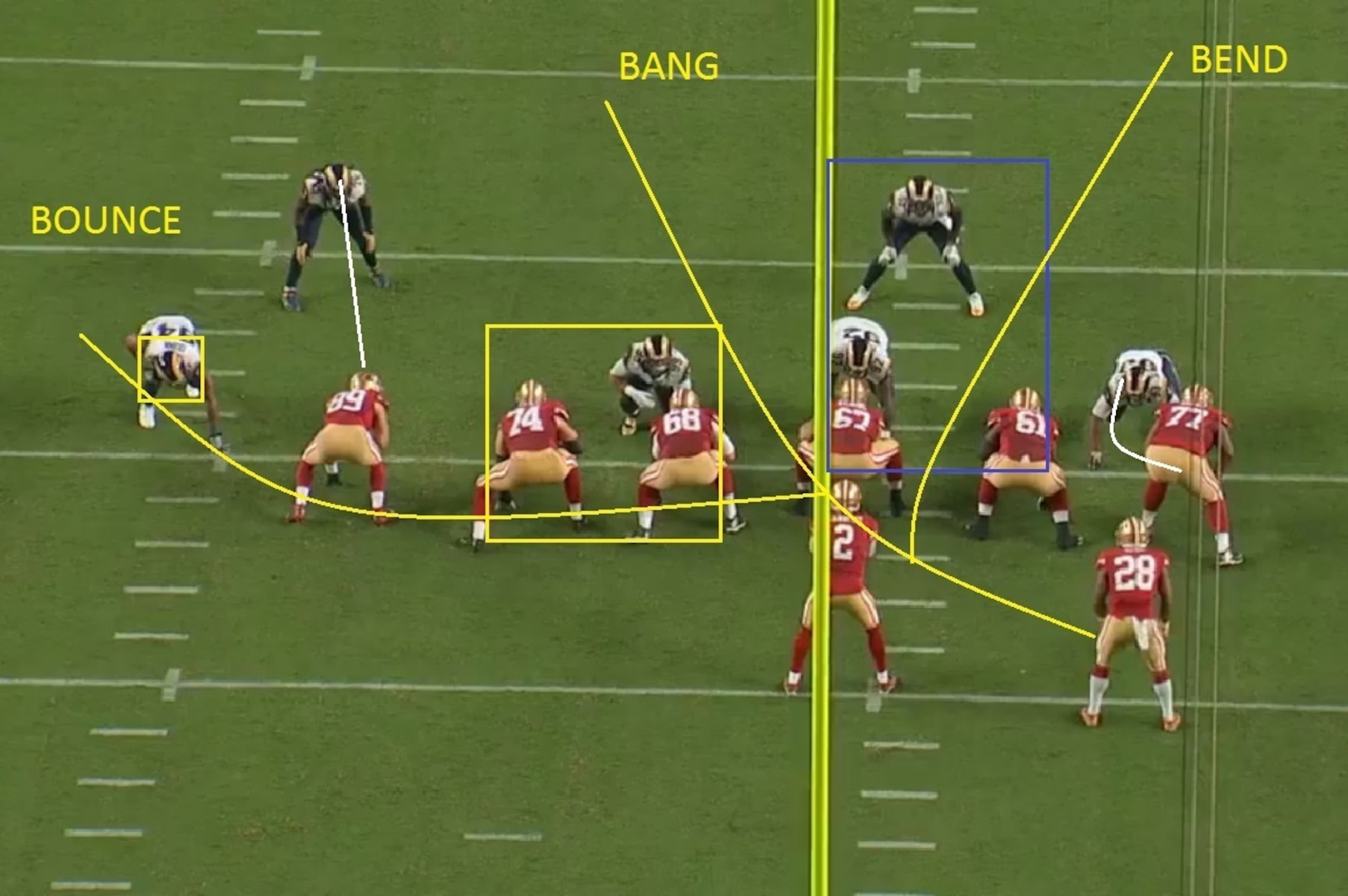
If you thought the blocking was bad on Hyde's third explosive play, though, his fourth will be even more stunning. The Rams again crowded the defensive interior, which didn't stop the 49ers from rolling with their inside-zone call.
This time, though, there was no option element. It was a base inside-zone handoff, which means the numbers advantage swung away from San Francisco by one body, the option man who in a perfect world would never come close to making a play on read runs.
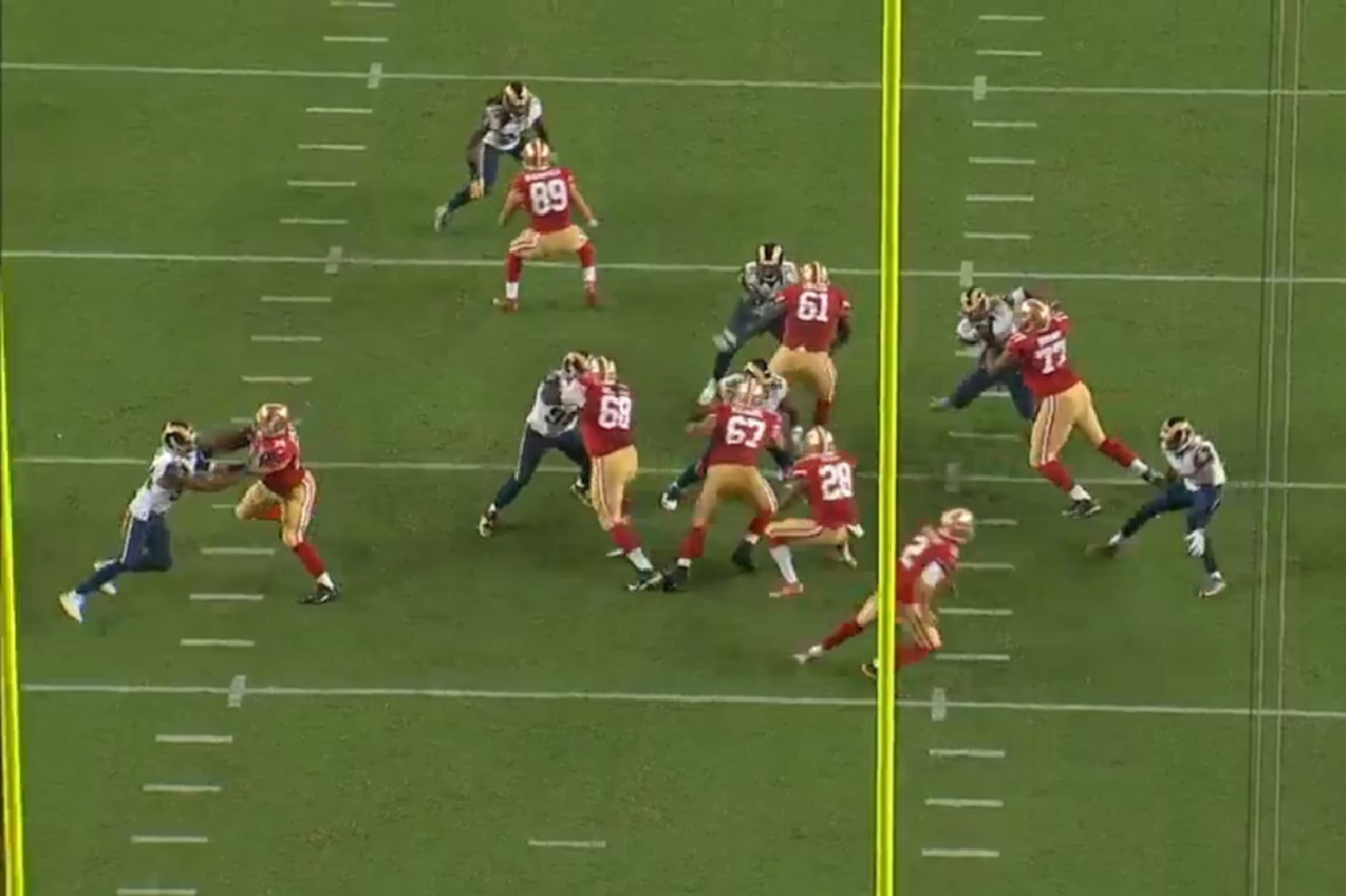
As soon as Hyde took the handoff, two Rams defensive tackles had pressed 49ers offensive linemen deep into the backfield, where Hyde's aiming point was designed. Almost literally, Hyde was running into wall, but that red wasn't bricks—it was backpedaling teammates.
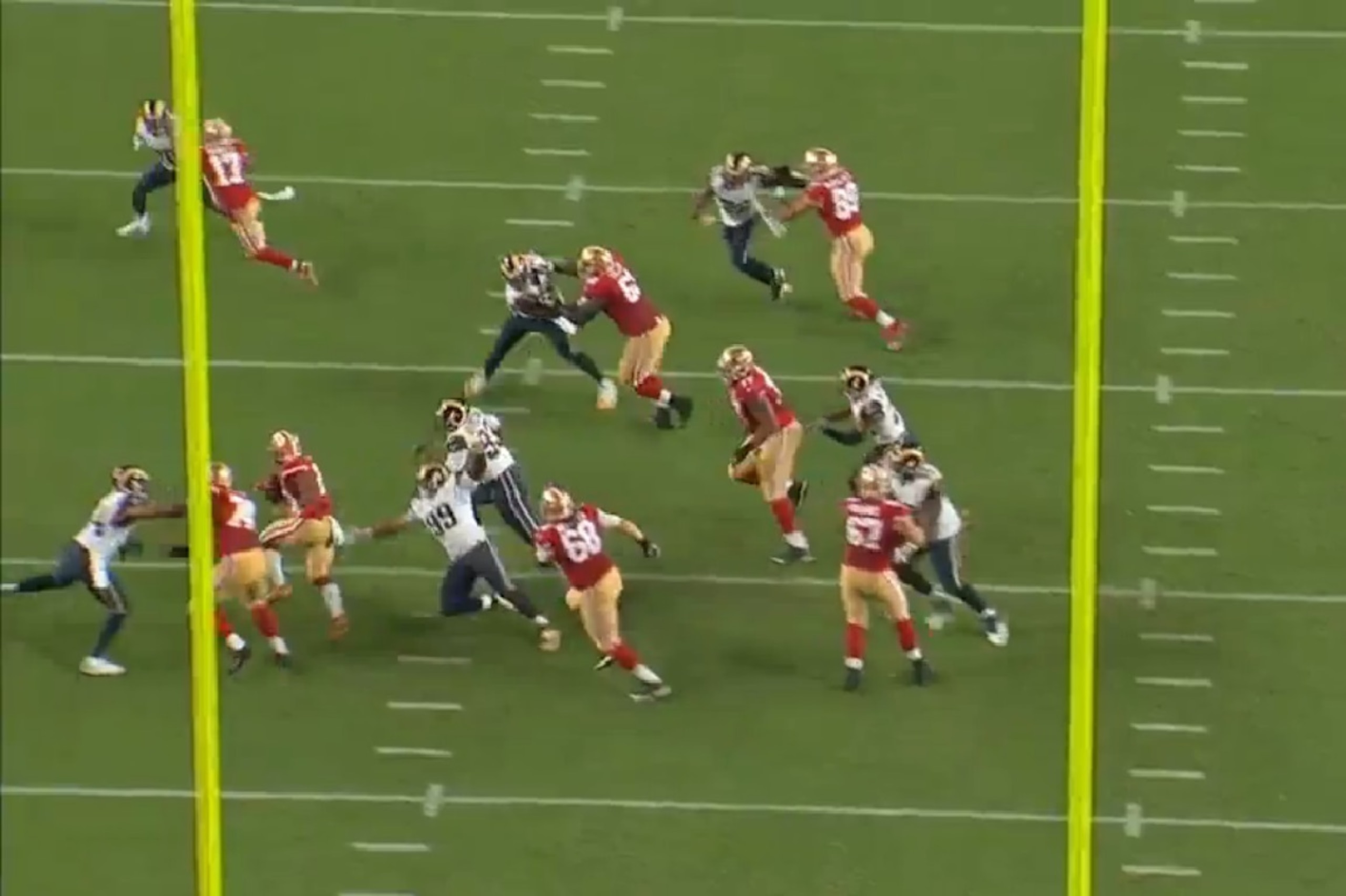
Most running backs would have finished that play with a loss of three or four yards, but Hyde broke the structure of the play into open space for an 11-yard gain. Once again, he made a backside edge defender miss, which is going to help balance overaggressive defenses all season.
The 49ers offensive line is young. They're starting Trent Brown, a second-year seventh-round pick at right tackle, all while trying to get Josh Garnett, a Stanford guard that the squad traded up in the first round to draft this year, acclimated to the NFL.
There are going to be growing pains at the line of scrimmage, which have only been increased by the management of Anthony Davis, who retired last year and decided he wanted to play tackle instead of guard just this week. Davis, according to Matt Barrows of the Sacramento Bee, only played three snaps, clock-killing reps, after going through the offseason as a starter.
Despite the chaos around him, Hyde took over in a nationally televised game and put up incredible production, considering the trench and schematic matchups that went in Los Angeles' favor. Not many franchises have a Robert Quinn and Aaron Donald, and the 49ers should only get better up front as Garnett, Brown and Davis start to mesh with a new offensive system.
When you consider everything, this could be Hyde's worst output of the season, should he stay healthy. Now, no one expects him to average 88 yards a game and scored 32 touchdowns this season, but to put his single game into perspective, Minnesota Vikings RB Adrian Peterson led the NFL last season with a rushing average of 92.8 yards per game and 11 rushing touchdowns on the year.
In whatever way you have an opportunity to buy stock in Hyde this season, be it in fantasy, betting, social capital in an "I told you so" or the very old-school personal enjoyment of just watching great football players on Sundays, it would be in your best interest to align yourself with his success.
.png?w=2560 "APTOPIX Cowboys Seahawks Football")