

Why Von Miller Is Worth $60 Million to the Broncos—At Least
Von Miller is going to earn a staggering amount of money soon. He will probably earn it from the Broncos. If John Elway continues his one-man attempt at an NFL wage freeze (give or take a Brandon Marshall contract), Miller will earn over $14 million under the franchise tag and then an even more staggering amount of money down the line.
We all know Miller is pretty great. But is he J.J. Watt great? In the wake of the Fletcher Cox contract extension by the Eagles, is Miller "$60 million guaranteed" great? Come to think of it, is any non-quarterback "$60 million guaranteed" great?
TOP NEWS

New NFL contenders starting to emerge after Week 4
.jpg?w=2560 "Cardinals Giants Football")
NFL investigating 2 referees for separate viral exchanges
.jpg?w=2560 "Hill Injury Update Football")
Report: Chiefs Contact Hill's Agent
To answer this question, I dug deep into the Football Outsiders internal database, Broncos game film and other sources to get a snapshot of Miller that goes beyond the sack totals and highlights.
Miller isn't just an edge-rusher who pressures a lot of quarterbacks. He's a unique, versatile chess piece who gives Wade Phillips the freedom to be as creative as he dares. Now that we know exactly what "elite defender" money looks like, it's clear Miller deserves every penny of it, and Elway would be foolish not to give it to him.
Impact Pressures
Miller recorded just 11 sacks (tied for eighth in the league) and 30 solo tackles last year. His tackle total was low, even by the standards of edge-rushers who are not expected to stuff their shoulder pads into the A-gap 50 times per game. If you want to be argumentative, you could state the Broncos would be crazy to pay a $1 million-per-sack premium for Miller when they could just develop cheaper prospects like Shane Ray and Shaquil Barrett.
Of course, you can make the same argument about most pass-rushers looking for a payday. We lack truly telling stats for them. There are hurries, but hurries are almost sacks, and an almost sack is like an almost royal flush. Quarterback hits, now tabulated by the NFL, are no better than hurries: If you knocked the quarterback down but didn't produce a sack, you didn't do much more than risk a 15-yard penalty.
The Football Outsiders database lists which defenders, if any, provided pressure on passing plays that did not result in sacks. This information lets us determine the result of that defender's pass pressure. Maybe he forced an interception, scramble, incomplete pass or a dump-off for two yards on 3rd-and-15. Whatever the result, it gives us more to go on than just the dozen or so sacks a pass-rusher scatters across the NFL season.
The following table shows the "impact pressures"—pressures that resulted in an important defensive play—for Miller and a sampling of other top edge-rushers and defenders in search of new contracts. A "bad completion" is a completion of five yards or less or one that does not produce a conversion on third down.
| J.J. Watt | 52 | 24 | 6 | 5 | 0 | 35 |
| Von Miller | 49 | 24 | 5 | 3 | 2 | 34 |
| Fletcher Cox | 39 | 20 | 5 | 5 | 2 | 32 |
| Aaron Donald | 36 | 20 | 5 | 5 | 0 | 30 |
| Muhammad Wilkerson | 36 | 14 | 4 | 5 | 1 | 24 |
| Kawann Short | 28 | 12 | 5 | 5 | 1 | 23 |
| Ziggy Ansah | 32 | 15 | 2 | 3 | 2 | 22 |
| Khalil Mack | 35 | 12 | 3 | 4 | 2 | 21 |
| Ndamukong Suh | 22 | 12 | 2 | 2 | 0 | 16 |
Keep in mind that no sacks, by the players themselves or their teammates, are counted among the data in this table. So Watt had 35 impact pressures plus 17.5 sacks (let's round to 18) for 53 pressure-related plays last year. Miller had 45. These top defenders are having a severe effect on three or four pass plays per game, and that's not counting what they did on running plays or in coverage, which we will get to in a moment.
Watt and Miller are at the top of the NFL heap, even though both of them had off years by their standards. Cox's numbers illustrate why the Eagles loaded up yet another money truck, and Aaron Donald's show why he earned Defensive Player of the Year consideration.
There's a clear impact tier between the Watt-Miller category of pass-rushers and players like Muhammad Wilkerson and Ziggy Ansah. Miller is not just another 11-sack defender. He's a much more consistent disrupter in the passing game.
And even these "impact pressures" tell only a portion of the story.
Expanded Role
The Broncos registered a league-high 52 sacks in the regular season and 14 sacks in the playoffs and Super Bowl. Miller directly contributed to 17 of those sacks: 11 in the regular season and six (2.5 each in the AFC Championship Game and Super Bowl, rounding up each time) in the postseason.
What was Miller doing during those other 49 sacks? Heroically occupying double-teams so DeMarcus Ware could hog the glory? Flushing quarterbacks into Malik Jackson's and Derek Wolfe's waiting arms? Sipping Gatorade on the sideline? I watched the film of all 49 of the Broncos' non-Miller sacks to determine what impact, if any, Miller had on the sack totals of his teammates.
Here's a breakdown of the results:
| Not on Field | 13 |
| In Coverage | 9 |
| Directly Involved | 9 |
| Double-Teamed or Chipped | 9 |
| Containment | 4 |
| Other | 5 |
"Directly involved" means Miller chased the quarterback toward the teammate who recorded the sack, had his arms around Ben Roethlisberger's ankles as a teammate arrived (but was not credited with half a sack) and so on. "Contain" means Miller was spying on a mobile quarterback or mush-rushing. Most of the plays in "other" were just situations where Miller lined up on the edge and got blocked.

Here's a scary thought: The Broncos generated more sacks with Miller on the sideline or in coverage than the Falcons and Bills generated all year! The fact that backups like Ray and David Bruton combined for 13 sacks during Miller's brief breathers shows how deep the Broncos defense was last year and how brilliant Phillips is every year. It could also be loaded cheese fries for any Miller skeptics out there.
But a deeper look at the data paints a more complicated picture. First, there are those 18 sacks during which Miller either battled a double-team or was directly involved in the play. It's hard to estimate how many of those sacks would turn into completed passes if you replaced Miller with a less accomplished pass-rusher. But there would surely be some drop-off.
Then there's the pass coverage. Miller only dropped into coverage 86 times in the regular season and postseason, according to Pro Football Focus. The Broncos asked one of the NFL's best pass-rushers not to rush the passer and got a sack out of the bargain 10.5 percent of the time as a result. Also, Miller intercepted Tom Brady in the AFC Championship Game, which is not a detail to overlook.
Miller is better in coverage than your stereotypical edge-rusher. He doesn't just fade into the flat zone; he draws man-to-man assignments against running backs and tight ends at times. But it's not Miller's coverage prowess that causes all of those sacks—it's that his versatility allows Phillips to be unpredictable, which puts the opposing offense in a pass-protection bind.
| Broncos | 57% |
| Colts | 55% |
| Raiders | 50% |
| Titans | 50% |
| Falcons | 46% |
The Broncos used their base defense more than any team in the NFL last year, according to Football Outsiders (see table). Phillips was able to use a base 3-4 alignment in situations where other teams would switch to nickel or dime packages, even though teams often trailed the Broncos late in games and needed to throw the ball to play catch-up.
Phillips got away with using base personnel in passing situations for many reasons, but Miller's versatility was one of them. Miller could threaten the right edge, drop into a coverage assignment while Phillips sent troops across the left flank and completely discombobulate the pass protection without leaving the Broncos vulnerable.
That made Miller the defensive equivalent of Rob Gronkowski, a player whose very presence on the field forces the opponent to make adjustments without tipping his team's strategic hand in any way. The Patriots can do anything from spread the formation to run right behind Gronk when he's on the field. The Broncos can do anything from blitz the house to call a four-deep, three-under zone with Miller in coverage (sometimes on Gronk).
As a final thought, here's a diagram of a blitz Phillips used variations of several times during the season; this example comes from the Vikings game. Miller (58) and Ware (94) start in their normal positions before motioning into the A-gaps before the snap. Other defenders replace them at the line and threaten the perimeter.
At the snap, Miller and Ware attack up the gut while chaos ensues elsewhere. Miller eats a double-team, but the rest of the Vikings' heavy-protection team (note the fullback and tight end in the backfield with Teddy Bridgewater) is so rattled that a guard crumples to the ground in confusion at Ware's feet. A five-man rush devastates seven-man protection.
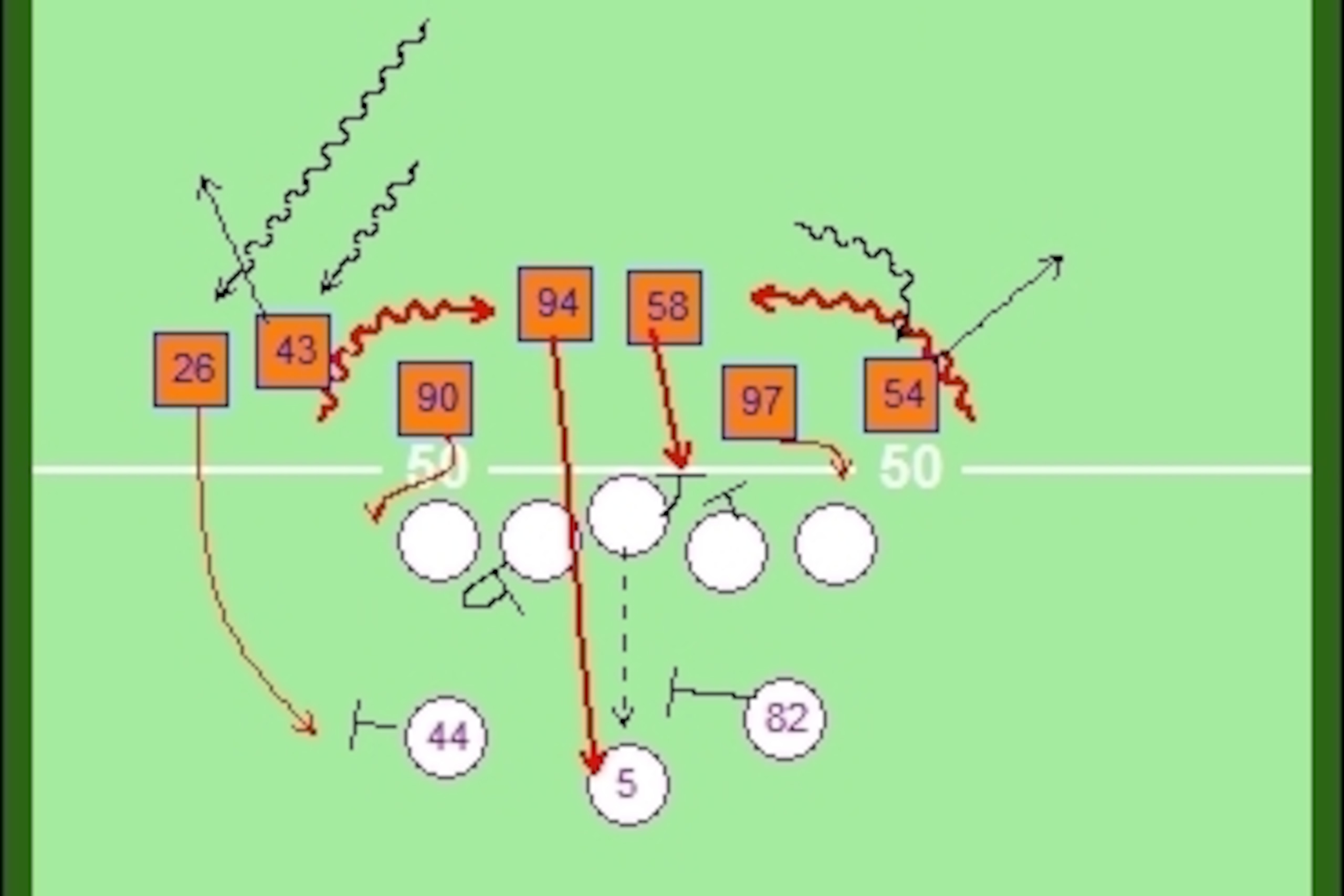
Phillips can run plays like this with lesser personnel, and they can still be effective. But with Miller dictating how the opponent tries to respond and protect its quarterback, they are devastating, as all of last year proved.
Defending the Run Defense
We haven't spoken much about Miller's run defense, because there is not that much to talk about. Miller does all that he's asked to do as a run defender. He just isn't asked to do all that much.
The final table compares Miller's run-defense statistics to those of other edge-rushers. It's a different group than the one in the first table, because comparing Miller to a defensive tackle like Cox (for whom run stuffing is a big part of the premium package) is an apples-to-oranges situation. For simplicity's sake, a "stop" is a good play and a "defeat" a great one; you can find more information here.
| Khalil Mack | 58 | 31 | 10 | 2.5 |
| J.J. Watt | 56 | 51 | 21 | 0.7 |
| Olivier Vernon | 43 | 34 | 13 | 1.4 |
| Carlos Dunlap | 35 | 26 | 7 | 2.5 |
| Cameron Jordan | 29 | 21 | 7 | 1.8 |
| Ziggy Ansah | 25 | 16 | 4 | 6.2 |
| Von Miller | 21 | 16 | 4 | 1.6 |
| Justin Houston | 19 | 16 | 4 | 1.4 |
There's a mix of defensive ends and outside linebackers in the table, players with diverse roles despite the fact that they line up in roughly the same place on the field and are famous for hitting quarterbacks. Miller does not stand out at all as a run defender in this company. In fact, he appears to be a notch below not just Watt, but players like Olivier Vernon and Khalil Mack, great defenders who (in Vernon's case) are below Miller's preferred tax bracket.
I don't want to hand-wave this data away, but there's a simple reason why Miller's run-defense totals are a little skewed. There was no one to tackle. The Broncos allowed just 3.3 yards per carry, the lowest figure in the NFL. You can't tackle a running back when Wolfe, Jackson or a gap-shooting linebacker got to him first, or when the offense has abandoned the run in the fourth quarter.
Vonsanity
We crunched an awful lot of data there to reach a pretty obvious conclusion. There's J.J. Watt, who is a generational superstar. Then there is Von Miller, perhaps with a handful of other top up-front defenders like Cox, Mack and Donald. Then there is everyone else, including lots of Pro Bowlers and sack leaders.
But hey, we also discovered just why teams are willing to dole out $60 million guarantees to the best of the best. Defenders like Miller don't just record sacks and provide playoff heroics. They force bad throws, force opponents to adjust and allow their coaches to dictate to the offense without being predictable.
There's a top tax bracket for NFL pass-rushers now, and Miller absolutely belongs at or near the ceiling of it.
Elway knows it—though he clearly doesn't like it—which is why Miller will get a Watt-Suh-Cox contract before the negotiations get too nasty and the calendar gets too close to training camp.
Mike Tanier covers the NFL for Bleacher Report.
.jpg?w=2560 "Titans Giants Football")
.jpg?w=2560 "Dolphins Bills Football")



.jpg?w=2560 "Greenlaw Talks Payton Exchange")
