

The Specter of Saban, CFB's King and Conqueror
TUSCALOOSA, Ala. — The firearms on the officers’ hips are visible enough. I count three of them in Bob's Victory Grille on this Thursday night. Scratch that. Make it four. An off-duty cop surveying the room comes into focus, not the least bit concerned about masking his identity. At the moment, there are far more pressing matters occupying his mind.
These gentlemen have one simple, imperative task: Protect the most important asset in the history of Alabama athletics. Guard the individual who has single-handedly transformed college football forever—a genesis that has been decades in the making.
Keep Nick Saban safe. Protect the crown jewel.
TOP NEWS
CFB Star's Projected NIL Valuations
Report: LeBron Race Down to 2 Teams
Live Follow HR Derby 2nd Round 💥
It is a little more than a month before Alabama will make its second College Football Playoff appearance in as many years.
Center stage for Saban’s weekly radio show in front of a packed house, a young, anxious fan asks a question after gathering himself. He needed a moment.
“When do you feel fulfilled? What makes you happy?”
The fan hands over the microphone, proud of what he's accomplished. For the next few seconds, the only sound in the room is that of plates clashing together in the kitchen. And then he speaks.
“I guess everybody thinks you get it all when you win the game, but we’re expected to win the game,” Saban says, breaking the silence. “It’s misery if you don’t win. It’s about 30 minutes of happiness when you do. But then what about next week? Because we’re supposed to win next week, too.”
There’s sadness in this world Saban has created—a place where he is the lone soul operating under a unique set of guidelines. He made this world. It’s an environment he molded through years of football brilliance and unprecedented dominance.
While it may seem unfair for anyone to operate under such excessive circumstances, this is also The Master's greatest value. Saban's drive for perfection is unmatched. He knows no other way.
His fingerprints are all over this playoff—as they were last year, and as they will be again. Mark Dantonio—a former Saban disciple—will lead Michigan State against Alabama in the Cotton Bowl. Once Saban’s student, it will be up to Dantonio to generate the misery Saban so deeply loathes.
He is not alone in that regard. Others have gone on to do great things, catapulting to glorious opportunities after years of soaking up information like an industrial sponge. These days, it's a yearly occurrence for Saban to watch his coworkers depart. Eventually, after acquiring enough of the secret sauce, they leave to become teachers themselves. They become the competition.
Dantonio wasn't the first, and he certainly wasn't the last. But the assembly line has never been more powerful than it is right now.
It was not by chance. It was all very deliberate. The foundation of Saban’s reign is the people he has handpicked to work alongside and the maniacal attention to detail that drives every day of his life.

It was a sweltering summer day in Baton Rouge in 2002.
Saban, then the LSU head coach, was capping off another successful high school camp—making an impression on potential future Tigers. It was the final day.
Kirk Doll, having been named the linebackers coach earlier in the year following a long, successful stint at Notre Dame, was conducting a pursuit drill for future linebackers.
Doll led a group of ninth- and 10th-graders through a defensive drill he had conducted for nearly two decades. He knew it like the back of his hand. The problem? It was not the drill Saban ran.
Call it a mental mishap under an unforgiving sun. Call it a natural reaction after running the same drill for so long. Call it a combination of both. Regardless, this was only a high school camp. It wasn’t Doll’s current stable of linebackers.

No big deal. Or so he thought. As camp wound down, an apprehensive manager trotted toward Doll.
“He kind of looked like he was scared,” Doll recalled, bursting into laughter. “He said that Coach Saban wanted me to run the LSU pursuit drill. I thought, oh lord. Needless to say, that was a topic of conversation after camp.”
The specifics of Doll’s conversation will remain a closed-door affair. Fill in the blanks. One doesn't have to dig too deep in their imagination to figure it out. But the moment stuck with the assistant.
“He coaches those young men [at high school camps] as hard as he coaches his players at whatever school he is at,” Doll said. “You get your money’s worth.”
Running the appropriate drill was the tip of the iceberg. Doll, a veteran of the fraternity of big-time college coaches, witnessed a completely different type of leadership.
It wasn’t just about teaching defense or the appropriate drill. It was more than leading a football team, for that matter. It was ensuring that every level of the program was operating with the same intentions.
Winning football games comes later. It's down the checklist some, below the integral pieces that few rarely stop to admire. This is where the building begins—on a practice field placed under the heat lamp in the heart of summer.
“What Nick wanted everybody to do was pay attention to detail and work as hard as he worked,” Doll said. “He didn’t want any little detail to go unturned. You take the recruiting, academics, in-season and offseason, and he has a plan for it. He has a plan for everything. This is how you do it.”
In his two years under Saban—working on a staff that included Will Muschamp and Jimbo Fisher—the Tigers won a BCS national championship and 21 games.
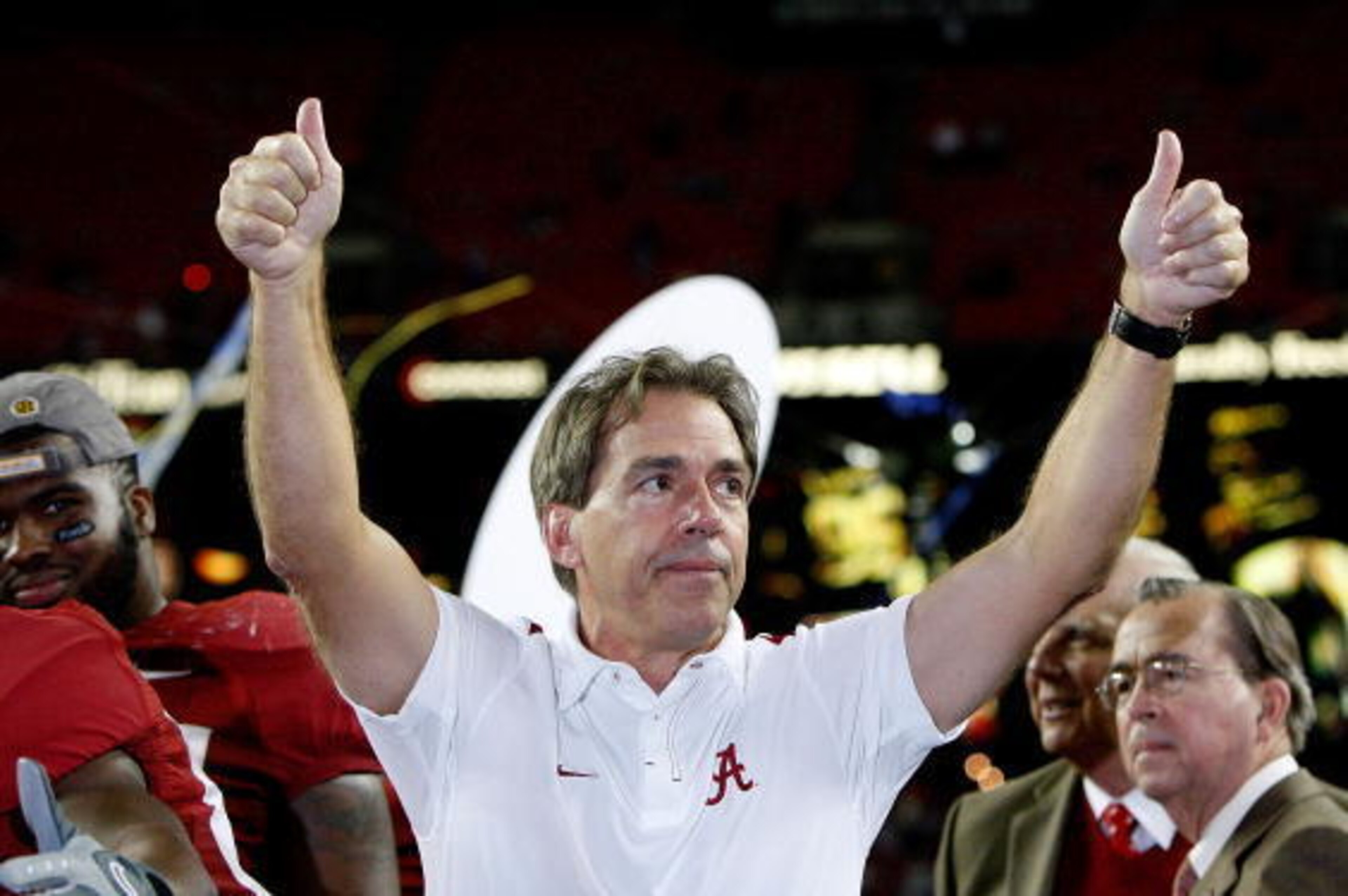
The soothing voice from the GPS told Sal Sunseri to turn at the next street. Sunseri didn’t follow her cues. He knew exactly where he was going and had another way. His co-pilot wasn’t so sure.
“Aren’t you going to listen to her?”
The voice in the passenger seat belonged to his boss. Saban, now the head coach of Alabama, didn’t want to be late. Not even for the test run. More on that in a second.
After six successful seasons in the NFL, Sunseri reunited with Saban in January 2009. Although Saban had doubts that he could lure his former coach back to college after working with him at LSU, he offered Sunseri the vacancy at linebackers coach regardless.
“It really was an easy decision,” Sunseri said of the move.

They went on to win two national championships together at Alabama. They also logged significant hours on the road recruiting and in living rooms.
When they scheduled an in-home visit, leaving early was not good enough. Saban wanted to ensure they’d arrive on time, which is why they would take dress-rehearsal drives to the home long before they were scheduled to meet.
“He didn’t want to be late, which is why we always did a dry run of getting to the house,” Sunseri said. “When you’re supposed to be there at 7:30, you’re there at 7:25 waiting to get into the house. That’s just the way it is. He likes to be on time. He loves to be detailed.”
It wasn't about putting together the right pitch. Again, this is down the line. It was about getting from A to B. It was taking something that is almost always a given and making it a focus.
This mindset wasn’t just evident on recruiting trips. It also extended to the film room.
When an opposing offense burned Alabama badly, it would become a borderline obsession. Saban and his staff would dissect what a team did, why it succeeded and, above all, how to prevent it from ever happening again. In many cases, it would boil down to a singular moment in a singular game.
“Coach was not going to let one play go by,” Sunseri said. “If they did it one time, he’s going to make sure they know how to defend it. It’s the total preparation. Not just playing the game, but the mindset going into the game and how you’re preparing for it. You know it, you see it and you react to something you saw seven or eight times on the field in Tuscaloosa.”
It all sounds exhausting. It's a way of life, certainly, but it's not one naturally acquired. Working in this profession is difficult enough; working under a coach as detail-oriented as Saban is another threshold of demanding.
But there is no better teaching environment. Fisher, Dantonio, Muschamp, Jim McElwain and now Kirby Smart were all Saban disciples. Now, they are paid small fortunes to lead their own programs. That's not by accident.
They grew under Saban. They refined a coaching voice along the way. They put in the time and hours, and now they do so on their own terms.
"Here’s the bottom line. Everyone tells you that coach is hard and tough. No, he’s the boss," Sunseri said. "He’s the CEO. He expects you to do your job. If you’re not doing that, he’s tough on you. But if you do what you’re asked to do, he’s easy to work for. It’s not hard. It really isn’t."
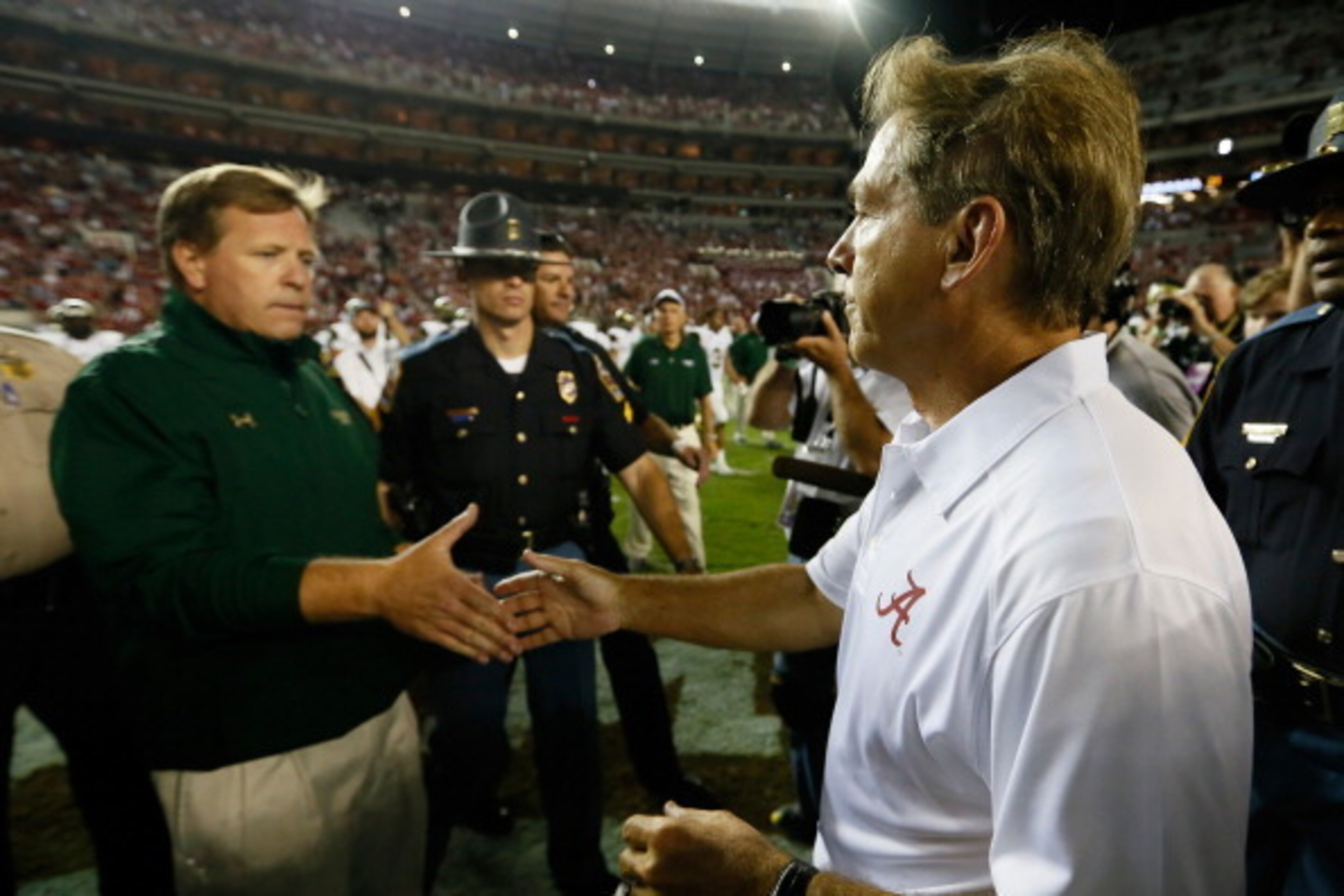
In the winter of 2008, Jim McElwain received a phone call. On the other end of the line was a man claiming to be someone with an opportunity. McElwain wasn’t buying it.
In fact, instead of truly contemplating the potential job offer, McElwain hung up the phone. He couldn’t believe a friend had taken the time to call him and pretend to be Nick Saban. The nerve.
Only, as he found out not long after, this was no hoax.
“I was just really excited he called back,” McElwain said.
Guiding the Tide’s offense, McElwain won his first 12 games as Alabama’s offensive coordinator before being upended by Florida in the SEC Championship Game. The next season, Alabama won a national championship.
As a result of the success, McElwain was named head coach at Colorado State before moving back to the SEC as the head coach of Florida. This was a historic climb. In a matter of years, McElwain went from guiding Fresno State's offense to being named the head coach at one of the nation's best programs.
“It’s a testament to him and how he trains us,” McElwain said. “I can’t tell you how fortunate I was to be around him and a part of it. It doesn’t matter if it’s a coach or someone else in the organization. He hires great people and lets them do their jobs. It doesn’t matter if you’re selling popcorn or calling plays, everyone has to be going in the same direction.”
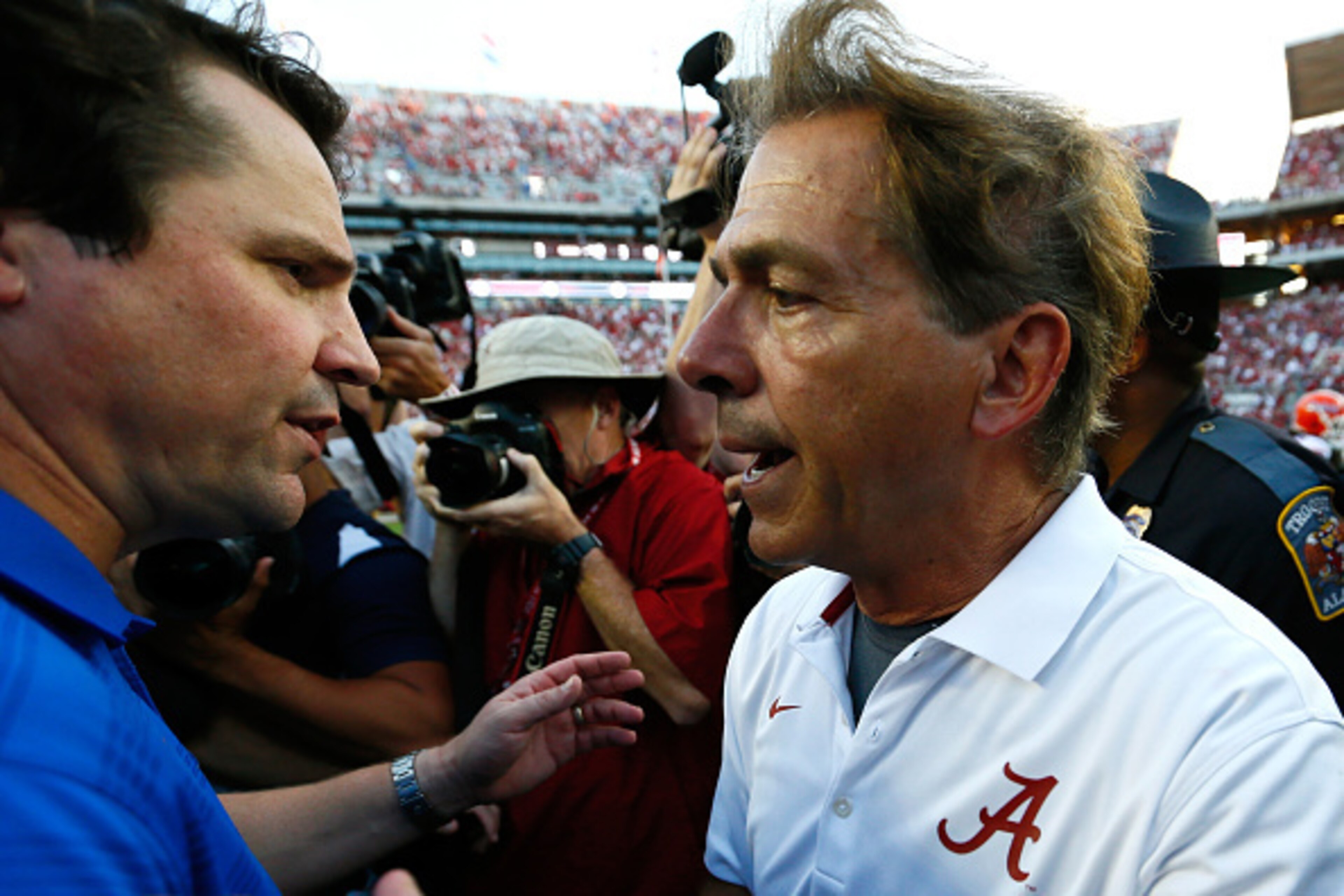
The former head coach of Florida experienced a similar (albeit slower) climb. Will Muschamp, now the head coach of South Carolina, was hired away from Valdosta State to coach Saban’s linebackers at LSU in 2001. By 2002, he was the defensive coordinator. In 2003, the Tigers won a national championship. Just like that.
More than a decade later, Muschamp will again compete against his former boss for conference titles. Given the opportunity to lead again, he will take with him the experience and knowledge gained in Baton Rouge.
And even to this day, despite the fact they are now bad for one another's business, they still have that bond.
“The staff, the recruiting, the public relations, he does everything the right way,” Muschamp said. “He’s been tremendous in my career in helping me. I can still pick up the phone and ask him what he thinks. He’s going to be honest, and you may not like the answer sometimes. But I appreciate the honesty and guidance he’s given me over the years.”
The teaching extends beyond the athletes on scholarship. In order to ensure the talent is maximized, the staff needs to be massaged. Handpicking it is only the start. The people—the building blocks of any program—need to receive the appropriate direction to succeed.
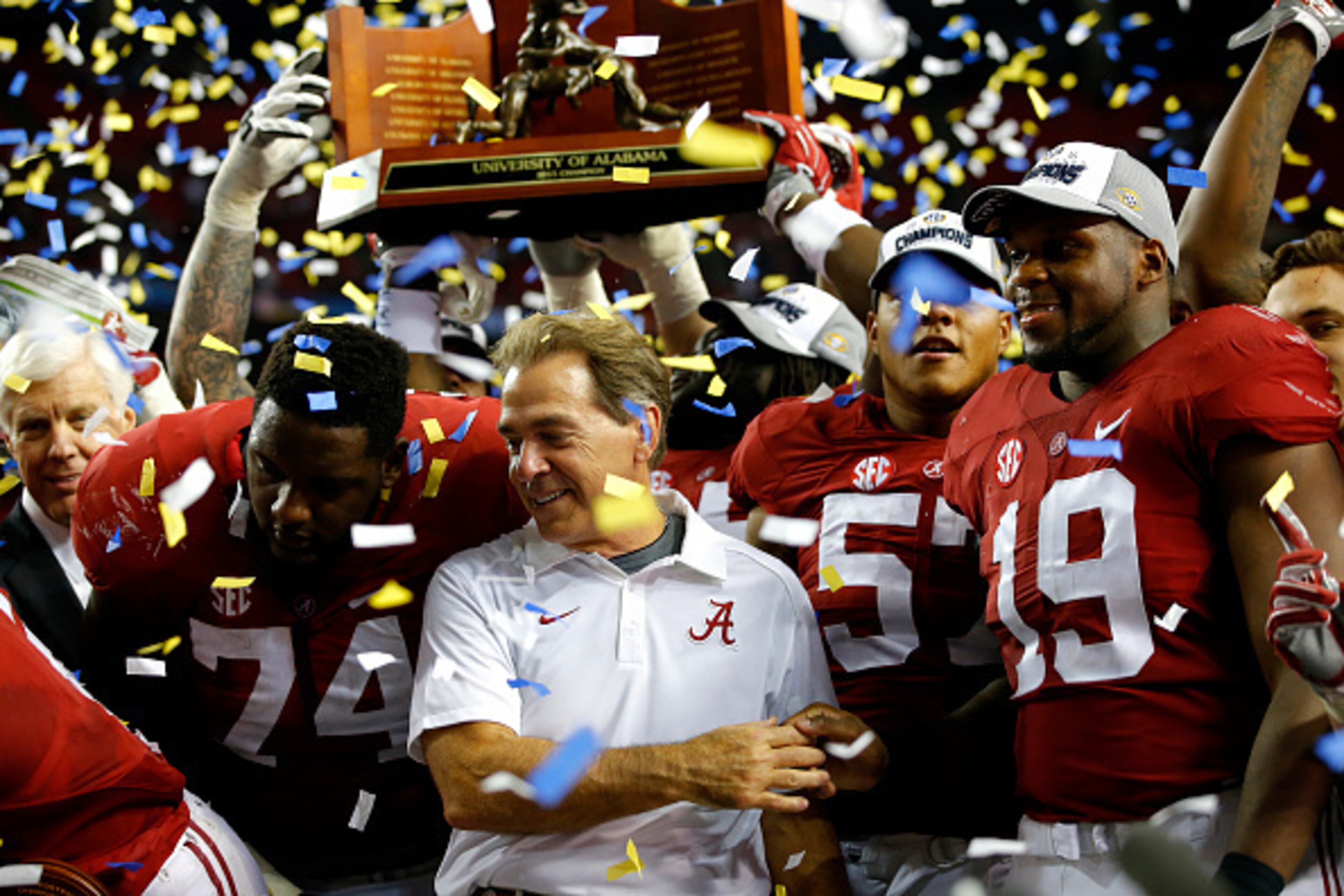
Back in Bob's Victory Grille, Saban has just been asked another question. This time, there is no hesitancy in his answer. His eyes light up like UFOs. His hands begin dancing like strobe lights—each operating with a different rhythm.
“When you play an option team,” Saban says, “the point of attack moves…”
It was a basic question about slowing down the option. More plainly, it was a football question.
For the next three minutes, Saban was in his comfort zone. He was a legendary composer drafting a symphony. He was a painter given a brush with the perfect weight and balance.
He spoke of gap integrity and schematics in brilliantly consumable detail. The room was silent again—soaking up the football gospel. Even the officers tasked with protecting him looked entranced by the unanticipated crash course.
At his core, this is who Saban is: a defensive-minded, unfathomably competitive, film-loving football junkie. But his genuine love for the game is often masked by everything else that comes with powering the nation’s most powerful program.
He is the university's greatest brand ambassador. He is a boost to the state’s economy. He is the reason schools are churning through coaches at a staggering rate. Every program, whether it’s realistic or not, is looking to unearth the next Nick Saban. One man has changed everything.
“I think everyone’s trying to catch up to coach,” Sunseri said. “His work ethic is relentless and his drive to be the best is unbelievable."
But deep down, football is what drives him. It’s where it all began. Strangely, it’s the last place one would look these days.
"The process," a term Saban has made famous over the years, starts here. Although it doesn’t end here. In fact, it never truly ends at all.
All quotes obtained firsthand unless otherwise noted.
.jpg?w=3840 "Rams Ravens Football")
.jpg?w=3840 "WWE Raw Live Grades 🔠")