DeAndre Hopkins Is Becoming One of NFL's Most Dominant WRs Despite Poor QB Play
When Houston Texans wide receiver DeAndre Hopkins looks up to see he’s in one-on-one coverage, a thought immediately enters his mind.
“One-on-one, I’m going to win,” he told Aaron Wilson of the Houston Chronicle, right after he did a whole lot of winning against the New York Jets in Week 11. “No matter who’s out there, I don’t really care.”
He should have that mentality, of course, because self confidence is about as essential as oxygen for premier wide receivers. The position is one where isolation is constant, and a receiver is often left out at the far reaches of the field, tasked with winning a battle.
TOP NEWS
.jpg?w=2560 "Patriots 49ers Football")
Aiyuk Slammed by Ex-Teammates 😬
.jpg?w=2560 "Saints Cowboys Football")
Report: Eagles to Sign Cowboys QB
.jpg?w=2560 "Packers Giants Football")
Josh Jacobs Can Play in Week 7
And only that battle matters. The battle happening right now, on the snap happening right now and against the also elite cornerback you’re facing right now.
Hopkins is well aware of that reality. What sets him apart, though, is that he wins with loud, definitive statements of dominance.
He wins with raw speed. He wins with precise route running. And he wins with one-handed catches.
He won repeatedly against Darrelle Revis, the Jets cornerback who had allowed only 267 yards in coverage prior to Week 11, according to Pro Football Focus. That’s an average of 29.6 yards per game.
Revis is one of only a few measuring sticks at cornerback. Normally, lining up in one-on-one coverage against him means an afternoon or evening of misery. We don’t need to look far while searching for a fine example of the darkness he brings. In Week 9, Buffalo Bills wide receiver Sammy Watkins exploded for 168 yards on eight catches. His totals against Revis in Week 10? Only 14 yards on three catches.
Few escape the famed Revis Island and paddle to any sort of meaningful production. But Hopkins is different.
The former Clemson standout's meteoric rise to the top of his craft won’t be slowed by anyone. That includes the Texans quarterbacks, who have been a parade of bleakness, with little continuity due to both injuries and awfulness. And it includes Revis, who was torched for 98 yards Sunday.
Which makes it easy to nod enthusiastically after T.J. Yates—the third quarterback to ride Houston’s carousel in 2015—said this about the man who made his decision-making process incredibly simple during the Texans’ third straight win.
For Yates, his thinking mostly went like this Sunday: Should I throw to Hopkins? Yes, I should.
That has pretty much been the standard binary question and answer for any Texans quarterback this season, which is the only way to operate when Hopkins plays for your team. He leads all wide receivers with 132 targets, and he has been on the other end for 48.4 percent of the receptions by Texans wideouts.
He’s turned those opportunities into nine receiving touchdowns (first among all wide receivers), 1,045 yards (third) and 76 receptions (third). But Hopkins’ success in his third season isn’t rooted purely in volume, because it turns out that seeing many footballs sail your way means little when a ladder and/or Inspector Gadget-style arms are needed to catch them.
Hopkins is at or near the top of every major receiving category and has already recorded five 100-plus yard games. Those accomplishments go from great to borderline unfathomable when you consider the sprayed footballs he’s dealt with.
Basically, Hopkins has been trying to catch throws from Rube Baker.
| Brian Hoyer | 59.5 |
| Ryan Mallett | 53.1 |
| T.J. Yates | 46.7 |
Of the 37 quarterbacks who have taken at least 25 percent of a team’s snaps this season, the completion percentages posted by current Texans starter Brian Hoyer and Ryan Mallett—who started four games before being released—rank 28th and 37th respectively, per PFF.
The separation between Hopkins and other top-tier pass-catchers lies in the fact he can’t benefit from even league-average quarterback play. While the Steelers’ Antonio Brown is snatching balls thrown by Ben Roethlisberger and the Falcons’ Julio Jones has Matt Ryan in his huddle (two quarterbacks who have combined for six Pro Bowl appearances), Hopkins is still thriving despite a cloud of mediocrity.
We’re left to wonder what Hopkins could do if he worked with even an adequate quarterback. That daydreaming gets depressing when we actually see what he’s leaving on the field.
Let’s return to the triumph over Revis then, because in one game, Hopkins displayed both his blend of athleticism and technically sound route running, along with a production ceiling that’s limited due to elements far out of his control. The former is football’s version of fireworks, while the latter is maddening.
Two highlights from the heavyweight Hopkins vs. Revis matchup stand out. The first is a 61-yard touchdown when Hopkins accelerated downfield on a post route, and separated from Revis by almost two full yards by the time T.J. Yates’ deep heave descended back to Earth.
Prior to Week 11, the longest reception allowed by Revis went for 33 yards. He had also given up only one touchdown.
The other shining moment for Hopkins is actually becoming a common one, as he often makes the impossible look quite possible.
In the first quarter, Revis had near-blanket coverage as Hopkins planted and turned toward the sideline. Yates whistled a throw high and a touch too wide of his intended target. Whether that was intentional or not depends on how much you believe a quarterback with his completion percentage can do anything intentionally. But it served the purpose here, as Yates’ placement was in the only area Revis couldn’t reach.
The problem? Success for Hopkins required some one-handed acrobatics. Which, again, hasn’t been too much of a problem at all for him.
It’s not really fair that he can turn this into an 18-yard catch…

Hopkins is impressively economical with his hands and frequently needs only one to finish the job. He also corralled an eventual game-winning touchdown catch against the Cincinnati Bengals in Week 10 using only one outstretched arm.
Note the almost flawless coverage by Bengals cornerback Adam Jones on that play, too. Hopkins was forced to elevate, maintain his concentration as the ball came down, absorb it with one hand and then use his shoulder and helmet to keep possession while hitting the ground.
It’s not hard to see why Texans head coach Bill O’Brien dropped a pretty notable name when asked about Hopkins’ habit of creating one-hand wonders. O’Brien told Deepi Sidhu of Texans Radio that only one other player he’s coached could make one-handed catches like Hopkins.
That player? Surely you’ve heard of his failed game show.
So that’s the dazzling Hopkins. Sadly, that version of the 23-year-old looks identical to the restricted Hopkins.
You may not notice the limited Hopkins quite as much because you’re blinded by his single-handed wizardry. But what’s missing is exactly the point here.
If Hopkins was playing with quarterbacks who could even meet the standards for slightly below average play and do it somewhat regularly, his already monstrous production would grow to dizzying heights. That becomes clear after looking at the times he fulfills his job description by getting open, and then a ball zooms toward an area inaccessible to any human.
An example of a failure to connect came against the Jets when Hopkins roasted Revis with perfect form on a stop-and-go route.
On 1st-and-10, he bent his route toward the sideline and was starting to gallop ahead. Then suddenly he stutter-stepped, and planted hard to sell an intermediate route just shy of the first-down marker.

Revis had to bite and was forced to shift his momentum forward while defending the possibility of a quick-strike pass. But as he did that, Hopkins hit the gas again and easily glided by a defender who had committed himself in the wrong direction.
Quickly, a full three yards were between receiver and cornerback downfield, and the most routine 69-yard touchdown pass ever should have followed. After all, is it even possible to overthrow Hopkins when he has the pedal pinned, with Revis fading in his rearview?
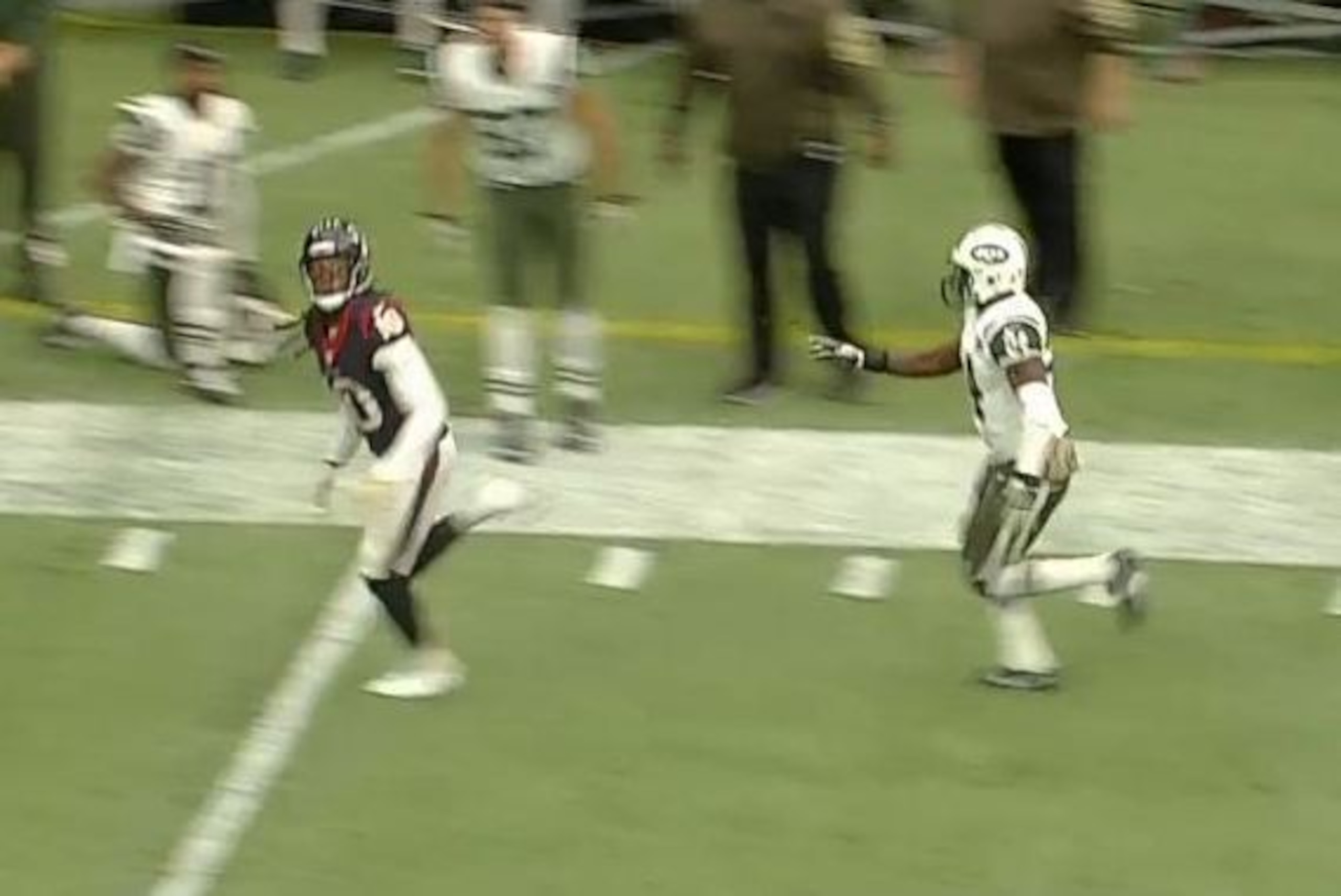
The answer, unfortunately, is yes, if you ask Yates. His throw landed with a thud about three yards beyond Hopkins. A golden opportunity was wasted.
Hopkins is 10 games into his third NFL season, and his statistical ceiling has been capped by a number of woeful passers.
He’s appeared in 42 games, and during that time Matt Schaub (eight starts), Case Keenum (10 starts), Mallett (six starts), Hoyer (five starts) and now Yates (one start) have all taken turns contributing to his anguish. Ryan Fitzpatrick (12 starts) is perhaps the best quarterback to work with Hopkins, which is the ultimate statement about the bottom-barrel talent the 6'1" receiver has relied on to deliver catchable footballs.
Yet while beating Revis repeatedly, he still became the third-youngest player to reach 3,000-plus receiving yards and 200-plus catches, per Wilson.
Despite the deficiencies of those around him, Hopkins can bust a game open at any time. That’s the hallmark of a transcendent talent.

.jpg?w=2560 "Cardinals Football")


.jpg?w=2560 "Ranking Tarik Skubal's Top Landing Spots 🛬")