

How Chris Johnson Became the Arizona Cardinals' Unlikely Hero
Chris Johnson is second in the NFL in rushing yards.
No, it's not 2009. Johnson isn't enjoying the prime of his career as a member of Jeff Fisher's Tennessee Titans. He is in the twilight of his career with Bruce Arians' Arizona Cardinals. He is an unexpected starter who entered training camp on the open market.
After a disappointing season with the New York Jets in 2014, following an obvious decline in his last year in Tennessee, Johnson was back on the free-agent market in 2015.
TOP NEWS
One player each NFL team should cut
.jpg?w=2560 "Cols Ravens Football")
Report: Colts Coach Suffers Serious Knee Injury
.jpg?w=2560 "Browns Camp Football")
Shedeur Apologizes to Reporters
Before the then-29-year-old running back could find a new team, he was shot and hospitalized. Instead of signing with a new team, Johnson was fortunate to be alive. He would spend the next five months rehabbing his shoulder, though only after spending six weeks on bed rest.
Unsurprisingly, Johnson said the incident changed his life. From ESPN's Josh Weinfuss:
"In his introductory press conference with the Cardinals on Tuesday, Johnson said the incident, in which one person was killed in an early-morning drive-by shooting, changed his perspective on his life. He rebounded from the shooting physically.
"Sometimes you just got to live life and not worry about those things so much," Johnson said. "Getting a chance to play in the NFL makes it better."
"[After] the situation I went through, I'm just happy to be back playing football on Sundays," Johnson said. "I'm just going to put my best foot forward."
"
According to Johnson, his injury led to him working out more on his upper body. He could still run while recovering, but his upper body needed to be strengthened. While this was a required action to restore his quality of life, it appears to have helped him on the football field.
Johnson has rushed for 567 yards and three touchdowns on 111 attempts so far this season. He is averaging 5.1 yards per carry and hasn't fumbled.
"Chris Johnson still has a bullet in his shoulder from a drive-by shooting earlier this year. He's in the top 5 in the NFL in rushing. #Tough
— ESPN Monday Night (@ESPNMondayNight) October 27, 2015"
He only became the team's starter because of injuries ahead of him, but he has played so well that he remains the primary option on a fully healthy depth chart. The difference between this version of Chris Johnson and the one who had meandered through the middle of his career is stark.
During the initial stages of his career, Johnson was exceptionally fast and decisive. Whenever he found the slightest crack of space, he could accelerate through it and away from defenders in pursuit of him.
Once he got paid, Johnson appeared to change his approach. He was no longer running with conviction. His explosiveness still allowed him to make some plays, but his tentativeness approaching the line of scrimmage and lack of power at the point of contact made him an ineffective runner.
The Titans eventually grew wary of the running back's inconsistencies and moved on from him. In New York with the Jets, he averaged 4.3 yards per carry but only had 155 carries and one touchdown as his inconsistency remained.
When the Cardinals signed Johnson, they likely thought they were just getting a third-choice running back—a talented but inconsistent player who offered some value in a bit-part role.
For as much as Johnson could talk about what had changed for him off the field, he would need to prove he was a different back on the field. He had his own injury during the preseason, a hamstring problem. At that point it wasn't even clear if Johnson would make the roster after signing a one-year deal.
The Cardinals showed faith in him after he performed well during the final preseason game. Since then, he has rewarded them with decisive, physical play.

Johnson doesn't run a 4.2 40-yard dash anymore, but he is still an explosive back. His success this season has been less about his explosiveness and more about his willingness to follow his blocks and play to contact. Playing that way behind Mike Iupati and Jonathan Cooper has allowed him to flourish.
This could be seen on his very first carry against the Baltimore Ravens in Week 7.
Before the ball was snapped, defensive lineman Chris Canty aligned on left guard Iupati's outside shoulder. At the snap, Iupati and left tackle Jared Veldheer engaged him in a double team and pushed him backward off the line of scrimmage.
This was a crucial block because it gave Johnson an opportunity to run directly to space at the line of scrimmage.

Because Johnson had this space to run into, he could build up momentum approaching contact. Johnson is stronger than he was previously, but he's still not a big back or a powerful one. As such, he needs to hit defenders with speed to make an impact.
Johnson is contacted one yard downfield, but he fights his way through the first wave of contact to get to space.
The second wave of contact hits him and should knock him backward. This is where the biggest difference in Johnson can be seen. He doesn't go backward. Even against the second wave, he can keep forcing his way forward for a four-yard gain.
In previous seasons, Johnson wouldn't have been as quick to attack the line of scrimmage in this situation. Often when runs were perfectly blocked, he would ruin them by being too tentative with his feet. On this play he didn't have a wide-open running lane to go through, but he got one on the very next play.
This may seem simple, and it is, but too often in the past Johnson would have considered breaking to the outside instead of just following his blocks.

Johnson is going to take the ball off the right side. He will follow his left tackle, Iupati, who pulls across the formation to secure the edge while the right side of the line collapses down. There are two phases of blocking to this run.
The first phase can be seen above. The key block is executed by the right guard, Cooper, as he clamps down on the Ravens' very talented nose tackle, Brandon Williams.
Williams is a big, stout body who can fend off and work through blockers to blow up running plays. Cooper must use his bulk and athleticism to shift him out of the play and keep him away from Johnson. As he does this, the right tackle advances farther downfield while both tight ends double-team Canty.

Cooper clamping down on Williams and Iupati crushing the edge defender gives Johnson a clearly defined path to the second level. On the second level, three blockers are accounting for Canty, who has been pushed back off the line of scrimmage, and inside linebacker Daryl Smith (No. 51).
Johnson is able to weave his way back infield unopposed before advancing farther downfield.
He is confronted by defensive backs. Johnson tries to cut away from them but has nowhere to go and is ultimately stopped in his tracks. Not finishing this play through a defender is fine, because he had already gained 10 yards and was trying to work in space.
The running back had already followed the design of the play by that point. Although he didn't break any tackles on this play, Johnson has been making more defenders miss this year. By Pro Football Focus' measure, Johnson broke 18 tackles in 16 games last season. So far this year, he has broken 18 tackles in just seven games.
For his 26-yard touchdown run against the Ravens, Johnson broke two tackles before evading a defender in space to sprint to the end zone.
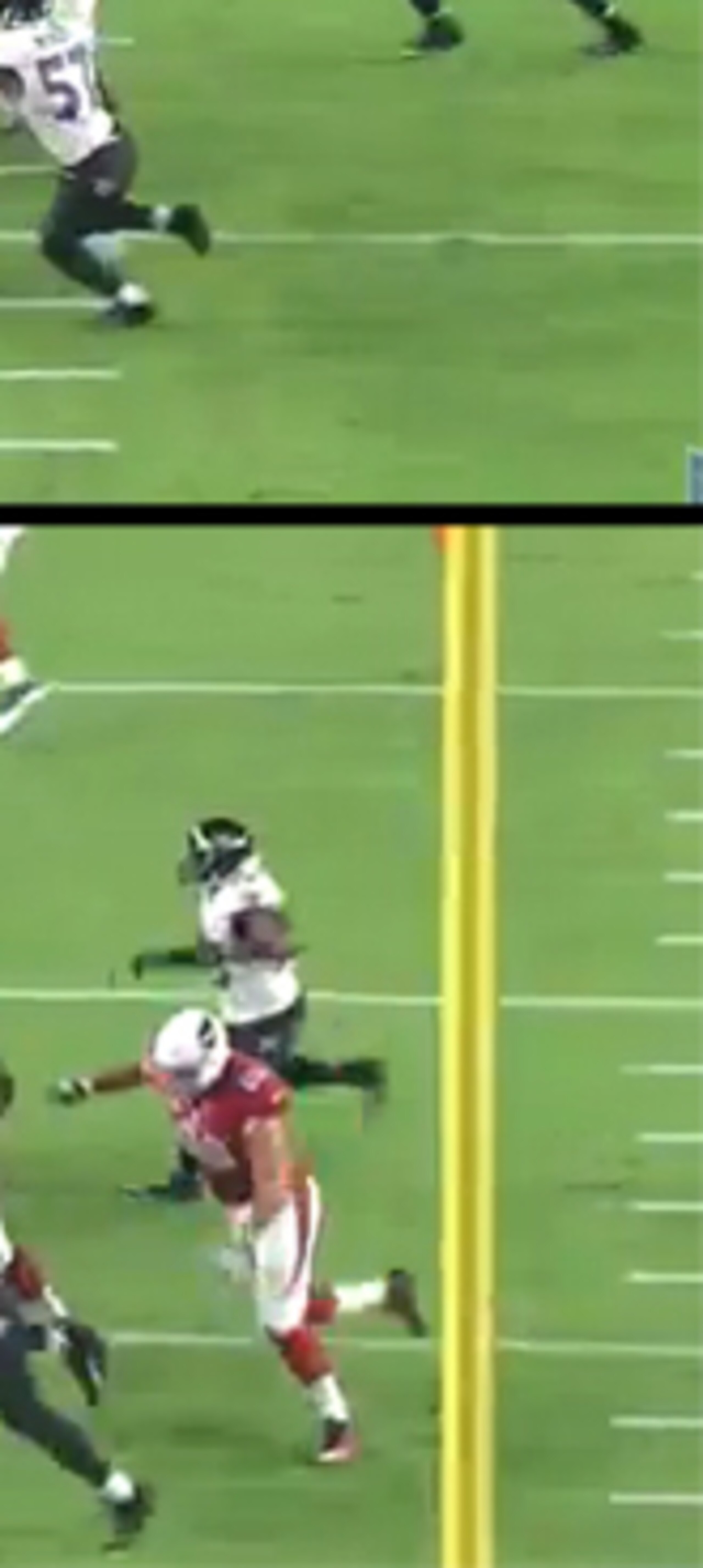
The Cardinals handed the ball to Johnson on a stretch play to the right side. He had space behind his right guard and right tackle, but his center was beaten at the snap. The center was able to recover enough to push the defensive tackle downfield.
Johnson was left in space with a decision to make. His right guard was directly in front of him, engaged with a linebacker.
The running back made a sharp but relatively subtle step to draw the linebacker across the formation before turning back to his left. Although Johnson's cut wasn't smooth or particularly quick, it allowed him to find the right running lane and accelerate to space.

Before escaping the crowd of bodies around him, Johnson took a blindside hit from a defender following the flow of the play. Johnson showed excellent strength to hold his ground and let the defender's body slide off of him as he brushed it away with his hand.
As the defender's extended arms attempted to pull Johnson down, the running back advanced forward toward another hit.
This time he was hit head-on by an incoming defender who attempted to level Johnson. Instead of letting the hit take him out, Johnson showed resilience and balance to bounce off of the defender's ill-disciplined tackle attempt before turning toward the sideline.
From there he accelerated away from the third defender before stretching the play as far as the pylon on the opposite side of the field. This was one of the most impressive runs of Johnson's career, because it was a run that was atypical of his career.
In Arizona, the coaching staff appears to understand how to get the most out of players. That may be the case in this situation, but Johnson's turnaround is more likely about his own decisions/actions.
The running back has made a hugely improbable career turnaround, because most backs at this age aren't even on rosters. His being one of the leaders in rushing this year should be considered one of the best storylines across the whole league.
.jpg?w=2560 "49ers Colts Football")
.jpg?w=2560 "Falcons-Pearce Football")

.jpg?w=2560 "Kubiak: QB1 Job Is Kirk's 'To Lose'")