

Rafa Benitez Should Persist with Use of Gareth Bale as Real Madrid's No. 10
Another busy summer at Real Madrid has not seen too much transfer activity, but a new manager, the departure of a club legend and ongoing speculation about players and positions means 2015-16 will be an intriguing season for one of the biggest clubs in the world.
While the undoubtedly world-class managerial talent of Carlo Ancelotti landed La Decima—Real's 10th European Cup/Champions League title—just over a year ago, there is little room to argue against his unwillingness to change the first XI having a detrimental effect on their last campaign. Besides the UEFA Super Cup and Club World Cup, Real ended the season empty-handed, and Ancelotti was on his way.
.png?w=2560 "FC Barcelona v Real Madrid CF - LaLiga")

In has come Rafael Benitez, a man brought up in the football ways of Real Madrid, but his more pragmatic and team-first approach is a new way of working for some of the playing staff. One of Benitez's first changes has been in the use of Gareth Bale over pre-season, utilising the Welsh attacker in a central role just off the forward.

Where the likes of Mesut Ozil, Isco and James Rodriguez have flourished in recent seasons, Bale is an altogether different animal in that central attacking-midfield berth, with pace and power his assets rather than craft and vision. Given the other players available to the manager, it's not a choice that finds unanimous favour among fans and commentators—but Benitez has to find a system with balance to get the best out of his top talents, and in time, using Bale in this role could yield huge dividends for the team.
Pre-Season and Pre-Real
Real Madrid have been heavily involved in the International Champions Cup over the summer as part of their pre-season programme, playing in both Australia and China and winning both versions. While most of the stars such as Cristiano Ronaldo, Toni Kroos and Sergio Ramos have been involved throughout, James Rodriguez missed the early stages as he received extra time off following the Copa America.

That led to suspicions that perhaps Bale was being used centrally on account of the Colombian's absence, but the most recent games showed that not to be the case—Bale played centrally, with Isco and James flanking him, in the Audi Cup against Tottenham Hotspur.
Whether because it was for a limited time or because people have forgotten, it seems to be being overlooked that this role is not exactly a new one for Bale. Enrique Ortego, for example, wrote for Marca that "Bale suffered more than ever in his new position." Ortego is far from the only one to make such claims, but Bale featured in a central role for Spurs before leaving the club.
The chant from the terraces at White Hart Lane shouldn't be forgotten quickly: "Gareth Bale, he plays on the wing," was heard with great frequency—and ignored—as the Welshman rattled in 21 league goals during the course of the 2012-13 season.
For most of the second half of that season, however, he featured just off a lone striker.
Ortego is right when he suggests Bale "needs spaces to fully exploit his style of play to make full use of his tremendous speed and power," but that space doesn't have to come from the flanks. Indeed, as Real showed last season, teams inevitably doubled up down the channels against Bale and Ronaldo to force play infield, where Isco and James flourished as they were left to make late runs into spaces through the middle.
Benitez
The new manager has a history of favouring 4-2-3-1. He utilised it at Valencia to great success, at Liverpool to sustain a challenge among the top teams in Europe and, most recently, with Napoli.
The central attacking midfielder has more often than not been the player he opts to use the best traits and strengths of, building the rest of the team accordingly to balance defensive awareness with pace and power going forward.
At Los Che, Pablo Aimar was technically gifted and creative, yes, but he was also an aggressive player, full-on with his closing down, his running at defences and ability to intercept and challenge for the ball in a defensive capacity. Steven Gerrard became a free-scoring figure under Benitez's tutelage at Liverpool, bursting beyond the main striker to provide penetration from deep. Marek Hamsik was intended for the same sort or role in his latest side.

Now, it will be Bale.
"Benítez on Bale: "Gareth is a key player for us; obviously I can't talk about offers for our players. He's an important member of the squad"
— AS English (@English_AS) August 3, 2015"
Not a schemer or one-touch specialist in the traditional No. 10 sense, Bale can nonetheless open up defences in different ways—and that is the point of an attack, not just to look skilful but to be effective, to help win games.
The movement of Karim Benzema is key for Real's attack and has been for some time; the French striker scores goals, but he isn't a selfish player. He is happy to make runs into the channels, to drop deep and create spaces for others—and that's where Bale will thrive, accelerating into the central gaps, raw power and pace ensuring he can beat defenders to the ball.
Bale also has the shooting technique to make use of such positions. If he is given time to develop further in the role, Bale is comfortably capable of scoring 20 goals from that area.
Ronaldo
Of course, no Real Madrid team can be focused on anything but getting the very best out of Cristiano Ronaldo. He's their top star, their most effective attacker and the man most likely to fire them toward titles on account of his relentless ability to hit the target.
Benitez would have pondered over three potential roles for Real's No. 7: the from-the-left-side role he played under Ancelotti, the central role Bale occupies and the centre-forward position itself. To watch Ronaldo perform in the latter would be thrilling, but it's understandable if Benitez wanted to use Ronaldo more in outlet and buildup play rather than only in areas that would see him finish off moves.
The manager will want control of matches, not just the frantic, all-out-attack of Ancelotti's system at times, and Ronaldo can provide a connection between counter-attack and a lower tempo on account of his pace, his ability to hold onto the ball and his natural attraction of opposition defenders, pulling them out of position before releasing passes infield to help a quick switch of play.
The other point to note is that Real's attack, in pre-season, has been far from static in a positional sense.
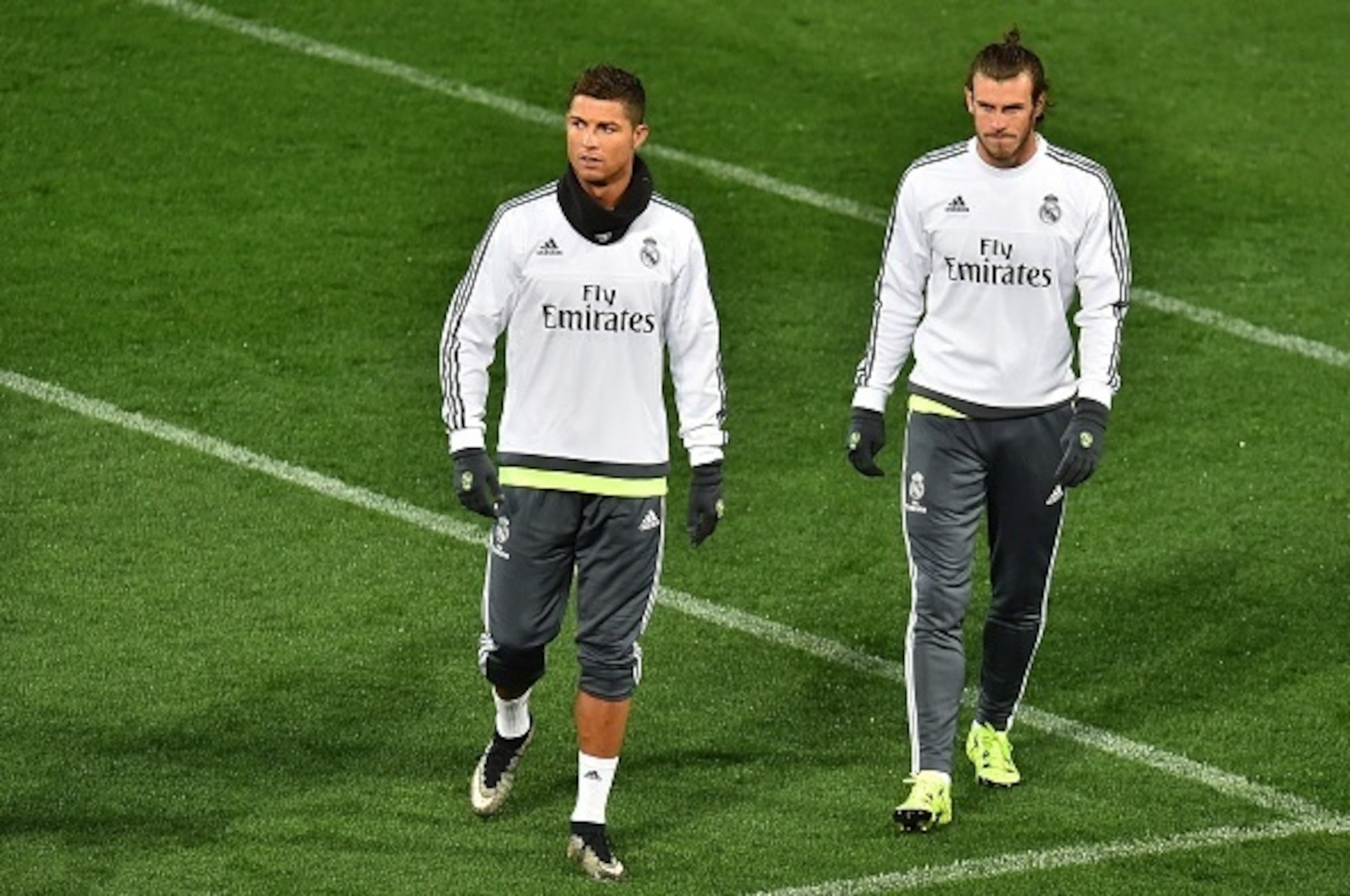
There have been plenty of times when Bale has been the No. 9, Ronaldo almost alongside him and Benzema out on the left after possession has been lost. At other times, Lucas Vazquez started on the right but tucked into a midfield three in the centre when Real were shaping up to defend a phase of play, with Ronaldo-Benzema-Bale left as an asymmetrical three-man attack.
As long as the players are on board with the direction the team takes and do not neglect their positional play defensively, there's no reason why the constant rotation of positions won't strengthen their attack immensely. Bale's ability to play right the way across the three-man line is doubtless paramount in Benitez's thinking here.
The rotation of players has everybody guessing—and the Spanish press apparently don't agree on what they know Benitez wants from his players.
"AS | Benitez is thinking of having Cristiano as striker (with freedom), Isco behind him, James on the right and Bale on the left.
— SocialRMadrid (@SocialRMadrid) August 1, 2015"
"Benitez wants to play Bale as an attacking midfielder, tucked in just behind the centre-forward. [Marca]
— Real Madrid Info (@RMadridInfo) August 1, 2015"
Jigsaw
Real Madrid isn't just a team—like it or not, it's an icon, a brand and a social status. That's why they buy the biggest names irrespective of whether they're what the team actually needs. It's why they travel to all corners of the world just weeks ahead of the new season and still expect to hit the ground running regardless of managerial changes and coaching time. Everyone involved knows it and has to accept it.
Benitez's job is to balance performance and results, names and politics. He has to play Ronaldo (who wouldn't, anyway?), he has to find a way to fit in and bring success of the most expensive signing, Bale, and he has to accommodate as many of the team's talented, creative attacking talents as possible but in his own managerial style, doing so in a way that leaves the defence protected and the chances of winning games as high as possible.
If that duo must almost always start, James and Isco have a duel ready to go for the other slot. In midfield, it's not hard to see Benitez wanting a real protector in place, and the progression of Casemiro gives the manager a ready-made option. Expect to see the Brazilian in place alongside Luka Modric or Kroos in certain matches. But that's the point, especially with Benitez versus Ancelotti—this will be a Real Madrid squad, not an XI.
The assurance the BBC attack will start when fit is gone, and not because the manager thinks Denis Cheryshev or Jese Rodriguez are better players but because he will want to keep the key starters at 100 per cent as often as possible for as long as possible. Having four start-worthy attacking midfielders for three roles is perfect.
Last season, James missed six weeks with a broken metatarsal, Bale had two short spells out injured, Ronaldo faced a suspension and Isco had suspensions and a minor injury. They will all inevitably miss games during the course of the season; this way, the manager gets them all involved regularly and keeps competition for places fierce.
If the outcome is a long-overdue Real Madrid Liga title win, his methods and choices can't be questioned—especially in attack, where Bale looks like being Benitez's central cog.
.jpg?w=2560 "WCup FIFA Investors Soccer")


.jpg?w=2560 "🚨 LIONS GIVE GIBBS RECORD DEAL")

.png?w=2560 "CJGJ Fired Up to Face Texans😤")
.png?w=2560 "JB Threw Phone After Trade 😳")
