Could Jared Goff Be the Second Coming of Aaron Rodgers at Cal?
Halfway down the hill from the nearly 100-year-old stadium where the University of California plays its football games, Jared Goff points to the patch of grass and trees where his family used to tailgate when he was a kid.
This wasn’t really that long ago, considering that Goff won’t turn 21 until October. The players he grew up watching in that stadium, among them Aaron Rodgers, Marshawn Lynch and DeSean Jackson, are at the peaks of their NFL careers, and it’s possible that by the time Goff finishes two more semesters at Cal, he'll be ready to join them.


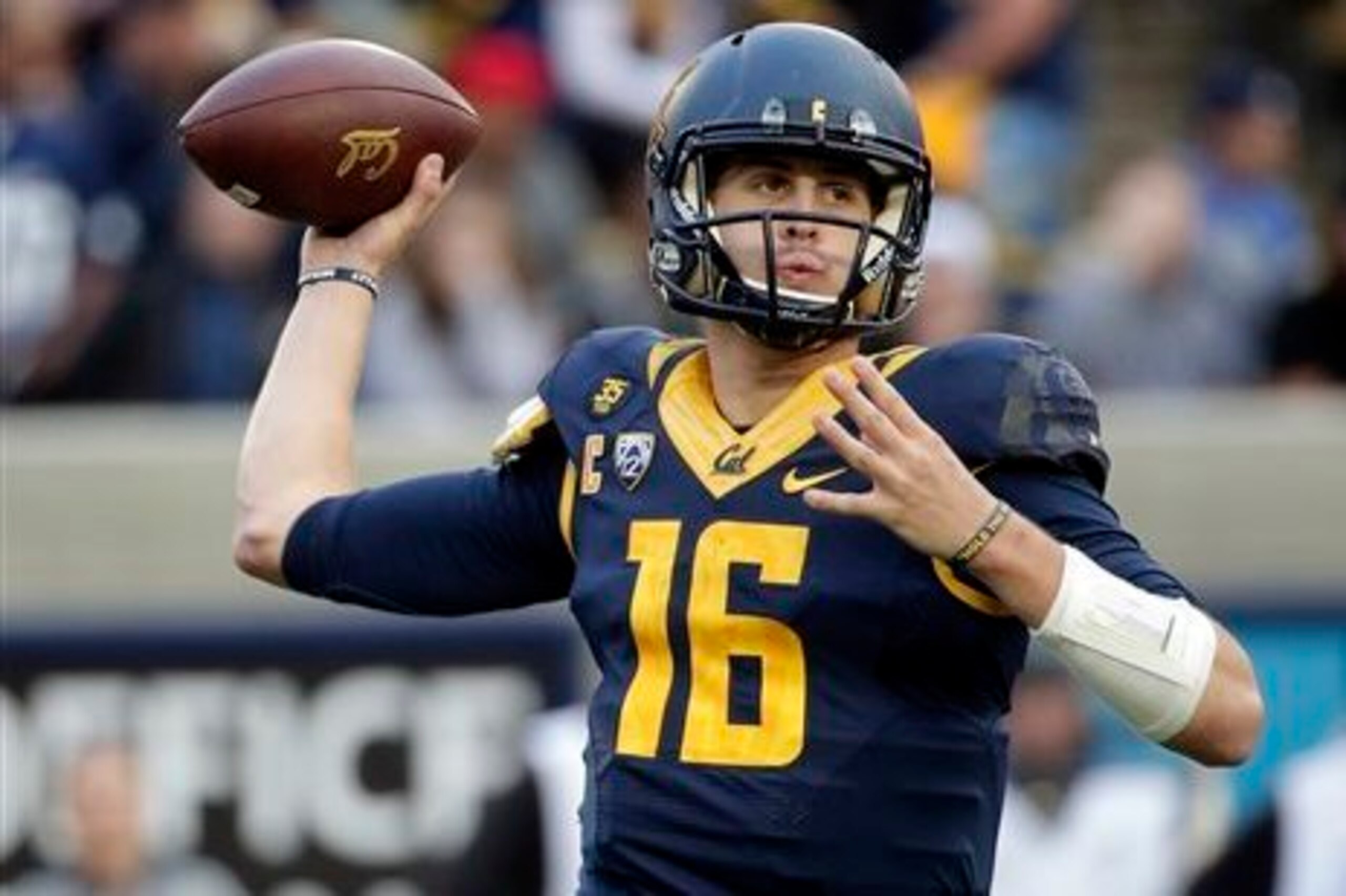
This will be Goff’s third year as the starting quarterback at the university his father, an ex-Major League Baseball catcher, and mother attended, and he enters the 2015 season as a dark-horse candidate for the Heisman Trophy.
There is enough speculation about the NFL swirling around him (including a Mel Kiper column that rated him the top quarterback prospect among underclassmen, ahead of Penn State’s Christian Hackenberg and Ohio State’s Cardale Jones) that Cal felt the need to issue a statement from Goff declaring that he wouldn’t talk about such things until after the season.
Were he playing anywhere other than Cal—if he were at USC or UCLA or Oregon or somewhere in the Big Ten or SEC—the crush of attention might be even heavier, the Heisman hopes even more concrete. But in a way, Goff is lucky, because he plays at a school where major college football is often a secondary concern for the student body.
“Most of the time,” Goff says, “they’re focused on splitting the atom.”

This is an attitude Goff, who grew up in nearby Marin County, hopes to alter at least somewhat this fall, as those other star players did before him and as the Bears did from time to time under former coach Jeff Tedford, maximizing their resources and building around a few marquee talents to win 10 games in both 2004 and 2006.
Still, this is a Cal program that hasn’t played in a Rose Bowl since 1958 and played in only one other bowl between 1959 and 1990. Even its successes are shrouded in geekdom and weirdness.
The most memorable play in Cal history—maybe the most memorable in college football history—is a flukish convergence of luck and physics that ended with a wayward trombone player getting mauled. And one of the enduring nationally televised moments under Tedford came when broadcaster Brent Musburger went on a rant against environmental protesters (“aging hippies,” he called them) who were protesting the destruction of trees around the stadium.
Goff was originally recruited by Tedford’s staff, but Tedford was fired shortly after, as the Bears went searching once more for a new identity, for someone who could elevate their program in the Pac-12 hierarchy.
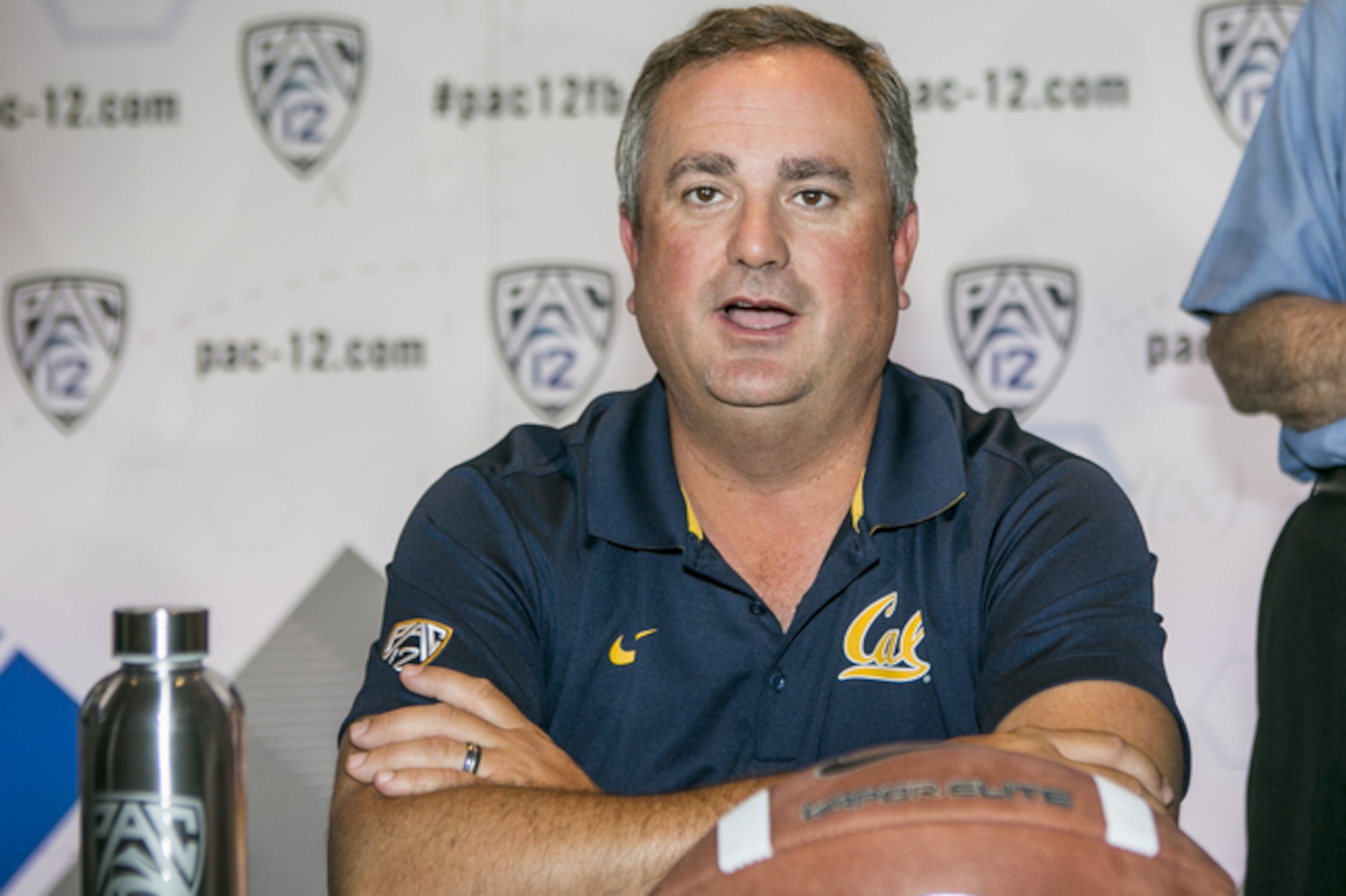
And while Stanford, Cal’s private-school analogue (and fierce rival) in Bay Area nerdiness, has managed to construct a first-tier Pac-12 program by embracing physicality over the conference-wide trend of offensive prowess, Cal hired a native Texan and Mike Leach disciple named Sonny Dykes, who immediately instilled a wide-open Air Raid offense and put Goff at the center of it, as in his freshman year.
In that first season, with Goff essentially learning on the job, the 2013 Bears were a mess, the worst team in the Pac-12, going 1-11 and losing all of their Pac-12 contests. Last year, they improved to 5-7, and if ever there were a time for the Bears to turn the corner, it would be now, in what could well be Goff’s final season before professional football lures him away.
“Growing up watching guys like Rodgers and Lynch and Jackson, and seeing them win 10 games every year, that’s kind of what we want to bring it back to,” Goff says. “There’s no time to waste. This is the year to do it.”
Cal has always been a bit of an odd fit for a major college football program, given its location at the radical epicenter of American culture and the hardcore academic environment of the place (it is continually ranked as the top public school in the country, according to the U.S. News & World Report). The culture of football isn’t infused with the same urgency at Cal as it is at nearly any other school in the South or the Midwest, or even among certain rivals in the Pac-12.
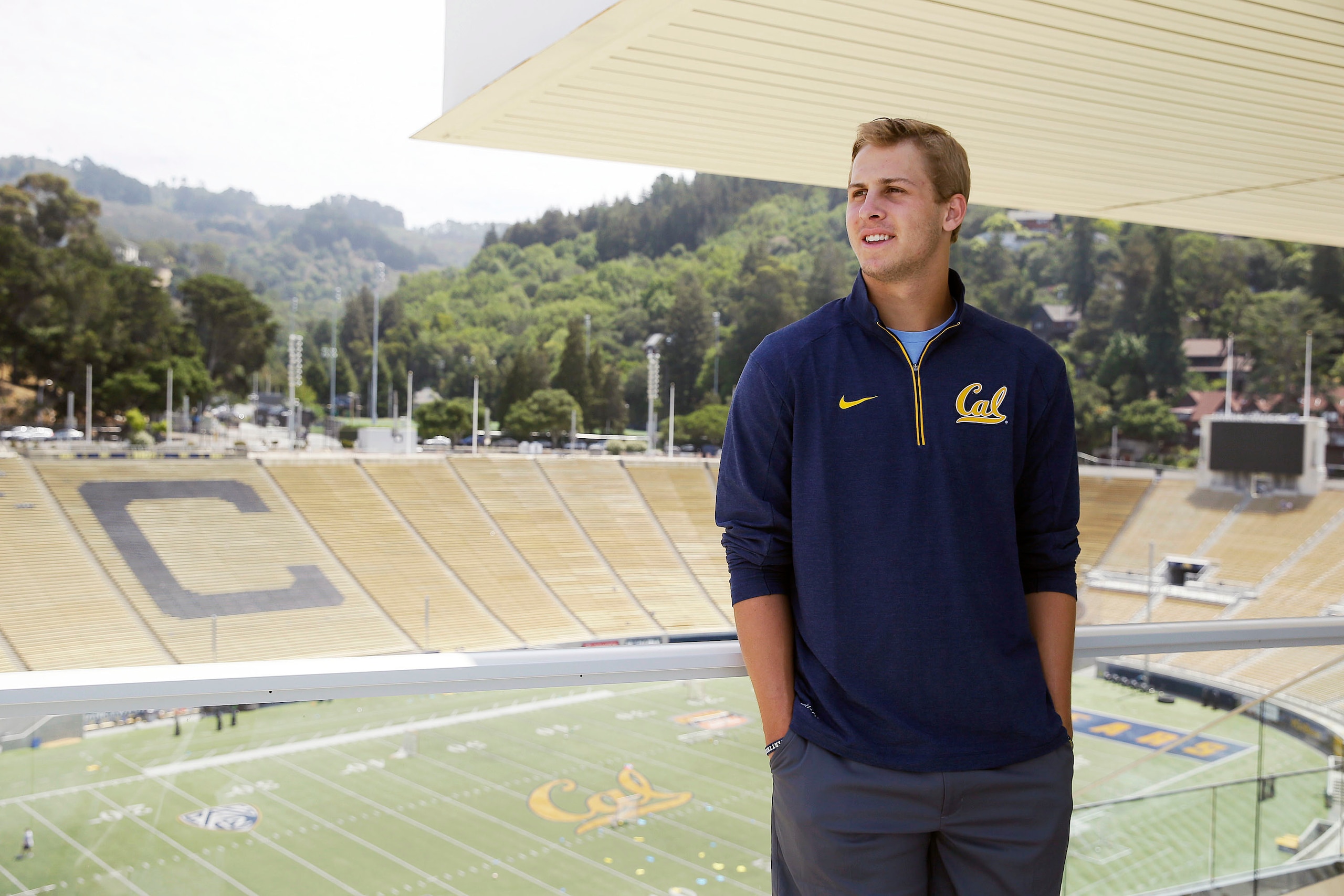
When the Bears are good, the student body tends to focus in a little more deeply and trudge up the hill to Memorial Stadium on Saturdays. But most of the time, football exists on the periphery of a campus where certain parking spaces are specifically reserved for Nobel laureates.
“It’s not like Florida State or LSU, where they’re just driven by the football program,” says Jerry Goff, Jared’s father, who was a walk-on punter at Cal for a season and now works as a firefighter in the Bay Area. “You gotta remember, you’re in class with these kids who are super-geniuses, four-point whatevers, you’re competing against that in the classroom, and you’re competing against the rest of the Pac-12 on the field.”
This is especially apparent to Cal offensive coordinator Tony Franklin, a quarterback guru who spent most of his career coaching in the South at places such as Kentucky and Auburn. Since coming to Berkeley, Franklin has embraced the spirit of the place to the point that he told CBS Sports’ Jon Solomon last spring that he’s transformed from a Republican to a Democrat (Goff calls Franklin “the most unique coach I’ve ever had”).
This is an ethos that Franklin says he’s tried to pass on to his players; he looks out at them, he says, and sees a future generation of world leaders. My age group has screwed the world up, he sometimes tells them. You guys get a chance to fix it.
“When [Jared] goes to class, he knows he’s sitting beside someone who may change the world with a medical discovery or may be the leader of a foreign country,” Franklin says. “When he walks to class, he doesn’t get bombarded. He doesn’t have an entourage.”
Indeed, while Goff and I are talking on campus next to the Campanile, the tower that’s perhaps the most recognizable building in Berkeley, no one interrupts our conversation. There are other things happening, summer classes in session, and that sense of perspective is part of the reason Goff chose Cal in the first place (perhaps his most recognizable moment among Bay Area sports fans to date came when he celebrated after catching a ground-rule double at a Giants game at nearby AT&T Park).
He wasn’t heavily recruited coming out of high school, with offers coming in from places such as Washington State and Boise State, but when Cal offered, it made so much sense to both him and his family that he couldn’t refuse: hometown school, academics, a chance to play in the Pac-12.
His first day on campus, he says, “was Coach Dykes’ first day. Coach Franklin came in and said, ‘I don’t care how old any of you are. I don’t care if you’re a freshman or a 25-year-old, whoever’s gonna play is gonna play.’”
And so Goff immediately competed for the job and immediately won it. Franklin was impressed by his “sneaky” mobility, his ability to keep plays alive in the way Peyton Manning often does. In the first game of his career in 2013, against Northwestern, Goff threw for 450 yards, and he continued to put up huge numbers game after game as the Bears struggled to stop any Pac-12 offenses.

In back-to-back weeks last season, he threw for 458 yards and seven touchdowns in a 59-56 overtime win over Colorado, then threw for 527 yards and five touchdowns in a wild 60-59 victory over Washington State. At that point, Cal found itself with a 4-1 record; suddenly, the campus began to flare with excitement.
“It was like we’d won the Super Bowl,” Goff said.
In the wake of the win over Colorado, Goff went back to the house he shared last year with several roommates. He was sitting on a bench, talking to some friends, when some members of the school’s marching band happened by. One of them asked, “Do you want us to come in and play?”
And so they did just that. Goff still has the photos on his phone of him conducting the band inside the house, the kind of glorious and spontaneous collegiate moment he hopes can inspire an oft-indifferent campus again this fall.
The Bears struggled through the remainder of the Pac-12 schedule in 2014, losing six of their final seven games in large part because of a suspect defense. Still, Goff finished the year with 35 touchdown passes and only seven interceptions, and Franklin says his 6'4" quarterback has only gotten bigger and stronger and more confident since then.
“I’m a lot more comfortable at the line of scrimmage,” Goff says. “[Coach Franklin] will say I have the best view of the field from where we’re at. The plays are more complicated, a lot more decisions to be made, stuff I wasn’t able to do two years ago.”
Two years ago as a freshman, says receiver Bryce Treggs, Goff would often try to air the ball out rather than check down a throw to his running back. “He used to like to show his arm off,” Treggs says. “He was trying to score on every play.”
Perhaps the biggest positive for Goff is that his teammates have grown up around him. Cal has fielded one of the youngest rosters in the country the past couple of seasons, as Dykes has attempted to rebuild the program in his own image, and so Goff has gotten to know his receivers, just as his receivers have gotten to know him.
They’ve worked together enough by now that tight end Stephen Anderson says all Goff has to do is give him a look for him to know the ball is coming to him. “Just a silent signal,” Anderson says.
Because of that—because they’ve worked together for so long—Goff has already been more critical of his receivers (and of himself) when they have made mistakes in fall camp. His demeanor, his manner, even his posture is more commanding than it has been in the past, according to his coach.
“He’s a different person this year,” Dykes says. “He just carries himself differently. The confidence that others have in him is different. From a leadership standpoint, he’s just a calming presence.”
No longer does Goff have to think through his progressions. He can make those decisions almost instinctively now and has Franklin’s permission to do so. He can more easily figure out when to audible and when to check down to a running play, as well as when to step up in the pocket and avoid the rush.
“His feet are definitely some of the best I’ve ever seen,” Treggs says. “He’s not the fastest guy, but he always keeps hot feet. His pocket presence is amazing.”
“He has a really good clock in his head,” Dykes says. “Just being able to anticipate the rush and being able to avoid it. Feeling the rush, but not feeling the rush.”
The obvious model for Goff growing up was Rodgers. The two have never met, in part because Rodgers largely backed away from the program in the wake of Tedford’s firing, but Goff has watched copious amounts of Rodgers on television and film and admires the fact that “he takes a lot of pride in every throw he makes. I don’t think he’s throwing the ball just to throw it.”

Still, when I ask Franklin if Goff reminds him of anyone he’s worked with in the past, he brings up a name that may cause certain NFL scouts to cringe.
“I didn’t coach Tim Couch [at Kentucky], but I was on the staff at that time, and he [Goff] reminds me of Tim,” Franklin says. “Tim had incredible footwork and leadership abilities and was able to extend plays in college. Jared has a better arm, but Tim was probably a better all-around athlete.”
Couch’s failures, of course, came after he’d molded himself into a top pick in the NFL draft, but no one around Goff is allowing him to think that far ahead. And he has the added benefit of professional perspective in his own household.
For six seasons, Jerry Goff was a borderline major leaguer, a backup catcher who would get a start here and there and put so much pressure on himself to make the most of those starts that he often couldn’t relax. One bad run of at-bats, he thought, and he could easily be sent down to Triple-A. “I was a mess,” he says.
In that way, Jerry tells me, he and his son are polar opposites; he never sees his son getting rattled in the way he did when he played.
And so he doesn’t imagine Jared will put too much pressure on himself to live up to the speculation of analysts such as Kiper (who will no doubt scrutinize Jared more closely because he plays in a spread offense where numbers are often inflated and of which NFL scouts are often skeptical). He sees, in his son, someone who’s embraced the challenge of elevating his hometown team into something special.
He also sees someone who’s willing to enjoy the moment he’s in, who has seemingly absorbed Franklin’s constant reminders that as a hometown kid quarterbacking his hometown team in a diverse and intellectually stimulating community, “You’re one of the luckiest humans alive.”
“He’s got so much room to grow,” Jerry Goff says, “and you can’t do that when you’re just looking to your future. And there’s no guarantee, you know? You want this to be fun as much as you can.”
.jpg?w=2560 "Goodell Explains Pro Bowl Decision")
.jpg?w=2560 "Steelers Rework DK's Deal")


.jpg?w=2560 "Biggest Draft Risers 📈")