Why Offensive Line Is True Key to New York Jets Offense
If New York Jets quarterback Geno Smith were a stock, right now, the smart move would be to buy. The second-year quarterback is coming off a strong four-game stretch to close out the 2014 season, and the Jets' decision-makers have surrounded him with all the talent he could ever want at his disposal.
But you can't make progress on your back.
The offensive line could be just as important, if not more important, to the success of the Jets offense than anything else.
.jpg?w=2560 "NFL Owners Football")
.jpg?w=2560 "Steelers Football")
.jpg?w=2560 "Raiders Texans Football")
The Jets have enough weapons in the passing game and enough solid running backs that they can get by with serviceable play at quarterback. If Smith continues to improve at the rate he showed at the end of the 2014 season, the Jets offense will cruise regardless of whether the new offensive pieces all jell quickly.
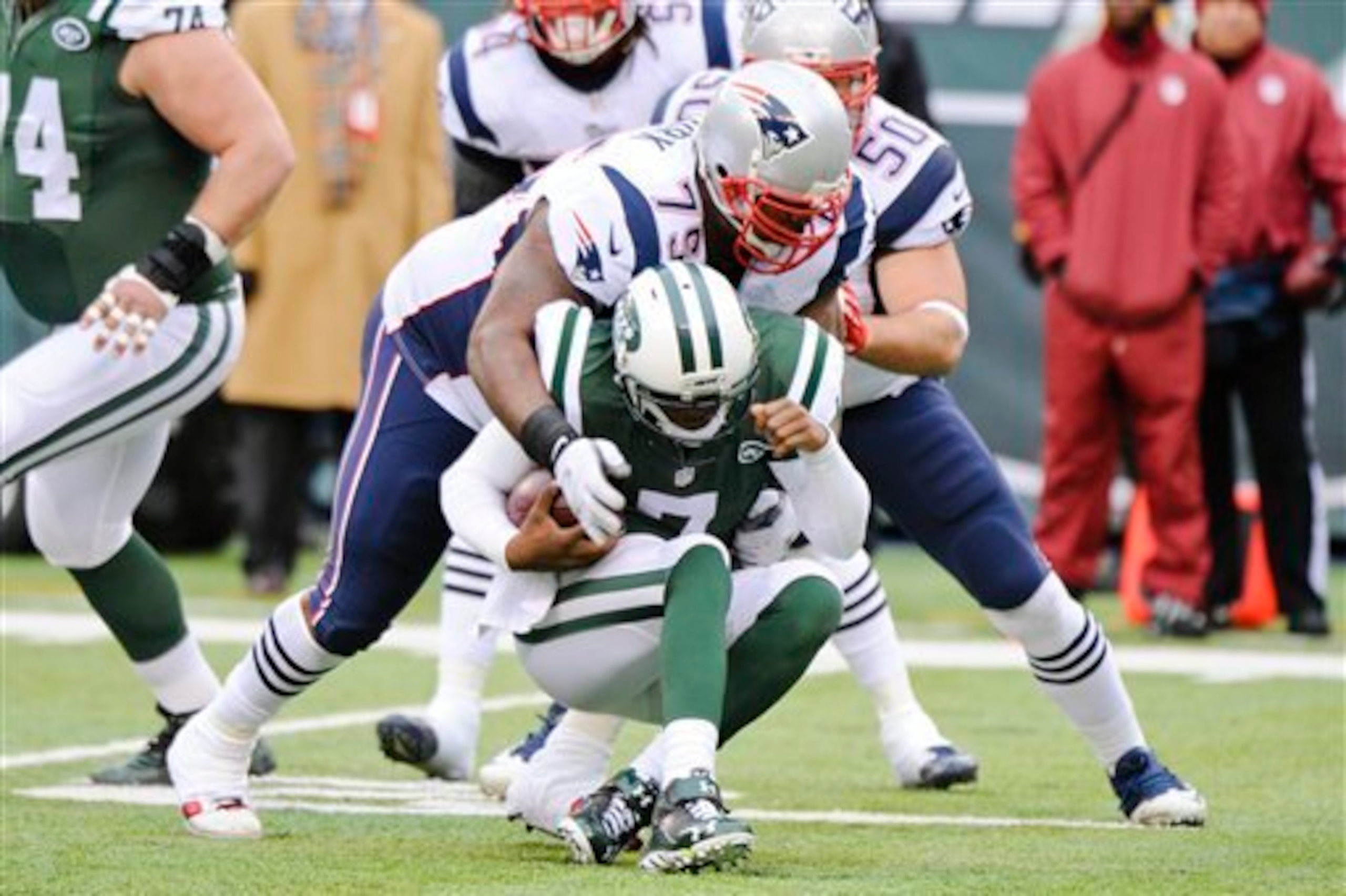
But if the offensive line doesn't hold up, nothing gets accomplished. Smith won't have enough time in the pocket to find his open receivers, the receivers won't have enough time to get open and the running game won't have any holes to gain positive yards.
It just so happens that the offensive line is the one spot where the Jets have some of their biggest question marks.
Veteran left tackle D'Brickashaw Ferguson and center Nick Mangold are locks to start in their respective spots, but Mangold was the only starting offensive lineman to finish with a positive grade from Pro Football Focus in 2014, and Ferguson only broke even at 0.0. The other three spots—both guard spots and right tackle—are concerns headed into the 2015 season.
Right tackle Breno Giacomini was unimpressive in his first year with the Jets after signing over from the Seattle Seahawks. He ranked 43rd out of 78 offensive tackles in pass-blocking efficiency, yielding 31 hurries, seven hits and three sacks. The Jets have no serviceable options to replace him and would incur $4.75 million in dead money against the cap if they cut him, so he's virtually a lock to start again.
The bigger questions are at guard.
Free-agent signing James Carpenter figures to win one of the two starting guard jobs, but the other spot is very much up for grabs. Oday Aboushi, Willie Colon, Brian Winters and Jarvis Harrison could all be given an equal opportunity to win that job. Then, there's the question of whether Carpenter will be a better fit in the Jets offense than he was in Seattle's, and also whether the other guard can carry his weight.
Everyone's getting a turn to prove themselves as an answer to those questions.
But those questions need to be answered if the Jets are going to maintain their dominance on the ground.
As usual, the Jets fielded a solid rushing attack in 2014 and ranked in the top 10 in nearly every rushing category (fourth with 31.7 attempts per game, third with 142.5 rushing yards per game, eighth with 4.5 yards per rush attempt).
The offensive line can take its share of the credit for that success—although Pro Football Focus gave it a team run-block grade of minus-24.4, 20th in the NFL, and it also ranked 20th in Football Outsiders' adjusted line yards on the ground.
With Chan Gailey as the offensive coordinator, you may think that the Jets are going to air it out regularly. That may be the case, and the Jets may spend a majority of their time in spread formations with three or four receivers and with Smith lined up in the shotgun, but the Jets didn't bring Gailey in so that he could completely abandon the run every week.
Quite the contrary—head coach Todd Bowles brought in Gailey for his reputation for running the football and having balance within his offense.
"We're going to run it and throw it," Bowles said of Gailey's offense. "We're going to be very balanced. It's not going to be a certain style of offense. As we get all our pieces in place, we'll kind of drift toward that as we go. But we're going to run the ball and we're going to throw the ball equally."
| Pressure % | 40.1 | 25 |
| Comp % | 38.5 | 26 |
| Acc % | 50 | 27 |
In order to have that balance, the Jets need to be able to block in the running game to force opponents to respect their rushing attack, but that protection up front is equally important to the passing game.
Smith's worst enemy is interior pressure, and although he has the legs to evade a pass-rusher coming up the middle, it eliminates his ability to step into his throws, which is where his mechanics start to go down the drain.
Smith was under pressure on 40.1 percent of his dropbacks in 2014 (the third-highest in the NFL out of 27 qualifying quarterbacks), and he was accurate on only 50 percent of his throws under pressure (lowest in the NFL) while completing only 38.5 percent of his throws (second lowest).
There are a lot of things that need to go right for the Jets to field a competent offense in 2015, but the offensive line is one thing that can't go wrong.
Unless otherwise noted, all advanced statistics provided by Pro Football Focus. Quotes obtained via team news release.
.jpg?w=2560 "Panthers Saints Football")