

How Ersan Ilyasova Changes the Dynamic of Detroit Pistons' Offense
When the Detroit Pistons acquired power forward Ersan Ilyasova from the Milwaukee Bucks, it immediately changed the way their offense will run in 2015-16.
Detroit shipped the non-guaranteed contracts of Caron Butler and Shawne Williams to Milwaukee for Ilyasova, 28, a 6'10" and 235-pound power forward. Pistons coach and team president Stan Van Gundy has coveted his new big man for several years.
"Coach Van Gundy said he was following me since he was coaching in Orlando several years ago and he really liked the way I played and how I fit into the system," Ilyasova told Gery Woelfel of the Journal Times.
TOP NEWS

Buzz: Kings Declined Trae Trade
Buzz: Why Kawhi Trade Is Delayed ✋

Lakers to Build Phil Jackson Statue
The Turkish big man will presumably move into the starting power forward role—the spot Greg Monroe filled the past two seasons. Monroe is an unrestricted free agent, and he was never the ideal partner for center Andre Drummond. Van Gundy used stretch 4s with the Orlando Magic in Rashard Lewis and Hedo Turkoglu, and Ilyasova fills that role in a way that Monroe never could. The trade has put a de facto end to Monroe's time in the Motor City.
"The fit has been bad in Detroit for a while, and Monroe's decision to take the Pistons' one-year qualifying offer last summer indicated a mutual unwillingness to keep working on a fix," Bleacher Report's Grant Hughes said. "This latest move shows nothing has changed. It's time for the Moose to migrate."
Detroit's old and new power forwards are very different bigs: Monroe is a plodding, low-post scorer who was really a center playing out of position; Ilyasova is the prototypical European 4 who likes to shoot from the outside.
Monroe has put up bigger rebounding totals the past few years than Ilyasova, partly due to the proximity in which he plays to the basket. Ilyasova has been a very effective offensive rebounder in the past, averaging 3.3 per game in 2011-12. Ilyasova certainly won't improve the Pistons defensively when he's on the court, but neither did Monroe. But their different offensive styles will be where you see the biggest changes for the Pistons.
Floor Spacing

The clearest change to the offense from this move is the way the floor is spaced. Monroe was anchored to the block—70.7 percent of his shots came from within five feet of the basket, and 92.4 percent came from within nine feet, per NBA.com.

Ilyasova is a very different player. Over one-third of his field goals came from beyond the arc (34.1 percent), and he was quite good from that range at 38.9 percent. He had two seasons (2011-12 and 2012-13) where he made at least 44 percent of his threes, so there's potential for him to be a truly elite shooter in Detroit.
He spends the majority of his time on the perimeter—56 percent of his field-goal attempts in 2014-15 came from at least 15 feet—and opposing defenses have no choice but to send an opposing defender out there to defend him.
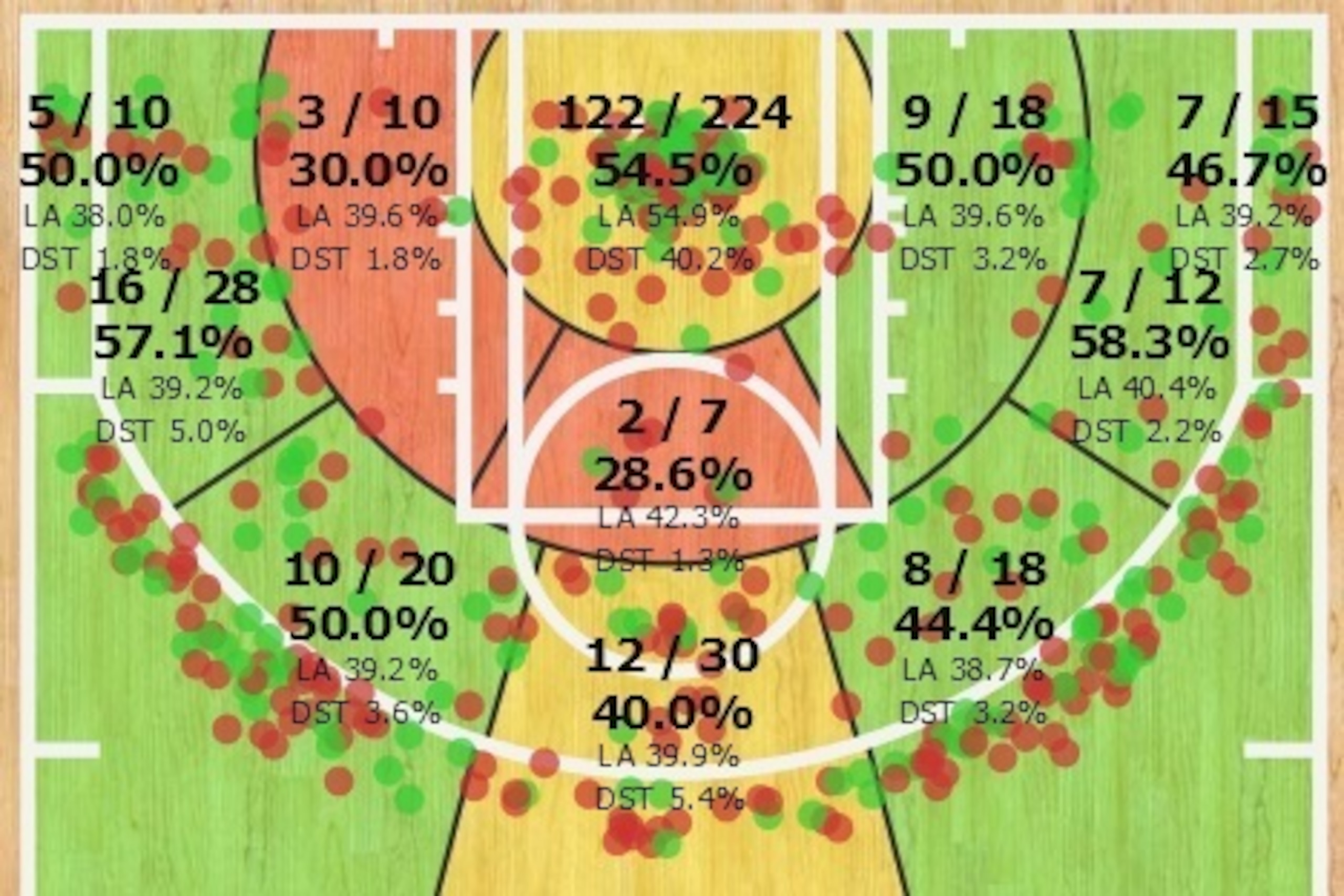
The extra player on the perimeter will open up space for the other Pistons to operate in the paint. There will be one fewer defender near the rim on Reggie Jackson drives or Kentavious Caldwell-Pope cuts, and nobody will be able to double Andre Drummond in the post without leaving a shooter open. The entire lane will be free when Drummond screens in a pick-and-roll.
When Monroe was on the court with Drummond, the Pistons always faced a second interior defender. Anthony Tolliver gave a taste of what the offense could be with a stretch 4 on the court, and he made 36 percent of his threes for Detroit. With a top-notch shooter at power forward, it will be able to breathe in all-new ways.
Offensive Flow
Losing Monroe will take away Detroit's top interior scorer, but it will also allow for more of a free-flowing offense.
While posting up Monroe gave the Pistons something to lean on offensively, it also bogged down their movement. Too often, the offense would become Monroe going one-on-one against his defender while the other four guys just stood around.
According to NBA.com, just 39.1 percent of Monroe's field-goal attempts came without him dribbling first. He was a willing passer, averaging 2.1 assists per game. But post touches simply require big men to put the ball on the floor, and when that happens, an offense can stagnate.
For the Bucks, Ilyasova's game came much more in the offensive rhythm. He took 77 percent of his field goals without ever putting the ball on the floor, and he took more than one dribble before just 9.5 percent of shots. Ilyasova's looks were considered "catch and shoot" by NBA.com 49.2 percent of the time. Just 3.9 percent of Monroe's looks had the same label.
Monroe is a talented low-post player, but his style requires a team to run much of its offense through him on the block. Ilyasova's talents allows him to be a complementary piece in a scheme with more movement by both the players and the ball. And if the Pistons need a post-up, they can go to Drummond without him butting heads with Monroe in the paint.
Rate of Play

Despite being one of the youngest teams in the NBA in 2014-15, the Pistons were one of the slowest squads, ranking No. 23 in pace, per NBA.com. Playing two traditional big men together for long stretches certainly played a role.
Detroit averaged 95.18 possessions per 48 minutes overall, and they were slower with Monroe on the court: down to 94.73 possessions. When Drummond and Monroe shared the floor, the pace slowed even more, to 94.02 possessions. But when Drummond played with Tolliver—a stretch 4 with more athleticism than Monroe—the Pistons played faster than average: up to 95.72 possessions.
The difference between Drummond playing with Monroe or with Tolliver—1.68 possessions per 48 minutes—may seem insignificant. But it is nearly as big as the difference between the Pistons at No. 23 in pace and the Minnesota Timberwolves and Los Angeles Clippers, who are tied at No. 10. Substituting an athletic big for Drummond could instantly convert the Pistons from one of the slowest to one of the fastest teams in the league.
The Bucks played at a faster pace overall than the Pistons, at 96.50 possessions per 48 minutes (No. 12 in the NBA). They were a bit quicker when Ilyasova played—up to 96.83 possessions. The uptick isn't enormous, but he is a player who can get up and down the floor easier than Monroe could. And Ilyasova will give the Pistons more incentive to run.
According to Synergy Sports Tech, he was quite dangerous in the open court for the Bucks.
"Ersan Ilyasova made 40% of his spot up 3's and 52% of his transition 3's this season at 6'10. He brings a new dimension to Detroit's offense
— Synergy Sports Tech (@SynergySST) June 11, 2015"
With Jackson and Brandon Jennings at point guard, Caldwell-Pope on the wing and Drummond at center, the Pistons have athleticism all over the court. The addition of Ilyasova as a knock-down shooter from the outside gives them even more reason to run the floor.
With two low-post players on the court at once, the Pistons weren't built to push the pace in 2014-15. The new roster makeup gives Van Gundy plenty of incentive to have them get up and down the court.
Jakub Rudnik covers the Detroit Pistons as a Featured Columnist for Bleacher Report. Talk Pistons basketball with him on Twitter:






.jpg?w=2560 "Week 1 Waiver Wire Targets")
.jpg?w=2560 "Donald Won't Play Week 1")
.jpg?w=2560 "🚨 Baker, Bucs Agree to Deal")
.jpg?w=2560 "Week 1 Start 'Em, Sit 'Em Plays")