

Is Tristan Thompson a Luxury or Necessity for Cleveland Cavaliers Next Season?
Every once in a while, an NBA team gets to experience one of those good problems.
Win or lose against the Golden State Warriors in the upcoming NBA Finals, the Cleveland Cavaliers will have one of them this offseason when they try to decide what to do with Kevin Love and Tristan Thompson. The former seems to desire a return to the Eastern Conference representatives, while the latter is a restricted free agent and won't be able to play anywhere else if the Cavs don't want to lose his services.
But will Cleveland actually have room for both? And if not, which one should the Cavs choose?
TOP NEWS

LeBron's Special Helicopter Deal

MJ Makes Record-Setting Donation 🙌
Shams: KAT, Hart Could Be Trade Names
Just a few months ago, that would've seemed like a ridiculous set of questions. But after Thompson has continued to prove himself in the starting lineup while Love recovers from his Kelly Olynyk-induced shoulder injury, it's much more legitimate one.
The Money
Few teams have murkier financial situations than the one the Cavs will play around with during the 2015 offseason. Thanks to a plethora of expiring contracts, plenty of player options and the massive non-guaranteed salary of Brendan Haywood—who could either be waived immediately or traded to a cap-rich team as an expiring deal—the actual amount of money Cleveland has committed to its players is entirely up in the air.
As broken down in detail here, the number could range anywhere from $25,229,613 to $88,274,420 heading into a season where the salary-cap and luxury-tax threshold are expected to fall in around $67.1 million and $81.6 million, respectively.
While it may seem as if the Cavaliers will have some money to spend this offseason, that's not exactly true. Well, they should hope it's not, because financial flexibility would mean that some of the key players are fleeing northeast Ohio for warmer destinations.
If the major pieces on this squad are going to be kept together, it'll cost quite a bit of money.
Focusing on the first of the two players in question, Love will likely opt out of the final year of his deal and seek a bigger monetary commitment—whether in the form of a one-year max deal before the salary cap rises exponentially in 2016 or a lengthy one that still pays him the max for 2015-16. Either way, he'll be making about $18.9 million next season, should he demand as much money as the collective bargaining agreement allows.
Thompson won't be making that much, but it's not as if re-signing him will be cheap. Unlike Love, this power forward is a restricted free agent, and it appears exceedingly likely that Cleveland will be asked to exercise its right of first refusal and match the offer sheet he inevitably signs.
Problem is, the former Texas Longhorn already turned down a big extension in 2014.
"Within the NBA, officials expected maybe $10 million a year, perhaps $12 million if Klutch wanted to push it," Yahoo Sports' Adrian Wojnarowski reported in January. "Well, they kept pushing it. Thompson turned down a $13 million-a-year extension offer—four-years, $52 million, league sources told Yahoo Sports."
Would he be willing to accept a similar deal now? He's far more proven at this stage of his career, having provided quite a bit of value in a much larger role under the bright lights of postseason play.
Fortunately, the CBA allows for the Cavaliers to re-sign both players with Bird rights. Teams can go over the cap to bring back their own players, and Cleveland will qualify for that situation as long as the organization is willing to pay a hefty luxury tax fee.
This franchise has paid the tax before, and there are no indications that Cavs president Dan Gilbert would avoid digging into his deep pockets in order to build the strongest team possible. Money has never been a driving factor in the past, and though he might make out the check to the NBA in handwritten Comic Sans, presumably he'd at least sign on the dotted line.
The finances aren't likely to be prohibitively problematic. But that doesn't mean the Cavs should bring back both bigs.
Playing Time
It's clear that certain members of the franchise would like each big to return to Quicken Loans Arena for more home games in the future.
"Tristan should probably be a Cavalier for his whole career. There's no reason why he shouldn't," LeBron James told reporters after Thompson played the hero in Game 3 of the Eastern Conference Finals, via ESPN.com's Dave McMenamin.
And while there's been a ton of speculation about Love's happiness, fit with his teammates, declining role and potential desire to play elsewhere, he's done nothing but remain adamant about wanting to finish what he started. All year, he's said and done the right things and has continued to do so as his team finds postseason success while his arm remains in a sling.
Here's Marc Berman of the New York Post:
"'I truly haven’t even thought about it,' Love said Sunday in his first comments since he injured his shoulder last month. 'I expect to be suiting up for Game 1. Next year.'
'With the Cavaliers?' he was asked.
'Yes, sir,' Love responded.
'I still feel like I’ll be part of this,' Love said at a press conference at the Cavaliers’ practice facility in suburban Independence, Ohio.
"
Desire is one thing. Playing time may be another.
Unless the Cavaliers successfully petition the Association to extend the average game to 60 minutes or do everything in their power to play as many overtime periods as possible, they're only going to have 48 minutes to get all their big men on the floor. That's not going to be an easy task, considering they'll have to divvy that time out to Thompson, Love, Timofey Mozgov and Anderson Varejao, who's still under contract for a few more years and should be healthy going into the 2015-16 campaign.
This year, Love played 33.8 minutes per game. Thompson checked in at 26.8 during the regular season, but that number rose to 34.3 when the postseason kicked off and Love subsequently went down against the Boston Celtics.
But remember, those numbers come with Mozgov arriving midway through the year and gradually gaining comfort in his new digs. Plus, Varejao played in only 26 games before tearing his left Achilles, so he wasn't really factoring into the rotation for long, and we have to remember that James plays some minutes at the 4 in small-ball lineups.
Finding minutes for all four is going to be exceedingly difficult. In theory, it's a good problem to have, but we've seen in the past that overpacked rotations sometimes engender bitterness. This year's Phoenix Suns backcourt serves as our most recent example, eventually leading to an unhappy ending that saw Goran Dragic and Isaiah Thomas depart for the Miami Heat and the Boston Celtics, respectively.
If everyone complements each other in the rotation, it can work. Even then, it's not guaranteed to succeed unless the personalities all mesh perfectly. But that cohesiveness may not be what's happening in Cleveland, even if it appears—on the surface level, at least—that Thompson brings a certain level of physicality and toughness that the perimeter-dwelling Love can't match.
A Luxury, But Not a Necessary One
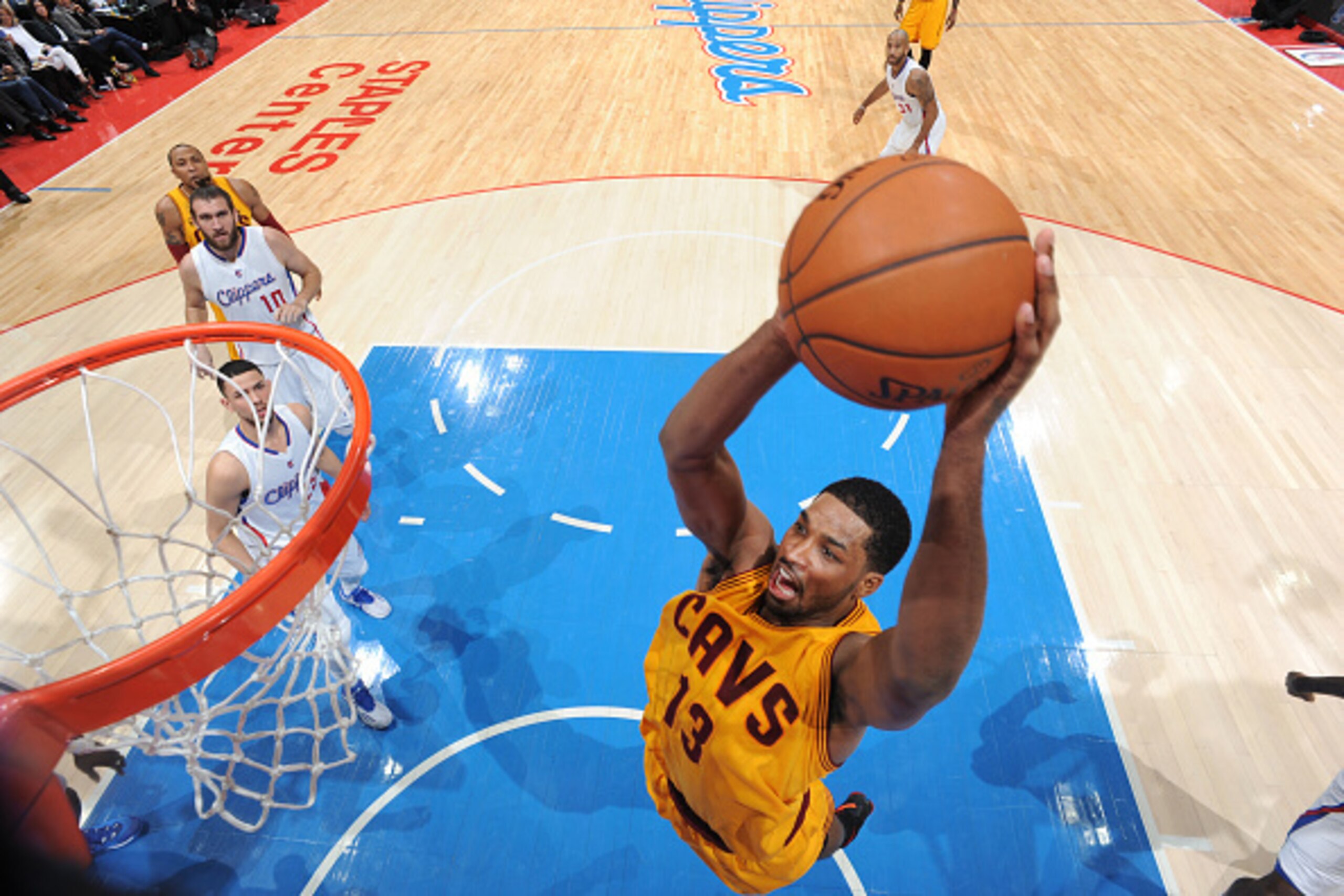
Paying Thompson and Love is fine as long as they're amenable to playing more restricted minutes and can provide different strengths. It's the latter part that could prove problematic, rendering this a luxury that's not actually necessary when other team-building routes can be pursued.
Right now, it's easy to be wrongfully swayed by Thompson's production.
He's been the starting power forward on a Cleveland squad getting set to match up against the Golden State Warriors in the NBA Finals, and his offensive rebounding prowess has helped the Cavs thrive. He's averaging 9.4 points and 9.9 rebounds during the playoffs, and unless he's shooting free throws, he passes the eye test with aplomb.
However, that doesn't mean he's a better fit than Love. He's not, even if he does bring that toughness to the lineups that feature him.
What exactly does Thompson do more effectively than Love?
Other than create second-chance opportunities, not much. He's a significantly inferior player on the defensive glass, he's a liability at the charity stripe, his defense isn't impressive and his lack of offensive range makes it tougher for Cleveland to score on the first possession.
Even during the playoffs, where he's gained much more national recognition, he hasn't shown the level of overall impact that Love typically boasts. Just look at how Cleveland has fared with Love and Thompson on and off the court, per my FATS model (based on historical similarities and explained in full here):
Obviously, the sample size is quite small for the playoff version of Love. But even looking past that, it's not particularly difficult to see that the All-Star is a much more impactful player.
His FATS differential (plus-19) during the regular season was larger than any player on the roster not named LeBron James. Meanwhile, Thompson finished seventh with his plus-4.0 differential, trailing James, Love, Iman Shumpert, Mozgov, Kyrie Irving and (in an exceedingly minuscule number of minutes) Lou Amundson.
Sure, Cleveland has been rolling with Thompson on the court throughout the playoffs. It's also been obliterating opponents when he takes a rest, thanks in part to the weak and injured state of the rest of the Eastern Conference field.
And it shouldn't be surprising, even if it's exciting to see the Texas product's relentless energy on the offensive glass and undying spirit when sacrificing his body for 50-50 balls. Love is simply the better, more well-rounded player, and increased skill on the offensive glass only does so much.
To prove that point, take a peek at the Cavs' offensive rebounding percentage with the two relevant players on and off the floor:
Even if we take the absolute biggest discrepancy (30.4 offensive rebounding percentage with playoff Thompson and 27.1 with regular-season Love) that's not exactly a huge difference. In fact, it's only 3.3 extra offensive rebounds per 100 possessions. And since the Cavs used just 92.3 possessions per contest, those 3.3 extra boards are actually spread over the course of more than one outing, rendering them even less impactful on a game-by-game basis.
Is that enough to account for the difference in most every other facet of the game? Not exactly, though Thompson could change one part of his profile and render this whole discussion moot.
If he can spend an entire offseason working on his timing around the rim and morph into a terrific rim-protecting presence, he's then complementary to Love. If he can't, he's a luxury commodity who isn't truly necessary on the roster.
According to NBA.com's SportVU data, Thompson allowed opponents to shoot 52.2 percent at the hoop while facing 6.5 shots per game during the regular season. Throughout the playoffs, he's up to 7.9 shots faced per contest but is still giving up buckets at a 52.7 percent clip.
Should that change, Thompson would bring two major benefits that Love can't provide—elite work on the offensive glass and the ability to serve as a defensive anchor. Given the limited playing time and exorbitant salary he's probably going to demand this offseason, that's what it might take for it to be worth re-signing him.
It may be painful for Cleveland to let its young big man go, especially after his stellar work during this championship pursuit.
But sometimes, the tough decision is the correct one.
Note: All stats, unless otherwise indicated, come from Basketball-Reference.com and NBA.com.
Adam Fromal covers the NBA for Bleacher Report. Follow him on Twitter: @fromal09.

.jpg?w=2560 "Grading WWE Raw 🔠")

.jpg?w=2560 "Viral Rams Coach Vid 🖕")
.jpg?w=2560 "Bijan's INSANE 1st Half 🤩")
.jpg?w=2560 "Injury-stricken Seahawks signing veteran RB")
.jpg?w=2560 "2 NFL Officials Suspended")
