Kramer's Korner: Ohio State's Quiet NFL Draft Day Should Terrify CFB World
The silence was deafening. As the commissioner of the NFL was buried by emphatic boos with each and every podium visit—offering up the first 32 players chosen in the 2015 NFL draft—something was absent.
More notably, someone was absent: Ohio State, the defending national champion and bona fide favorite heading into the fall, was nowhere to be found. In total, the Buckeyes had five players drafted. None were selected in the first round, and only two Ohio State players were picked in the first three rounds.
If you’re a Big Ten coach or College Football Playoff hopeful, this should be alarming. The silent freight train is headed your way.
.jpg?w=2560 "Titans Giants Football")

| Player | Position | Round Taken | Pick Number | NFL Team |
| Devin Smith | Wide Receiver | 2nd | 37 | NY Jets |
| Jeff Heuerman | Tight End | 3rd | 92 | Denver Broncos |
| Doran Grant | Cornerback | 4th | 121 | Pittsburgh Steelers |
| Michael Bennett | Defensive Tackle | 6th | 180 | Jacksonville Jaguars |
| Evan Spencer | Wide Receiver | 6th | 187 | Washington Redskins |
Now, let’s not just gloss over the losses highlighted above.
Devin Smith averaged more than 28 yards a catch last season, which was best in the nation by more than four yards. Michael Bennett, who inexplicably fell to the sixth round—do better, NFL scouts—was one of the conference’s better defensive linemen. Doran Grant, Jeff Heuerman and Evan Spencer also had their moments.
These were outstanding collegiate players. But as you assess the Buckeyes’ uneventful draft weekend, one can’t help but look over the 2015 depth chart and marvel at all of the robust talent still at so many key positions. It’s startling, really. The silence signifies power.
Had defensive end Joey Bosa been eligible to leave, he might have been the first defensive player off the board. Ezekiel Elliott, Urban Meyer’s workhorse back, almost certainly could have cracked the first round if he were allowed entry. Ohio State will likely have both for one more year.

As for Cardale Jones, well, who knows? At the very least, he would have garnered serious consideration by someone early on, even with such a limited sample size. The tools would have been too fruitful to ignore.
This is who Ohio State has coming back, not to mention a slew of players who will garner serious NFL draft interest: Left tackle Taylor Decker, safety Vonn Bell, linebacker Darron Lee and wideout Michael Thomas could all go in the first round of the 2016 draft if things shake out accordingly next season. Even defensive lineman Adolphus Washington could sneak into that conversation if he realizes his enormous potential.
There is star power everywhere and promising recruits waiting for a chance to get an opportunity—and many likely will after next season. But before the assembly line of talent starts to churn, there is a season to be played.
The NFL draft provided a very discreet but overpowering reminder that the Ohio State you watched last season will look a lot like the team that hits the field come fall. There are no guarantees that it will come together for another title, but what a lovely place to be.
As for other draft observations and their impact on college football, here are a few items that resonated over the weekend.
Vernon Adams, First-Round Destroyer

On the same weekend Oregon quarterback Jeff Lockie dazzled the crowd during the Ducks spring game, three Washington defenders—Danny Shelton (pick No. 12), Marcus Peters (pick No. 18) and Shaq Thompson (pick No. 25)—were off the board in the first round of the NFL draft. Another Huskies defender, Hau'oli Kikaha (pick No. 44), was gone in the second.
How are these moments related? It stretches beyond conference and football familiarity. It involves a player, Vernon Adams Jr., who could impact the Pac-12 more than any other this year—even if the graduate transfer isn’t in Eugene just yet.
On Sept. 6 last year, however, the former Eastern Washington star got his shot at Washington and three (eventual) first-round picks. The undersized quarterback didn’t just prove he could hang with elite talent; he was flat-out sensational.
The Eagles nearly upset the defensively charged Huskies, losing 59-52: Adams finished with 475 yards passing and seven—yes, seven—touchdowns. If there were any concerns that he couldn’t compete against elevated competition, those were squashed right there.
“I want to earn the starting spot, earn everyone’s trust, win games, win a Pac-12 championship, hopefully a Heisman and a national championship,” Adams told me earlier this offseason. “My goals are set high.”
It won’t be easy. Lockie’s exceptional spring could make this more complicated than many—including myself—expected. But Adams, regardless of what happens next, was able to make four of the nation’s first 44 draft picks look completely helpless.
The Risk of Leaving Early Is Still Worth It

Each year, right around this time, we eulogize a group of young football players’ careers that are nowhere near dead. In 2015, this group is 24 strong, as Matt Hayes of Sporting News pointed out—down significantly from a season ago:
"24 of 84 underclassmen who declared for #NFLDraft were not picked.
— Matt Hayes (@Matt_HayesSN) May 3, 2015"
That’s how many early enrollees weren't drafted this past weekend, including Houston wideout Deontay Greenberry and USC wideout George Farmer. Both flashed moments of brilliance during their collegiate careers; both also signed with the Dallas Cowboys as undrafted free agents once the draft concluded.
In comparison, Texas defensive coordinator Vance Bedford called attention to the fact that 36 of the 98 total early enrollees went undrafted last season:
"In 2014, 36.7 percent (36 of 98) of the early entrants went undrafted.
— Vance Bedford (@CoachBedfordUT) May 3, 2015"
One could connect the dots and assess exactly what this data means, but the overall trend remains the same: Juniors and redshirt sophomores will continue to explore the NFL when they are allowed to leave—even if they are not assured a spot in one of the early rounds of the draft.
And that’s perfectly fine. In fact, it’s better than fine. It’s completely reasonable, and all options should be explored. There's way too much money at stake not to evaluate the move.
The notion that an early enrollee who goes undrafted failed, however, is utterly preposterous.
Disappointing? Certainly. But it doesn't end now.
Most, if not all, will end up signing with a team less than a day after the draft ends. They will get their shot. Many will still make a team out of camp. Others will latch onto a practice squad and still make a lucrative living while being paid, finally, to play football. What a wonderful backup plan.
I have stressed this time and again, although it is worth mentioning once more: School can wait. That’s not an attempt to undermine the undeniable importance of a degree or an education. It’s essential. But the circumstances, at least as they pertain to this sport, are unique.
The window for football is so obscenely small—and there are zero guarantees that returning to college for another year will propel a career. Heck, given the danger of injuries, it could do the opposite.
According to Forbes, the minimum salary for an NFL player will jump to $435,000 in 2015. That’s the floor. It’s a risk to leave early without guarantees, although given the window to play professionally and the lucrative nature of the profession, it’s a risk worth taking.
The Draft by the Numbers
29: In the past three years, 29 Florida State Seminoles have been taken in the NFL draft. That’s an astonishing number that also has a place in draft history, according to ESPN 30 for 30 filmmaker Billy Corben:
"FSU sets record with 29 players drafted in last 3 years; USC (08-10) and Miami (02-04) shared the old record with 28 http://t.co/8pI3C4a9TZ
— Billy Corben (@BillyCorben) May 3, 2015"
What does it mean? For starters, head coach Jimbo Fisher and his staff—which has had plenty of turnover—have done a tremendous job of identifying and developing talent. Bigger picture, it could also mean that this year’s large talent exodus may not have the daunting effect many expect on the 2015 season.
Bigger picture, Florida State just got more ammunition to recruit, and talented high schoolers will be drawn to this magnificent run.
7: Only seven quarterbacks were drafted in 2015, which is an astonishingly low figure. Two, Jameis Winston and Marcus Mariota, represent the top selections. After that, it got quiet quickly.
Perhaps more startling about this dearth of QBs called is that it was the least bit surprising. This is about what many expected, despite the historic absences, as NFL.com's Gil Brandt alluded to:
"The 7 QBs represent the lowest number drafted in a single year since 1955.
— Gil Brandt (@Gil_Brandt) May 4, 2015"
As I wrote last week, the position—at all levels—is enduring a drought of sorts. There are fewer guarantees at the collegiate ranks, which is something that carried over into the spring with some of the nation's elite programs.
Given the way offenses are evolving from the high school level up, it will likely remain increasingly difficult to scout, project and draft.
47: On the opposite end of the drafted spectrum, defensive back was the most desired commodity for NFL teams this year. Of the 256 players drafted, 47 played cornerback or safety, via Brandt:
"2015 draft by position: DB 47 LB 37 WR 34 OT 26 DE 23 RB 23 TE 18 DT 18 OG 16 QB 7 C 5 P 1 LS 1
— Gil Brandt (@Gil_Brandt) May 4, 2015"
That’s more than 18 percent.
More significantly, it’s a fascinating bit of evidence of where the sport is right now and where it could be heading. Even with the collective struggles at quarterback, the forward pass is essentially taking over. Finding the right group capable of slowing these offenses down is precisely what teams are after.
Young, talented high school defensive back mulling the move to wide receiver, stay right where you are.
The market says so.
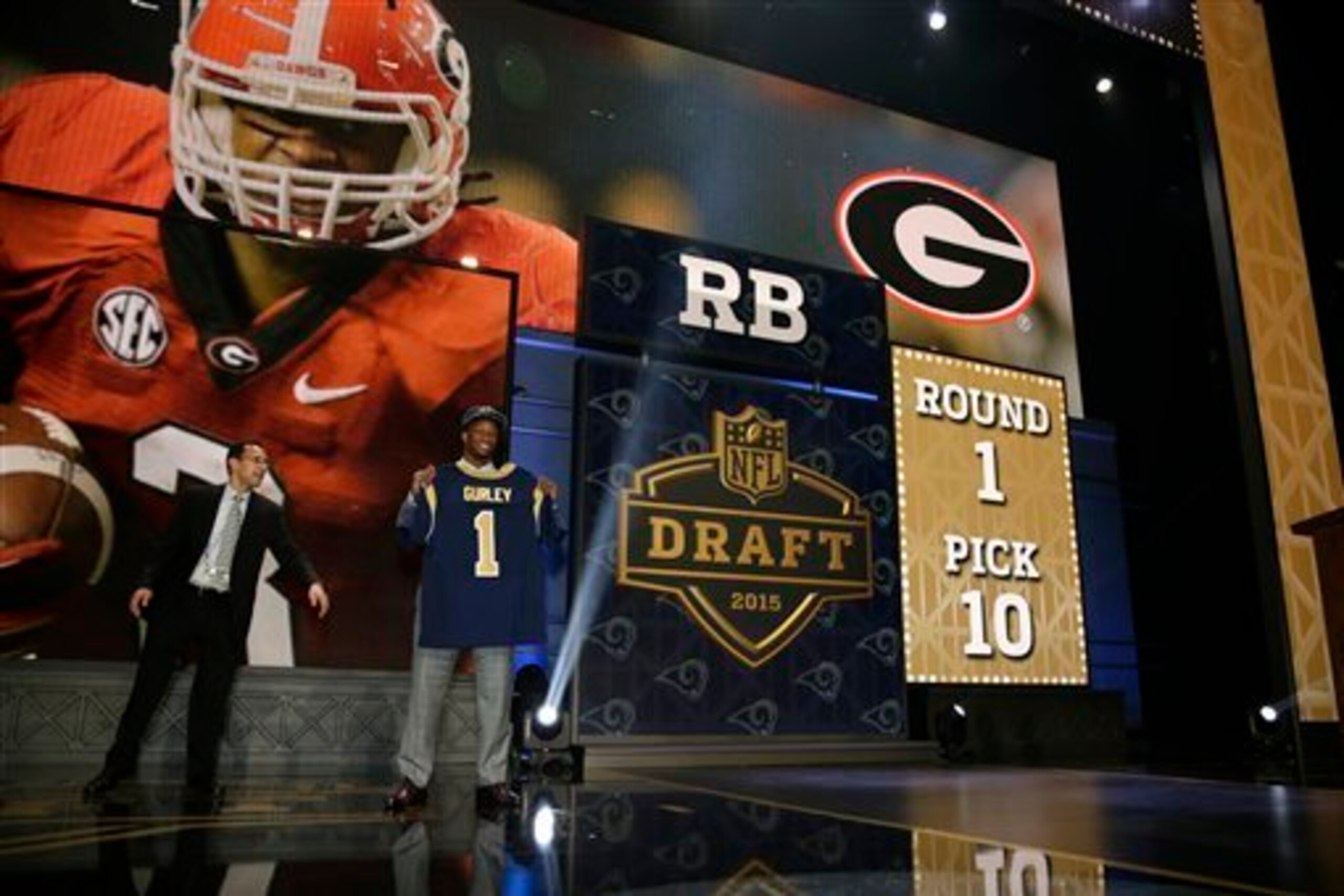
2: Yes, the streak is finally dead. Not one, but two running backs were taken in the first round of the draft. Former Georgia tank Todd Gurley and former Wisconsin stat monster Melvin Gordon each heard their names called in Round 1. Gurley went No. 10 to the Rams, while Gordon was taken by the Chargers at No. 15.
The last time a running back was taken in the first round was 2012, which is good news if you’re a running back—say, Ezekiel Elliott, for example—with your eyes on a big 2016 payday.
Given the incredible talent at running back at the collegiate level—and the special true-freshman class we had last year—running backs should continue to share first-round real estate.
54: Yes, the SEC once again led all conferences in players drafted, per Fox Sports' Bruce Feldman:
"SEC (54) led all conferences with most players drafted. 2. ACC with 47; 3. Pac-12 with 39. 4 Big Ten with 35. 5. Big 12 with 25.
— Bruce Feldman (@BruceFeldmanCFB) May 3, 2015"
The dominant conference watched 54 of its young men realize their NFL dream in 2015, extending an impressive—albeit unsurprising—streak.
This is very simple college football math: When you consistently attract the nation’s elite prospects, you’re going to consistently turn many of these prospects into elite players. Not all, but some. And the SEC, without any reasonable doubt, has out-recruited the rest of the nation by a wide margin.
Although it hasn’t translated to national championships the past two seasons—and there are teams outside of the conference keeping pace—the SEC’s NFL draft presence will likely carry on in the years to come.
Adam Kramer is a National College Football Lead Writer at Bleacher Report. All quotes obtained firsthand unless otherwise noted.

.jpg?w=2560 "Broncos Eagles Football")

.jpg?w=2560 "Rap: Lions, LaPorta End Contract Talks")
.jpg?w=2560 "Report: Baker May Miss Up to 6 Weeks")