Everything You Need to Know About the 2015 NCAA Basketball Championship Game
The 2014-15 NCAA men's basketball season all comes down to this.
It's Wisconsin vs. Duke.
It's the most lovable team of the season against the most hated team of the past several decades.
It's Frank Kaminsky and Jahlil Okafor waging war for a second time.
Best of all, it's a battle between two of the most efficient offenses in recent memory.
We've got a full breakdown of everything you need to know about the 2015 title game: how the two teams got here, the biggest storylines to watch, who their stars and underrated players are, each team's blueprint to victory and one final prediction sure to go wrong.
By the time you're done reading, you'll hopefully understand why the game was initially listed as a pick'em, according to Odds Shark.
Unless otherwise noted, all statistics are courtesy of KenPom.com and Sports-Reference.com.
Duke Blue Devils
1 of 8
Record: 34-4, No. 1 seed in South Region
Path to Indianapolis: 85-56 over No. 16 Robert Morris, 68-49 over No. 8 San Diego State, 63-57 over No. 5 Utah, 66-52 over No. 2 Gonzaga, 81-61 over No. 7 Michigan State
Biggest strength: Ranked No. 3 in the country in adjusted offensive efficiency
Achilles' heel: Allows opponents to score 61.1 percent of points on two-point field goals, the third-highest ratio in the country
How they got here
Save for a couple of hiccups back in January against Miami and North Carolina State, Duke has been dominant all season long.
The Blue Devils won their first 13 games of the season by double-digit margins—including a 10-point, neutral-court win over Final Four team Michigan State and a 10-point, true road win over Wisconsin. They have been equally overpowering in the tournament, beating their five opponents by an average margin of 17.6 points per game.
Justise Winslow didn't have a massive offensive output against Robert Morris, but he has averaged 17.3 points, 9.0 rebounds and 2.0 steals since the round of 32. Jahlil Okafor was a bit invisible in the two games in Houston, but he had 18 points against Michigan State in the Final Four and played a large part in getting the entire Spartans roster into foul trouble.
The guards haven't been too shabby either, with Quinn Cook scoring in double figures in all five tournament games and Tyus Jones tallying 26 assists against just seven turnovers.
However, the really impressive thing about the Devils in March has been their defense.
From Jan. 1 through Feb. 18, Duke allowed 12 of 14 opponents to score at least 62 points. The Blue Devils allowed 70.5 points per game during that stretch. But in the Big Dance, they have held all five opponents to less than 62 points, allowing an average of 55.0 points.
That defense seemed to go flying out the window when Michigan State scored 14 points in the first four minutes on Saturday night, but the Blue Devils dug their heels in and held the Spartans to 47 points over the final 36 minutes.
As Dana O'Neil wrote for ESPN after the game, "Mixing up just a little zone with man-to-man, the Blue Devils jumped out on the Spartans' shooters, clogging the lane inside, forcing 14 turnovers and limiting a team that loves to shoot threes to just 7-of-20 shooting from beyond the arc."
Since adding that zone defense to their arsenal before the game against Louisville in January, the Blue Devils are 20-0 against teams not named Notre Dame.
They didn't win the ACC regular-season title. They didn't win the ACC conference tournament title. But Duke is one win away from Mike Krzyzewski's fifth national championship.
Wisconsin Badgers
2 of 8
Record: 36-3, No. 1 seed in West Region
Path to Indianapolis: 86-72 over No. 16 Coastal Carolina, 72-65 over No. 8 Oregon, 79-72 over No. 4 North Carolina, 85-78 over No. 2 Arizona, 71-64 over No. 1 Kentucky
Biggest strength: Ranked No. 1 in the country in adjusted offensive efficiency
Achilles' heel: Ranked No. 309 in three-point defense at 37.6 percent
How they got here
Wisconsin's adjusted offensive efficiency (AOE) was already off the charts before scoring 71 points in a 58-possession game against Kentucky—one of the most efficient defenses of the past decade. Now sitting at 128.5, the Badgers' AOE looks like a typo compared to the old record of 124.1 (set by Michigan in 2013-14).
In case you aren't well-versed in tempo-free statistics in college basketball, just know that an AOE of 120.0 is pretty incredible. Over the previous 13 seasons, only 20 teams had reached that mark.
If it helps to compare to a more familiar statistic, a 120.0 AOE is basically the equivalent of a .340 batting average in baseball. Over the past 13 seasons, only 27 players have reached that mark, and the best average during that stretch was .372.
Given those relationships and the ratios between them, Wisconsin is effectively batting .407—which hasn't been done in major league baseball since 1924.
Are you beginning to appreciate how absurd this offense has been?
The irony of the Badgers' incredible season is that they have had one of their worst defensive years. They will enter the title game ranked 55th in adjusted defensive efficiency with a rating of 96.4. Both in terms of national standing and numerical rating, that ranks 12th out of the last 14 years for Wisconsin, a team that is typically renowned for its stingy defense.
Long story short, this hasn't been your typical Wisconsin team. But the Badgers have done such a phenomenal job on offense that their slight drop in defense wouldn't even be noticeable if they weren't getting so darn unlucky with three-point shots.
With Kentucky's 3-of-5 three-point shooting on Saturday night, the Badgers will carry a 50.9 defensive three-point percentage in the tournament into their war against Duke—a program that has basically lived at the three-point line since its inception.
If anything, though, that just further illustrates how ridiculously efficient Wisconsin has been on offense. Tournament opponents are making better than one out of every two three-point attempts, and the Badgers have yet to win by less than seven points.
Biggest Storylines
3 of 8
Who will win the Wooden Award?
The big reveal won't come for another few days (April 10, to be exact), but it is exceedingly likely that the winner and first runner-up for the Wooden Award—given to the nation's most outstanding basketball player—will be squaring off for the title.
This is quite the far cry from last season, when both Doug McDermott and Jabari Parker were eliminated before the Sweet 16.
And the best part is that they'll be going mano a mano. Frank Kaminsky vs. Jahlil Okafor. College basketball's version of Dirk Nowitzki vs. college basketball's version of Shaquille O'Neal—right down to the poor free-throw shooting.
Okafor dealt with some foul trouble in the pair's December meeting, so we didn't get a proper battle the first time around. Hopefully, the refs aren't too quick with the whistle on Monday night because those fans and NBA scouts didn't come to see Marshall Plumlee against Vitto Brown.
The voting for the Wooden Award is already finished, though. It ended on March 23. So we could be headed for an awkward situation where Okafor absolutely owns Kaminsky to win the national championship only for Frank the Tank to win the individual award—or vice versa.
Either way, try to keep in mind that we'll be watching the two best players in the country. Throw in Justise Winslow and Sam Dekker for arguably the four best players of the tournament. It probably would have been more fun to get Duke vs. Kentucky—both for their tournament history and for the quest for perfection—but Duke vs. Wisconsin is about the best consolation prize we could possibly ask for.
Two of the three most consistently great programs of the 2000s
Kansas takes the cake and eats it too. The Jayhawks have won 11 consecutive Big 12 titles. You don't need any advanced metrics to know how consistently incredible they have been.
But a major honorable mention goes to Bo Ryan and Mike Krzyzewski for the job they have done keeping their programs at the top of the totem pole for so many consecutive years.
Wisconsin has finished eight of the last nine seasons and 10 of the last 13 seasons ranked in the top 13 of KenPom's Pythagorean formula—which, in a nutshell, is the combination of how efficient a team is on both offense and defense. Duke, meanwhile, has been ranked in the top 13 in 13 of the last 14 seasons, including seven seasons in the top four.
We expect this from Duke and Krzyzewski. The man has more than 1,000 career wins and has been pretty consistently a No. 1 or No. 2 seed for the past several decades.
But this comparison really emphasizes the fact that Ryan was hardly the weak link in the unbelievable collection of great coaches we had in the Final Four. Ryan doesn't have anything close to the number of D-I wins that Krzyzewski has, but he also didn't became a D-I head coach until 24 years after Coach K.
Since taking over at Wisconsin 14 years ago, Ryan has led his teams to 14 NCAA tournament appearances, four Big Ten regular-season titles and a pair of Final Fours, winning 74.2 percent of games coached with the Badgers.
Take Kansas out of the equation, and you would have a hard time finding any programs that have been as consistently strong as Duke and Wisconsin.
Freshmen vs. Upperclassmen
We've already addressed the battle between the Wayman Tisdale Freshman of the Year and the presumed Wooden Award-winning senior, but this entire game is fraught with youth against experience.
In the red corner, we have a seven-man rotation (including Duje Dukan and Traevon Jackson off the bench) consisting of four seniors, a junior and two sophomores. It's highly unlikely that a freshman will see the court for the Badgers unless this turns into a blowout, and Ryan just decides to let Riley Dearring and Aaron Moesch experience the moment.
But in the blue corner, half of Duke's eight-man rotation is made up of freshmen, and Quinn Cook is the only senior in the bunch.
The funny thing is that Cook will likely be guarding Bronson Koenig—the second-youngest player in Wisconsin's rotation. Thus, we'll see individual battles all over the court of wily veterans against young bucks.
Big Ten—ACC Challenge
For those of you who only watch college basketball in March and April, there has been an early-season battle raging between the Big Ten and the ACC for the past 16 years. It started out as nine games between the two conferences but has expanded along with the conferences to include 14 showdowns this past season.
Similar to the format of the Ryder Cup in golf, whichever side wins the most head-to-head battles wins the challenge.
From 1999-2008, the ACC won 10 years in a row, but the Big Ten has won four of the last six (the other two were ties).
But where the ACC has really dominated the challenge is in NCAA tournament titles. Over the past 24 years, the ACC has won eight national championships (four by Duke, three by North Carolina and one by Maryland before the Terrapins defected to the Big Ten). The Big Ten, however, has just one national championship during that stretch (Michigan State in 2000).
Furthering the ACC's claim to dominance, five of those ACC titles were won in games against Big Ten teams. If Duke beats Wisconsin on Monday night, the Big Ten could go 14-0 in the Challenge next season, and the ACC would still have bragging rights as the best conference in the country. If Wisconsin wins, though, the Big Ten would take a giant step toward being on the same playing field with the ACC.
Stars to Watch
4 of 8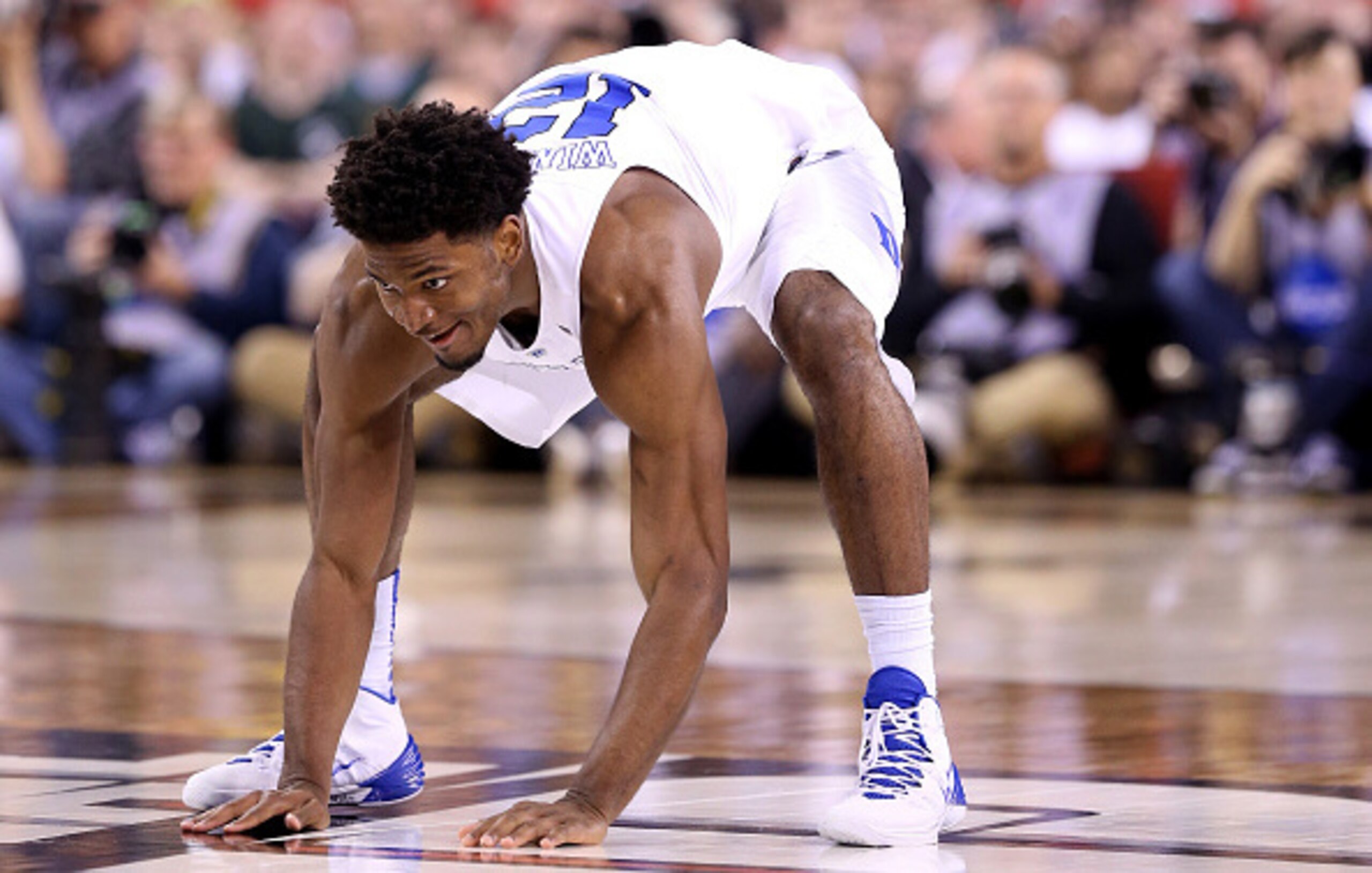
Justise Winslow, Duke
Tournament stats: 15.0 PPG, 9.4 RPG, 3.0 APG, 1.6 SPG, 1.4 BPG
Jahlil Okafor was Duke's Wooden Award candidate during the regular season, but there's little doubt that Winslow will be named the tournament's Most Outstanding Player if the Blue Devils are the ones cutting down the nets on Monday night.
He has been a one-man box score for the Blue Devils, doing just as much defensively as he has on offense. In the win over San Diego State, he had a ridiculous 13 points, 12 rebounds, five assists, four steals and three blocks.
The 6'6" stretch 4 figures to be at a pretty significant height disadvantage against 6'9" Sam Dekker on Monday night, but he just might be able to turn it into an advantage by being quicker and more versatile than whichever big man he gets matched up against.
Frank Kaminsky, Wisconsin
Tournament stats: 22.2 PPG, 8.8 RPG, 2.2 APG
He won't even come close to reaching Glen Rice's record of 184 points in a single tournament, but that shouldn't keep us from fawning over what Kaminsky has done in scoring 111 points thus far.
The versatile big man has been unstoppable. He has scored at least 16 points in 14 of his last 15 games and has scored at least 12 points in 27 straight games dating back to late December.
There's not much that can be done to slow him down, and there is extremely little hope that the referees will help in that quest. The Elite Eight game against Arizona was the only time this season that Kaminsky was whistled for more than three fouls, and he was still able to play 38 minutes while racking up four of them.
Jahlil Okafor, Duke
Tournament stats: 16.0 PPG, 6.2 RPG, 2.0 BPG, 1.0 SPG
Okafor hasn't been Duke's best player over the past several rounds but only because opponents have been so focused on making sure that he isn't the one who beats them.
Don't let the decreased scoring fool you, though. Okafor has only averaged 11.0 points per game since the start of the Sweet 16, but Duke has remained extremely efficient on offense because the laser-like focus on the big man has opened doors for everyone else.
If the Blue Devils are to win it all, they'll need to ride Okafor hard in the title game. Duke guard Matt Jones certainly sees it that way.
"We needed Jah to have a performance like this, and obviously he responded," Jones said after the Michigan State victory on Saturday, via Fox Sports' Stewart Mandel. "When he has a performance like this, as a team we gel better. Hopefully he can do it again Monday.”
Sam Dekker, Wisconsin
Tournament stats: 20.6 PPG, 5.0 RPG, 1.0 APG
Every year, there seems to be one junior or senior who finally has it all click in the NCAA tournament. Last year, it was Connecticut's DeAndre Daniels. In 2013, Louisville's Luke Hancock exploded out of nowhere to earn Most Outstanding Player. Even youth-loaded Kentucky got some huge games out of senior Darius Miller in 2012.
This year, that guy has been Dekker.
Dekker has always been pretty good, but he flipped a switch at the start of the tournament and became a stone-cold assassin. Shades of Aaron Harrison from a season ago, Dekker was shooting 30.4 percent from three-point range before the tournament but has hit 15-of-30 triples (50.0 percent) over his last five games.
It's not just that he's making shots either. It's how confident he looks doing it. Get ready for Dekker and Quinn Cook to have a "dagger swagger" competition after each made three-pointer.
Tyus Jones, Duke
Tournament stats: 11.0 PPG, 5.2 APG, 2.0 SPG, 1.4 TOPG
Jones hasn't yet had one of the "he might be the best freshman on the team" type of games he had earlier this year against Michigan State, Wisconsin and Connecticut, but he has been exceptionally solid in the tourney for a freshman point guard playing 36.6 minutes per game. He has picked his spots well and absolutely dominated Gonzaga's Kevin Pangos in the Elite Eight.
Perhaps most noteworthy of all is that Jones has averaged 3.7 assists per turnover and has more steals than he does turnovers. Duke has done a fine job of avoiding turnovers throughout the season but particularly so in the tournament, thanks to the play of Jones.
Nigel Hayes, Wisconsin
Tournament stats: 12.2 PPG, 5.4 RPG, 2.2 APG
Raise your hand if you knew before the season began that Hayes would make 37 three-pointers while shooting 38.1 percent in the process.
Liars.
Hayes has been the biggest difference from last season. The 2014 Big Ten Sixth Man of the Year who didn't attempt a three-pointer as a freshman has evolved into a 6'8" long-range assassin. He drained two triples against Arizona and another pair of them against Kentucky on Saturday night.
In this particular game, he figures to be a matchup nightmare. Dekker was still dealing with that injured ankle the first time Wisconsin faced Duke, and Hayes committed four fouls in just 23 minutes of ineffective action. But what can the Blue Devils possibly do to slow down all three of Wisconsin's big men?
Even if Okafor is on Kaminsky and Winslow is on Dekker, that leaves 6'5" Matt Jones to guard Hayes. He can either back Jones into the post at will or shoot right over him on the perimeter. Let's just say it wouldn't be the first time Hayes scored 20 points in a game this season.
Underrated Players to Watch
5 of 8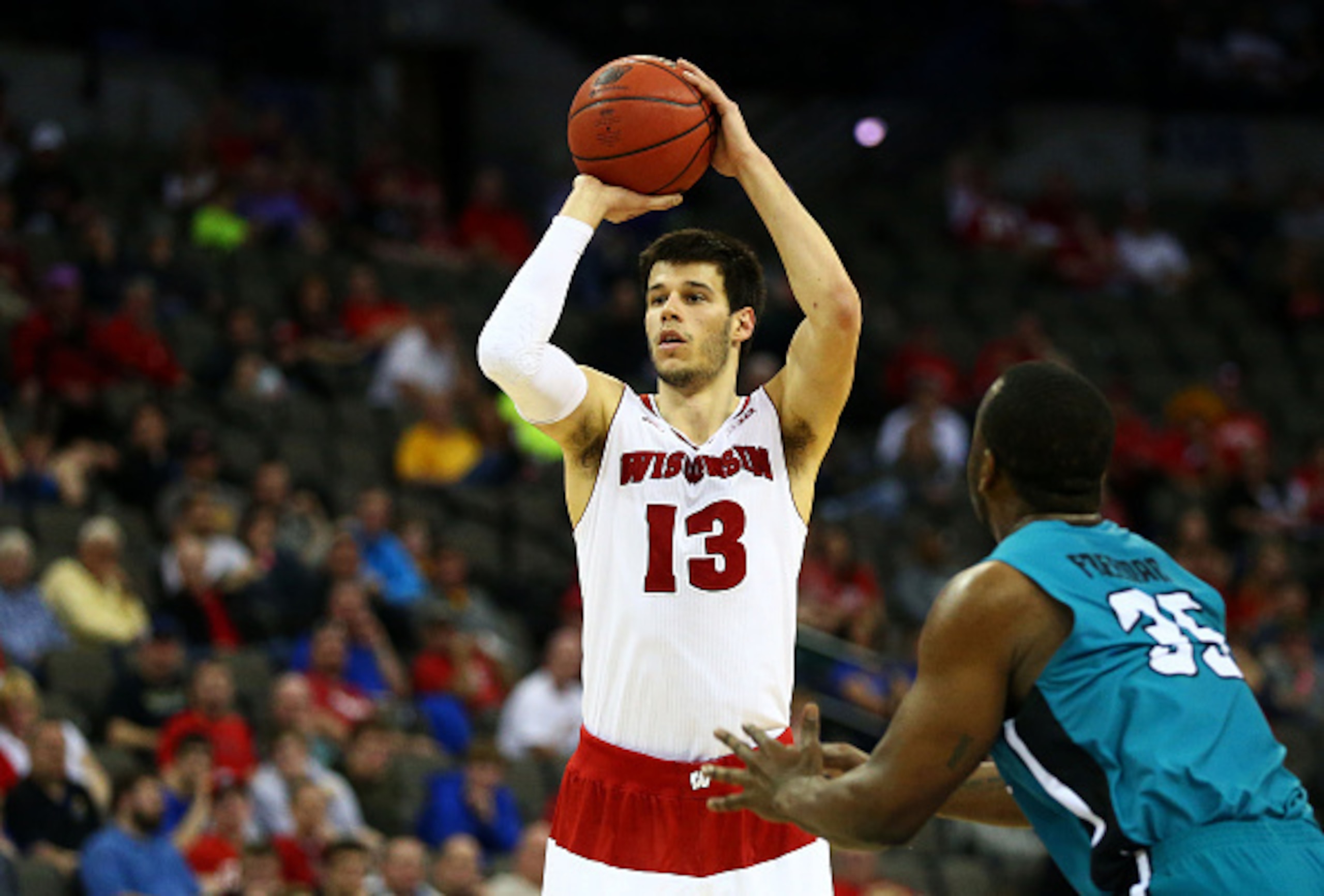
Traevon Jackson, Wisconsin
Tournament stats: 28 minutes, 10 points, three rebounds, three assists
Maybe "underrated" isn't the proper adjective for the senior point guard who was expected to be the linchpin of Wisconsin's success this season, but Jackson is just now starting to get back into the swing of things after missing 19 games with a broken foot.
Prior to that injury, he was Wisconsin's entire offense in the first game against Duke, as he led all scorers with 25 points.
We certainly aren't expecting that much of an impact on Monday night, but you might be crazy if you think he fought back through injury just to lay a complete egg in the national championship game.
Amile Jefferson, Duke
Tournament stats: 89 minutes, 15 points, 21 rebounds, three assists
Not that long ago, Jefferson was Duke's starting power forward and a crucial contributor. In seven November games, he averaged 9.3 points and 8.9 rebounds. He had double-doubles against Furman, Connecticut and Miami and was widely regarded as an underrated player in a key role for Duke's championship hopes.
And just like that, he disappeared. Quite the contrast to the first seven games of the season, he averaged 2.1 points and 3.7 rebounds in Duke's final seven games before the tournament.
Yet, he has shown flashes of his old self throughout the tournament, helping out nicely on the glass in fairly limited minutes.
Chances are he'll play an important role against Wisconsin, even if it's merely eating up as many minutes as he can without becoming a liability.
Duje Dukan, Wisconsin
Tournament stats: 77 minutes, 16 points, 10 rebounds
Like Jefferson for Duke, Dukan's primary role in this game may be to do just enough to provide a respite for Wisconsin's big men without hurting the team.
It almost isn't fair, though, that Wisconsin—a team that starts three players 6'8" or taller with three-point range—has another three-point shooting big man on the bench. Dukan has connected on 28 three-pointers so far this season and hasn't been afraid to let it fly, averaging one three-point attempt for every 6.7 minutes on the court.
Also, it almost seems inevitable that he does something big in this game, because the "Dukan Downs Duke" headlines write themselves.
Grayson Allen, Duke
Tournament stats: 50 minutes, 18 points, six rebounds, zero assists, zero steals, zero blocks
Since the season began, Allen has been the ultimate X-factor for Duke. There's no telling whether he'll score 10 points in 15 minutes of action or barely get off the bench. Case in point, he played three scoreless minutes against Gonzaga before scoring nine points in 17 minutes in the Final Four.
For the most part, he only really gets involved in blowouts. Of the nine games in which Allen played at least 12 minutes this season, the closest margin of victory was Saturday night's 20-point win over the Spartans.
But that doesn't mean he couldn't play a huge role in a close title game. Should Quinn Cook, Tyus Jones or Matt Jones get into some foul trouble, Allen is really the only guard the Blue Devils can go to off the bench. He's going to be a massive piece of Duke's puzzle next season, and he could get off to a nice start with a bucket or two on Monday night.
Duke's Blueprint to Beating Wisconsin
6 of 8
It won't be easy, but if Duke can do these four things, the Blue Devils will be the 2015 national champions.
1. Embrace the Small Lineup
It might be tempting to give extra minutes to guys like Amile Jefferson and Marshall Plumlee to combat Wisconsin's height, but as Notre Dame proved against Kentucky, being bigger isn't always better.
The Fighting Irish stuck with their conventional four-guard lineup against the massive Wildcats, and it ended up working to their advantage as they ran circles around Kentucky's big men in nearly pulling off the upset.
Sure, it's going to be difficult for 6'5" Matt Jones to defend 6'8" Nigel Hayes. 6'6" Justise Winslow will be giving up a few inches against 6'9" Sam Dekker. But what can Hayes do to keep up with Jones? And does anyone really think Dekker's defensive footwork is good enough to keep Winslow from blowing right past him?
There's a fine line between in-game adjustments and wholesale changes. Look for the Blue Devils to stick with what got them here.
2. Rain Threes
As previously mentioned, Wisconsin's opponents have shot 50.9 percent from three-point range in the tournament.
Duke is shooting 39.7 percent from downtown in five tournament games. The Blue Devils shot 7-of-12 in the first game against the Badgers and have made at least nine triples in 12 games this season.
It's not rocket science. Duke is a great three-point shooting team facing a poor three-point shooting defense. Don't expect 40 three-point attempts, but it would be a mistake if the Blue Devils didn't take at least 20.
3. Play a Fair Amount of Zone Defense
This might seem counterproductive since Wisconsin has been red hot from three-point range. Dating back to March 5, the Badgers are shooting 41.6 percent from downtown and have sunk at least seven triples in 10 straight games.
However, Duke—and particularly Okafor—desperately needs to stay out of early foul trouble. Zone defense is the best way to accomplish that goal, and it also helps the Blue Devils avoid situations where Hayes and Dekker are effortlessly scoring over smaller men.
In years past, "Mike Krzyzewski" and "zone defense" went together like cats and water. But the ugly losses to Miami and NC State in January in advance of a must-win game against poor-shooting Louisville forced Coach K's hand to embrace the defensive strategy that Jim Boeheim has been employing for decades.
Duke won't exclusively play zone defense, but the ability and willingness to mix and match with man-to-man might keep the Badgers from getting into an offensive rhythm. At any rate, it's worth a shot. No one else has figured out how to keep them from scoring at will.
4. Okafor. Okafor. Okafor.
Wisconsin had no answer for Karl-Anthony Towns. Kentucky's big man shot 7-of-11 from the field, finishing the night with 16 points and nine rebounds.
But when the going got tough, the Wildcats' guards tried too hard to get themselves going. Towns didn't have a field-goal attempt in the final 6:30, during which time Kentucky was outscored 15-4.
Whether Towns or Okafor is actually the best NBA prospect, there's no arguing that they were the two most dominant post players in the country this year. Okafor's offensive game is even more polished than Towns', so if Wisconsin couldn't contain Towns, how can the Badgers hope to stop Okafor?
When the Blue Devils aren't raining threes, they should be feeding Okafor as much as possible.
Wisconsin's Blueprint to Beating Duke
7 of 8
It won't be easy, but if Wisconsin can do these four things, the Badgers will be the 2015 national champions.
1. Avoid Turnovers
Wisconsin has been doing this better than any other team in the country, but it is especially imperative to limit Duke's transition opportunities.
Prior to Saturday night, the Badgers had gone 27 straight games without committing 10 or more turnovers. They averaged just 6.6 per game during that stretch.
Bronson Koenig has committed just five turnovers in the entire tournament.
2. Put the Frontcourt Front and Center
Duke has allowed 55.0 points per game in the tournament.
Wisconsin's Frank Kaminsky, Sam Dekker and Nigel Hayes have combined to average 55.0 points per tournament game.
Something has to give, and the Badgers would be wise to do whatever it takes to keep their forwards scoring like crazy. Whether it's in the post or on the perimeter, they need to feed the big men repeatedly.
If they can get Jahlil Okafor in foul trouble in the process, even better.
3. Protect the Defensive Glass
By far the biggest key to Wisconsin's win over Kentucky was its ability to keep the Wildcats from getting second chances.
The Badgers grabbed 78.6 percent of possible defensive rebounds against what had been one of the best offensive rebounding teams in the country. They were also extremely effective on the glass in the Elite Eight, corralling 85.0 percent of Arizona's misses.
Duke has only averaged 7.6 offensive rebounds per tournament game, so recent history would suggest Wisconsin should win this battle without too much of a problem. However, it will still need to be a huge focus if Duke is launching a ton of three-pointers.
4. Get Open Looks for Josh Gasser
The senior shooting guard very rarely shoots, but he has been lethal in his limited chances. Since the start of March, Gasser has made 13-of-27 (48.1 percent) from three-point range.
He's primarily a defensive specialist, but he has made at least one triple in 13 of his last 14 games.
It will be particularly interesting to see what Duke does to Gasser on defense. Quinn Cook is Duke's best perimeter defender, but the Blue Devils probably won't waste their ace on a guy who hasn't attempted at least seven shots in a game since early February.
Whoever is guarding him better not fall asleep. He only needs a little bit of space to provide the Badgers with a big momentum shift.
Prediction
8 of 8
The Badgers didn't come this far just to rest on their laurels.
From the moment that their 2014 tournament run came to a brutal end, everything has been about getting back to the Final Four and winning it all. Big Ten titles are great, but they'll feel empty without a national title.
And they'll get the job done.
This offense is just too doggone good, big, versatile and fun to fall to a bunch of young Blue Devils.
Yes, I'm well aware that Duke beat Wisconsin by a 10-point margin back in December. But that wasn't the same Badgers team. Sam Dekker and Nigel Hayes combined for nine points while the former dealt with an ankle injury and the latter dealt with foul trouble.
In their last 30 games, they have averaged 27.6 points per game. In only three of those games did they fail to score at least 22 combined points.
Duke's defense has improved substantially in the tournament, but there's about a 0.01 percent chance that the Blue Devils hold those stud forwards to less than 10 points again.
The Prediction: Frank Kaminsky and Jahlil Okafor each score at least 23 points, but Kaminsky's supporting cast has the slightly better game. Traevon Jackson hits a couple of clutch buckets off the bench as the Badgers win a game that makes us temporarily forget all our complaints about the low-scoring nature of the current state of college hoops.
Wisconsin: 78
Duke: 74
Kerry Miller covers college basketball for Bleacher Report. You can follow him on Twitter @kerrancejames.
.jpg?w=2560 "Rams Seahawks Football")