

Do the 2015 Cubs Have the Pitching Needed to Make Good on the Hype?
Let's do something other than talk about the Chicago Cubs offense.
We've talked enough about that, though not without good reason. The Cubs offense looms large in discussions about why they're destined to contend in 2015, as surely any lineup with Kris Bryant, Anthony Rizzo, Jorge Soler, Starlin Castro, Miguel Montero and Dexter Fowler is going to mash.
So instead, let's talk about the Cubs' pitching.
TOP NEWS
Report: Reds Give SP Historic Contract
Buy or Sell for All 30 Teams 🤔
Buzz: Skubal Asking Price 'Outrageous'
We were doing that a lot around when they dropped $175 million on Jon Lester and Jason Hammel in December, but not as much since. In general, the attitude about Chicago's pitching has been along the lines of, "Oh, don't worry. It'll be good enough."
But now's a good time to ask: Will it really?
| Atlanta Braves | 5.18 |
| Chicago Cubs | 5.20 |
| Chicago White Sox | 5.39 |
| San Francisco Giants | 5.48 |
| Texas Rangers | 5.76 |
Cubs hitters have been doing just fine this spring, carrying a collective .736 OPS into Thursday's action that ranks fifth in the National League. But only the San Francisco Giants have done worse than the Cubs' 5.20 ERA among NL clubs.
And no, the Cubs can't blame it entirely on no-name scrubs.
Chicago's projected rotation of Lester, Jake Arrieta, Hammel, Kyle Hendricks and Travis Wood has combined for a 4.18 ERA. Meanwhile, two members of Chicago's projected late-inning trio of Hector Rondon, Pedro Strop and Neil Ramirez have been hit around a bit. Entering Wednesday's action, hitters were hitting better than .300 against Rendon and Ramirez.
The Cubs weren't so good at pitching baseballs in 2014, finishing 13th in the NL in ERA. From what's happening this spring, you can't help but wonder if maybe their pitching won't be much better. You can't keep an all-caps "DOOMED" from crossing your mind.
Unless, of course, you're a sensible person.
In times like these, turning to the projections can either result in salt in the wound or a calming, mom-made cup of hot cocoa. Fortunately for the Cubs, projections for their pitching fall more under the latter umbrella.
Take what's at FanGraphs, for example. Their projections have Chicago's pitching staff producing more Wins Above Replacement than all but four other teams. They thus could not disagree more with what's happening this spring, which should calm anyone who's freaking out.
If not, perhaps a discussion about which spring stats really matter will.
We turn to ERA because it's an easy-to-understand stat, and for the most part, it does the job just fine. But not in spring training, however. When Mike Podhorzer crunched the numbers at RotoGraphs in 2012, he found that spring ERAs are "completely useless" at predicting the coming future.
What's more useful are spring strikeout and walk rates. To that end, what's good news is that Chicago's projected rotation is doing quite well in those departments this spring.
Here, take a look:
| Travis Wood | 19.1 | 13 | 3 |
| Jason Hammel | 14.0 | 15 | 3 |
| Jake Arrieta | 10.0 | 10 | 5 |
| Jon Lester | 8.1 | 9 | 1 |
| Kyle Hendricks | 7.0 | 4 | 0 |
| Total | 58.2 | 51 | 12 |
What stands out is how the Cubs' projected front three of Lester, Arrieta and Hammel have all struck out at least a batter per inning. And overall, their projected starters own 7.9 strikeouts per nine innings and 1.9 walks per nine innings. If that carries over, the Cubs will rank among the elites in both categories.

Really the only sore spot is Arrieta, whose 10-5 strikeout-to-walk ratio is more reminiscent of the pitcher he was before before he broke out in 2014. Look past his rocky spring debut, however, and he owns an 8-2 strikeout-to-walk ratio in his last eight innings.
So despite their unspectacular ERA, the Cubs' projected starters have actually spent this spring teasing that they could be an elite unit in 2015. And when we break them down individually, that's really not so hard to believe.
- Lester: He has an ERA in the mid-2.00s since the middle of 2013, and Grantland's Shane Ryan can vouch for how Lester's mastery of location and sequencing allowed him to easily overcome lesser velocity on his way to a 2.46 ERA in 2014.
- Arrieta: The 2.53 ERA he broke out with in 2014 might actually undersell how good he was, as Eno Sarris of FanGraphs can tell you about how refined mechanics and a shape-shifting slider helped Arrieta become arguably the most dominant pitcher this side of Clayton Kershaw.
- Hammel: Even if he can't repeat the 2.98 ERA he had in half a season with the Cubs in 2014, he'll be a solid No. 3 if his velocity stays in the 92-93 range and his slider continues what Brooks Baseball can highlight was a comeback last year.
- Hendricks: He doesn't have the power stuff to repeat last year's small-sample-size 2.46 ERA, but his excellent command and ability to get ground balls make him an ideal No. 4 starter.
- Wood: There's no rationalizing for the 5.03 ERA he had last year, but Wood is only a year removed from an All-Star 2013 campaign that featured a 3.11 ERA.
Also, bear in mind that the Cubs have some depth beyond these five.
Sure, Edwin Jackson is useless. But Tsuyoshi Wada pitched to a 3.25 ERA in 13 starts last year, and ESPN.com's Keith Law noted that Jacob Turner's velocity was back into the mid-90s this spring before his elbow started barking. Down the road, either he or Wada could step in and help.
As for Chicago's bullpen, let it first be said that it might be the best hidden strength in baseball.
Sahadev Sharma of Baseball Prospectus noted that the pedestrian numbers that Chicago's relievers posted in 2014 are misleading, as they mask how much the bullpen came together as the year went along. The numbers bear that out, as FanGraphs WAR ranked Chicago's bullpen as the third-best in baseball in the second half.
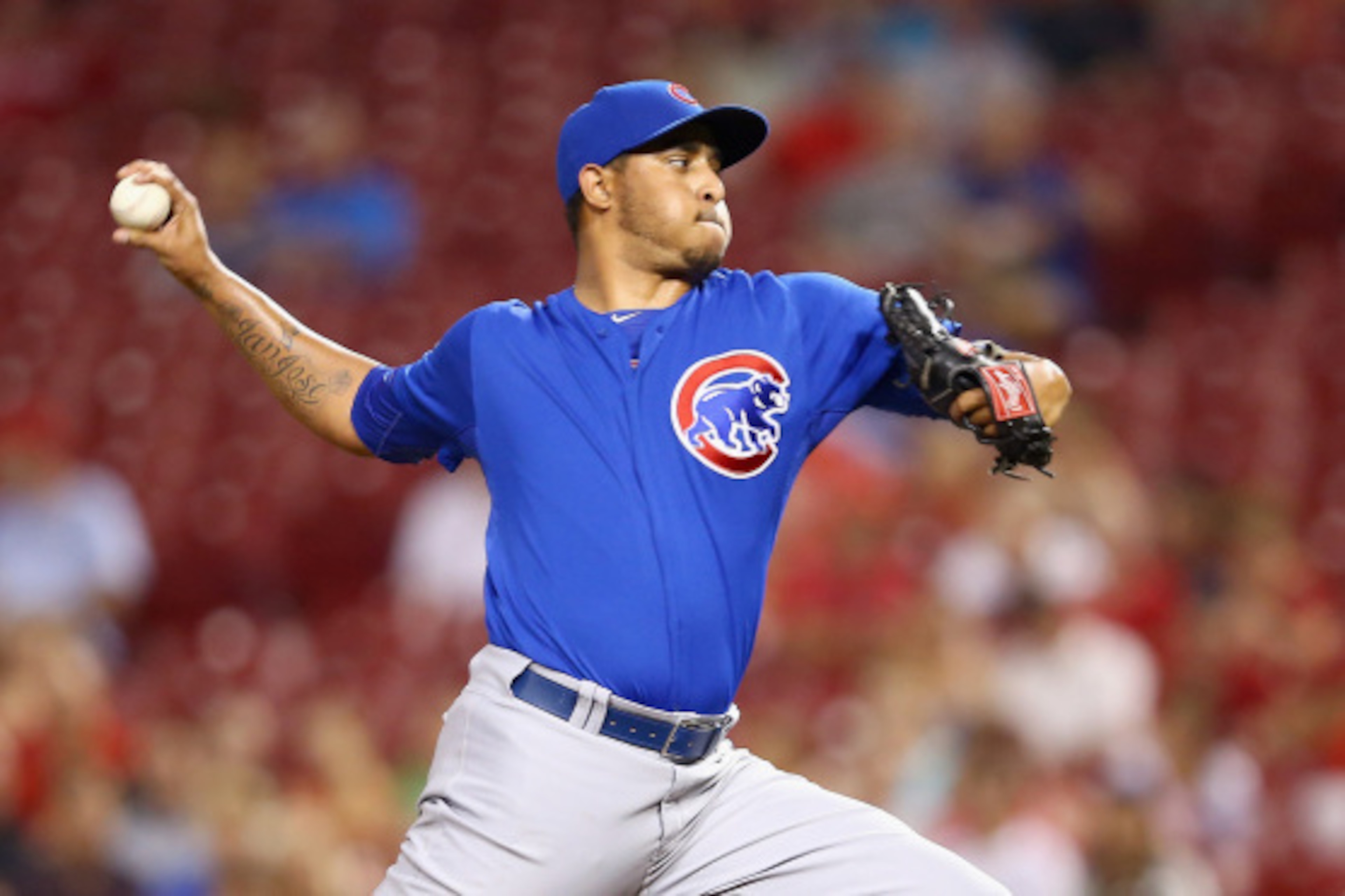
That had a lot to do with how overpowering Rondon and Strop were, as they combined for a 0.93 ERA and a 60-10 strikeout-to-walk ratio in 58.1 innings. And so far this spring, they've carried on with a 19-5 combined strikeout-to-walk ratio in 12 innings.
Throw in Ramirez, who had a 1.44 ERA in 2014, and you can see how Chicago's late-inning trio could keep it up in 2015. All three average in the mid-90s with their fastballs. And as Baseball Prospectus can show, each got whiffs on better than 40 percent of the swings against his slider.
And just like with Chicago's rotation, there's depth here too. Justin Grimm caught fire as a strikeout-to-walk merchant in the second half of 2014, and Blake Parker's quiet dominance was reminiscent of his strong 2013 season.
Lastly, there's an advantage that all Chicago pitchers will share in 2015: good catching.
The Cubs have switched out last year's catching duo of Welington Castillo and John Baker for a duo of Montero and David Ross. Cue some knowledge from Grantland's Rany Jazayerli:
"Various analyses of their pitch-framing abilities estimate that Montero was anywhere between 23 and 48 runs better than Castillo last season, while the difference between Ross and former backup John Baker was worth about eight to 10 runs. That means the Cubs have gained something like three to five wins for a skill that until recently was completely hidden from view.
"
Between the individual talents of the pitchers and the talents of the catchers they'll be throwing to, the question shifts to what could actually stop Cubs pitchers from putting up gaudy numbers in 2015?
Health, maybe. It's a question mark for all pitching staffs and may be a more pressing question mark with this Cubs staff.
The 31-year-old Lester may not be able to get rid of his tired arm. Arrieta may run out of gas trying to beat last year's career high of 156.2 innings. Hammel is a 32-year-old who has yet to cross the 180-inning plateau in his career. And so on.
However, we've already mentioned that the Cubs are actually well off in terms of depth. And where they also have depth is in their farm system and in their pockets.
If they find themselves needing to make a move for an established starter or a shutdown reliever or two, they'll be able to win pretty much any mid-summer bidding war. And with a guy like Cole Hamels very likely to be on the block, that bargaining power could end up being a season-saver.
What's going on this spring suggests that you should be worried about the Cubs pitching. Everything else, however, suggests otherwise. What they have has actually been pretty good this spring and figures to keep being good in the regular season.
So let's keep trotting out the company line about their pitching. Oh, don't worry. It'll be good enough.
Note: Spring stats courtesy of MLB.com and are current through Wednesday, March 25. All others courtesy of Baseball-Reference unless otherwise noted/linked.
If you want to talk baseball, hit me up on Twitter.
.png?w=3840 "Every City's 2000s Mt. Rushmore 🤩")
.jpg?w=3840 "Watch: Jerry Rice Chases After Heckler")

.jpg?w=3840 "Cowboys Removing Grass 🥲")