Proposing a New Revenue-Sharing System for Formula 1
Formula One's revenue-sharing model is broken. Cobbled together around a campfire fuelled by the burning remnants of FOTA, the system is a series of secretive agreements made between the teams and Bernie Ecclestone.
Some, those with more political power and clout, had a bit of negotiating room when coming to the table to make these deals. Others—those at the wrong end of the pit lane—had less choice in the matter.
What resulted from this process is the grossly lopsided and unequal method of sharing out the sport's considerable commercial revenues that we see today. The larger teams get extra cuts before a wheel has even been turned, while the minnows are left to feed on the scraps.
TOP NEWS
.jpg?w=2560 "Chargers Mack")
Every Trade's Best Trade Asset 🔁
Giannis' Warning to NBA ⚠️

Caitlin Clark to appear on College GameDay
The legal mess surrounding Sauber's contract with Giedo van der Garde has put this issue firmly back in the spotlight. Unsavoury as their behaviour was, the Swiss team did not break his contract for a laugh—they did it because they needed the income from Felipe Nasr and Marcus Ericsson to survive.
Even before the dramatic scenes in the Melbourne courthouse, Alan Baldwin of Reuters reported Sauber, Lotus and Force India had needed an advance payment of their revenue cuts to pay the bills before the start of the season.
And more recently, Christian Horner's call for greater engine equality inadvertently focused attention on equality in other areas of the sport.
Hopefully it will remain at the forefront of fans' minds in the coming months, because addressing the revenue-split inequality is key to the very survival of F1 as we know it.
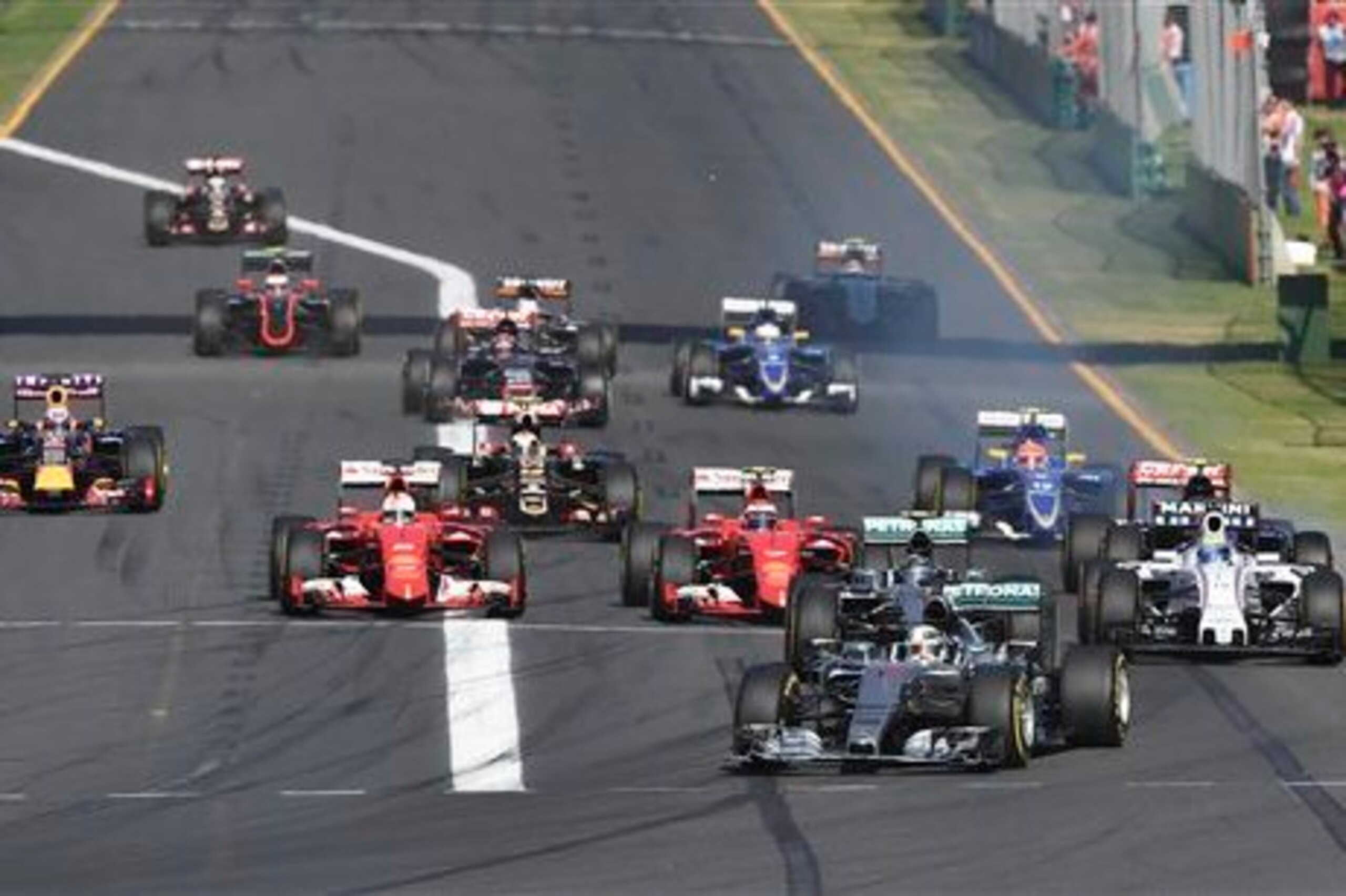
The precise details of the current revenue-sharing model are not entirely clear; it's impossible to acquire exact figures due to the secrecy surrounding the agreements. However, some journalists have found out enough to be able to piece together a very good idea of how it works.
Joe Saward is one of them—his graphical representation of the current model provides a telling and accurate picture of the sport's current situation.
BBC Sport's Andrew Benson's article does the same, to a less-detailed degree.
For the purpose of a clear explanation of how it currently works, we'll use Joe Saward's figures—which this writer believes are the most accurate available to the world at large—and work in U.S. dollars.
The overall pot of $1.8 billion is split into two equal parts, one for the teams and one for the commercial rights holder (CRH). A small amount—2.5 percent—is creamed off each side (a total of $90 million) and given to Ferrari due to their position as F1's longest-serving and arguably most influential team.

The 47.5 percent ($855 million) left over on the teams' side is divided into two halves. One half is split equally between the leading 10 (or currently, only 10) teams over the last three constructors' championships. The other half is split based on where the teams finished in the previous season alone.
On the other side of the split, around $200 million is taken from the CRH share and given to the leading teams. The most significant cut—the constructors' championship bonus (CCB)—is spread between the most successful teams in recent years.
It is believed that further payments are made to big teams which do not qualify for the CCB, ostensibly for their historic importance. The other teams—Lotus, Sauber, Force India, Manor Marussia and Toro Rosso—receive no extra funding.
In addition, token payments of $10 million each are given from the CRH side to the 11th and 12th teams (if they exist) based on where the final standings over the previous three seasons.
The CRH is left with a share of around $650 million. From this, it pays the bills and keeps what is left as profit.

Whether intentional or not, the system has become a way of keeping the big teams at the front and the small teams at the back. Too much money is channeled to those who need it the least, and too little goes to those having to fight just to stay in business.
The ability of the larger teams to attract the best sponsors only serves to increase the gulf between the two groups.
The model also funnels huge sums out of the sport and into the pockets of those who own a stake in the holding company. Per the Financial Times, these include investment companies like CVC Capital Partners, Waddell and Read, Norway's sovereign wealth fund and Bernie Ecclestone himself.
The collapse of Caterham and near-demise of Marussia, coupled with the problems at Sauber, Lotus and Force India prove beyond any doubt that the system is badly broken.
"Bernie Ecclestone has offered revenue payments to Sauber, Force India and Lotus to help with cash-flow problems ahead of the 2015 season.
— Latest F1 News (@LatestNews_F1) March 3, 2015"
Unfortunately, those with the power to change it—the leading teams and the CRH—are content keeping their snouts in the trough. The interest of the sport comes a distant second to their own self-interest.
But suppose a magical fairy landed in the pit lane one day and cast a spell which made everyone want to work together to secure a healthy, competitive F1 with a strong and stable future.
What would a fairer, more reasonable and fully sustainable revenue-sharing model look like?
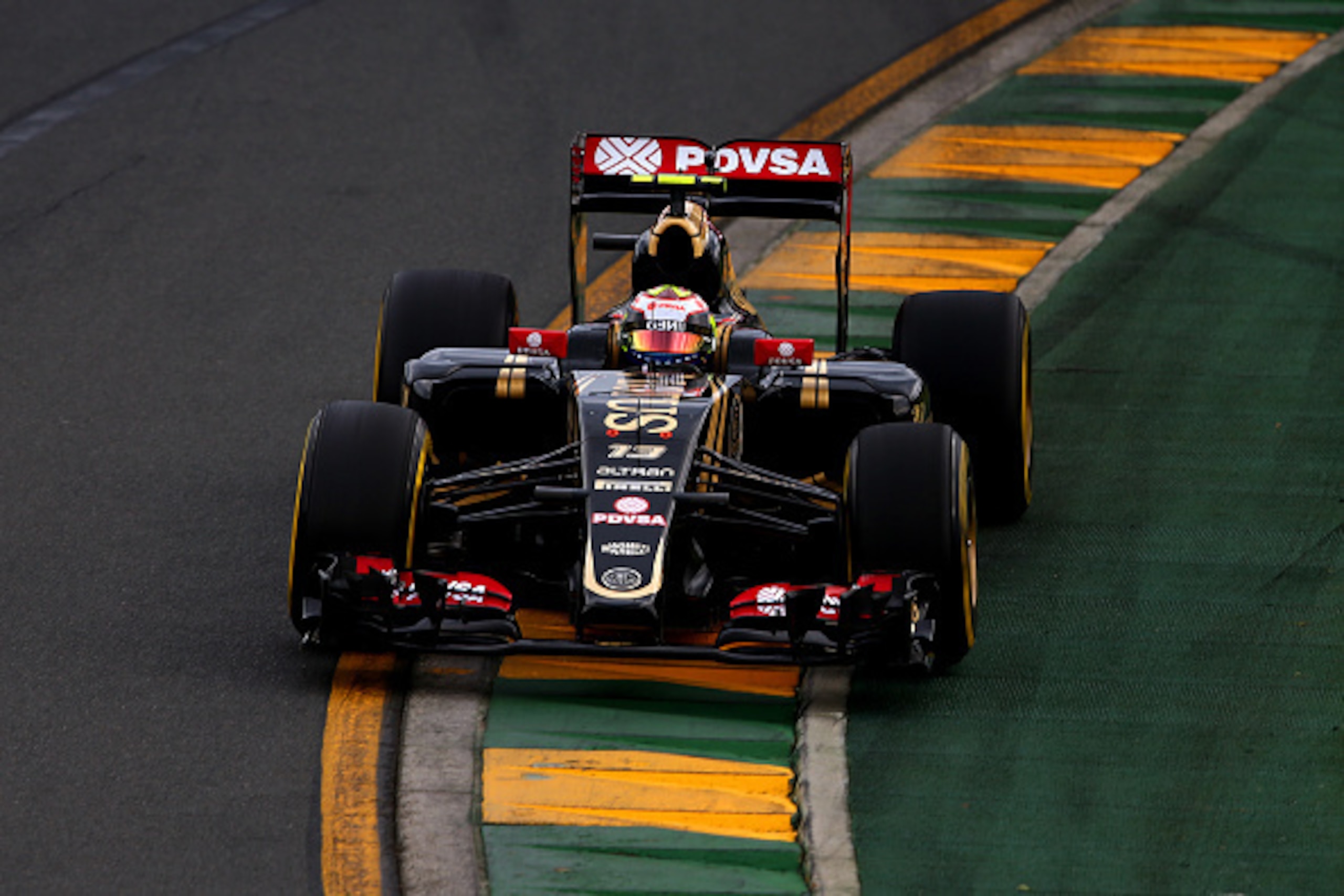
Starting with the figure of $1.8 billion, the first step would be to slash the share given to the commercial rights holder. The long-term future of the sport is more important than the short-term thickness of an investor's wallet.
The current share which reaches the teams, when all additional cuts and payments are made, is around 64 percent. Ecclestone and friends have to pay the bills and are due at least some profit. The pot should therefore be split 75-25, with the teams getting the larger share.
The CRH's 25 percent ($450 million) is theirs. They can take it and do with it what they wish.
What is left, $1.35 billion, is for the teams to share among themselves. In the current model, certain teams would receive extra cuts of this before the others even got a sniff; in this fairer model, that is no longer the case.
The "thanks for coming" five percent payment to Ferrari should go. They gain sufficient benefit from their history in the form of a massive fanbase, significant merchandise sales, brand exposure and ability to attract premium sponsors.
They shouldn't be gifted yet another bonus from F1's revenues.
The other payments which work to keep the big teams ahead and the smaller teams behind should also be removed. Like Ferrari's payment, the constructors' championship bonus and historical payments exist for political, not sporting, reasons and have no place in a fair revenue system.
Token payments to the least-successful teams are also thrown out, as they are no longer needed.
Untouched to this point, the £1.35 billion is split into two columns. This is similar to the manner in which this is done today, but with a slight modification to the percentages and qualifying criteria.

Seventy percent ($945 million) is split equally among the teams which have been present in the championship for at least one season. For the current grid, this is a simple division by 10, each team receiving $94.5 million.
In an ideal world, the entire revenue would be split that way. But even the purest purist of all must recognise that F1 and the world has moved on; trophies are no longer sufficient reward for a year of competition.
There must be some financial bonus for success and a reason to fight for minor placings.
Therefore, the remaining 30 percent ($405 million) is split between the teams based on their constructors' championship position from the previous season.
The team finishing in the middle of the championship table receives a basic share of this amount, reached by dividing the 30 percent figure by the number of teams competing. With the current 10 teams, this would be $405 million divided by 10, so they would receive $40.5 million.
With an even number of entrants, the two middle teams would receive this sum.
The top team would receive 150 percent of this amount, the bottom team 50 percent. Teams in between would receive sums befitting their position, with an equal gap between each. With 10 teams, the increment from one team to the next would be 12.5 percent of $40.5 million—or $5.0625 million.
This would leave us with a revenue split, based on the current 10 teams and where they finished in 2014, looking like this:
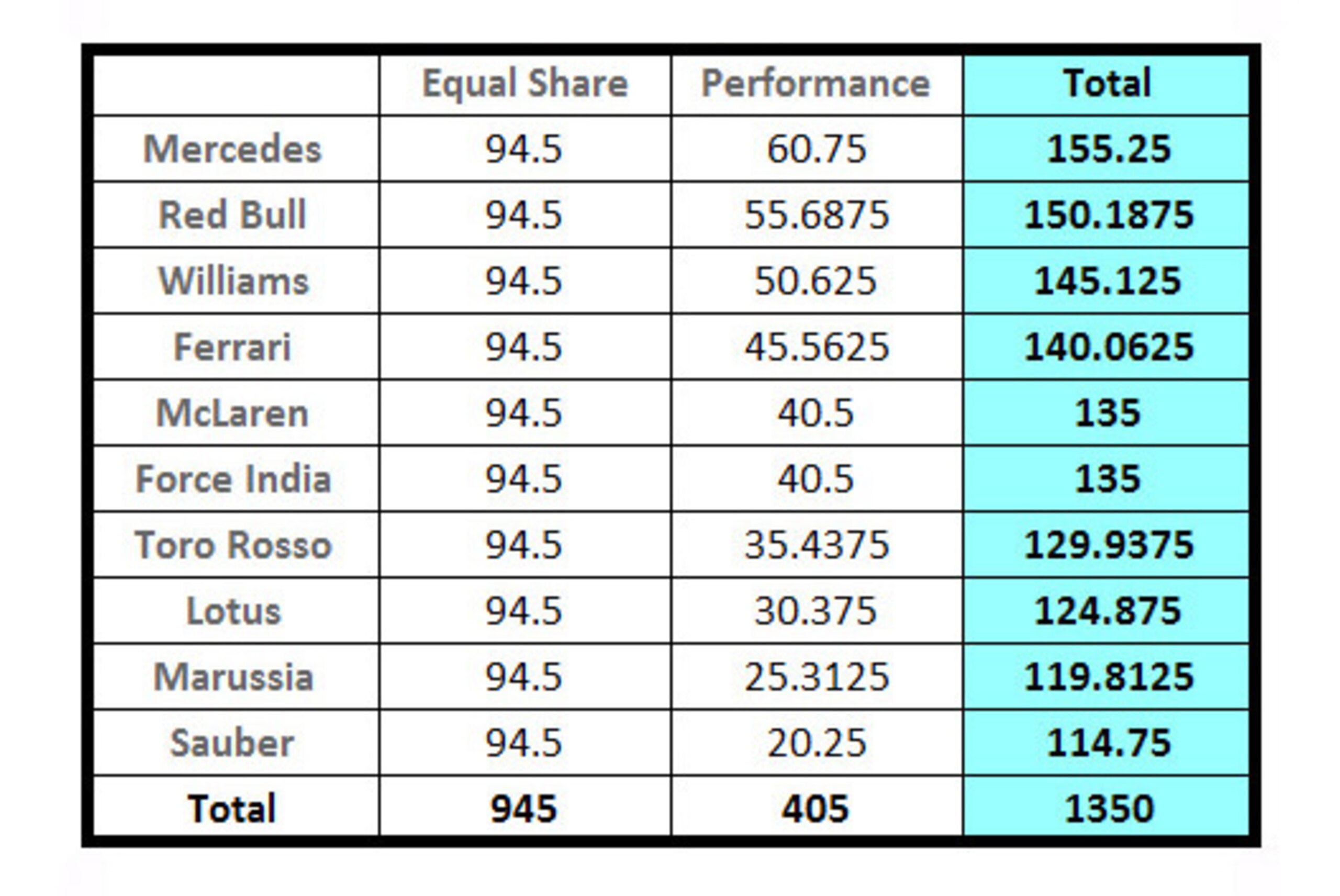
Champions Mercedes would receive $40.5 million more than last-placed Sauber—a significant sum, but not so great that it would give them an insurmountable advantage before a wheel had been turned the following year.
Under the current system, the gap in 2013 between the top team and the team in 10th was (per Saward's chart) $142.9 million.
Should more than 10 teams be present, all amounts would be reduced to include them in the equal and performance-related splits.
In October of 2014, Autosport revealed details of a letter sent by the smaller teams to FIA president Jean Todt. In it, it was claimed that an average midfield team needed to spend a minimum of $120.25 million to maintain their position. A backmarker spends less.
Under this new system (with 10 teams), even the lowest-paid team would receive $114.75 million. With 12 teams, the figure would drop no lower than $95.625 million.
That's more than close enough to the "minimum spend" to ensure every team could survive without racking up huge debts. After sponsorship income, many could even turn a profit.
More importantly, the removal of bonus payments to the big teams would give the smaller squads a chance to compete on a level playing field. No one would be paid vast sums just for turning up, and the financial gap between first and last would always be relatively small.
Should a big team wish to throw more money into developing their car, let them. Without the subsidies they currently receive, they'd need to dig into their own pockets and perhaps suffer financial losses if they went too far above their prize money plus sponsorship figure.
Per Ian Parkes in the Daily Mail, Jean Todt wants a form of budget cap—this would, to some degree, act as one.
The new system would also help to cut the number of pay-drivers making it to F1 primarily because of their financial backing. With fewer monetary pressures, smaller teams could select drivers based on ability, not sponsorship.
Ultimately, this system would be a fairer way of doing things than the current model. Everyone could compete, success would still be rewarded and the owners could still make a profit.
But is it realistic? Sadly not.

Magic isn't real and fairies don't appear to exist. For such a system to be put in place, the big teams would need to agree of their own accord to receive a smaller slice of the pie—as would the commercial rights holder.
If they value the future of the sport and a healthy, competitive environment they'd sign up for it. Sadly, a pig with its snout in the trough rarely thinks of the well-being of his herd; he'll seldom invite a friend to share his swill.
But unless something is done, F1 as we know and love it will cease to exist. There will be no plucky backmarkers, no little guys for the neutrals to cheer. Two-car teams will no longer be capable of filling the grid—third or customer cars will swell the ranks.
The fat will grow fatter and the weak—made weak by the unfair and horribly lopsided revenue system forced upon them—will die. Whoever takes their place at the rear of the field will get sick of losing and die as well. Three-car teams could easily become four-car teams, and who's to say the rot would stop there?
The strong teams need to act while there's still an F1 worth saving.
Unfortunately, it's only the weak—and the mugs paying for all this to happen—who seem to care.

.jpg?w=2560 "Grading SmackDown 🔠")

.jpg?w=2560 "🚨 Tony Romo, CBS Sports Part Ways")