Kenny Stills Provides Upgrade over Mike Wallace and Youth to Dolphins Offense
It's been the offseason of the unexpected trade so far.
First came the trade of an All-Pro tight end from one potential NFC contender to another. The cap-strapped New Orleans Saints decided to trade Jimmy Graham to the Seattle Seahawks for a first-round pick among other conditions.
Before anyone had time to inhale that news, the St. Louis Rams and Philadelphia Eagles made an almost unfathomable accord. In his search for a starting quarterback, Eagles head coach Chip Kelly sent starting quarterback Nick Foles to the Rams for their starting quarterback, Sam Bradford.
Those were the blockbuster trades that stood out above other big-name moves that saw Haloti Ngata and Brandon Marshall sent to new teams.
One of the more recent trades that doesn't stand out in terms of big-name appeal saw Saints wide receiver Kenny Stills move on to the Miami Dolphins. While this trade is being overlooked now because of the expected impacts of the other moves, this one could prove to be the biggest steal.
As rare as big-name trades in the NFL are, they are often understandable. Most of the players moved are either past their prime, have durability concerns or are overpaid. What is tougher to understand is when a team trades away a cheap, young player who has shown a lot of promise.
That is what the Saints did when they sent Stills away.
Stills is 22 years old and will turn 23 before the start of next season. He is scheduled to make $585,000 this season and $675,000 in 2016 during the final years of his rookie contract. As a bit-part player for the Saints over the past two years, he caught 95 passes for 1,572 yards and eight touchdowns.
When the Saints traded Graham, it was surprising but somewhat understandable because of his contract and the return of a first-round pick. When they traded Stills, it was impossible to figure out a logical reason for his departure. Eventually, it was reported that Stills had drawn the ire of starting quarterback Drew Brees.
Even considering this, it still seems bizarre that a team would give up on a talented player so quickly.
The Saints appeared to land in the perfect storm to create this trade. Because Brees' window is closing, the short-term impact of players is likely being weighted more than the long-term value. Instead of working with a character problem/waiting for him to mature at a position that Brees can elevate, they likely see more value in adding a rookie without character concerns at a position of need.
For the Dolphins, Stills represented a deep threat who was both younger and cheaper than Mike Wallace. Wallace was subsequently traded to the Minnesota Vikings.
Wallace struggled a lot in Miami. While Ryan Tannehill must share in the blame for their inability to consistently connect on deep passes, the quarterback shouldn't take all of the blame. Wallace too often failed at the catch point because of his lack of comfort with his hands and feet.
He also showed off varied speed in his routes as well as a lack of effort. Wallace is definitely faster than Stills, and early in his career he was a significantly better player. Yet, the second half of Wallace's career has suffered a significant decline to the point that Stills could already prove to be a better player.
In 2014, Stills caught 63 passes for 931 yards and three touchdowns.
Those 63 passes came on just 68 catchable targets. Stills' hands could be better, but it's important to note that only two of his five drops last season came in uncontested situations. Most of his issues with corralling the football came when he was being impacted by defenders.
Significantly, Stills is a natural receiver who comfortably adjusts to different passes in different situations. That is a major positive in his favor when the receiver is compared to Wallace.

Stills does most of his best work down the sideline, adjusting to both high and low passes while tracking the ball early to best set his feet inbounds. However, at 6'0" he is also able to make slight adjustments between the numbers to be a possession receiver also.
On a number of occasions last year, Stills willingly extended as high as he possibly could while waiting on a high Brees' pass over the middle of the field. He had no hesitation in exposing himself to punishment.
Because of his size and quickness, Stills doesn't take many big hits. It was notable that when he did fully extend to pluck the ball out of the air over the middle of the field he was able to quickly shoot back to the ground before anyone could touch him.
These traits all play a role in helping Stills to be an effective receiver on intermediate routes. Twenty-five of Stills' receptions resulted in gains between 11 and 19 yards.

Having the physical ability to be a possession receiver is important, but to be fully effective that receiver needs to understand the nuances of the role. One of the most important aspects of this is adjusting to the coverage that the defense plays.
This is something that Wallace simply can't do. As this play will highlight, Stills has shown signs of it early in his career.

Before the ball was snapped, the Lions were showing their hand. With both safeties back, the offense will have expected them to be playing some kind of Cover 2. As the receivers released into their routes, that proved to be the case.
Stills opens his route by running directly toward the boundary cornerback. As that cornerback backs away, Stills is able to angle back infield. Once he is level with the first defender, he brings his eyes back to the middle of the field before looking back to his quarterback.

As he runs downfield, Stills angles back toward the outside before breaking inside in a motion that suggests his called route was a deep in. Instead of continuing through that route, he settles in a spot where he has equal distance between each of the four defenders around him.
This is a subtle adjustment but an important one for creating separation and offering his quarterback a route with the football.
A large number of Stills' intermediate successes came on crisp comeback routes down the sideline where he was able to create a lot of separation. Stills' precise footwork allows him to be balanced while moving at speed no matter where he lines up.
That balance and footwork plays a role in setting Stills up to create separation downfield.
In 2014, Stills had seven plays of at least 30 yards. Six of those plays went for at least 44 yards. In total, Stills had nine receptions of 20-plus yards, which is an impressive number considering the decline in Brees' ability to throw the ball down the field.
Unlike Wallace, who relied on his narrow skill set (his straight-line speed) to get open down the field, Stills uses a combination of route running, speed and ability at the catch point to create big plays down the field. Because Tannehill isn't a precision deep thrower, he needs his wide receivers to be effective at tracking the ball in the air.
As this play against the Tampa Bay Buccaneers highlights, Stills can do this and do it very well.
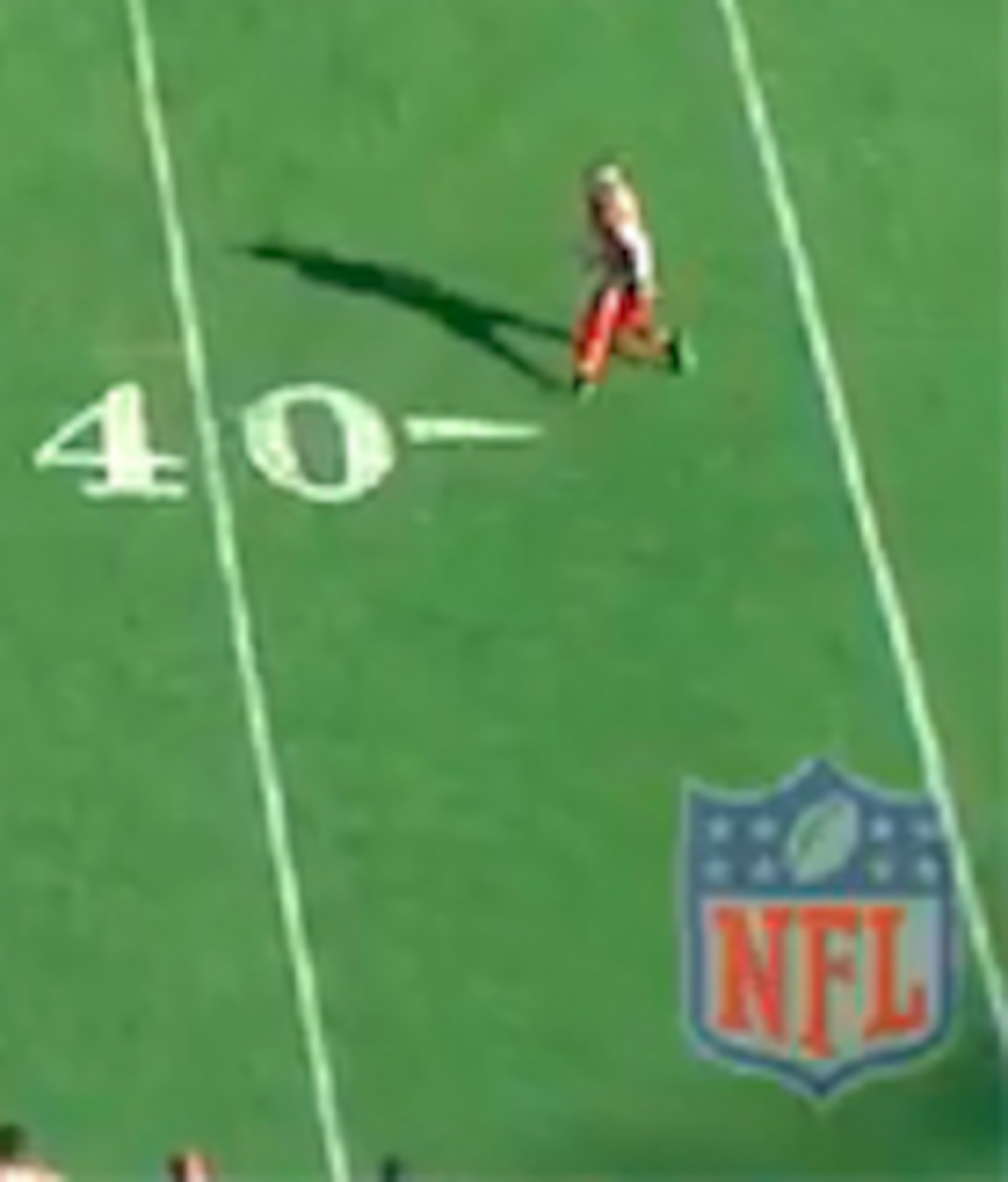
On third down, the Buccaneers defense comes out in a Tampa-2 coverage with Stills in the slot. Stills doesn't need to work hard to get open on this play; he simply has to rely on his speed to push his way down the seam before attacking the space between the two safeties.
In the Tampa-2 coverage, the middle linebacker is responsible for running with Stills. He obviously has no chance of sticking with the wide receiver once they are level.

Ideally, Brees would lead Stills down the middle of the field for the receiver to run underneath the ball. However, Brees would have needed Joe Flacco's arm strength to push the ball that far down the field. Brees still puts the ball in front of Stills, but the receiver is forced to adjust.
Stills had been looking back for the football as soon as he got level with the middle linebacker. As such, he was able to stop and turn before catching the ball high between defenders.
By adding Stills and tight end Jordan Cameron, the Dolphins now have two versatile deep threats who can help rather than hurt their quarterback's frail deep passing ability. Cameron is significantly bigger than Stills, but the receiver's ability negates any concerns about his size.
A third-round pick in this year's class could be a valuable one, especially for a team looking for a wide receiver.
The 2015 class doesn't offer the same promise that the 2014 class did, but that class proved to be special in the NFL. Instead, the 2015 class offers a large number of potential role players, like Stills, who could be developed into starters.
By trading away their third-round pick this year, the Dolphins have taken on some character concerns but acquired a talented player who has already developed some as a professional.
While Norv Turner, the Vikings offensive coordinator, could return Wallace to who he was during his Pittsburgh Steelers days, the Dolphins likely won't regret these moves. Stills should comfortably be an upgrade on the player that Wallace was during his time in Miami.
.jpg?w=2560 "Saints Falcons Football")