

Max Scherzer's Addition Can Make Nationals' Rotation an All-Time Great Group
For now, the decision is unanimous, as it should be.
The Washington Nationals boasted the best starting rotation in the National League by the end of last regular season, and it was nearly the best in the majors by terms of Fangraphs WAR. The question this offseason was how could it get better in 2015.
Enter: Max Scherzer.
TOP NEWS

Realistic Offseason Trade Ideas 💡

Yankees Sloppy in Game 2 Loss 😬

Players Who Were Worse Than You Think in 2026 ⚾
When the Nationals stunned baseball by signing Scherzer to a seven-year, $210 million contract last week, they obtained that extra boost needed to make them the best rotation in the majors, a title held by Scherzer’s previous team, the Detroit Tigers, in 2014. Whether the group of Scherzer, Jordan Zimmermann, Stephen Strasburg, Doug Fister and Gio Gonzalez will find a high perch in pitching history is yet to be determined, but it appears it will be MLB’s best for the upcoming season.
"National reaction to the Max Scherzer deal: #Nationals now have best rotation in baseball. http://t.co/ZpUkqQ9IQw #tigers
— Freep Sports (@freepsports) January 19, 2015"
Baseball is a game filled with statistical and subjective debates, many of them concerning the exact same topics. One of the favorites seems to be determining which starting rotation is the best in the game’s history. There are lists upon lists and opinions countered by opinions regarding this subject, but if the 2015 Nationals plan to even be one of the best in this decade, they have some ground to cover.
Just in the previous four seasons, two of the all-time great rotations have come to pass. By any number of statistical standards, WAR calculations or eyeball tests, the 2011 Philadelphia Phillies and the 2013 Tigers are two of the great rotations of all time. Of course, advanced drug testing, the eradication (mostly) of the PED era and changing attitudes about striking out have helped both units, but both also pitched in eras of smaller ballparks and lowered pitching mounds.

According to accumulative WAR, the Phillies’ combined 24.7 WAR from their starters is the seventh-best mark in the Live Ball era (via Fangraphs), which started in 1920. That rotation lived up to offseason expectations after it acquired Cliff Lee before the season. Roy Halladay, along with Lee, Cole Hamels, Roy Oswalt and rookie Vance Worley made up the group, and three of them—Halladay, Lee and Hamels—had ERAs more than a run lower than league average (3.81) and finished second, third and fifth, respectively, in Cy Young Award voting. Worely also had an ERA (3.01) well below league average.
The 2013 Tigers were slightly better, ranking sixth since 1920 with a 25.1 WAR, despite the 2011 Phillies having a better ERA and FIP. But the Tigers were an elite strikeout team. Scherzer was the best of the group, finally living up to expectations that followed him since he was the 11th overall pick by the Arizona Diamondbacks in 2006. Scherzer would win the American League Cy Young that year, and Anibal Sanchez, Justin Verlander, Rick Porcello and Fister backed him up. Their 981 strikeouts were 102 more than any other rotation, and their insane 8.63 strikeouts per nine innings was the best ever until the 2014 Cleveland Indians posted an 8.92 mark.
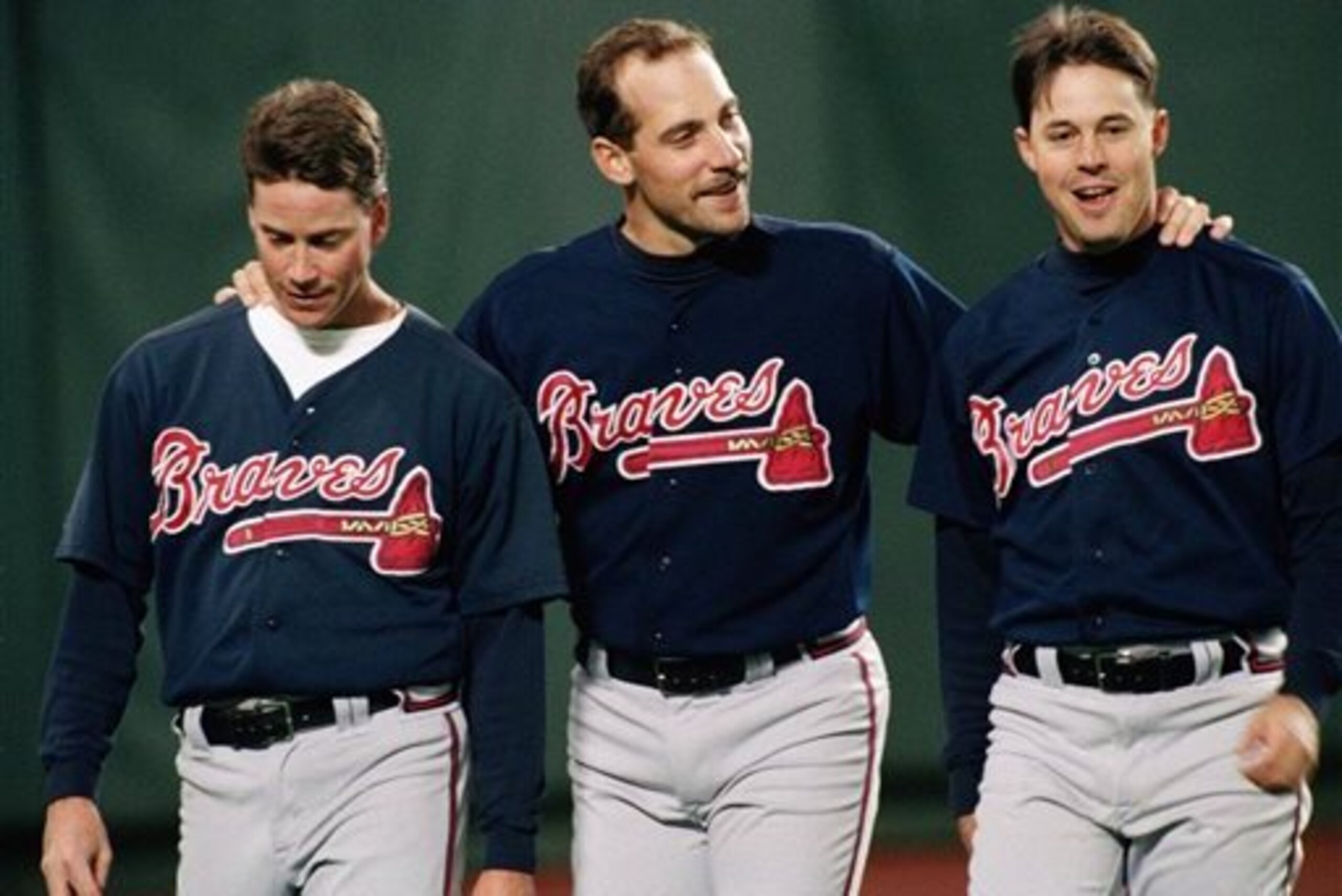
Going back a little further, the 1997, 1996 and 1998 Atlanta Braves were the fifth-, 11th- and 14th-best rotations, respectively, when it comes to their 25.4, 23.9 and 23.7 WAR marks. Greg Maddux, John Smoltz and Tom Glavine, all Hall of Famers within the last 13 months, led those dynamite groups.
The Nationals have a long way to go catch those rotations, but they have the wind behind them in their march to do so.
Scherzer is a pitcher in his prime, and he has conserved bullets to this point. His first full season was 2009 with Arizona, and it was not until 2013 when he pitched more than 200 innings in a season, throwing 434.2 over the last two years.
He is now going to the National League, where he can face pitchers, virtually no designated hitters and pitch in the big ballparks of the NL East. It is entirely plausible that Scherzer can get better as a National. Dave Szymborski’s ZiPS projection system sees Scherzer with a 2.64 ERA in 204.1 innings, a 144 ERA-plus and 5.9 WAR.

If you still need more positive reinforcement for this rotation, Strasburg is coming off a relatively down season by his standards, but ZiPS loves him for next season. The system has him at a 2.93 ERA over 193.1 innings with a 2.89 FIP, 10.1 strikeouts per nine innings, 130 ERA-plus and 4.9 WAR. Those numbers would make him the team’s dominant No. 2 behind Scherzer.
Gonzalez was the Nationals’ worst starter in 2014, with a 3.57 ERA and 105 ERA-plus in 158.2 innings. All of those numbers are worse than his averages for the previous three years, but he had a solid 3.02 FIP and his .294 BABIP was the highest it had been since 2009. So, with a little better luck, ZiPS has Gonzalez at a 3.28 ERA, 3.25 FIP, .282 BABIP, 116 ERA-plus and 3.5 WAR over 170.1 innings. That doesn’t make the lone lefty in the rotation great, but it makes him better than last season.
As for Zimmermann and Fister, repeats of their 2014 seasons would be fine for this rotation to be elite. But ZiPS sees Zimmermann falling a bit from a 5.2 WAR to 4.5 while Fister goes up from 1.3 to 3.4.
If ZiPS is somewhat accurate, that would be a combined WAR of 22.2 for this quintet, which on its own would be good for 37th highest in the Live Ball era. Add in some more value for spot starters—Tanner Roark is the odd man out right now but had a 3.0 WAR as a full-time starter last season—and this rotation has what it takes to be seen as one of the best ever in terms of WAR and strikeouts.
There is too much luck and unpredictability in baseball to say for sure, but based on projections, track records and optimistic hyperbole, we could be looking at the 2015 Nationals as one of the all-time great rotations when it’s all said and done.
Anthony Witrado covers Major League Baseball for Bleacher Report. He spent he previous three seasons as the national baseball columnist at Sporting News and four years before that as the Brewers beat writer for the Milwaukee Journal Sentinel. Follow Anthony on Twitter @awitrado and talk baseball here.

.jpg?w=2560 "Grading WWE Raw 🔠")

.jpg?w=2560 "Bijan's INSANE 1st Half 🤩")
.jpg?w=2560 "Viral Rams Coach Vid 🖕")
.jpg?w=2560 "Injury-stricken Seahawks signing veteran RB")


.jpg?w=2560 "2 NFL Officials Suspended")
