

Carmelo Anthony's Adjustment to Triangle Offense an Early Success for NY Knicks
Even though the New York Knicks are 4-14 and among the worst teams in the Eastern Conference, Carmelo Anthony is adjusting to the new offense quite well.
The nature of the triangle suits his game. If his 47.4 field-goal percentage holds for the year, it would rank as his fourth-most efficient shooting season. His overall points—23.7 per game—might be down a bit for his usual high 20s average, but that's more a function of the Knicks' weak roster.
The basis of the triangle offense is in its focus on post-ups. There are classic post-ups from the mid-block area available for any player on the floor, as well as an elbow action called a pinch post—in which a player on the perimeter hits a teammate on the elbow and cuts off him for a dribble handoff, fades to the corner or backdoor cuts.
TOP NEWS

Ranking Every NBA Team's Starting Lineup Ahead of Preseason 🔢
Duren Weight Clause Dropped
.jpg?w=2560)
NBA Trade To Boost a New Eastern Conference Contender 🏀
Anthony's back-to-the-basket game is a signature of his offensive repertoire, and his work from the elbows is also a great strength. What all of these areas of focus have in common, however, is that they're located in the mid-range.
Much of the criticism of the triangle early in the season has been that it's generating too many mid-range shots. The mid-range accounts for 28.8 percent of the Knicks' points this season, according to NBA.com, a figure that leads the league by a wide margin.
In an analytics-based NBA that de-emphasizes long twos, the Knicks seem to be inefficient. They also sport the ninth-worst offensive rating in the league, a number that fuels this fire.

More likely, however, is that the Knicks are in a new offense with inferior offensive players. The combination is difficult to overcome, no matter how proficient the shot selection is.
John Schuhmann of NBA.com investigated this triangle-mid-range correlation and found that Phil Jackson teams didn't resort to two-point jumpers more often than the rest of the league: "The Triangle isn't necessarily a mid-range focused offense. None of Phil Jackson's Lakers teams ranked higher than 18th in percentage of shots from mid-range."
Anthony's bread and butter, however, is the mid-range. Whether he's shooting it off the dribble or creating from 18 feet out, it's where he prefers to start with the basketball.
That doesn't necessarily mean he's shooting it from that area. There's no question that Anthony will shoot his share of two-point jumpers, but what's more crucial to his game is that he starts with the ball within the three-point line.
The triangle, by design, sets this up for him nicely.
Take this initial post-up against the Utah Jazz, for example, from where the triangle derives its name.
As Shane Larkin enters the ball to Pablo Prigioni on the wing, Larkin follows his pass and cuts to the strong-side corner.
Prigioni, Larkin and Anthony (at the mid-post) form the triangle.
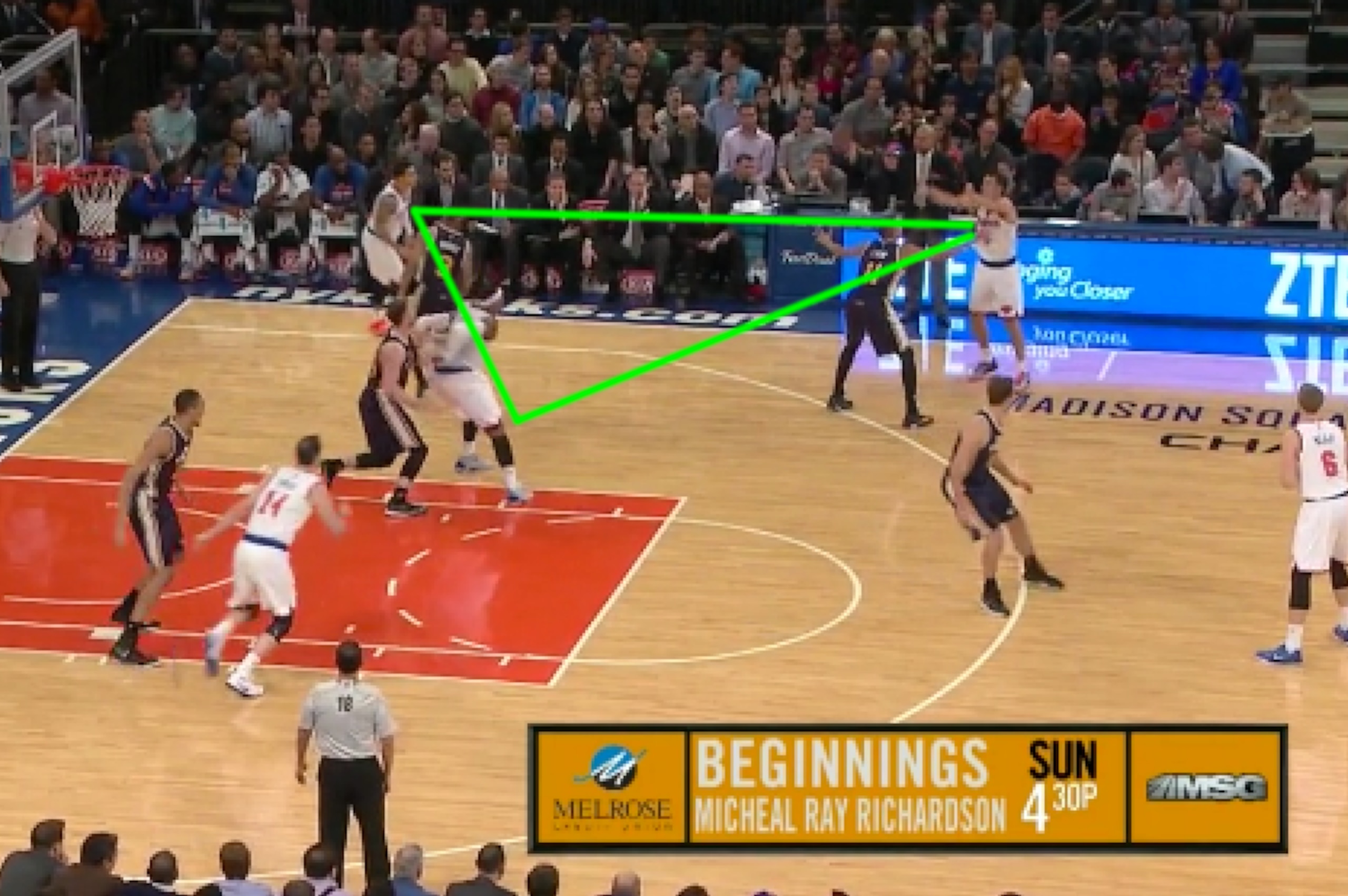
The beauty of the triangle is in its demand for dominating spots. In years past, Anthony would catch the ball at 18 feet and closer to the baseline, cutting off his options. Here, he's planted firmly in the mid-post and more centered on the floor.
On the catch, he's only eight to 10 feet from the rim.
The post action off an initial entry into the post also keeps weak-side defenders busy so they cannot load to Anthony immediately.
Larkin cuts through underneath along the baseline and drags his defender Trey Burke away from the play to create space.
Prigioni cuts directly toward the low big to set a screen for a quick curl action, this time for Travis Wear. Rudy Gobert cannot completely ignore Wear and double the ball because he must be cognizant of Anthony hitting Wear on the dive to the rim.
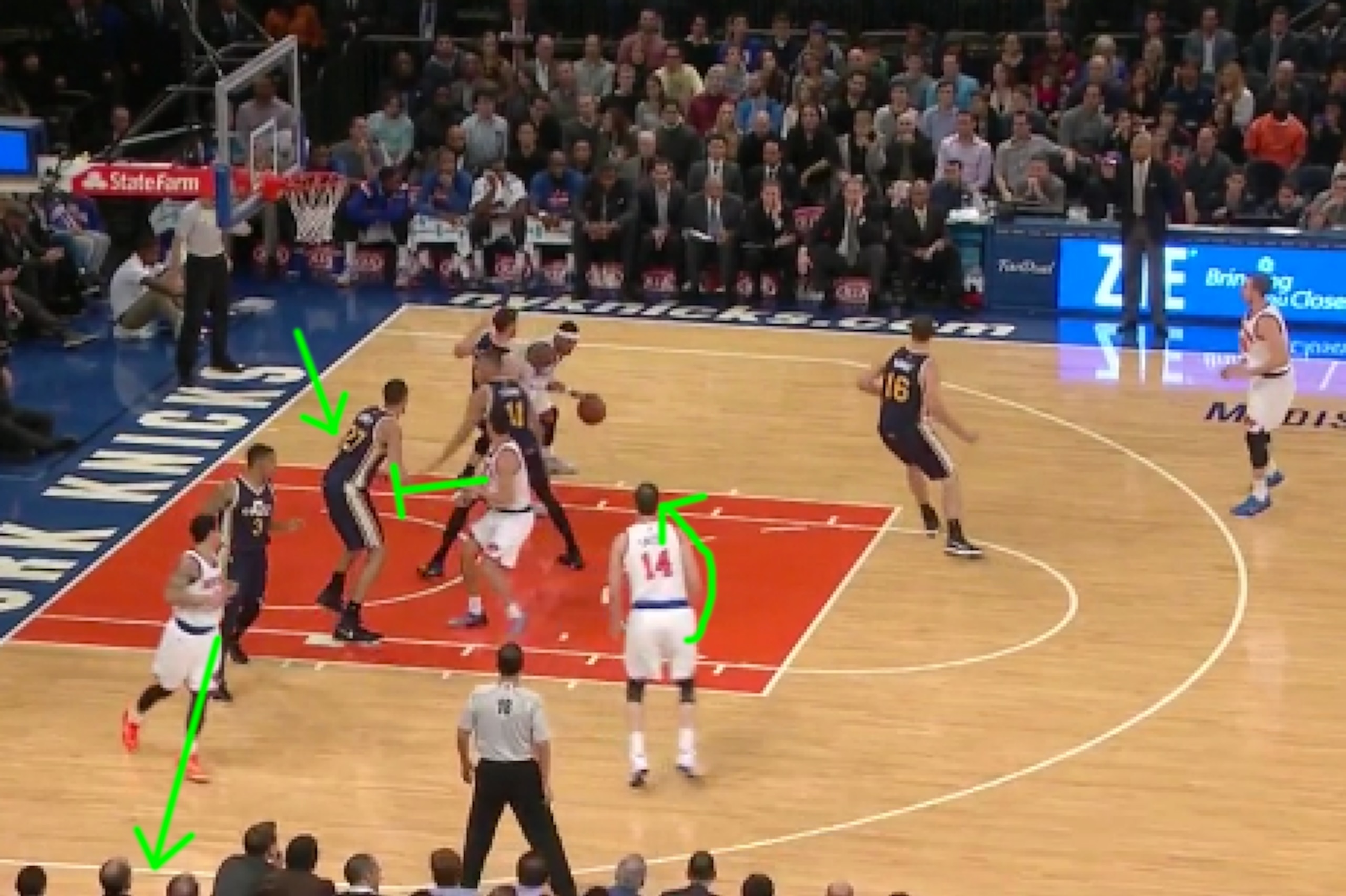
By the time Gobert does commit to help defense, he's late: Anthony has two feet in the restricted area, forcing Gobert to leap for the last-second block. Anthony, sensing the help, pump-fakes to draw the foul and get to the line.
The other main triangle variation for Anthony is the pinch post, which occurs when the ball swings to the opposite side of the triangle.
Initially Anthony heads toward the dunker spot—an area behind the rim and along the baseline approximately six feet from the basket—on the weak side to create space for the strong-side action.
Once the ball whips across the floor, he pops back toward the elbow for the catch.
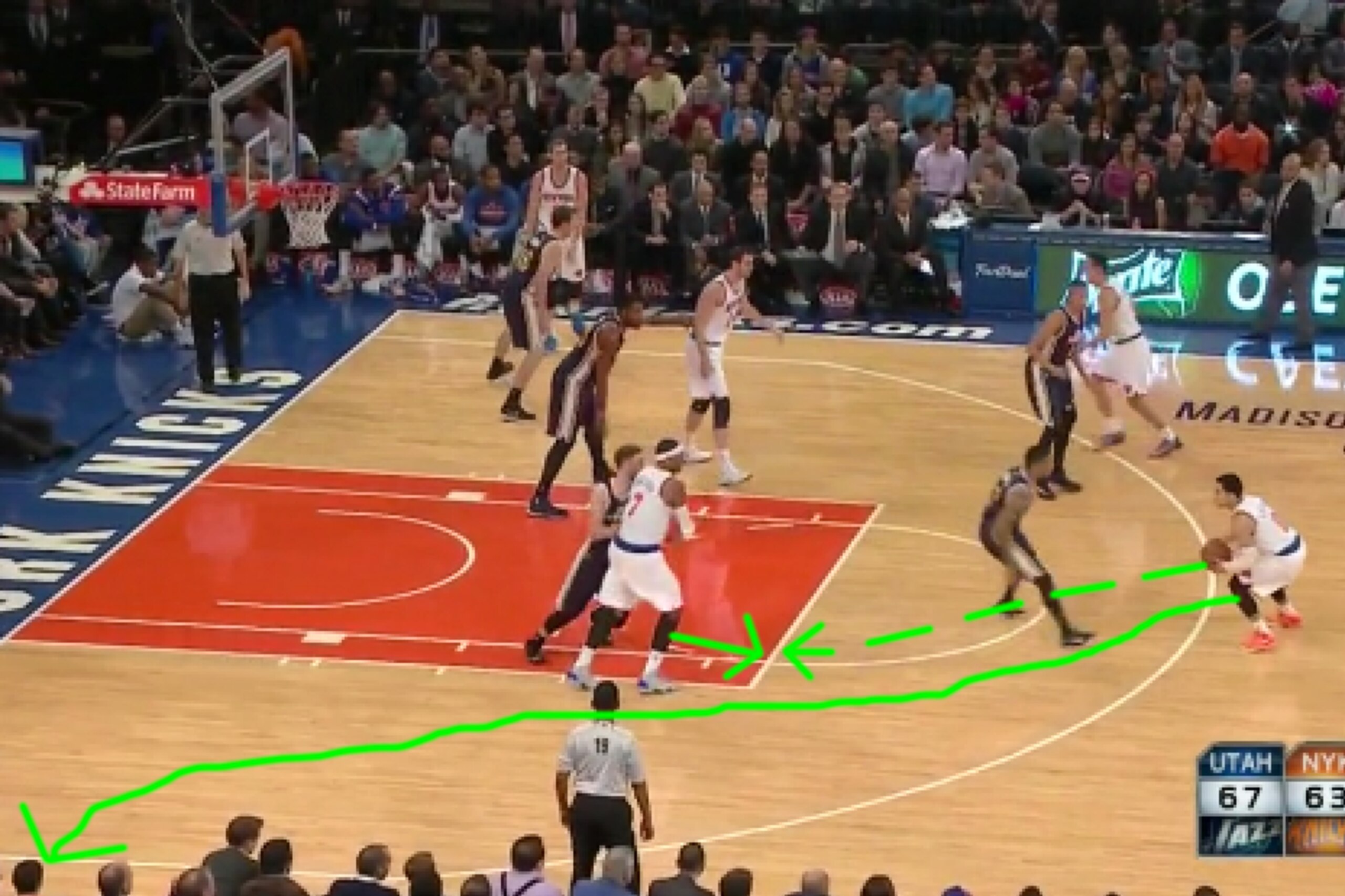
Larkin and Anthony play the pinch post, with Larkin eventually spacing out to the corner. Because he's in the strong-side corner, Burke cannot come off Larkin to help—the pass is too short and the corner three-pointer is a dangerous shot.
What's left, then, is a face-up isolation 15 feet away from the basket. Very few defenders in the NBA can handle that situation, especially when the help has much less time to rotate. By the time Anthony takes a dribble, he's pretty much on the rim.

Once Jason Smith clears out after ducking in for a possible post-up, it's Anthony's show. Without anyone on Utah to properly help outside of an immediate double-team, he scores a bucket plus the foul.
With roster continuity and a more diverse group of creators, the triangle offense will begin to succeed in New York for players outside of Anthony.
It's difficult for any offense to succeed when the opposing defense only has to focus on one player. They throw constant double-teams at him and pressure other players to create. When they cannot, the offense struggles.
Until New York improves its team, the offense will be stagnant. It also doesn't help that the triangle is a read-and-react scheme, which demands a certain synergy that station-to-station sets do not necessarily require.
If every player is not on the same page, they might accidentally cut to the same spots or crowd certain areas of the floor. With time, players learn each other's tendencies and understand how and when to cut within the principles of the offensive design.
This will happen in New York if the triangle and core offensive pieces remain in place.
And considering how it's tailor-made for Anthony's game, he could flourish at a much higher level than he's already shown so far.
.jpg?w=2560 "Suns Brooks Basketball")
.jpg?w=2560 "Joey Porter Jr. Traded to Cowboys 🤠")


.jpg?w=2560 "Browns Open to Watson Future")
.JPEG?w=2560 "Marshawn Reveals Scary Stat 🚗")