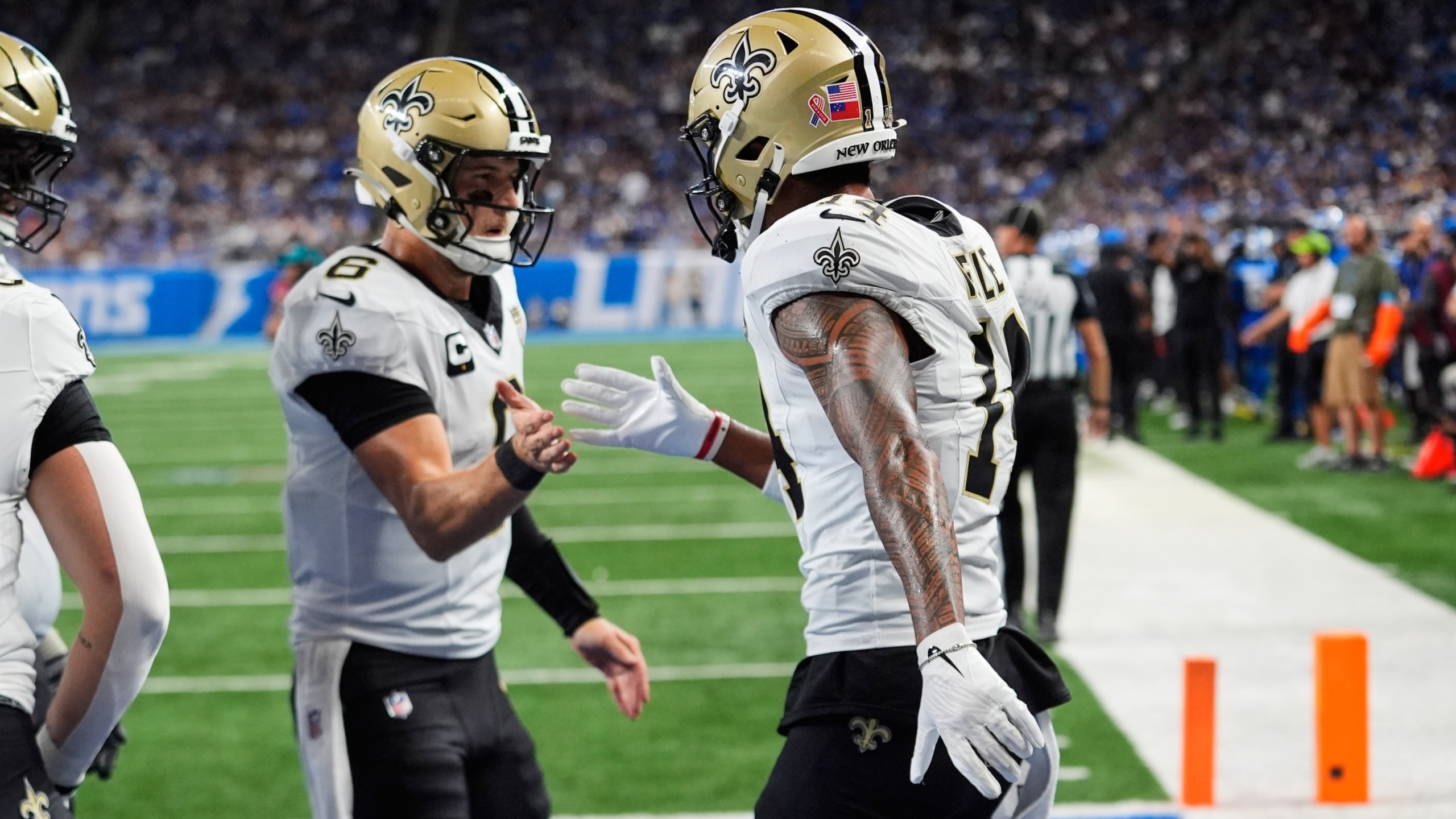
Meet Oregon's Solution to the Stanford Problem
When Oregon unraveled against Stanford last season, its prized commit didn’t watch the familiar demolition unfold. It wasn’t that Royce Freeman didn’t want to fully immerse himself in one of college football’s booming rivalries before he arrived on campus; he was simply too busy causing destruction of his own.
“I had a football game that night,” Freeman said. “So I didn’t get to see it.”
Perhaps this wasn’t the worst thing, given the results. For the second consecutive season, Stanford dismantled the Ducks’ high-powered offense and their season. The 26-20 scoreboard told a misleading tale, as the Cardinal controlled the line of scrimmage from the first whistle. Oregon’s neon, high-octane attack stalled.
TOP NEWS
Arch Apologizes to Holly Rowe

New CFB Playoff Projections 🔮

Top QB Report Card Grades after Week 2 📝
In 2013, the Ducks averaged 273.6 rushing yards per game. Against Stanford, Oregon could only muster up 62 yards on 24 carries. To find a worse rushing performance in the program’s history, you have to go back in time to September 2009.
Beyond any statistic, the most jarring and significant numbers to come from this game are the only ones that carry any true meaning: In 2012 and 2013, Oregon was 23-1 when playing any non-David Shaw coached team. Against Stanford, the Ducks were 0-2.
The Cardinal have been their Kryptonite, and yet, there are reasons to be optimistic if you’re on the Oregon sideline. Beyond the presence of quarterback Marcus Mariota—arguably the nation’s most talented and explosive player—hope exists in a true freshman running back who looks, sounds and plays nothing like his age.
Even the man behind this diabolical run can’t help but notice the sudden and unexpected rise of Freeman, a chess piece fit for a matchup of this nature.
“You see a young freshman running back not looking like a freshman running back,” Shaw said of Freeman. “He’s coming into his own as a really, really good college football player.”
Who Is Royce Freeman?

Before we proceed, I want to show you a short video.
It’s not footage of Freeman tossing hopeful tacklers aside like airborne mannequins. It’s not one of the 13 touchdowns he’s rushed for in only his first eight games. And no, it’s not the passing touchdown he has accounted for, either, though feel free to check that off your bingo card.
The best way to truly appreciate Freeman’s rare physical gifts is to see him motionless, padless and far away from the football field. Running backs, especially those speaking after their first collegiate game, are not supposed to look like this.
Prior to arriving at Oregon, Freeman played for Imperial High School in California, where he posted Hulk-ish numbers. In his four seasons, he averaged 11.8 yards per carry, ran for 7,606 yards and found the end zone 119 times, according to MaxPreps.com.
This freakish production—along with his freakish build—is why he was tabbed as the nation’s No. 6 running back recruit and the No. 37 player overall by 247Sports in the class of 2014. It’s rare to see a back this put together, regardless of age or level. There simply aren’t many 229-pound human beings capable of moving at these speeds.
It’s also uncommon to see a back like this at Oregon, a program that has relied primarily on one-cut speed runners during its offensive renaissance. The match between program and player was unorthodox, although it existed from the get-go thanks to a variety of factors.

“It’s the ideal city, and the tradition they have at running back is very positive,” Freeman said. “But it was also Cam. He’s the main part of the success at running back here. That got me really interested.”
“Cam” is better known as Gary Campbell, the running backs coach at Oregon and one of the fixtures of all of college football. Campbell has been at Oregon since 1983—well before the machine really started to churn—and 14 backs he’s coached have rushed for 1,000 yards in his time at Eugene.
Even in August, long before Freeman carried the ball in an actual game, Campbell recognized that his new toy was special.
"He's fast. He's big and he's tough,” Campbell told Tyson Alger of The Oregonian. “A lot of times you get guys like him that come in and have great success in high school and they haven't really had to work at it and when they get into tough competition at the college level they shy away from it.
"He steps right up."
And he has, although it hasn’t been quite as easy as it's looked.
Freeman's first moment of clarity came long after he logged his first carry and found his first end zone. In fact, it all started to fall into place only a few weeks ago against the Bruins. It was then that he finally found something to build on.
“It was one of the runs against UCLA where it started to click,” Freeman said. “I broke a good amount of tackles and finished a run hard. Every time I get the ball I need to have that attitude.”
Freeman has already rushed for 748 yards this season, despite splitting carries through much of the first half. His 13 rushing touchdowns put him at No. 6 overall in the country.
In a year ripe with impressive freshman running back debuts, Freeman’s performance jumps off the page.
| Player | Team | Carries | YPC | Rushing Yards | Total Touchdowns |
| Royce Freeman | Oregon | 136 | 5.5 | 748 | 14 |
| Leonard Fournette | LSU | 131 | 5.0 | 657 | 7 |
| Nick Chubb | Georgia | 99 | 5.7 | 569 | 6 |
| Samaje Perine | Oklahoma | 133 | 4.9 | 657 | 10 |
| Nick Wilson | Arizona | 100 | 5.9 | 592 | 8 |
| Jalen Hurd | Tennessee | 113 | 4.2 | 473 | 3 |
As injuries have hit Oregon's backfield, particularly with sophomore Thomas Tyner, Freeman’s workload has increased.
Although the plan was to operate with Tyner, Freeman and Byron Marshall carrying the ball in somewhat equal shares, Marshall has become an integral part of the Oregon passing attack and Tyner has been sidelined. Marshall, a unique and valuable weapon in his own right, has also seen Freeman come into his own as roles have evolved.
“He’s been ballin’ these last couple weeks,” Marshall told Justin Wise of the Oregon Daily Emerald. “I can’t put my finger on the right exact word, but for a true freshman he doesn’t play like a true freshman, which we really appreciate.”
In the past three games, when Oregon has leaned on its youthful bulldozer, he has responded. Freeman has rushed for 402 yards and eight touchdowns since the Ducks fell at home to Arizona. The offensive line has also gotten healthy in this time, which has helped the entire offense return to form.
Even with this tremendous output over the past month—and the obvious progression in his game—Freeman remains his toughest critic.
“I’m trying to become a more complete back,” Freeman said. “I’m still adjusting to a different kind of offense, reading blocks and different aspects of the position in detail. I can get better at finishing runs and breaking away.
“Not being tackled, that’s what I’m working on.”
Shedding the Label with the Necessary Ingredient

As strange as it may sound, Freeman is more Stanford than Oregon. He is more Tyler Gaffney than De'Anthony Thomas. More Stepfan Taylor than LaMichael James. He is, even in his college football infancy, the most physical and explosive runner the rivalry has seen—on either side—over the past few seasons.
His style is violent and, in many ways, a lost art. It’s why Shaw’s voice brightens when he speaks about the freshman, even as he braces for the challenge ahead. And while Freeman’s game may echo bits and pieces of various backs around the country, he’s sculpted his running style after a different era entirely.
“I really don’t watch many college players and model my game after them,” Freeman said. “I look at the older backs, older school guys and see how they run.”
He is a throwback, which is an element his team has dearly lacked. Especially in weeks such as these.
Although the “soft” label has been unfairly applied to the program based on 120 minutes of football, the Ducks have been unable to match the Cardinal’s physical presence. This is the reality. It is something Freeman has heard through reputation and now seen through film.
Although the pieces on Stanford have changed plenty since Oregon last saw them, the results stay the same. Despite all of the new faces, the Cardinal defense remains one of the nation's most immovable.
| Defensive Category | Statistic | National Rank |
| Yards Per Game | 250.6 | No. 1 |
| Yards Per Play | 3.72 | No. 1 |
| Total Yards Allowed | 2,005 | No. 4 |
| Points Per Game | 12.5 | No. 2 |
| Touchdowns Allowed | 11 | No. 2 |
“They are a physical defense and a physical team,” Freeman said. “They’re very sound and they always come to play. It’ll be a different kind of game out there.”
For Freeman, every game is different. Every game week, game plan and football situation is original as he seeks stable ground. His experience against Stanford is non-existent as of now, just tales told in the film room, through the media and from teammates.
He was not part of the last two seasons when Oregon entered the week against Stanford as the nation’s No. 1 and No. 2 team only to watch these rankings come undone. In many ways, his youth and inexperience serve as a valuable reboot—he doesn't know any better.
“We have to go out there with a mindset that it’s just another game and another week,” Freeman said. “You can’t treat it any different. Once you start thinking about other things, you start trying to compensate and end up out of your element. That’s how you end up losing.”

Although it's unfair to place the weight of the rivalry on the shoulders of a true freshman—regardless of how gargantuan and cartoonish he might appear—Freeman’s presence cannot be overstated.
He won’t help Oregon win the line of scrimmage. He won’t be tasked with slowing down a Stanford offense that has experienced success in this matchup. And it won’t be up to him to direct the offense; that will fall in the very capable hands of his quarterback. But his destructive style and 229-pound frame are a direct answer to a problem.
“I just have to go out there and play my game, full speed, and try to make something happen,” Freeman said. “If we go out there and play how we have been playing the last couple weeks—maybe turn it up a notch—we should do well.”
Paralleling Oregon’s opportunity at redemption is the unofficial launch of the first College Football Playoff.
On Tuesday night, as the college football masses focused on their televisions to see the selection committee’s first-ever Top 25 rankings, Freeman bounced from classes to meetings. The Ducks debuted at No. 5, but he missed the hoopla entirely without showing the least bit of interest.
“Strictly Stanford,” he said. “We can’t be thinking about things like that.”
Freeman’s ability to miss these critical college football broadcasts has carried him this far, from blue-chip recruit to potential Stanford antidote. Given where this routine has taken him, there’s no reason to abandon it now.
Unless otherwise noted, all quotes obtained firsthand, and all stats courtesy of CFBstats.com.


.jpg?w=2560 "Report: Darnold Could Miss 3-6 Weeks")
.jpg?w=2560 "Grading WWE NXT 🔠")