How the Los Angeles Kings Are Bending but Not Breaking to Start 2014-15
The Los Angeles Kings’ 4-1-1 record to begin the 2014-15 season is deceptive. Head coach Darryl Sutter’s club has not performed well in the least, allowing scoring chances galore and handily losing the puck-possession battle.
Despite those significant blemishes, L.A. has managed to gut out nine of a possible 12 points while only conceding 1.67 goals per game.
This is not a matter of clever schemes or team-wide defensive excellence. Thus far, the Kings have bent without breaking on the strength of two individuals.
TOP NEWS
NHL Star Booed Amid Trade Request
Mark Scheifele Landing Spots 📍

Every Team's Odds to Win the Cup 🏆
Jonathan Quick
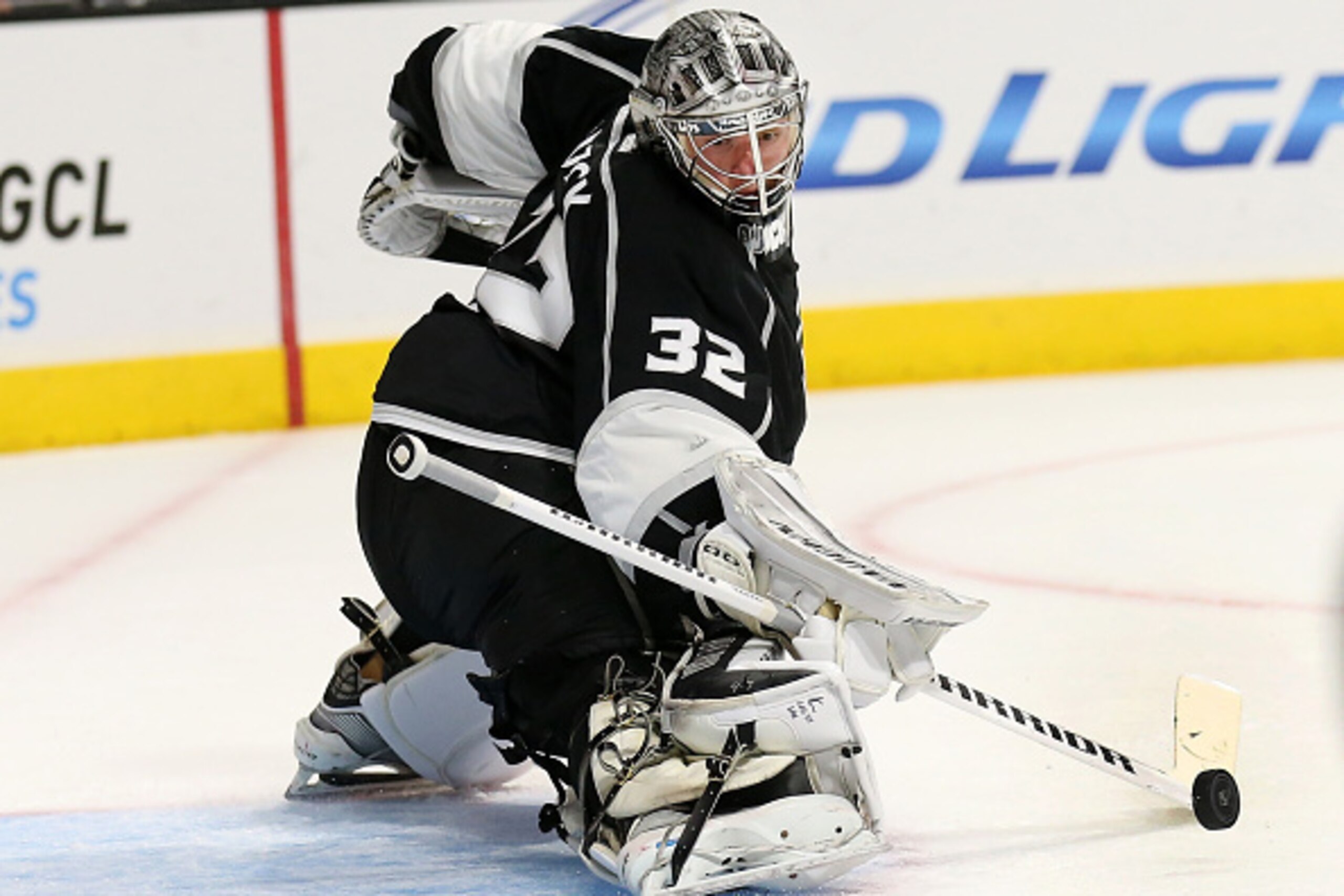
L.A.’s early-season doldrums are nothing new, but its horrid possession numbers are.
Through six contests, the team ranks 23rd in the league in Corsi percentage at 47.6. In 2013-14, the Kings sat atop the NHL at 56.8 percent.
Injuries and fatigue from three straight lengthy playoff runs are likely contributing to this dip in play, but it remains a cause for concern.
To this point, Quick has allowed the club to stay afloat with stellar goaltending. The former Conn Smythe Trophy winner hasn’t looked this calm and assured in net since the 2013 postseason, when he posted a 1.86 goals-against average and .934 save percentage.
At present, he sports a 1.86 GAA and .951 save percentage.
One of his most noticeable issues last year was an inability to consistently find pucks through traffic. In 2014-15, the acrobatic netminder has tracked plays superbly.
Last week, the Kings were dominated by the St. Louis Blues to the tune of a 43-18 shot disparity. However, L.A. never buckled because Quick repelled all comers.
On the penalty kill in the second period, he keeps his eyes peeled on the puck, inching away from David Backes' screen to remain square to Kevin Shattenkirk at the point:
In the third frame, Vladimir Tarasenko negotiates a path into the slot and is afforded two cracks at the net. Quick is alert, understanding precisely where the rebound will travel and giving the nifty Russian nothing to shoot at:
With a defensive corps that has largely struggled to start the season, Quick’s confidence has been a true boon for the Kings. His even-strength save percentage has risen from .928 in 2013-14 to .954 this year.
An even greater improvement has taken place short-handed, where he’s reined in his aggressiveness to just the right measure.
That refinement in positioning is preventing opponents from exposing his typically audacious playing style. His command in the crease is reminiscent of his 2011-12 form, which earned both Vezina and Hart Trophy consideration.
As a result of his tweaks, his four-on-five save percentage has vaulted from a putrid .866 to a sparkling .949.
On the whole, he's rediscovered the blend of sound and hyper-athletic movement that made him appear so unbeatable during the Kings' first Cup run:
By sharpening his focus and situational awareness, Quick has helped his rusty team to a 4-1-1 start that finds L.A. in second place in the tough Pacific Division.
His gaudy numbers won’t last—at least not to this degree—but his quality through six contests is one of the primary reasons the Kings are in good shape in spite of really bad showings.
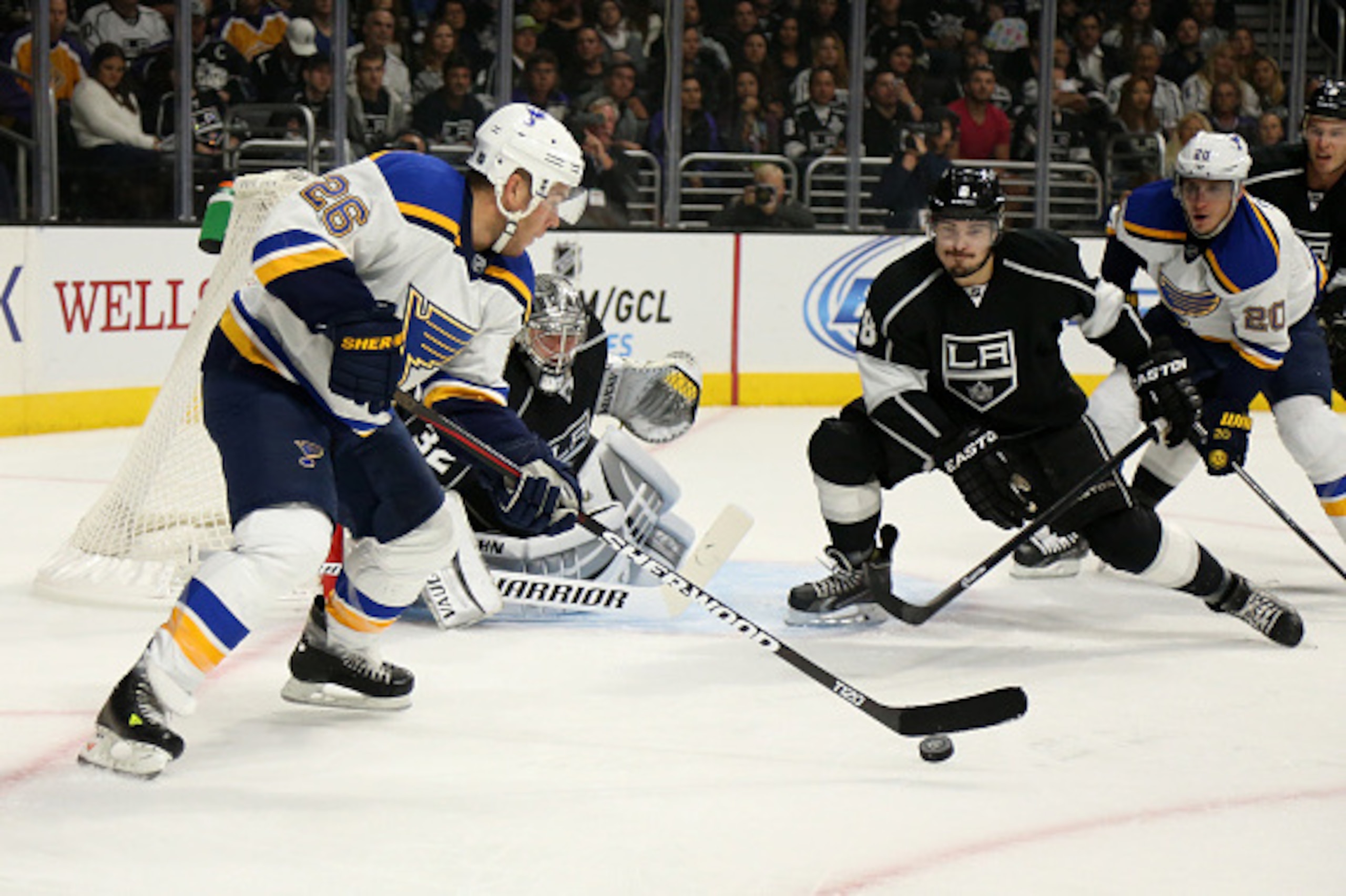
Another new development: Doughty playing at a phenomenal level...in the regular season.
In the playoffs, the 24-year-old can reach a gear no other blueliner can even sniff, but he has always left a little bit to be desired during the dog days of the year.
Other than in the season opener, that has not been the case whatsoever to start 2014-15. Paired with a deer in headlights (Brayden McNabb) on the first unit while regular partner Jake Muzzin recovers from an upper-body injury, Doughty has delivered surprisingly great two-way performances.
He’s not only covered up McNabb’s repeated gaffes, either—he’s somehow managed to supplement the offense as well.
Against the Winnipeg Jets, he provides Jordan Nolan with an outlet while the trailing forward (Jeff Carter) joins the fray. With his head on a swivel, he draws a defender's attention and feeds Carter in a dangerous area. Seconds later, Tyler Toffoli cleans up the garbage:
Frankly, the statistics are remarkable.
With McNabb on the ice, Doughty’s Corsi percentage is 47.5. Without him, it leaps to 59.3. That’s virtually tied with the mark he established alongside Corsi poster child Muzzin last season (59.4).
How about the on-ice/off-ice figures?
| GA/60 On | GA/60 Off | Corsi On | Corsi Off | |
| Drew Doughty | 0.53 | 2.11 | +4.27 | -10.92 |
| Brayden McNabb | 1.24 | 1.61 | -1.24 | -6.78 |
| Slava Voynov | 1.20 | 1.64 | -13.85 | 0.00 |
| Robyn Regehr | 0.60 | 1.98 | -11.93 | -0.99 |
| Alec Martinez | 2.91 | 0.90 | -1.45 | -6.29 |
| Matt Greene | 3.24 | 0.86 | -1.62 | -6.04 |
Doughty has been nothing short of spectacular in the new campaign, playing against top competition over a team-high 27 minutes and seven seconds per game (25:42 last season) and posting the blue line’s best plus/minus rating.
His ability to defuse pressure with crafty passes and breakouts has been crucial to a club that has otherwise been quite porous, curbing its time spent in the defensive zone in order to mask any current deficiencies.
When he has been forced to defend, such as on the penalty kill, he's displayed his well-rounded skill set. On Sunday, the Minnesota Wild were granted a second-period power play for a chance to even up the score.
As the puck reaches Justin Fontaine at the side of the net, Doughty recognizes that the forward is likelier to pass than shoot in his current position. Instead of screaming toward Fontaine, he holds his ground to cover the backdoor threat while locking on to the puck:
Sure enough, he nullifies a would-be tap-in.
The familiar sights for early-season Doughty—sloppy turnovers, listless coverage—are nowhere to be seen, as he's elevated his game without the help of his regular pairmate. In fact, he's led the charge while carrying an albatross around his neck.
His goals-for percentage is an incredible 80.0 at the moment (58.1 last season). Without McNabb, that number rises to 100 percent.
He’s been an all-around stud in 2014-15, providing shutdown defense and sterling transition hockey in the face of adverse circumstances.
Outlook

That ‘70s Line has been tremendous through six tilts, but L.A. as a whole is scoring fewer goals per game than it did in 2013-14, when it ranked 26th in the league.
Even with poor overall play, the Kings are still winning due to their defense and goaltending.
Doughty and Quick have been the catalysts in this regard, forming the last line of resistance while most of their teammates shake off the cobwebs.
The former has expertly limited damage and launched the breakout, whereas the latter has stood on his head when lesser rearguards—especially those on the second pairing—have been called upon.
Can L.A.’s defensive and goaltending pillars sustain these performances long-term? Probably not, but the Kings will take them while they can.
Advanced statistics courtesy of Behind the Net and Stats.HockeyAnalysis.com.

.jpg?w=2560 "Every Trade's Best Trade Asset 🔁")
.jpg?w=2560 "Insiders: Cowboys Overpaid for Porter")
.jpg?w=2560 "Top NFL Trade Targets")