Tight Ends, Running Backs Play Crucial Role in Colts' Red-Zone Success
It's no secret that Pep Hamilton loves tight ends.
After all, he built an offense in Stanford around multiple-tight end sets, and the Indianapolis Colts' acquiring of Coby Fleener and Dwayne Allen in the 2012 draft was a big reason in the hiring of Hamilton in 2013. The Colts had the weapons Hamilton needed to run his style of offense, not to mention the quarterback most familiar with the scheme in Andrew Luck.
The players know what Hamilton is about, as Dwayne Allen reiterated to the Indianapolis Star's Zak Keefer before this season:
.jpg?w=2560 "Bills Falcons Football")
.jpg?w=2560 "QB Competitions Football")
"If you're familiar with the Stanford offense, there was always like three, sometimes four, tight ends out there at the same time. It's all about mismatches. We can do multiple things out of it – we can run the ball, we can pass protect, we can send a couple of guys down the field.
"
It boils down to flexibility, which would be the Hamilton philosophy in a nutshell. Now in his second season as an NFL coordinator, Hamilton is pushing the flexibility of his tight ends even further.
The Colts suffered a setback last season when Allen was lost for the season after Week 1 with hip surgery, but they are locked and loaded for the 2014 season. Along with Allen is the refitting of backup tight end Jack Doyle, who was miscast as a traditional tight end last season.
Now, with Allen back in his natural role, Doyle plays a "move" tight end who lines up anywhere from out wide to in the fullback position, and it's much more often the latter. Doyle, with soft hands and fantastic lead blocking ability, is the perfect piece for the Colts' heavy sets, and brings an aggressive blocking style that fullback Stanley Havili never had in 2013.
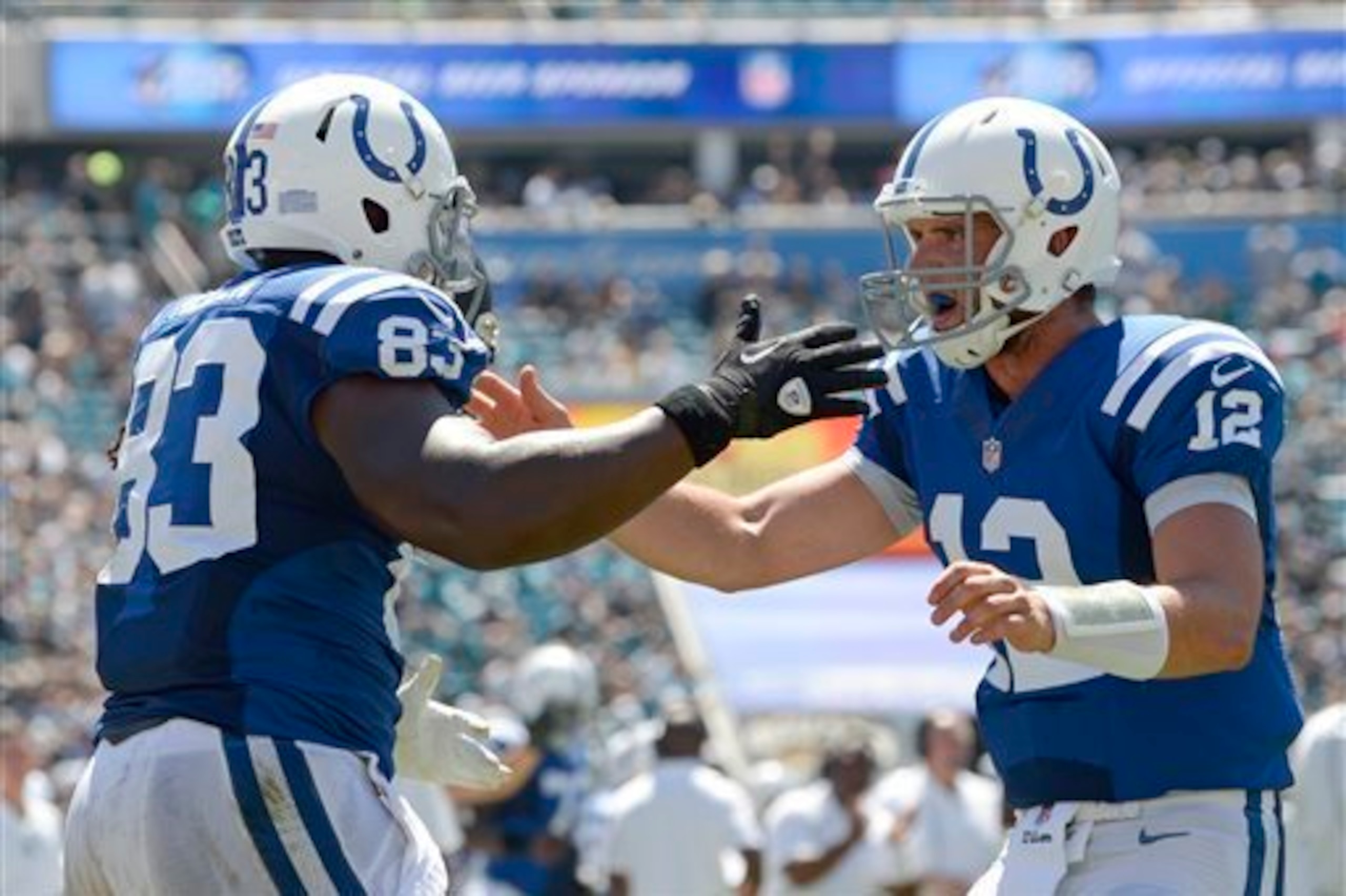
The Colts running backs are just as much a part of this flexibility as the tight ends. The Colts have split snaps with Trent Richardson and Ahmad Bradshaw fairly evenly, with both taking exactly 150 snaps so far this season. Occasionally, the Colts have both on the field at the same time, with multiback pistol sets being run regularly so far this season.
But those heavy sets also bring a downside. Unlike the high-flying Chip Kelly sets in Philadelphia (and Oregon before that) or Bruce Arians' downfield passing attack in Arizona, the "flexible" sets that Hamilton employs don't stretch the defense and open space for its playmakers. This limits the passing offense, as we saw in the Colts' loss to Philadelphia in Week 2.
While spread sets with three, four or five receivers force defenders to cover the entire field, the power-running sets condense the area the defenders have to cover and limit the amount of deep shots the offense can take.
Against Philadelphia, the Colts rarely took shots down the field, and when they did, they generally came with just one or two options for Luck. This led to an inefficient passing offense overall, and when the Colts absolutely needed to pass efficiently for a game-winning drive, they couldn't do it.
In the red zone, however, the tight end and running back flexibility is vital, and it makes for a much more effective base system. The spread and shotgun sets are great for the open field, but when the field is condensed in the red zone, it's more difficult to scheme space for targets.
It's no coincidence that Philadelphia and Arizona, who have been as explosive offenses as any, are incredibly inefficient in the red zone.
| Colts | 9 | 9 | 3 | 9 |
| Eagles | 6 | 26 | 24 | 28 |
| Cardinals | 14 | 25 | 8 | 26 |
But so far this season, the Colts are using play action and heavy sets with great success, ranking ninth in the league in points per red-zone trip. That number could be even higher if not for three trips where the team went for it on 4th-and-1 and failed, rather than kick a field goal.
*Note: That was absolutely the right call by the coaches, it just didn't work out. Regardless of outcome, the aggression in the red zone is a fantastic area of growth by Chuck Pagano.
In the Colts' first game against Denver, the offense fell into the trap of consistently going spread because of the deficit, even when in the red zone. They struggled to score touchdowns because of it, turning the ball over on downs on one drive and being forced to kick a field goal in another. The Colts had four drives get inside the opponent's 10-yard line, and they only scored touchdowns on two of them. Each of those four drives were mostly shotgun sets.
The Colts made a change from there, going to more heavy sets near the goal line, and it's paid dividends: The Colts have scored touchdowns on 69 percent of their red-zone appearances since, a mark that would put them in the top five in the league for the season.
Let's take a look at the film to get a sense of why these sets are working so well for the Colts.
The first time the Colts ran this set came against the Eagles in Week 2, on their first touchdown of the game.

The numbers are clearly in the Colts' favor here. With just one defensive back lined up on the right side, the Colts simply have to run two players to that side and throw to the open one. The linebackers are too worried about the run, sucking them inside.
Dwayne Allen runs directly toward the corner, essentially forcing the DB to cover him, while Bradshaw quickly leaks out of the backfield into the flat. Doyle goes to chop at anybody who breaks through to ensure Luck has time to get the throw off, and it's an easy touchdown.
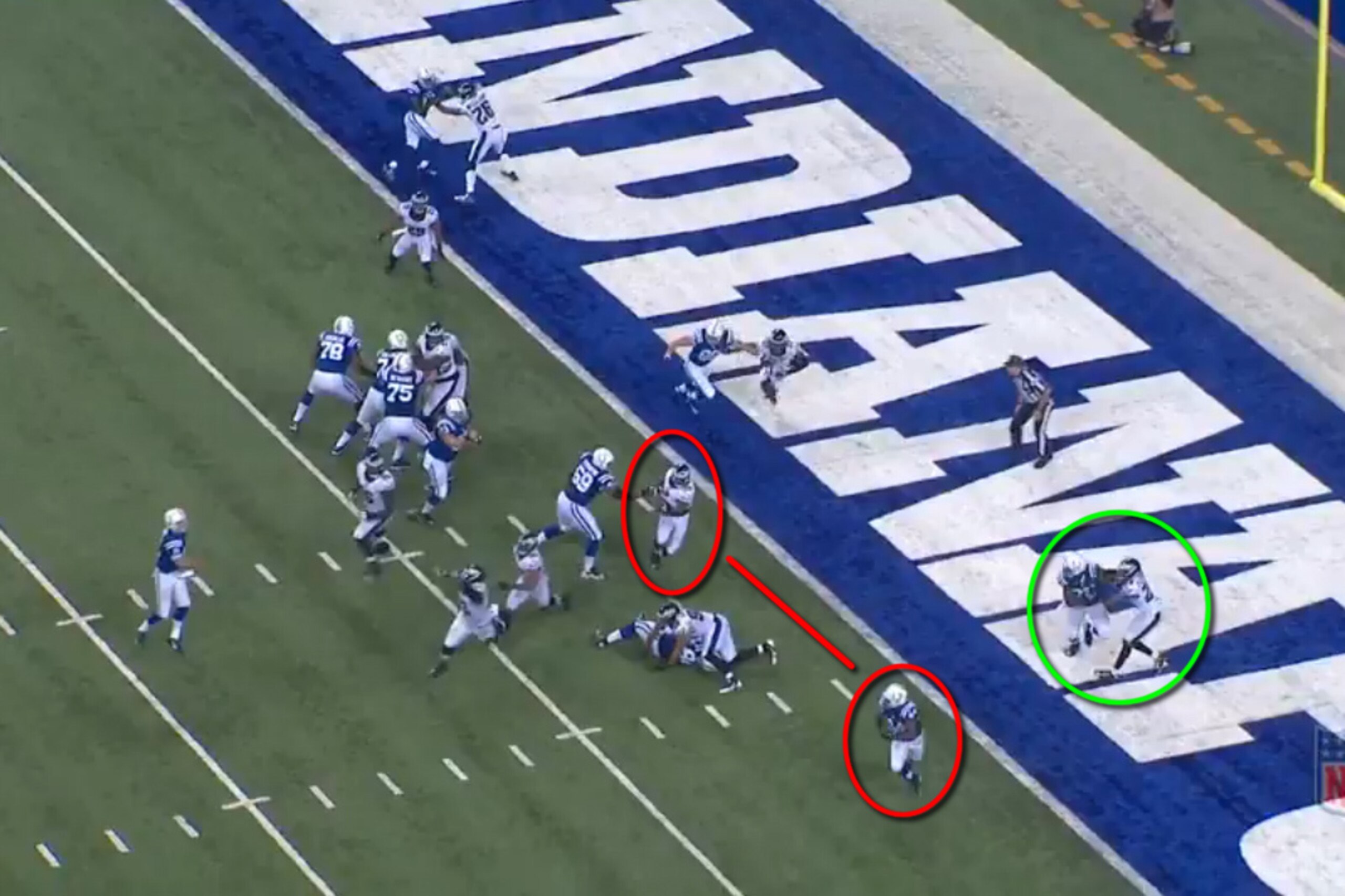
Bradshaw is wide-open, with the linebackers both sucked inside and just now getting off their blocks.
The Colts would use a similar concept on the next touchdown, a 2-yard touchdown pass to Jack Doyle, who was trailed by a defensive lineman after the linebacker crashed the line on the play action. Then, on the Colts' third touchdown, it was almost the exact same play as the first, with Bradshaw leaking free to the flat.
Against Jacksonville, the Colts are able to use a bit more trickery out of this formation.
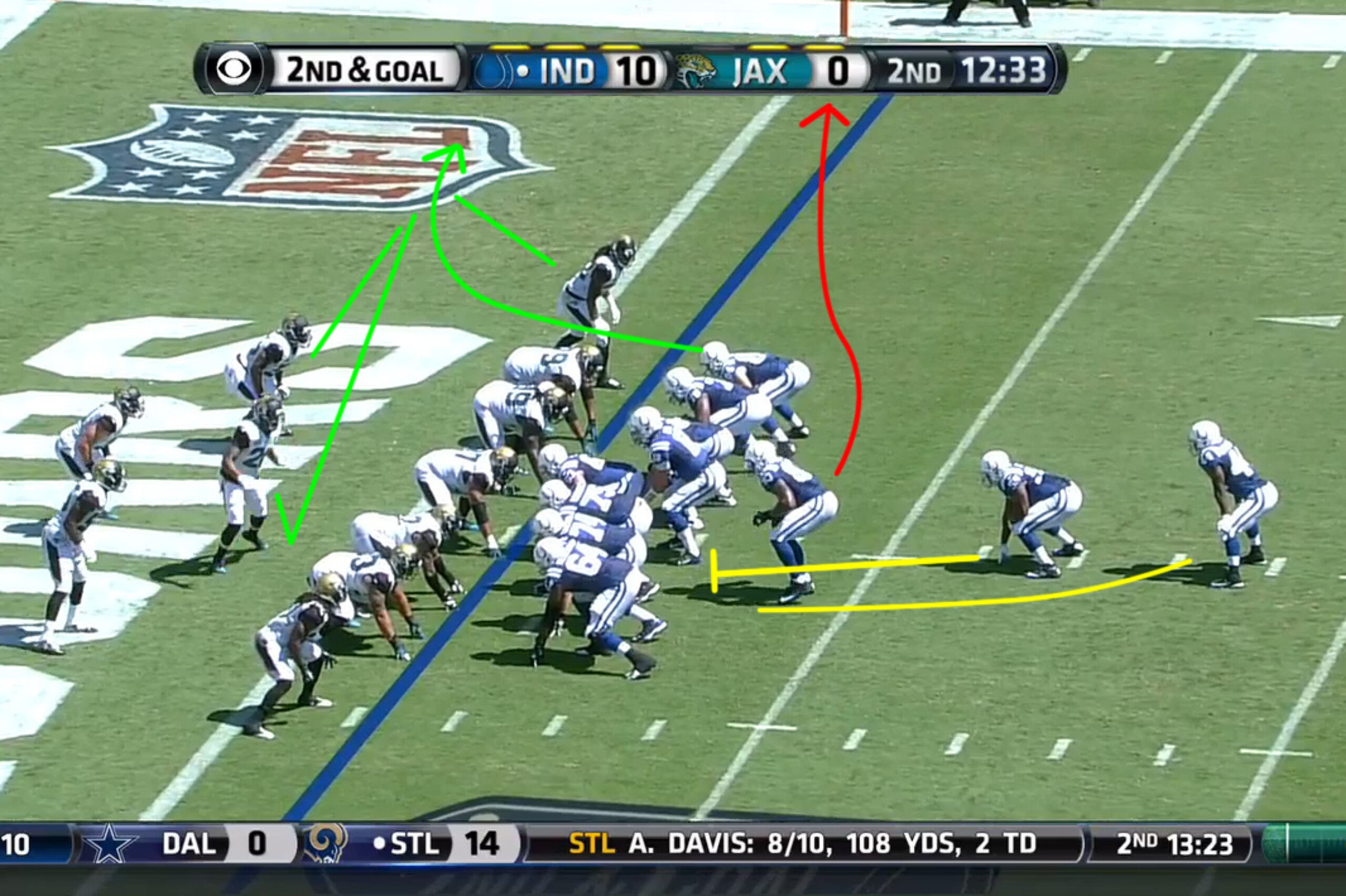
On this play, the Colts motion Dwayne Allen across the formation as an H-back and run play action to the left side. Coby Fleener runs the quick out to the right, which the defensive backs key on. But Allen comes back across the formation as a receiver, and by the time the defenders realize it, he already has the ball and is able to use his momentum to fall into the end zone.
A big key here is the pre-snap motion by Allen, which draws the safety over to the left side, too far to be able to get back over to the right side after play action.
The flexibility of the tight ends, their quickness and ability to block on the run, works well in the run game at the goal line as well.

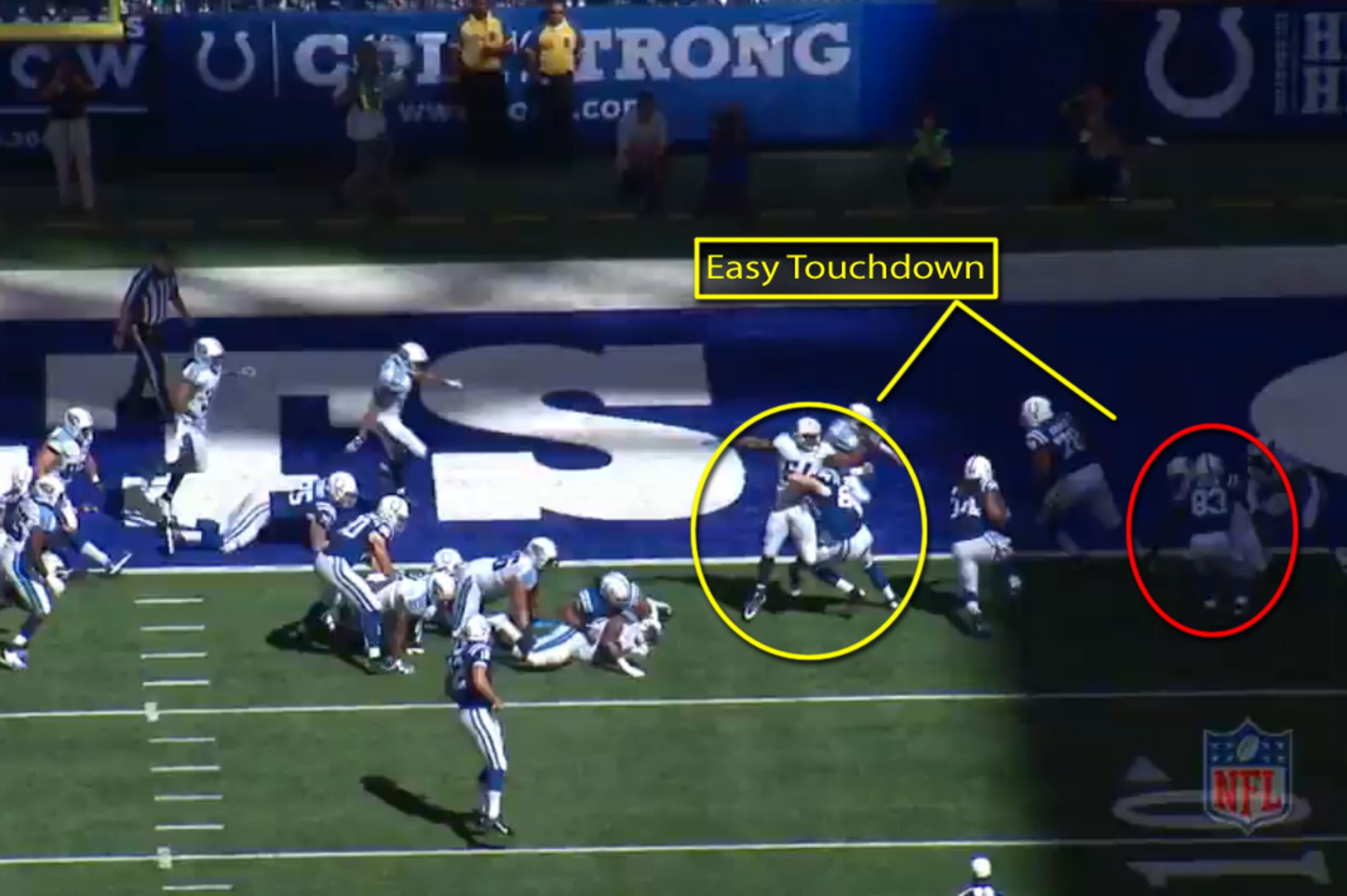
Against the Tennessee Titans in the first quarter, the Colts got their first "power-running" touchdown of the season by bringing the defense in close in a goal-line formation and then running a stretch play to the right. Allen, from his spot as an in-line tight end, takes the defensive end and pushes him far wide, while Doyle comes across from his fullback spot and gets there quick enough to get the seal block on the linebacker.
The result is an easy touchdown for Trent Richardson.
This doesn't even cover the benefits that the tight ends and running backs bring in shotgun and one-back sets. We saw Allen get a touchdown last week because of his size and ability to find a soft spot in the zone, for example. Bradshaw scored once last week and once against the Jaguars on simple leaks out of the backfield and powering through initial contact to find the end zone.
The Colts have one of the deepest wide receiver corps in the league, and they should use them as much as possible. But make no mistake, when the team gets to short-yardage situations, to red-zone situations when the field condenses, the flexibility of the tight ends and running backs in heavy sets is a key wrinkle that must be utilized.
Hamilton has his flaws, but over the last three weeks, he's gotten this absolutely right.
.jpg?w=2560 "Browns Bears Football")