How the Arizona Cardinals Are Maximizing John Brown's Speed
John Brown is his own person. He is John Brown, the Arizona Cardinals rookie wide receiver who’s as fast as a speeding lightning bolt and has already done so much with so little only three games into this season.
But he’s also T.Y. Hilton? And Mike Wallace? He’s sort of three people, all of whom are quite familiar to Bruce Arians, one of the league’s foremost vertical offense wizards. He has Wallace-like speed, with Hilton’s route running from the slot and elusiveness in the open field.
And as John Brown, he could be the final offensive piece the Cardinals needed.
.jpg?w=2560 "Green Bay Steelers Football")
.jpg?w=2560 "Chargers Mack")
.jpg?w=2560 "Giants Football")
Brown lit up the 40-yard dash at the scouting combine last February with a time of 4.34. Knowing he was likely about to lose Andre Roberts in free agency, Cardinals general manager Steve Keim targeted Brown in the third round of this year’s draft, landing him with the 91st overall pick.
At first there was buzz around Brown throughout minicamp. Then buzz built to a high-pitched yell (think dog whistle) when Arians himself made the Hilton comparison.
During Arians’ final season as the offensive coordinator in Indianapolis, Hilton was on the field for 57 percent of the Colts’ offensive snaps. That’s all he needed for 861 receiving yards on 50 receptions with seven touchdowns, and three of those catches went for over 60 yards.
Prior to the season Arians also said Brown could be featured in up to 60 percent of the team’s snaps, a significant number in an offense with Larry Fitzgerald and Michael Floyd needing to be fed on the outside. We had now reached dull roar status with Brown.
Then training camp started and, while talking with Robert Mays of Grantland, Keim dropped a name that carries some weight in Arizona: “I haven’t seen a rookie come in and do what he’s done —and it’s early still —since Anquan Boldin.” As camp progressed, keeping up with Brown just didn’t happen.
That’s how we arrived where we are now, with Brown going from being a small-school “who’s that?” during the draft process, to already a key element in the Cardinals passing game.
Over three games he’s caught nine passes and five of them have ended in a gain of at least 16 yards. Three have also resulted in touchdowns, and two have been of the game-winning variety. He’s done all that on a meager 15 targets (on pace for 80) and an average of only 37.7 offensive snaps per week.
That’s efficiency, speed and a new threat quickly inserted into an offense. But pure speed is only one part of the package with Brown.
The graveyard of NFL mediocrity is littered with wide receivers who are fast and only fast (look down the Cardinals depth chart and note Ted Ginn). But Brown is different with his precision route running and cutting that puts safeties in difficult situations, especially with Fitzgerald and Floyd drawing attention.
That was evident on his second touchdown against the 49ers in Week 3, which eventually stood as the game-winner. It was third down on San Francisco’s 21-yard line, with the Cardinals needing six yards. Brown lined up the slot with Fitzgerald to his right this time.
Though Fitzgerald has slowed somewhat with age, he’s still plenty fast and his speed needs to be respected. But when he was placed next to the added danger of Brown’s wheels on this play, the split-second choice for safety Eric Reid was between two poisons. He picked the wrong one.
Fitzgerald ran an underneath route, with his slant cutting to the middle. Meanwhile, Brown ran up the seam, but first his route angled toward Fitzgerald.
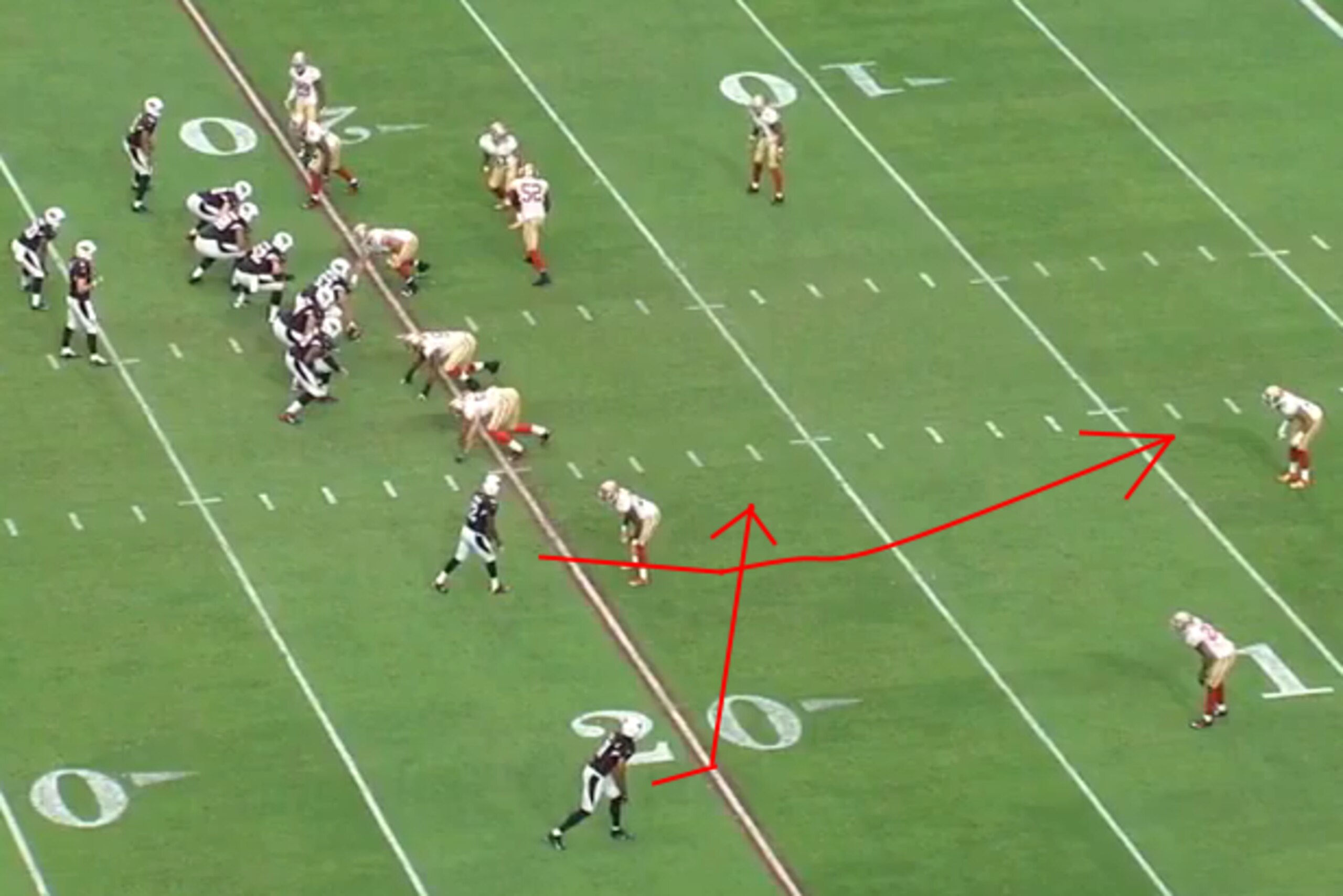
When Fitzgerald cut into the middle, he was open and in position for a potential first down. That means the possibility of three more plays, more opportunities for seven points and defensive failure.
Ward had motivation to be aggressive then, and he bit on quarterback Drew Stanton’s pump fake in Fitzgerald’s direction. But there were two chances for failure on this play.
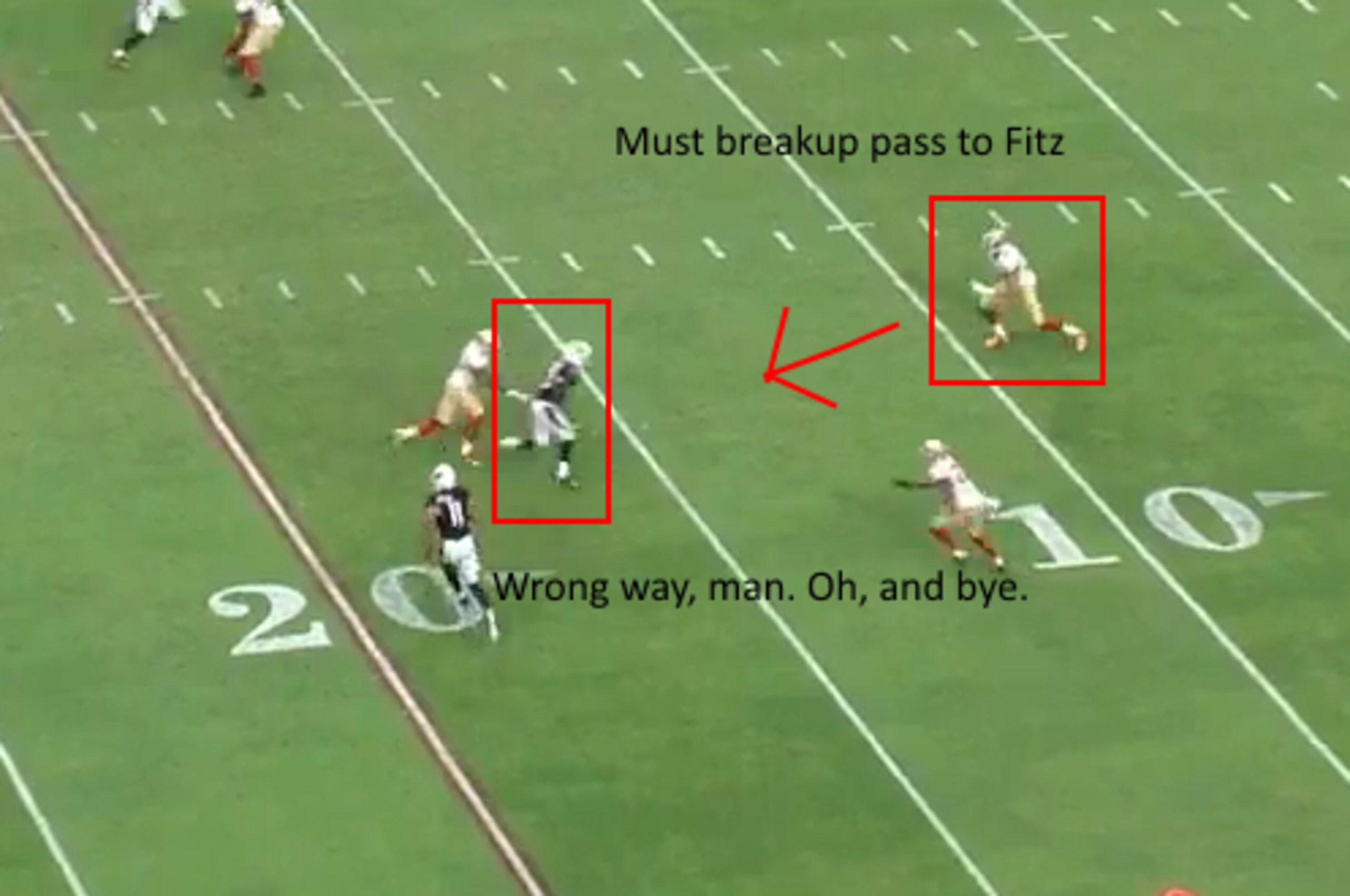
On a play designed to put stress on the safety and have his movement determine where the ball goes, Fitzgerald’s presence still pulled Reid forward by a few steps. Then Brown had to beat his man and leave another defender flailing.
Done.

Brown is plenty dangerous when isolated by himself. But when his elusiveness is coupled with the threats presented by Fitzgerald and Floyd, an entirely new dimension is added to the Cardinals offense.
Then yet another level of creativity comes when Brown is used on screen and swing passes. We saw that in Week 1 against the Chargers when his light feet and juking in the open field created two missed tackles and a 13-yard touchdown.
Here’s the early breakdown from Pro Football Focus (subscription required) of where Brown has been targeted on the field. It shows us that he can do great things, and he can do them from pretty much anywhere.
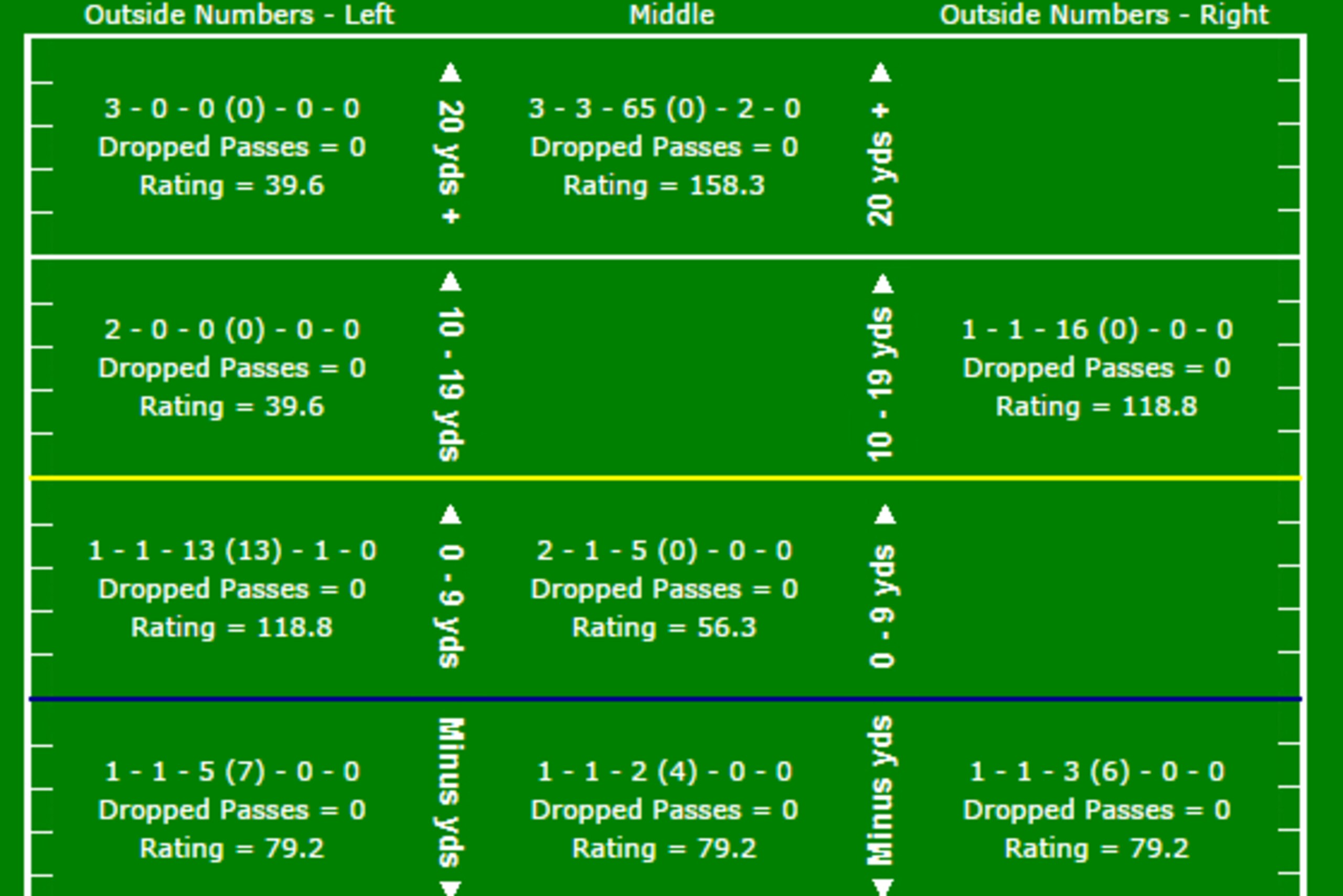
Of his nine receptions, three have come from behind the line of scrimmage, and three have come on balls that traveled 20 yards or more through the air down field.
That’s some serious multi-faceted tools right there, and because of them Brown has quickly replaced Andre Roberts as a reliable set of hands in the slot. When Drew Stanton or Carson Palmer have looked to Brown deep up the middle, they have connected for 65 yards and a passer rating of 158.3.
His use may be limited right now, but he's still much more than a mere speed specialist. As he grows, Brown’s versatility will eventually make him Fitzgerald’s replacement next season if the veteran’s anchor of a contract is jettisoned.
That feels inevitable because, according to Spotrac, Fitzgerald is due to be paid $23.6 million in 2015, and he’s already ceded his role as the motor that drives Arizona’s passing game. In two of the Cardinals' three games so far he’s waited until the fourth quarter to record his first catch.
Brown has been the more productive receiver already. And when we again consider the snap count chasm between the two, it’s not close.
| Snaps | % of offensive snaps | Receiving Yards | Receptions | +20 yard catches | Touchdowns | |
| John Brown | 113 | 53.3 | 109 | 9 | 3 | 3 |
| Larry Fitzgerald | 184 | 86.8 | 107 | 10 | 2 | 0 |
The undersized receiver’s role will continue to grow throughout the season, just as Hilton’s did two years ago while Arians watched, schemed and nodded approvingly. In addition to Brown's secondary-busting speed, the Cardinals will have two weapons who can remove defenders from their undergarments in the open field when Andre Ellington is at full health.
There’s no fancy advanced stat for that. Just a lot of falling bodies and trailing, frustrated cornerbacks.
.jpg?w=2560 "Commanders Cowboys Football")
.jpg?w=2560 "Texans Patriots Football")