Why Mike Richards Is Set for Comeback Year with Los Angeles Kings in 2014-15
If it seems as though Mike Richards has been brought up incessantly over the offseason, that’s because he has been.
From ESPN.com to Pro Hockey Talk to the Los Angeles Times, prominent outlets have discussed the player at length this summer, and rightfully so.
Not only does the Los Angeles Kings center need to justify his lofty salary-cap hit as well as the faith general manager Dean Lombardi has placed in him, but his ability to bounce back from a poor 2013-14 could play a leading role in the squad’s title defense.
TOP NEWS
3-Way Trade Ideas for Hellebuyck 💡
Ovi to Retire After Season 🫡
Mark Scheifele Landing Spots 📍
Depth down the middle is crucial in L.A., and if Richards can perform up to snuff this season, knocking the Kings off their throne could prove really, really tough.
Thankfully, his offseason work and savvy management have created a propitious situation for both player and team heading into 2014-15.
Fitness

It’s no secret that Richards appeared sluggish last season, finding himself a step behind rather than in the thick of the action. After amassing 27 points in 32 games early on, he struggled with an unspecified illness and closed out the year with a meager 14 points in 50 tilts.
While he’s never been the swiftest player around, he had previously always been mobile enough to reach the point of attack and leverage his blend of grit, skill and hockey IQ for the betterment of the team.
He took the game to the opposition.
In 2013-14, the smarts and guts were still in the right place, but he just wasn’t as involved as he had been in the past.
With a demotion to the fourth line and whispers of a possible compliance buyout, Richards dedicated himself to his conditioning this summer in the hopes of rediscovering the two-way menace he had been for most of his career.
For one of the most decorated players in the world—two Stanley Cups, Olympic gold, World Junior gold, Memorial Cup, Calder Cup—the adversity was welcome.
“It was definitely a learning experience last year, maybe even a little bit of an eye-opener where you might take things for granted, or take having success for granted,” he told ESPN.com’s Pierre LeBrun. “And to be honest, I deserved to be put in that position last year."
Complacency has been traded in for a chip on his shoulder. If you’ve followed Richards for a while, you know that could represent awful luck for the rest of the Western Conference.
According to LeBrun, he claims to be in much better shape coming into the year:
"This summer, I put in the work. Of course, injuries can happen, but at least going into the season right now, I feel good and I’ve skated a lot more than I have in the past. I feel prepared, and I’m excited for the year. ...
I worked out with trainers for the first time in a long time. I never felt that I needed to be pushed off the ice to work out, but I think it’s good to have somebody there, first to make sure that you’re going every day, and secondly to help me with different things.
"
Armed with something to prove for the first time since winning his first Cup in 2011-12, Richards appears primed for a reemergence.
He may not produce another version of “The Shift” (video below) ever again—no one can really play like that into their 30s—but the 29-year-old should be a much more active and influential three-zone center in 2014-15.
A boost in pace and endurance should help him in every area of the game, allowing him to establish his forecheck, dictate play in the neutral zone and battle even harder in the trenches. Richards has made his name as a player who's tough as nails and a pain to match up against.
"He arrives at every part of the ice in ill humor. He doesn't give anyone an inch out there, no matter who they are," former linemate Dustin Penner told reporters in 2012.
General manager Dean Lombardi echoed that sentiment in a recent interview with the Los Angeles Times' Helene Elliott. "It's hard to find people, athletes, as competitive as Michael," he said. "Competitive and also completely understand the significance of the moment. That's a special gift."
Assuming his concussion issues—two in three seasons—don't crop up, Richards may even summon some of the physicality that vanished after his first year with the Kings:
In Philadelphia and early in his L.A. tenure, he was continually in the right spot at the right time. His hockey sense should receive an extra push from his summer workouts, which should in turn lead to greater overall success.
There’s no question that Richards should feel a fair deal of pressure—from management, fans and himself—nipping at his heels coming into this season.
That’s good news, though, because he’s a tremendous player when his feet are moving.
Fit
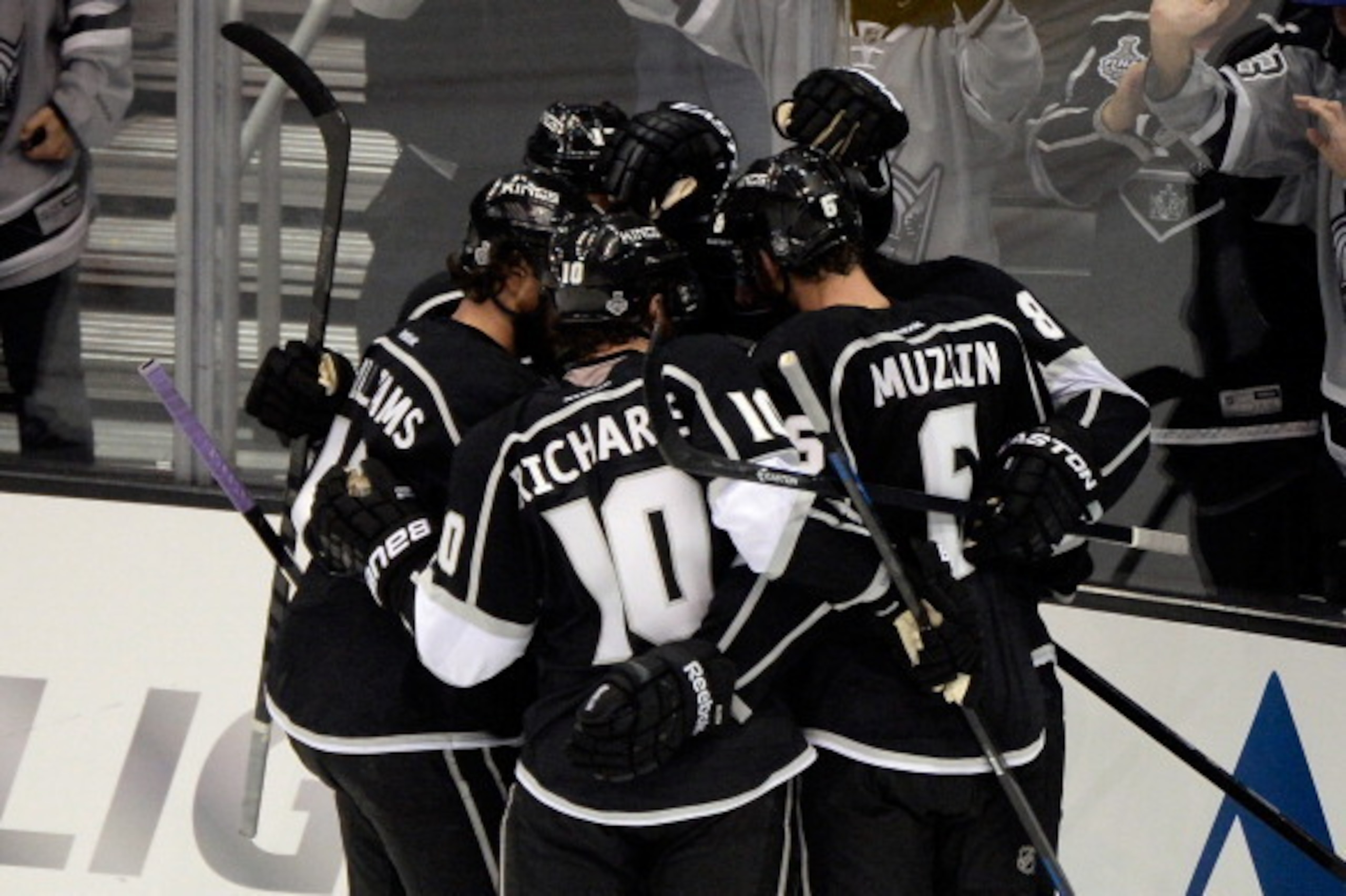
Coupled with his conditioning, another factor in Richards’ gradual slide between 2012 and 2014 was the line configurations put together by head coach Darryl Sutter.
Slotting him next to Jeff Carter may seem like a perfect match at first blush—they were drafted in the same year by the same team and are close friends—but beyond the “Richards likes to pass, Carter likes to shoot” criterion, the chemistry isn’t great.
Carter operates at a quicker tempo, whereas Richards needs to see more touches to leave his imprint on a contest.
Moreover, both are natural centers, which isn’t ideal on defense. Wingers are accustomed to covering point men and battling along the wall to clear the puck out of the defensive zone. Carter doesn't excel at those tasks.
That’s precisely why Philadelphia seldom lumped them on the same line, as indicated by Dobber Hockey.
In the two seasons during which Richards has played alongside Carter more or less full time (2013 and 2013-14), he’s been on the ice for 1.02 goals against per 20 five-on-five minutes. Without Carter, his GA20 over that span drops to 0.71.
In his first year with the Kings, his GA20 with Carter was 0.73. Without him, that number was 0.59.
Clearly, the two couldn't figure things out defensively.
Sutter has apparently taken note of this. Before the club's first preseason game of the year on Monday night, LA Kings Insider reported that Richards would start with Justin Williams and Dwight King while "That '70s Line" (Carter, Tanner Pearson, Tyler Toffoli) would remain intact.
Sure, this was merely an exhibition contest, but Richards potting two goals is reason for optimism.
Even on offense, he has been limited by Carter’s presence of late, pigeonholing himself as a supplier and nothing else. Though he is certainly a fine playmaker, at his best, Richards was among the league’s most complete forwards: He could dole out crunching hits, offer sterling defense, set up his teammates and score in his own right.
His average of 0.13 goals per game last season was the lowest in his career and far worse than anything he’s generated since 2007-08.
That figure should rise with King and Williams by his side.
Both are stellar puck-possession wingers who work hard in the corners and can keep plays alive with defenders on their backs.
That will afford Richards several more touches per night than he has enjoyed in the last couple of years.
King saw a decent amount of time on Richards’ left side in 2013-14, and the with/without statistics are telling. With him, Richards posted a 47.1 goals-for percentage and 55.2 Corsi percentage. Without him, those respective numbers dipped to 40.8 and 54.4 percent.
In all zones, King seems to be a strong complement, utilizing his 6’4”, 230-pound frame and deceptively soft hands to facilitate the breakout and extend offensive-zone time.
Meanwhile, Williams and Richards haven’t played much together in the regular season. But with a championship on the line in the playoffs, they were borderline dominant when Sutter mixed up his units and paired them together.
Williams’ ability to create separation and control the puck in tight spaces should provide Richards with a number of high-quality looks.
Both King and Williams thrive in the possession game, crash the net, hold their own on the boards and finish when tendered the opportunity.
Neither is a pure sniper, though.
This is key, as it could force Richards’ hand into a more direct approach, looking to attack the net and shoot the puck himself as opposed to simply waiting for Carter to skate into the frame.
If Richards is to regain his form, he has to shun his one-dimensional tendencies. At least so far, he’s been partnered with the right linemates to bring that out of him.
Outlook

Richards is no longer in his scoring prime, so finding his 70-point peak once more on a defense-first Kings squad is unlikely. A bounce-back campaign at present would fall somewhere in the vicinity of 18-20 goals, 50-55 points and stout all-around play.
Beyond the basic numbers, he has to reassert himself as a dependable two-way pivot—the kind of player Sutter can deploy at even strength, on special teams and in crucial late-game scenarios.
With the trials he endured last season, improved fitness and a projected lineup conducive to more involvement around the puck, the pieces are in place for a resurgence.
Now it's up to Richards to deliver the goods.
As a fiery competitor on the hunt for redemption, the odds are in his favor.
Advanced statistics courtesy of Stats.HockeyAnalysis.com.



.jpg?w=2560 "2 NFL Officials Suspended")

.jpg?w=2560 "Mahomes' Wife Trolls Kubiak 💀")

.jpg?w=2560 "Love's Body Already 'Tired'")